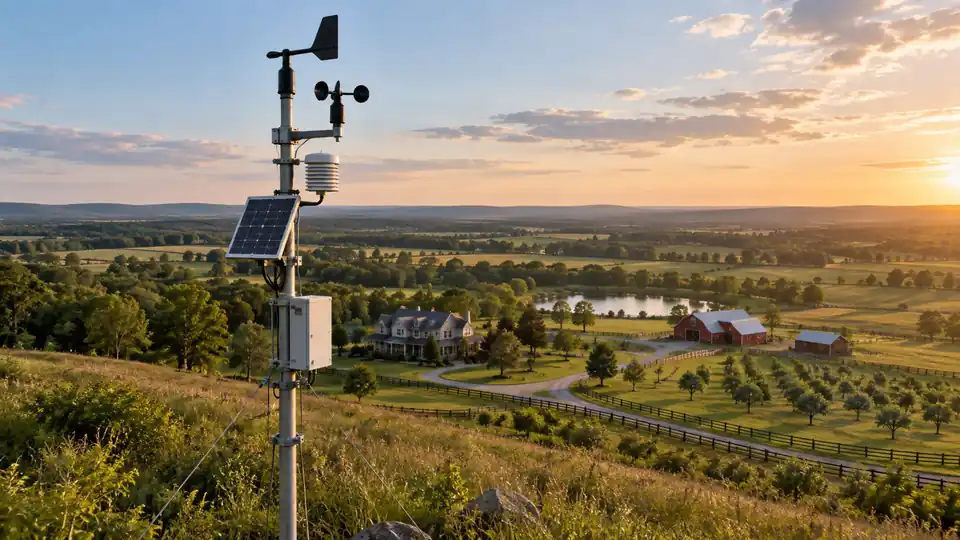
A large property can have several different weather stories at once. The garden may need rainfall totals, the pasture may need wind information, and a greenhouse or workshop may depend on temperature and humidity readings from another corner of the land. The best weather stations for large properties bring those observations into one place, but the useful choice depends on more than a colorful console. Sensor coverage, wireless range, rainfall measurement, data access, outdoor placement, and power requirements all matter.
Wireless sensor transmission and Wi-Fi solve different problems. A station can send readings from an outdoor array to a console without connecting to the internet, while a Wi-Fi model may also place those readings in an app or weather network for access away from home. Advertised transmission distances are open-area figures, so walls, metal buildings, trees, and terrain can change the result. For broad properties, the Sainlogic Wi-Fi station with local data storage and Excel export is particularly compelling, while the Ambient Weather WS-2902 remains the stronger choice for smart-home connectivity and a broad outdoor measurement set.
This comparison weighs complete weather stations by their measurements, sensor layout, connectivity, property coverage, data history, displays, and installation implications. Some choices favor remote access, while others make more sense for a large yard, garden, orchard, or farmstead where a local screen matters more than an app.
Quick Answer
- Best Overall: Ambient Weather WS-2902 Wi-Fi Smart Weather Station combines temperature, humidity, rain, wind, UV, and solar radiation with Wi-Fi, remote access, smart-home support, and a color display.
- Best for Data Logging: Sainlogic 5G/2.4G WiFi Smart Weather Station adds app alerts, rainfall history, a listed 443-foot open-area transmission range, two-year local storage, and Excel export.
- Best for Weather Underground: AcuRite Iris 5-in-1 connects to Weather Underground and provides local readings for temperature, humidity, pressure, wind, and rainfall.
- Best Local-Only Option: Sainlogic 12-in-1 Wireless Weather Station offers a broad measurement set and long listed wireless range without requiring Wi-Fi.
Best Weather Stations for Large Properties Comparison Table
| Product | Measurements | Connectivity | Sensor Design | Best For |
|---|---|---|---|---|
| Ambient Weather WS-2902 | Temperature, humidity, rain, wind, UV, solar radiation | Wi-Fi, smart-home, remote access | Integrated Osprey array | Connected property monitoring |
| Sainlogic Wi-Fi Data Station | Temperature, humidity, rain, wind, pressure | Dual-band Wi-Fi, app, Bluetooth pairing | Outdoor array with rain gauge | Large properties and data export |
| AcuRite Iris 01512MCB | Temperature, humidity, rain, wind, pressure | Wireless local console | Integrated outdoor sensor | Detailed local records |
| Sainlogic 12-in-1 | Temperature, humidity, rain, wind, pressure, derived readings | Wireless, no Wi-Fi | Integrated outdoor sensor | Broad local monitoring |
| AcuRite Iris 5-in-1 | Temperature, humidity, rain, wind, pressure | Wi-Fi, Weather Underground | Integrated sensor array | Weather-network sharing |
| AIRAIN TECH Wireless Station | Temperature, humidity, rain, wind, UV, pressure | Wireless, no Wi-Fi | Outdoor sensor with dual displays | Multiple indoor viewing points |
| Sainlogic Wi-Fi AI Forecast Station | Temperature, humidity, rain, wind, pressure, UV | Dual-band Wi-Fi, app alerts | Outdoor array plus extra sensor | Connected monitoring across zones |
| Newentor Wireless Station | Temperature, humidity, pressure, forecast | Wireless, up to three channels | Remote sensor system | Multiple temperature locations |
| DreamSky Wireless Station | Temperature, humidity, pressure, forecast | Wireless, up to three sensors | Remote sensor system | Large readable local display |
The detailed reviews explain how each station handles property coverage, weather measurements, data access, and the compromises behind its ranking.
1. Ambient Weather WS-2902 Wi-Fi Smart Weather Station — Best Overall
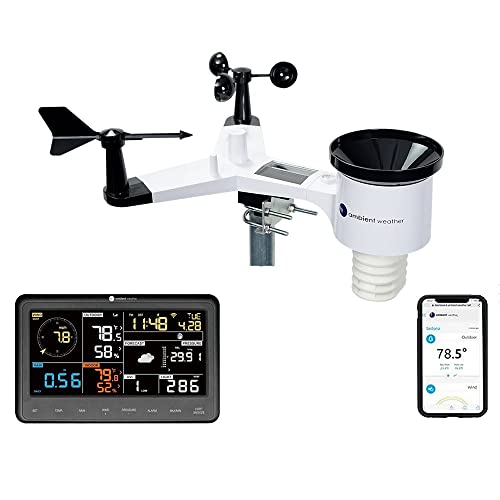
The WS-2902 earns the top position because its sensor array covers the measurements that usually matter across a broad residential property: outdoor temperature, humidity, rainfall, wind speed, wind direction, UV intensity, and solar radiation. Its Osprey array keeps those outdoor instruments together, which can simplify a pole or post installation when a property owner wants one main observation point rather than several separate sensors.
Its Wi-Fi connection changes the station from a console you check in the kitchen into a system that can provide access away from the display. The product information also identifies IFTTT, Google Home, Alexa, and the Ambient Weather Network, giving it more integration potential than the local-only models here. The trade-off is that an integrated array places many measurements in one location, so a distant greenhouse or shaded garden will still need separate monitoring if conditions differ substantially.
Pros
- Measures temperature, humidity, rainfall, wind speed, wind direction, UV intensity, and solar radiation.
- Wi-Fi supports remote access and weather data sharing through the identified network.
- Listing information identifies IFTTT, Google Home, and Alexa compatibility.
- Includes an Osprey outdoor sensor array and color LCD display.
- Strong fit for a property owner who wants local readings and connected access.
Cons
- Its integrated array concentrates outdoor measurements at one installation point.
- The product information does not specify a wireless transmission distance or data-storage period.
This is the strongest all-around choice for a large home site where smart-home actions, remote checks, and broad outdoor measurements matter. Someone who wants spreadsheet export, a clearly listed two-year archive, or a lower-cost local-only setup may prefer Sainlogic instead. Careful placement still matters, particularly for rain and wind readings, because the station cannot correct for a roof, wall, tree, or pavement affecting the sensor environment.
To buy this product, click here.
2. Sainlogic 5G/2.4G WiFi Smart Weather Station — Best for Data Logging

Large properties often create a second problem after installation: what do you do with weeks or months of readings? This Sainlogic model addresses that question with local storage identified as lasting up to two years, plus Excel export. The app records hourly, daily, monthly, and yearly rainfall totals, while temperature and humidity trends can be examined after a stretch of hot days, wet weather, or changing conditions around a garden.
The station also lists dual-band 5GHz and 2.4GHz Wi-Fi, Bluetooth fast pairing, a rain gauge, wind sensor, and a 443-foot open-area wireless range. That range is a placement aid, not a guarantee through barns or multiple walls, but it gives the outdoor array useful flexibility on a spacious lot. The supplied information lists temperature accuracy of ±0.2°C, humidity accuracy of ±1.8%RH, and rainfall accuracy claims that vary by precipitation amount. Those are listing specifications, rather than independent verification.
Pros
- Supports 5GHz and 2.4GHz Wi-Fi according to the product information.
- Stores up to two years of local weather data and supports Excel export.
- Records rainfall across hourly, daily, monthly, and yearly periods.
- Lists a 443-foot open-area sensor transmission distance.
- Includes Bluetooth fast pairing and app-based real-time readings.
Cons
- Actual transmission distance can be reduced by walls, terrain, metal structures, and interference.
- Its app and Wi-Fi functions add setup dependencies that a local-only station avoids.
This is a smart pick for someone tracking rainfall across seasons or comparing conditions before planting, watering, or maintaining a distant part of the property. It makes less sense for a reader who wants a simple clock-style display with no network setup. The Excel function is the distinguishing reason to choose it over many console-only stations, especially for anyone who wants their own weather records rather than a handful of current readings.
To buy this product, click here.
3. AcuRite Iris 01512MCB Indoor/Outdoor Weather Station — Best for Detailed Local Monitoring
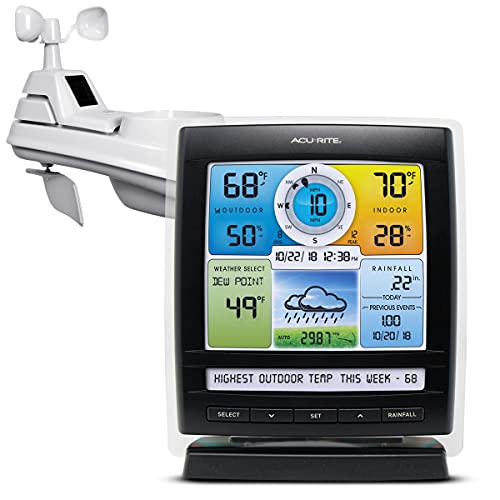
The Iris 01512MCB takes a local-console approach but still covers the measurements expected from a complete personal weather station. Its outdoor system reports temperature, humidity, wind speed, wind direction, barometric pressure, and rainfall, while the display presents a broader set of information that the listing describes as more than 55 data points. Heat index, dew point, feels-like temperature, pressure trends, and historical information can make a console more useful than a basic indoor/outdoor thermometer.
Setup is presented as a straightforward battery installation followed by mounting the outdoor sensor to a pole or post with the included bracket. That arrangement suits a large yard where the main need is a dependable central observation point and an easy-to-read indoor screen. It does not offer the clearly identified Wi-Fi, app, or remote-monitoring functions found in the top connected models, so checking conditions from another town is not its strength.
Pros
- Measures temperature, humidity, wind speed, wind direction, pressure, and rainfall.
- Provides a large color LCD display with an adjustable dimmer.
- Lists more than 55 data points, including dew point and heat index.
- Includes a mounting bracket for attaching the outdoor sensor to a pole or post.
- Uses elevation and pressure information for a personalized short-term forecast.
Cons
- Remote access and Wi-Fi are not identified in the supplied product information.
- The integrated outdoor sensor keeps the main measurements centered on one location.
Choose this AcuRite when a property owner wants a detailed local display without making internet connectivity part of the station. It is especially sensible in a house, barn office, or workshop where someone regularly checks the console. A connected Sainlogic or Ambient Weather model is a better fit for away-from-home access, while this one keeps the day-to-day experience more self-contained.
To buy this product, click here.
4. Sainlogic 12-in-1 Wireless Weather Station — Best Local-Only Broad Measurement Set
There is a certain appeal to a station that works without a network account, router settings, or app alerts. This Sainlogic model sends outdoor readings to a local 6.5-inch color display and covers temperature, humidity, pressure, wind speed, wind direction, rainfall, dew point, and feels-like temperature. Its 12-in-1 label is product-specific, so the useful detail is the actual measurement list rather than the number printed in the name.
The station lists rainfall records from hourly through cumulative totals, a 0 to 9,999 mm rainfall span, and ±7% rainfall accuracy. It also gives temperature and humidity accuracy claims of ±0.2°C and ±1.8% RH, plus a listed 443-foot open-area wireless range. That combination makes it appealing for a garden, orchard, or farm driveway where the console is close enough to check but Wi-Fi is unavailable or deliberately avoided.
Pros
- Measures temperature, humidity, pressure, wind, rainfall, dew point, and feels-like temperature.
- Includes a 6.5-inch color display with three backlight levels.
- Records rainfall by hourly, daily, weekly, monthly, and cumulative periods.
- Lists included mounting hardware and a 443-foot open-area wireless range.
- Operates as a local station without Wi-Fi.
Cons
- No Wi-Fi, app, or remote-monitoring function is identified.
- The listed wireless range is an open-area figure and may not translate directly through buildings.
This is the better choice for a large property with a nearby occupied building and a preference for straightforward local monitoring. It gives up cloud access and export tools, but that can be a benefit for someone who wants fewer connected components. Check the mounting location carefully, because a broad measurement list cannot compensate for a rain gauge blocked by a structure or a wind sensor sheltered by trees.
To buy this product, click here.
5. AcuRite Iris 5-in-1 Home Weather Station — Best for Weather Underground
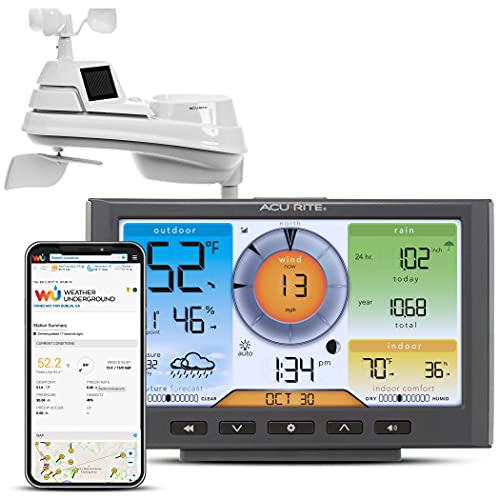
The clearest reason to choose this Iris model is its identified Wi-Fi connection to Weather Underground. That distinction matters on a spread-out property because the local console can show conditions in the house, while the weather-network connection makes the station useful for sharing and checking observations beyond that room. The system measures indoor and outdoor temperature and humidity, barometric pressure, rainfall, wind speed, and wind direction.
The outdoor array combines an anemometer, wind vane, rain gauge, barometer, hygrometer, and thermometer. Its listing describes more than 25 data points, including heat index, dew point, wind chill, rainfall history, and threshold alarms. Those extra values are calculated or recorded from the station’s measurements, so they should not be confused with separate physical sensors. The model is a better network-sharing choice than the local-only Iris, but the listing does not identify broad smart-home support or spreadsheet export.
Pros
- Wi-Fi connection to Weather Underground is explicitly identified.
- Measures temperature, humidity, pressure, rainfall, wind speed, and wind direction.
- Provides a local color display with adjustable dimming.
- Includes threshold alarms and historical rainfall information.
- Combines several outdoor instruments in one sensor array.
Cons
- The product information does not identify support for Alexa, Google Home, or IFTTT.
- Its 5-in-1 label should not be treated as a standardized comparison with every other brand.
This station fits someone who wants local weather observations to join a recognized online weather network. It is less suitable for a reader whose priority is long-term Excel analysis or multiple remote temperature zones. The central advantage is specific and useful: Weather Underground support, rather than a vague assumption that any Wi-Fi weather station can upload to any platform.
To buy this product, click here.
6. AIRAIN TECH Wireless Weather Station — Best for Multiple Indoor Displays
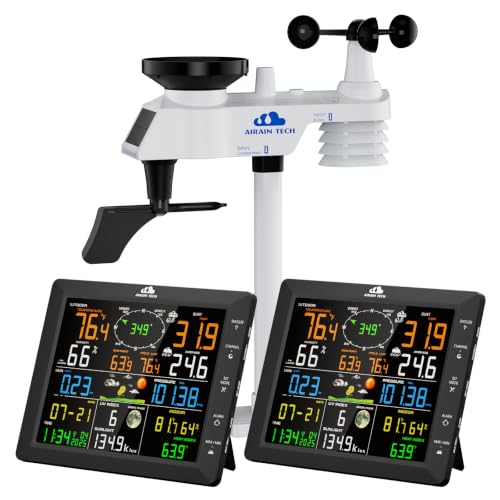
Two main displays can be useful when a large property has more than one frequently occupied building. Instead of walking to a single console, the supplied package identifies two display units, along with an outdoor sensor, mounting pole, bracket, and hardware. The station reports temperature, humidity, rainfall, wind speed, wind direction, UV index, pressure, dew point, wind chill, and moon phase, giving the local screens plenty to show at a glance.
The product information lists an 8.5-inch color display and a 328-foot wireless transmission range. It also gives temperature and humidity ranges and accuracy claims, including a temperature range from -40°F to 140°F and humidity from 10% to 99%. Those are published listing specifications, not a guarantee that every installation will produce identical results. There is no Wi-Fi, so its usefulness away from the property is limited to what the local displays provide.
Pros
- Includes two main display units for viewing conditions in separate indoor locations.
- Measures rainfall, wind, UV, temperature, humidity, pressure, dew point, and wind chill.
- Provides an 8.5-inch color display with adjustable brightness.
- Includes a mounting pole, bracket, and mounting hardware.
- Lists automatic pairing and a 328-foot wireless transmission range.
Cons
- No Wi-Fi or app-based remote access is identified.
- Two displays do not create two outdoor measurement locations because the package lists one outdoor sensor.
This station makes sense for a property with a main house and a second building where simultaneous local viewing matters. It offers more physical viewing flexibility than a single-console system, but it should not be mistaken for a multi-zone sensor network. Choose a connected model instead if checking readings while away is central to the purchase.
To buy this product, click here.
7. Sainlogic Wi-Fi Smart Weather Station with Extra Sensor — Best for Connected Multi-Zone Monitoring

This Sainlogic station is aimed at readers who want a connected system with more than one monitoring point. The listing identifies an extra sensor, dual-band Wi-Fi, Bluetooth pairing, app alerts, and a 443-foot open-area transmission distance. That architecture can be useful when a property includes a house, greenhouse, cellar, or other zone where temperature and humidity deserve separate attention.
Its app is described as providing current readings, weather maps, alerts, and data history, while the station stores up to two years of local data and supports Excel export. The rainfall system lists hourly, daily, monthly, and yearly records, along with accuracy claims that vary below and above 15 mm of precipitation. The product description uses AI forecast language, but forecast information should still be treated as a prediction rather than a direct measurement of future conditions.
Pros
- Includes an extra sensor for monitoring an additional location.
- Supports 5GHz and 2.4GHz Wi-Fi with Bluetooth pairing.
- App functions include alerts, current readings, maps, and weather history.
- Provides two-year local storage and Excel export.
- Lists a 443-foot open-area transmission range and rainfall history.
Cons
- Its connected functions depend on Wi-Fi and the associated app setup.
- The listing does not identify compatibility with Weather Underground, Home Assistant, or other specific platforms.
This model deserves attention where a single outdoor array and an additional temperature or humidity point are more useful than a second display. It is a stronger multi-zone candidate than the simpler indoor/outdoor clock stations, although the exact role and measurement details of the extra sensor should be confirmed before ordering. For a property needing only rain and wind at one central mast, the less complex WS-2902 may be easier to justify.
To buy this product, click here.
8. Newentor Wireless Indoor Outdoor Weather Station — Best for Multiple Temperature Locations

Not every large property needs a full wind-and-rain array. Sometimes the practical question is whether the greenhouse, garage, nursery, and living space are staying within comfortable temperature and humidity ranges. The Newentor station supports up to three remote sensor channels and includes one remote sensor, making its main strength location-based temperature and humidity monitoring rather than broad outdoor instrumentation.
The color display also shows pressure, forecast information, daily high and low records, time, date, moon phase, alarms, and customizable alerts. Its included adapter allows an always-on display, while battery operation uses a brief illuminated view before entering an energy-saving mode. That power distinction matters if the console will sit on a wall or desk all day. The station does not list rainfall, wind speed, or wind direction measurement, so it ranks below complete sensor arrays for exposed land monitoring.
Pros
- Supports up to three remote sensor channels.
- Includes one remote sensor for indoor and outdoor temperature and humidity readings.
- Provides a large color LCD with adjustable backlight behavior.
- Offers high and low records, alerts, pressure, and forecast information.
- Includes an AC adapter and atomic time function.
Cons
- Wind speed, wind direction, and rainfall measurement are not identified.
- Additional sensors are supported but only one remote sensor is listed as included.
This is a sensible secondary-zone monitor for a large property, especially where temperature and humidity matter more than wind or rainfall. It is a poor substitute for a complete outdoor array beside an orchard or open field. Buyers choosing it should plan around the included sensor and verify the cost and availability of any additional channels needed for separate buildings.
To buy this product, click here.
9. DreamSky Wireless Weather Station — Best for a Large Readable Display

The DreamSky concentrates on readable local information. Its display shows large figures for indoor and outdoor temperature, humidity, forecast information, atomic time, date, and calendar details, while five backlight levels make it easier to adapt the screen for a bright kitchen or a darker bedroom. On a property where people check conditions while passing through a house, that clear console can be more useful than a dense app dashboard.
It supports up to three outdoor sensors and includes one, with high and low temperature alerts for monitoring changing conditions. The station also uses a 12-to-24-hour forecast based on pressure information after a calibration period. Its outdoor measurement set is narrower than the leading stations because the listing does not identify rainfall, wind speed, or wind direction sensors. The USB port, adapter power, and battery backup give the display flexible placement, although battery-only operation dims after a short illuminated period.
Pros
- Uses large display figures for temperature, humidity, time, and forecast information.
- Supports up to three outdoor sensors and includes one sensor.
- Offers high and low temperature alerts.
- Provides five adjustable backlight brightness levels.
- Includes atomic time, auto daylight-saving adjustment, USB charging, and backup power support.
Cons
- Rainfall, wind speed, and wind direction are not identified in the product information.
- Battery-only display operation is limited to a brief illuminated view before dimming.
Pick the DreamSky for straightforward temperature and humidity checks across a home and nearby outbuildings. It can complement a larger station, but it is not the right primary instrument for tracking rainfall or wind across open land. Its value lies in the uncluttered local display and sensor-channel support, while buyers needing full property weather coverage should move higher in the list.
To buy this product, click here.
Buying Guide
Match the Sensor Set to the Property
Temperature and humidity may be enough for a greenhouse or storage building, but an open field, orchard, or garden usually benefits from rainfall, wind speed, and wind direction as well. UV and solar radiation can add context for outdoor conditions, while dew point, heat index, wind chill, and feels-like temperature are calculated values derived from measured information. A station with more displayed metrics is not automatically more useful if the extra readings do not answer a real monitoring question.
Wireless Sensor Range Needs Context
The listed range describes communication between the outdoor sensor and the console or receiver under stated conditions. It does not mean the station connects to the internet, and it does not guarantee the same distance through a house, metal barn, concrete wall, or wooded area. The Sainlogic models list up to 443 feet in open space, while AIRAIN TECH lists 328 feet. Treat those numbers as placement guidance, then account for the physical obstacles between the sensor and indoor display.
Wi-Fi and Wireless Are Different
Every station in this roundup uses some form of wireless communication between outdoor equipment and an indoor display or receiver, but only certain models identify Wi-Fi. Wi-Fi can support app access, remote viewing, alerts, data export, or weather-network uploads, depending on the exact product. The Ambient Weather WS-2902 identifies smart-home and remote functions, while the AcuRite Iris 5-in-1 specifically identifies Weather Underground. Do not assume that a wireless console provides either service.
Check What Remote Monitoring Actually Provides
Remote access is most useful for a cabin, greenhouse, or distant property where nobody is standing beside the console. Look for a stated app, cloud service, alerts, or online weather platform. A local-only station can still be excellent for a house or farm office, but it will not provide the same away-from-property access. App support also does not automatically mean every reading can be exported or viewed without an internet connection.
Review the Data History and Export Tools
Historical information matters if rainfall totals will guide irrigation, planting, drainage work, or seasonal comparisons. The Sainlogic Wi-Fi models list two years of local storage and Excel export, while other stations describe historical readings or rainfall history without identifying a comparable file-export function. Decide whether you need a quick daily glance or a record that can be opened and analyzed later.
Plan the Outdoor Installation Before Ordering
A sensor array needs an exposed location that represents the conditions you want to monitor. Roof surfaces, walls, pavement, trees, and nearby heat sources can affect readings. Rain gauges need appropriate exposure and leveling, while wind sensors need access to moving air. A mounting bracket or pole can simplify installation, but the supplied hardware does not remove the need to choose a structurally suitable location and follow the product instructions.
Separate Included Sensors From Supported Sensors
Newentor and DreamSky support multiple sensor channels, but each listing identifies one included remote sensor. The Sainlogic Wi-Fi model identifies an extra sensor, which gives it a different multi-zone proposition. Always verify how many sensors are in the package and what each sensor measures. Compatibility with an additional sensor is not the same as receiving that sensor in the box.
Best Weather Stations for Large Properties FAQ
What is the best weather station for a large property?
The Ambient Weather WS-2902 is the strongest overall choice here because it combines temperature, humidity, rainfall, wind, UV, and solar radiation with Wi-Fi, remote access, identified smart-home compatibility, and a local display. A property owner who values data storage and Excel export may prefer the Sainlogic Wi-Fi model instead.
Is a wireless weather station the same as a Wi-Fi weather station?
No. Wireless usually describes the link between an outdoor sensor and an indoor console. Wi-Fi connects a station or receiver to a local network and may enable app access, remote viewing, alerts, or online weather-platform uploads. A station can be wireless without having Wi-Fi.
How much wireless range is enough for a large property?
That depends on the distance between the outdoor array and the indoor receiver, plus the walls, floors, metal structures, trees, and terrain between them. The listed 443-foot range on certain Sainlogic models is an open-area figure, not a guarantee through buildings. Measure the intended installation path rather than relying on the headline number alone.
Which station is best for rainfall records?
The Sainlogic Wi-Fi models are the strongest choices in this group for documented rainfall history. The listing identifies hourly, daily, monthly, and yearly records, with up to two years of local storage and Excel export. The Sainlogic 12-in-1 also records several rainfall periods but does not provide Wi-Fi or export in the supplied information.
Can these weather stations monitor multiple locations?
Newentor and DreamSky support up to three remote sensor channels, but each listing identifies one included sensor. The Sainlogic Wi-Fi station with an extra sensor is more directly suited to connected multi-zone monitoring. The main outdoor arrays in the roundup generally concentrate wind and rainfall measurements at one location.
Do weather stations need to be connected to Wi-Fi?
No. The Sainlogic 12-in-1, AIRAIN TECH, AcuRite Iris 01512MCB, Newentor, and DreamSky models can provide local monitoring through wireless sensor communication without identified Wi-Fi functions. Wi-Fi becomes useful when you want remote access, app alerts, weather-network uploads, or data services that require a network connection.
Does a forecast icon replace a local weather measurement?
No. Forecast icons are predictions generated from station readings or other information. Temperature, humidity, pressure, rainfall, wind, UV, and solar radiation are local measurements only when the product includes the relevant sensor. Dew point, heat index, wind chill, and feels-like temperature are generally calculated from measured conditions.
Where should a large-property weather station be installed?
Place the outdoor equipment where it can represent the conditions you want to observe, away from obvious obstructions and heat sources. The rain gauge should be appropriately exposed and level, while the wind sensor needs access to moving air. Follow the product instructions and account for the wireless path back to the console or receiver.
Final Verdict
The Ambient Weather WS-2902 is the strongest overall option for a large property that needs broad outdoor measurements plus connected access. It combines an integrated sensor array with temperature, humidity, rainfall, wind, UV, and solar-radiation readings, then adds Wi-Fi, remote access, identified smart-home compatibility, and a local color display. It is the most balanced choice for someone who wants to see conditions at home and interact with the data away from the console.
The Sainlogic 5G/2.4G WiFi station is the better alternative for long-term records, rainfall history, and Excel export. The AcuRite Iris 5-in-1 is the focused choice for Weather Underground, while the Sainlogic 12-in-1 offers broad local monitoring without Wi-Fi. Buyers who mainly need temperature and humidity in several buildings can save complexity with Newentor or DreamSky. Before ordering, match the station to the measurements, data access, sensor locations, and installation path that the property actually requires.