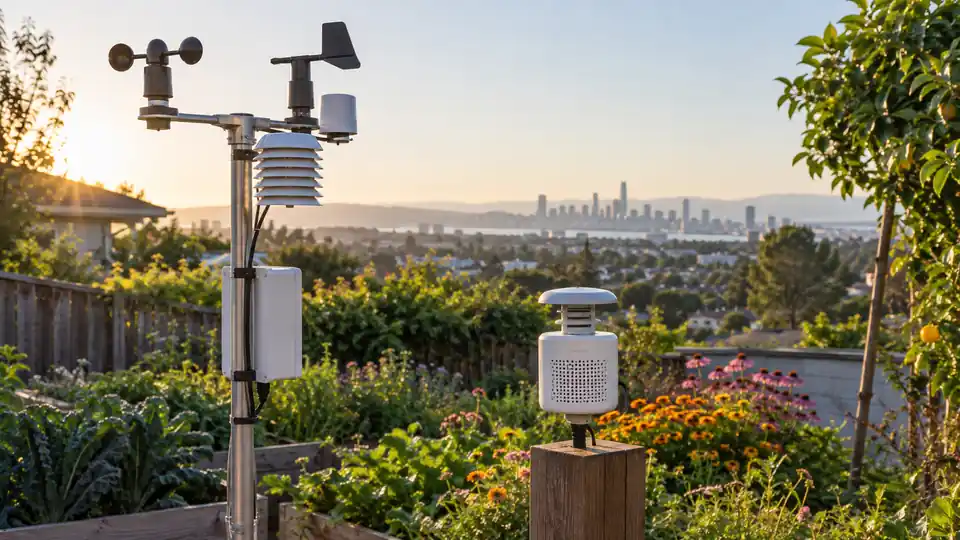
A weather station with an air quality monitor has to answer two different questions at once: what is happening outside, and what is happening in the air around your home. Temperature, humidity, wind, rainfall, pressure, UV, particulate matter, carbon dioxide, and TVOC readings can each serve a different purpose. A gardener may care about rain and sunlight, while a family may pay closer attention to indoor CO2, PM2.5, or ventilation alerts.
The biggest distinction in this category is sensor coverage. Some systems measure TVOC alongside outdoor weather conditions, while others monitor PM2.5, PM10, CO2, and AQI with far more detail. Wi-Fi also needs a close look. A wireless outdoor sensor can send information to a console without offering app access, while a Wi-Fi-connected system may provide historical graphs or remote monitoring. The 16-in-1 WiFi Weather Station is the strongest overall fit for shoppers who want a single system covering weather, outdoor air quality, app access, and data history.
The selections below include complete weather stations with air-quality functions, connected weather platforms that can work with compatible air-quality monitors, and specialized monitoring systems that make sense for homes prioritizing indoor or outdoor air data. The comparison focuses on actual measurements, connectivity, sensor architecture, power, and the compromises attached to each design.
Quick Answer
- Best Overall: 16-in-1 WiFi Weather Station combines broad outdoor weather readings with TVOC monitoring, a color display, Tuya app access, historical trends, and rainfall records.
- Best Air-Quality Coverage: Temtop W100 measures PM2.5, PM10, CO2, TVOC, and AQI alongside outdoor weather conditions, with alerts and remote app access.
- Best Smart-Home Platform: Netatmo Smart Weather Station offers indoor and outdoor air-quality information, smartphone alerts, and compatibility with Alexa, Google Home, and Apple Home.
- Best Modular Air-Quality Add-On: Ambient Weather PM2.5 Wireless Outdoor Particulate Monitor focuses on outdoor fine particles and can send data to the Ambient Weather Network.
Best Weather Stations With Air Quality Monitor Comparison Table
| Product | Air-Quality Measurements | Weather Measurements | Connectivity | Best For |
|---|---|---|---|---|
| 16-in-1 WiFi Weather Station | TVOC | Temperature, humidity, pressure, wind, rain, UV, light | 2.4GHz Wi-Fi, Tuya app, RF sensor link | Best overall coverage |
| Temtop W100 | PM2.5, PM10, CO2, TVOC, AQI | Temperature, humidity, wind, rain, UV, sunlight, pressure | Wi-Fi, Temtop app, LoRa | Detailed air-quality monitoring |
| Netatmo Smart Weather Station | Indoor and outdoor air quality | Temperature, humidity, pressure, forecast | Wi-Fi, Netatmo app, Alexa, Google Home, Apple Home | Connected homes |
| Ambient Weather PM2.5 Monitor | Outdoor particulate pollution | Temperature and humidity information from the monitor | Ambient Weather Network, Alexa, Google Home | Outdoor PM2.5 tracking |
| Ambient Weather AQIN Pro | PM1, PM2.5, PM4, PM10, CO2 | Temperature and humidity | Ambient Weather Network with compatible hub or station | Indoor particle detail |
| Ambient Weather WS-2902 | Requires compatible air-quality expansion | Temperature, humidity, wind, rain, UV, solar radiation | Wi-Fi, Ambient Weather Network, Alexa, Google Home, IFTTT | Expandable weather monitoring |
| Ambient Weather WS-2000 | Air-quality expansion depends on compatible equipment | Temperature, humidity, wind, rain, UV, solar radiation | Wi-Fi weather-network connection | Large color-console setup |
| Sainlogic 12-in-1 | None listed | Temperature, humidity, pressure, wind, rain, dew point | Wireless sensor-to-console link | Local weather data without Wi-Fi |
| AcuRite Iris 01512MCB | None listed | Temperature, humidity, wind, rain, pressure | Wireless sensor-to-console link | Traditional weather monitoring |
The detailed reviews explain which products provide air-quality readings directly, which rely on compatible additions, and which are better suited to weather monitoring alone.
1. 16-in-1 WiFi Weather Station — Best Overall

The strongest all-in-one fit here is the 16-in-1 WiFi Weather Station because its air-quality function is built into a broader outdoor monitoring package. It lists TVOC detection alongside temperature, humidity, barometric pressure, wind speed, wind direction, rainfall, UV index, and light intensity. That makes it useful for a patio, garden, or greenhouse area where sun exposure, rain, wind, and general air conditions need to be viewed together rather than scattered across several devices.
Its 2.4GHz Wi-Fi connection works with the Tuya app for current readings, historical trends, and rainfall records. The large color display offers five brightness levels and a night mode, so it can serve as a wall or tabletop information center while the app handles remote viewing. The outdoor sensor uses a 433.92MHz wireless link with a listed open-area range of up to 300 feet. That figure is a best-case transmission claim, so walls, metal structures, and sensor placement still deserve attention before installation.
Pros
- Combines TVOC monitoring with temperature, humidity, pressure, wind, rain, UV, and light readings.
- Tuya app provides current data, historical trends, and rainfall records over 2.4GHz Wi-Fi.
- Large color display includes adjustable brightness and night mode.
- Lists temperature accuracy of ±0.5°C and humidity accuracy of ±2% RH.
- Outdoor sensor lists IPX5 protection and an operating range from -40°F to 158°F.
Cons
- The air-quality measurement listed is TVOC, rather than particulate readings such as PM2.5 or PM10.
- The advertised 300-foot wireless range applies to open-area conditions and is not a guaranteed distance through a building.
This is the most balanced choice for someone who wants one purchase to cover the largest spread of outdoor conditions while still adding an air-quality reading and app access. It suits a home garden especially well because UV, light intensity, rainfall, and TVOC sit alongside the core weather measurements. A household specifically concerned with particulate pollution or CO2 should choose the Temtop W100 or Ambient Weather AQIN Pro instead, since those products list those measurements directly.
To buy this product, click here.
2. Temtop W100 Smart Weather Station — Best for Detailed Air Quality

For air-quality detail, the Temtop W100 moves well beyond a basic TVOC reading. Its listed measurements include PM2.5, PM10, CO2, TVOC, and AQI, giving a clearer picture of airborne particles and ventilation conditions. A nursery, classroom, office, or living room can benefit from seeing several indoor indicators on one 7-inch touchscreen instead of relying on a single generalized air-quality number.
The outdoor sensor adds wind speed and direction, rainfall, UV, sunlight, and pressure, while the station also displays temperature, humidity, dew point, and feels-like temperature. Wi-Fi connects the system to the Temtop app for remote viewing, history, alerts, and over-the-air firmware updates. The listed LoRa transmission distance reaches up to 3,280 feet in open areas, which may help on a larger property, although real placement depends on terrain, walls, and structures. The console is intended for plug-in use and has a 4,000mAh battery for temporary backup.
Pros
- Lists PM2.5, PM10, CO2, TVOC, and AQI measurements.
- 7-inch touchscreen shows weather and air-quality information with trend charts.
- Air-quality alerts can notify users when listed thresholds are exceeded.
- Temtop app supports remote viewing, history, time synchronization, and OTA updates.
- Outdoor sensor lists LoRa transmission up to 3,280 feet in open areas.
Cons
- The console is intended to remain plugged in for routine use, with the battery serving as temporary backup.
- Its larger sensor and display package may be more equipment than a buyer seeking only basic TVOC monitoring needs.
The W100 is the better fit for readers who put indoor air information ahead of a simple local weather display. CO2 and particulate readings make its alerts more useful for ventilation decisions than a TVOC-only system. It also suits a larger property where the listed LoRa link offers more distance than ordinary short-range sensor communication. Choose another model if a compact, lower-complexity station is the priority.
To buy this product, click here.
3. Netatmo Smart Weather Station — Best for Smart-Home Integration

The Netatmo Smart Weather Station takes a different approach from the large outdoor sensor arrays above. Its listed measurements cover indoor and outdoor temperature, humidity, air quality, indoor noise level, and air pressure. Rather than emphasizing a long list of outdoor instruments, it puts household environmental information and smartphone alerts at the center of the system.
The ventilation alarm is a practical touch for a home office, bedroom, or nursery. The product information says the station can send warnings for indoor and outdoor conditions, while the Netatmo app provides measurement graphs and seven-day forecasts. Alexa, Google Assistant, Apple Home, and Siri compatibility gives the system a place in a connected home, although the station requires a stable 2.4GHz Wi-Fi connection. A wall mount is included, which helps create a tidy installation for the indoor unit.
Pros
- Lists indoor and outdoor air-quality monitoring alongside temperature and humidity.
- Provides ventilation alerts for indoor conditions.
- Supports Alexa, Google Assistant, Apple Home, and Siri access.
- Offers app-based graphs, smartphone access, and seven-day forecasts.
- Includes a wall mount and free app updates without a stated subscription requirement.
Cons
- The supplied information does not identify specific PM2.5, PM10, CO2, or TVOC measurements.
- A stable 2.4GHz Wi-Fi connection is required for remote control and app operation.
This station is a sensible choice for a connected home where alerts and voice access matter more than maximum outdoor sensor coverage. Someone opening a window after a ventilation alert gets a more direct household benefit than someone simply watching a forecast icon. Shoppers who need named particulate and CO2 readings should look toward the Temtop W100 or AQIN Pro, while those needing rainfall and wind instruments may prefer the 16-in-1 station.
To buy this product, click here.
4. Ambient Weather PM2.5 Wireless Outdoor Particulate Monitor — Best for Outdoor Particle Monitoring
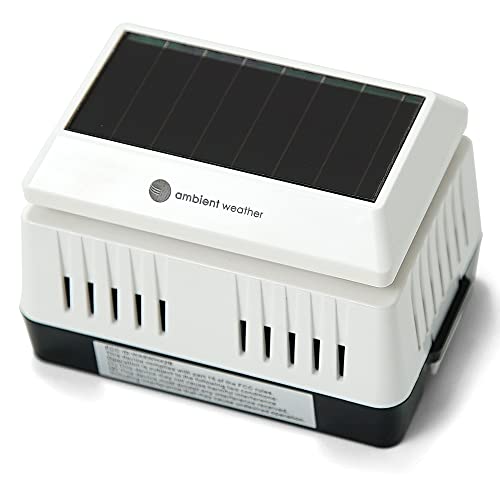
Outdoor air quality is the reason to choose this Ambient Weather monitor. It focuses on fine particulate pollution around the home, using a Sensirion particle sensor and sending information to the Ambient Weather Network. That narrow focus can be valuable near a busy road, during smoky conditions, or around a property where outdoor particulate levels matter more than a long list of weather instruments.
The monitor can create alerts and connect with Google Home or Amazon Alexa through the Ambient Weather ecosystem. Solar power assists the unit, and the listing identifies two rechargeable AA battery backups as included. Its compact 2.8 by 4.0 by 2.7-inch size opens up more placement options than a full weather-station array, though it does not replace a station that measures wind, rain, UV, or barometric pressure.
Pros
- Focuses directly on outdoor PM2.5 and particulate pollution.
- Uses a listed Sensirion particle sensor.
- Can send information to the Ambient Weather Network.
- Supports alerts and listed Google Home and Amazon Alexa connections.
- Solar-assisted design includes rechargeable battery backup.
Cons
- It does not provide the complete weather measurements of a full station.
- The product information does not list CO2 or TVOC readings.
This is best used as a focused outdoor air-quality component for a home that already has, or plans to use, an Ambient Weather setup. It makes sense for tracking fine particles outside a house, but it should not be mistaken for a complete rain, wind, and temperature station. Pairing it with a compatible Ambient Weather system creates a broader monitoring arrangement than using it alone.
To buy this product, click here.
5. Ambient Weather AQIN Pro — Best for Indoor Particle Detail

The AQIN Pro is aimed at indoor air quality rather than traditional outdoor weather instrumentation. Its display lists PM1, PM2.5, PM4, PM10, CO2, temperature, and humidity. That range of particulate categories gives a more detailed view than a station that reports a single TVOC value, while the integrated thermo-hygrometer adds basic room-condition context.
The compact enclosure measures 2.8 by 4.0 by 2.7 inches, making it easier to place near a bedroom, office, workshop, or living area. The USB-C adapter supports routine operation, and optional rechargeable lithium battery backup is identified in the listing, though those batteries are not included. Compatibility with select Ambient Weather stations or the Ambient Weather Network Weather Hub allows cloud-based monitoring, but buyers should confirm that their existing equipment supports this exact monitor before ordering.
Pros
- Lists PM1, PM2.5, PM4, PM10, and CO2 measurements.
- Includes temperature and humidity through an integrated thermo-hygrometer.
- Compact dimensions allow flexible indoor placement.
- Large display presents several air-quality values at a glance.
- Can work with select Ambient Weather systems for wireless and cloud monitoring.
Cons
- USB-C power is included, while optional rechargeable backup batteries are not included.
- Compatibility depends on a select Ambient Weather station or Weather Hub.
Choose the AQIN Pro if the air-quality question is primarily about indoor particles and CO2 rather than wind and rainfall. It is a strong companion to a separate weather station, especially for a household that wants a room-level view without placing a large outdoor array nearby. Its ecosystem requirement means it is less straightforward as a standalone purchase than the 16-in-1 station.
To buy this product, click here.
6. Ambient Weather WS-2902 — Best Expandable Weather Platform
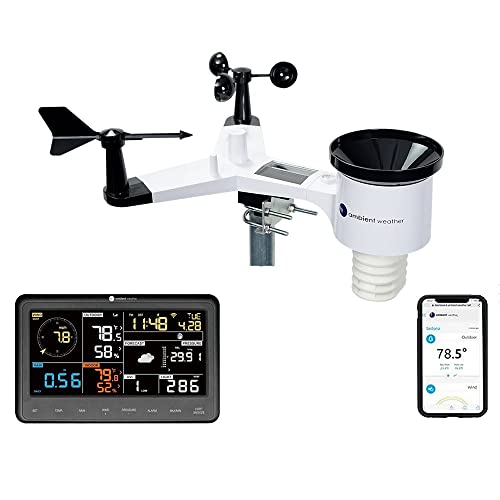
The WS-2902 is a complete weather station first, with an air-quality path through compatible Ambient Weather equipment rather than a listed built-in air sensor. Its Osprey sensor array measures wind speed, wind direction, temperature, humidity, rainfall, UV intensity, and solar radiation. That combination suits a backyard or garden where local weather observations need to be collected in one place.
Wi-Fi gives the station a broader data role than a console-only system. The listing identifies remote access, alerts, IFTTT, Google Home, Alexa, and the Ambient Weather Network. Those features can help turn a rainfall event or temperature change into a notification or smart-home action. Buyers should distinguish the station’s supplied weather measurements from any additional air-quality hardware, since the available product information does not state that PM, CO2, or TVOC sensors are included with this model.
Pros
- Includes an Osprey sensor array with wind, rain, temperature, humidity, UV, and solar readings.
- Offers Wi-Fi access and remote weather data.
- Supports listed IFTTT, Google Home, and Alexa connections.
- Can connect with the Ambient Weather Network.
- Color LCD console provides a local view of backyard conditions.
Cons
- The supplied information does not list built-in PM, CO2, or TVOC measurement.
- Air-quality expansion should be confirmed for the exact station and configuration before purchase.
This model fits someone building a broader Ambient Weather setup and wanting a dependable base for local weather observations. It ranks below the all-in-one air-quality stations because the air-monitoring function is not identified as included. Its advantage is the platform, especially for a buyer who wants weather-network access, smart-home links, and the option to build around a recognized sensor ecosystem.
To buy this product, click here.
7. Ambient Weather WS-2000 — Best for a Large Color Console
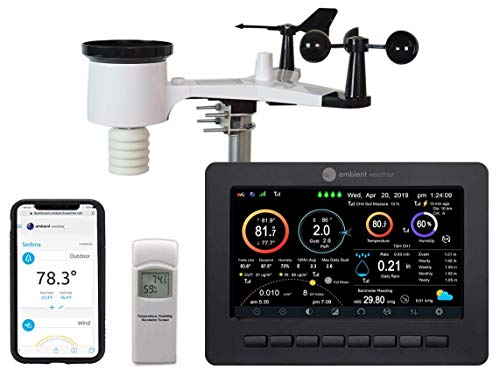
The WS-2000 centers the experience around a TFT color display and an integrated outdoor sensor array. It measures wind speed and direction, temperature, humidity, rainfall, UV, and solar radiation, covering the measurements most people expect from a full personal weather station. The console supports imperial and metric units, with calibration available according to the product information.
Its Wi-Fi capability can transmit data to the Ambient Weather network, giving it a place in a connected monitoring arrangement. Air-quality support is not listed as part of the included sensor array, so the station is better viewed as a weather foundation for readers who may add compatible monitoring equipment after confirming support. The console uses an included 5V DC adapter, while the outdoor array requires three AAA batteries that are not included.
Pros
- Integrated array measures wind, temperature, humidity, rainfall, UV, and solar radiation.
- TFT color display presents weather information locally.
- Supports imperial and metric units.
- Calibration is identified in the product information.
- Wi-Fi can transmit data to the Ambient Weather network.
Cons
- Air-quality sensing is not listed as included with the weather station.
- The outdoor sensor requires three AAA batteries, which are not included.
The WS-2000 makes sense for a reader who values a substantial local display and wants Ambient Weather connectivity. It is less suitable as a single-box air-quality purchase than the top three choices, since the supplied information does not identify particulate, CO2, or TVOC measurements. Its main appeal is the combination of broad weather sensing, calibration, and network access.
To buy this product, click here.
8. Sainlogic 12-in-1 Wireless Weather Station — Best for Local Weather Data
The Sainlogic 12-in-1 is a local weather station without Wi-Fi, so its place in this comparison is narrower. It measures indoor and outdoor temperature and humidity, barometric pressure, wind speed, wind direction, rainfall, dew point, and feels-like temperature. The station also records hourly, daily, weekly, monthly, and cumulative rainfall totals, which can be handy beside a garden shed or on a small property where a phone app is unnecessary.
A 6.5-inch color display with adjustable backlight keeps the readings visible indoors. The outdoor sensor lists wireless transmission up to 443 feet in open, unobstructed conditions, and mounting hardware is included. The product information gives temperature accuracy as ±0.2°C, humidity accuracy as ±1.8% RH, and rainfall accuracy as ±7%. None of the listed functions include air-quality sensing, so this is a weather-focused option rather than a direct substitute for the 16-in-1 or Temtop systems.
Pros
- Measures temperature, humidity, pressure, wind, rainfall, dew point, and feels-like temperature.
- Records rainfall across hourly, daily, weekly, monthly, and cumulative periods.
- 6.5-inch color display includes adjustable backlight levels.
- Mounting hardware is included.
- Lists temperature accuracy of ±0.2°C and humidity accuracy of ±1.8% RH.
Cons
- No Wi-Fi, app, or remote-monitoring function is listed.
- Air-quality measurements are not listed.
This station suits someone who wants a broad local weather readout and does not need air-quality data or Internet access. The rain history is more useful than a basic temperature display for garden planning, while the listed wireless range offers placement flexibility in open conditions. Choose a different system if PM2.5, CO2, TVOC, or remote alerts are central to the purchase.
To buy this product, click here.
9. AcuRite Iris 01512MCB — Best Traditional Weather Station
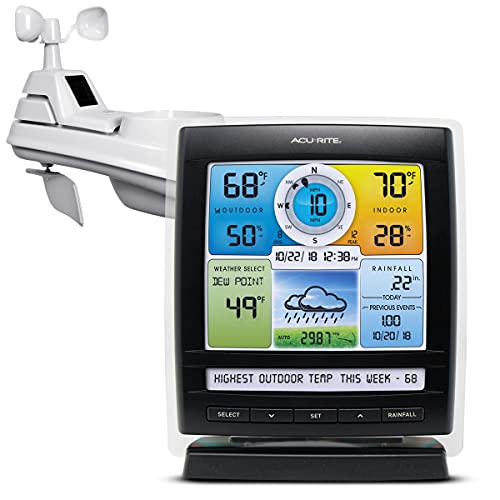
The AcuRite Iris is a conventional wireless weather station built around a color LCD console and a single outdoor sensor array. It receives indoor and outdoor temperature and humidity, wind speed and direction, barometric pressure, and rainfall. The listing also mentions historical data, heat index, dew point, feels-like temperature, and pressure trends, so the console goes beyond a simple indoor/outdoor thermometer.
Setup is centered on batteries, a mounting bracket, and the outdoor sensor rather than Wi-Fi accounts or app configuration. The forecast uses elevation information and barometric pressure to create a 12-hour local forecast. That can be useful for a porch or kitchen display, but the product information does not identify PM2.5, PM10, CO2, TVOC, or remote air-quality monitoring. It belongs at the bottom of this list because it covers weather fundamentals while leaving air quality outside the system.
Pros
- Measures indoor and outdoor temperature, humidity, wind, pressure, and rainfall.
- Displays heat index, dew point, feels-like temperature, and pressure trends.
- Color LCD console includes time, date, and adjustable dimmer.
- Outdoor sensor includes a mounting bracket.
- Uses elevation and pressure information for a 12-hour personalized forecast.
Cons
- Air-quality measurements are not listed.
- Remote app access and Wi-Fi connectivity are not identified.
The Iris is a reasonable choice for a household that values local weather observations and wants a familiar console rather than an Internet-connected air-quality platform. It can track rain, wind, and pressure in a straightforward format, but anyone shopping specifically for air monitoring should move up to the 16-in-1, Temtop, Netatmo, or a compatible Ambient Weather air-quality system.
To buy this product, click here.
How to Choose a Weather Station With an Air Quality Monitor
Separate TVOC From Particulate and CO2 Readings
Air quality is a broad label. The 16-in-1 station lists TVOC, which can help indicate the presence of volatile organic compounds, while the Temtop W100 lists PM2.5, PM10, CO2, TVOC, and AQI. The AQIN Pro lists several particulate categories plus CO2. Those are different measurements, so choose according to the concern you actually want to track. A TVOC reading does not replace a PM2.5 reading, and a forecast icon does not tell you the room’s CO2 level.
Wireless Sensor Links Are Different From Wi-Fi
A weather station can send information wirelessly from an outdoor sensor to a console without connecting to the Internet. Wi-Fi adds a network connection, but its practical benefit depends on the app or platform attached to it. The Sainlogic system lists a wireless sensor connection but no Wi-Fi. The 16-in-1, Temtop, Netatmo, WS-2902, and WS-2000 list Wi-Fi-related functions. Check whether you need local readings, app access, cloud history, alerts, or smart-home control.
Check Which Air-Quality Sensors Are Included
Compatibility and inclusion are separate matters. The Ambient Weather WS-2902 and WS-2000 list broad weather measurements and network functions, but their supplied information does not identify PM, CO2, or TVOC sensing as part of the included station. The Ambient Weather PM2.5 monitor and AQIN Pro provide more focused air data, yet they may require a compatible Ambient Weather station or hub for broader reporting. Confirm the exact package before comparing systems by feature count.
Treat Transmission Range as a Best-Case Figure
The 16-in-1 station lists a 300-foot open-area range, the Temtop W100 lists up to 3,280 feet through LoRa in open areas, and the Sainlogic system lists up to 443 feet without obstructions. Buildings, metal siding, floors, trees, terrain, and interference can reduce communication distance. Place the console or gateway where the product can maintain a clear connection, and avoid treating the maximum listed range as a guarantee through walls.
Decide Whether You Need a Local Display
A large screen is useful when you want to glance at conditions from a kitchen counter, office, or bedside table. The Temtop W100 uses a 7-inch touchscreen, while the 16-in-1 system offers a large color display with brightness controls and night mode. A compact air monitor may be easier to place near a bedroom or desk, but its information can be more specialized. App-first buyers may care less about console size and more about historical records, alerts, and remote access.
Match the Power Arrangement to the Installation
Power requirements vary across the system. The Temtop W100 is intended for plug-in use with temporary battery backup. The AQIN Pro includes a USB-C adapter, while optional rechargeable backup batteries are not included. The Ambient Weather PM2.5 monitor lists solar assistance and rechargeable battery backup. A console, outdoor array, gateway, and air-quality sensor may each use a different power method, so review the complete arrangement before choosing a location.
Install Sensors Where Their Readings Make Sense
Even a sophisticated station can report misleading conditions if its sensors sit beside a heat source, under direct sun, behind an obstruction, or too close to a wall. Rain gauges need an open, level location, while wind sensors need exposure to moving air. Indoor air monitors should sit where they represent the room you want to understand rather than directly beside a window, vent, or cooking appliance. Sensor placement remains part of the measurement system.
Best Weather Stations With Air Quality Monitor FAQ
What Is the Best Overall Weather Station With an Air Quality Monitor?
The 16-in-1 WiFi Weather Station is the strongest overall fit because it combines TVOC monitoring with temperature, humidity, pressure, wind, rainfall, UV, light intensity, a color display, app access, and historical records. Choose the Temtop W100 instead if PM2.5, PM10, CO2, and AQI are more important than having a simpler all-in-one design.
Which Station Measures PM2.5 and PM10?
The Temtop W100 lists PM2.5 and PM10 measurements, while the Ambient Weather PM2.5 monitor focuses on outdoor particulate pollution. The Ambient Weather AQIN Pro lists PM1, PM2.5, PM4, and PM10 for indoor monitoring. The 16-in-1 station lists TVOC rather than those particulate categories.
Does a Wireless Weather Station Automatically Have Wi-Fi?
No. Wireless often describes the connection between an outdoor sensor and the indoor console. Wi-Fi connects a station or gateway to a home network and may support an app, remote access, or cloud history. The Sainlogic and AcuRite Iris listings describe wireless sensor systems, while the 16-in-1, Temtop W100, Netatmo, WS-2902, and WS-2000 list Wi-Fi functions.
Can These Stations Monitor Air Quality Away From Home?
The 16-in-1 station lists Tuya app access to real-time data, historical trends, and rainfall records. The Temtop W100 lists remote monitoring through its app. Netatmo lists smartphone access and alerts. Ambient Weather products list network or cloud-related functions, though a compatible hub or additional monitor may be required for some air-quality configurations. Confirm the exact app and equipment arrangement before relying on remote access.
Which Product Is Best for Indoor Air Quality?
The Temtop W100 is the most complete indoor air-quality choice in this selection because it lists PM2.5, PM10, CO2, TVOC, and AQI, plus threshold alerts. The Ambient Weather AQIN Pro is also a strong indoor option for detailed particulate and CO2 readings, especially for buyers already using compatible Ambient Weather equipment.
Do These Weather Stations Measure Carbon Dioxide?
The Temtop W100 and Ambient Weather AQIN Pro list CO2 measurement. The other products in this comparison do not identify CO2 as an included measurement. A TVOC reading, humidity value, or general AQI display should not be treated as a substitute for a direct CO2 reading.
Does a Larger Number of Measurements Mean a Better Station?
More measurements can be useful, but only when they match the monitoring goal. The 16-in-1 station adds UV, light intensity, and TVOC to weather readings, while the Temtop W100 emphasizes several indoor air indicators. A station with fewer measurements may be easier to install and understand if you mainly need temperature, rainfall, and wind. Compare the actual sensor list rather than relying on the “in-1” label.
Do Weather Stations With Air Quality Monitors Need Outdoor Installation?
Complete systems with wind and rainfall sensors require an outdoor sensor location, while indoor air monitors such as the AQIN Pro can sit inside. The Netatmo system uses indoor and outdoor components, and the 16-in-1 and Temtop systems combine outdoor weather arrays with air-quality functions. Read the installation requirements for each component, since the console, gateway, and sensors may have different power and placement needs.
Final Verdict
The 16-in-1 WiFi Weather Station is the strongest overall choice for a buyer who wants one system covering a broad set of outdoor conditions plus TVOC air-quality monitoring. Its Tuya app, color display, rainfall history, UV and light readings, and listed outdoor sensor range create a well-rounded package for a home, patio, garden, or greenhouse. Its main limitation is the type of air-quality data. Shoppers specifically concerned with PM2.5, PM10, or CO2 should step up to the Temtop W100.
The Temtop W100 is the premium air-quality choice, while the Netatmo station is more appealing for voice assistants, smartphone alerts, and household ventilation awareness. The Ambient Weather PM2.5 monitor and AQIN Pro are useful focused options when particulate data matters and an Ambient Weather setup is acceptable. The WS-2902 and WS-2000 provide capable weather foundations, while the Sainlogic and AcuRite Iris suit local weather monitoring without the same air-quality coverage. Match the final choice to the measurements you will actually use, the connectivity you need, and the installation your property can support.