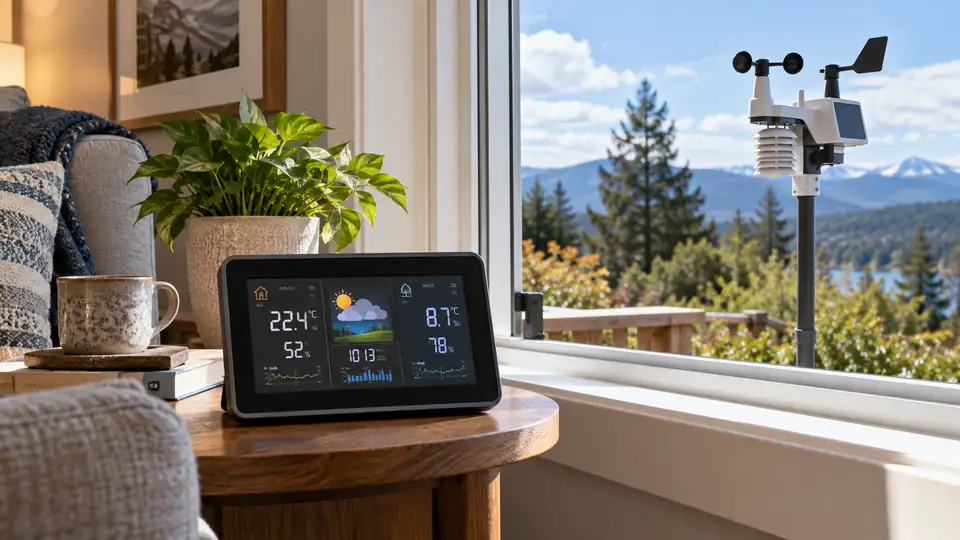
A useful indoor/outdoor weather station should answer more than one question at a glance: How warm is it outside? Is the house becoming too humid? Did the temperature drop overnight? Will wind, rain, or changing pressure affect the day ahead? The best weather stations with indoor outdoor sensors combine a local outdoor sensor with a console that makes those readings easy to follow, but the systems differ sharply in what they measure, how many locations they can monitor, and how much installation they require.
The biggest divide in this group is sensor depth. A compact thermometer-hygrometer may be ideal for a bedroom, garage, greenhouse, or nursery, while a full station with wind and rainfall sensors makes more sense for a yard, cabin, or larger property. Wireless transmission also needs context. These products send sensor data to a console, but the supplied information does not identify Wi-Fi, app access, cloud storage, or remote monitoring for the models here. A long listed range can help with placement, yet walls, metal, floors, and other obstructions may reduce the actual distance.
Our comparison gives the strongest weight to useful indoor and outdoor measurements, sensor architecture, display clarity, expansion options, power arrangements, and setup demands. The AcuRite Iris earns the top position because it adds rainfall and wind data to the usual temperature, humidity, and pressure readings. Buyers who prefer a larger screen, multiple included sensors, or a simpler temperature-focused setup will find better fits lower in the list.
Quick Answer
- Best Overall: AcuRite Iris (01512MCB) provides the broadest local weather picture here, including indoor and outdoor temperature, humidity, wind, rainfall, and pressure.
- Best for a Large Display: AIRAIN TECH Wireless Weather Station uses an 8.5-inch display and shows wind, rain, pressure, temperature, humidity, and related readings without Wi-Fi.
- Best for Multiple Sensors: Weather Stations Wireless Indoor Outdoor Thermometer with Multiple Sensors includes three remote sensors for monitoring several locations.
- Best Budget Temperature Monitor: U UNNI Indoor Outdoor Thermometer Hygrometer focuses on temperature and humidity, with stated accuracy figures and a listed 330-foot open-area transmission range.
Best Weather Stations with Indoor Outdoor Sensors Comparison Table
| Product | Measurements | Sensor Design | Display and Power | Best For |
|---|---|---|---|---|
| AcuRite Iris | Temperature, humidity, wind, rain, pressure | Outdoor sensor array, indoor console | Color LCD, adjustable dimmer | Most complete local monitoring |
| AIRAIN TECH Wireless Weather Station | Temperature, humidity, wind, rain, pressure, UV | Outdoor multi-function sensor | 8.5-inch color display, two displays | Large-screen weather tracking |
| Multiple Sensors Weather Station | Temperature, humidity, pressure, forecasts | Three remote sensors included | 7.5-inch color display, adapter or batteries | Monitoring multiple rooms |
| Large Display Three-Sensor Station | Temperature, humidity, pressure, forecasts | Up to three sensors, one included | 7.5-inch HD display, adapter or batteries | Readable household console |
| AcuRite 02077M | Temperature, humidity, pressure trends | One wireless outdoor sensor | Color LCD, adjustable dimmer | Simple branded setup |
| U UNNI Weather Station | Temperature, humidity, dew point, heat index | One sensor, supports up to three | Compact backlit display, battery powered | Budget humidity monitoring |
| La Crosse Technology Advanced Station | Temperature, humidity, high/low records | One weather-resistant sensor | Color LCD, adapter with battery backup | Clock and basic weather readings |
| AcuRite Digital Vertical Forecaster | Temperature, humidity, pressure, forecasts | One wireless outdoor sensor | Auto-dimming vertical LCD | Wall or tabletop placement |
| DreamSky Wireless Weather Station | Temperature, humidity, pressure-based forecast | One included sensor, supports three | Color display, USB power and backup battery | Readable atomic-clock console |
The detailed reviews below focus on what each station actually measures, how its sensor arrangement affects daily use, and where its limitations matter.
1. AcuRite Iris (01512MCB) Indoor/Outdoor Wireless Weather Station — Best Overall
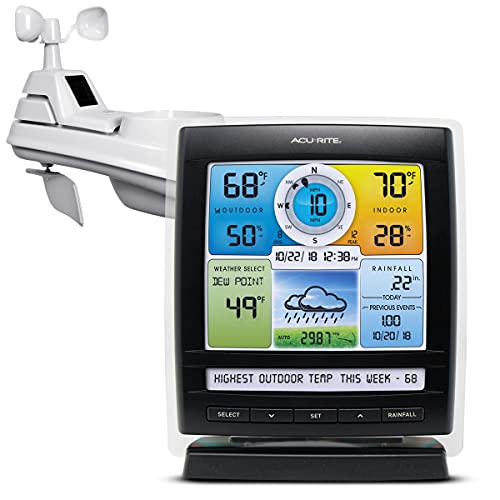
The AcuRite Iris is the strongest choice for readers who want a complete local weather picture rather than a temperature display with a few forecast icons. Its outdoor system sends temperature, humidity, wind speed, wind direction, barometric pressure, and rainfall to the indoor color console. That measurement mix gives a yard, cabin, or garden more useful context than a station limited to temperature and humidity, especially when a windy afternoon or a sudden pressure change matters.
Its listing also identifies more than 55 data points, including historical information, heat index, dew point, feels-like temperature, and pressure trends. Those latter readings are calculated or trend-based rather than separate weather sensors, so they should be treated as useful interpretations of the measured data. Installation still involves mounting the outdoor sensor to a pole or post, and the console is local rather than advertised as Wi-Fi-connected. For someone who wants rich information in the house without an app requirement, that is a sensible trade.
Pros
- Measures indoor and outdoor temperature and humidity.
- Includes wind speed, wind direction, rainfall, and barometric pressure.
- Provides historical data, pressure trends, heat index, dew point, and feels-like readings.
- Uses a large color LCD with an adjustable dimmer.
- Includes a mounting bracket for the outdoor sensor.
Cons
- The outdoor sensor requires a suitable pole or post location.
- The supplied information does not identify Wi-Fi, app access, or remote monitoring.
This is the station to choose when rainfall and wind matter as much as indoor comfort. It is a heavier-duty installation than a small temperature sensor, and the extra measurements are unnecessary for someone who only wants to check a nursery or basement. For local, all-around monitoring, though, the Iris offers the most complete sensor package in this comparison.
To buy this product, click here.
2. AIRAIN TECH Wireless Weather Station — Best for a Large Display
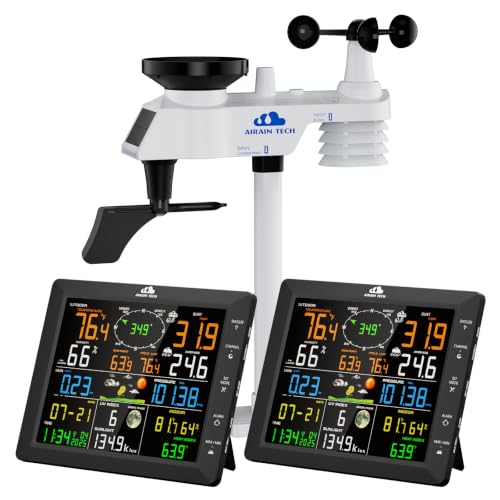
AIRAIN TECH takes a different route from the smaller console-style stations. Its 8.5-inch color display is intended to keep wind speed, wind direction, rainfall, indoor and outdoor temperature, humidity, and barometric pressure visible in one broad view. Two main display units are listed, which can be useful when one console belongs in the kitchen and another sits in an office or living area.
The outdoor unit also reports UV index, moon phase, dew point, and wind chill according to the product information. Some of these are derived readings, while rainfall and wind come from dedicated parts of the outdoor system. The station is explicitly described as having no Wi-Fi, so it suits local observation rather than checking conditions from away. Its listed 328-foot transmission distance applies to favorable open conditions, and the outdoor array requires a mounting location with enough exposure for wind and rain measurements.
Pros
- Displays temperature, humidity, rainfall, wind speed, wind direction, and pressure.
- Uses a large 8.5-inch color screen with adjustable brightness.
- Includes two main display units.
- Lists UV index, dew point, wind chill, and moon phase information.
- Includes a mounting pole, bracket, hardware, and power adapter.
Cons
- No Wi-Fi is identified, so the station is intended for local display use.
- The outdoor array needs a more involved installation than a simple temperature sensor.
Choose this model if the screen itself is central to the buying decision and you want wind and rainfall on the same page. Skip it if a compact console or phone-based access matters more than a large local display. Its broad measurement list and two-console arrangement make it a useful alternative to the AcuRite Iris, with a particularly strong visual presentation.
To buy this product, click here.
3. Weather Stations Wireless Indoor Outdoor Thermometer with Multiple Sensors — Best for Multiple Sensors

Three included remote sensors give this station a clear purpose. A household can monitor the outside, garage, basement, bedroom, or another area from one console, with temperature and humidity readings assigned to separate channels. That arrangement is more useful than a station that merely says it supports extra sensors but ships with one, particularly for comparing conditions across rooms.
The 7.5-inch VA color display also reports pressure trends, forecast icons, sunrise and sunset times, moon phase, tide indicators, comfort levels, and alerts for temperature, humidity, and frost. The listed sensor tolerance is ±1.8°F for temperature and ±5% relative humidity. Those figures are product information claims, not independent verification, but they provide more context than a listing that gives no accuracy figures. The stated 200-foot transmission distance is for open spaces, so placement still matters inside a building.
Pros
- Includes three remote sensors for monitoring several locations.
- Displays temperature and humidity from four areas when the indoor console is included.
- Offers temperature, humidity, and frost alerts.
- Uses a 7.5-inch color display with four backlight levels.
- Includes pressure trends, comfort indicators, forecast icons, and historical high and low records.
Cons
- The listed 200-foot transmission distance is specified for open spaces.
- The supplied information does not identify Wi-Fi, app access, or cloud monitoring.
This is the practical pick for a property where several indoor locations matter. It gives up rainfall and wind measurement, so it is less suitable for detailed outdoor weather observation than the two higher-ranked stations. For temperature and humidity mapping across a house, however, the three included sensors are a meaningful advantage rather than a headline feature with extra purchases attached.
To buy this product, click here.
4. Weather Station Wireless Indoor Outdoor with 3 Sensor — Best Large Display for Household Monitoring

A 7.5-inch HD screen makes this model easy to read from across a room, which can matter more than an elaborate data list when the console sits on a kitchen counter or family-room shelf. The display separates temperature, humidity, time, date, and forecast information into clear areas. Its indoor/outdoor system can connect with up to three sensors, although the package information identifies one included sensor, so additional locations require extra compatible units.
Forecast information is generated from barometric pressure trends and is described as covering an 8- to 12-mile radius after a seven- to ten-day calibration period. That is a local station forecast aid, not a replacement for a broader weather service. The console stays lit with the adapter and uses a short, touch-activated display period in battery mode. A listed 328-foot wireless distance offers placement flexibility under favorable conditions, while walls and building materials can alter the result.
Pros
- Provides a 7.5-inch high-contrast display.
- Supports up to three remote sensors.
- Uses atomic timekeeping with multiple time-zone settings.
- Offers pressure-based forecast information after calibration.
- Supports adapter operation with battery backup for settings and power interruptions.
Cons
- Only one remote sensor is identified as included.
- The product information does not identify rainfall or wind measurement.
This station fits a home that values large numbers and a steady, always-visible console. The additional sensor support is useful for later expansion, but the purchase decision should account for the fact that extra sensors are not listed as part of the package. It is a better match for indoor temperature and humidity coverage than for a garden where rainfall and wind are central.
To buy this product, click here.
5. AcuRite Wireless Home Weather Station 02077M — Best Simple Setup
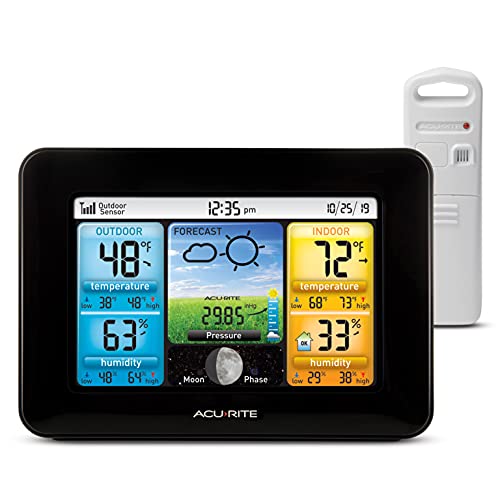
The AcuRite 02077M keeps the system focused on the measurements most households check every morning: indoor and outdoor temperature, humidity, and pressure trends. Its outdoor sensor has an integrated hanger for a post or tree branch, which reduces the hardware required for basic setup. The console adds high and low records, signal strength, trend arrows, moon phase, and more than 15 listed data points.
The color LCD includes an adjustable dimmer, and the listing presents it as suitable for a house, office, or RV. It provides a personalized 12-hour forecast based on current conditions and pressure-related information. Buyers should still treat forecast icons as an interpretation of local readings, not a guaranteed prediction. The outdoor sensor requires two AA batteries, which are not included, and the supplied information does not identify Wi-Fi or support for viewing readings away from the console.
Pros
- Includes indoor and outdoor temperature and humidity monitoring.
- Tracks barometric pressure trends and high/low records.
- Uses an integrated outdoor-sensor hanger for straightforward placement.
- Offers a color display with adjustable dimming.
- Includes signal strength, trend arrows, moon phase, and forecast information.
Cons
- Wind and rainfall measurements are not identified.
- Outdoor sensor batteries are not included.
This model makes sense for someone who wants a recognizable, moderately detailed console without installing a wind-and-rain array. It sits below the multi-sensor stations because only one outdoor sensor is identified and expansion is not described. Its simpler hanging arrangement may appeal to an RV, apartment, or smaller home where a post-mounted sensor is enough.
To buy this product, click here.
6. U UNNI Indoor Outdoor Thermometer Hygrometer — Best Budget Temperature Monitor

U UNNI is the most focused option in this group. It centers on temperature and relative humidity, then adds heat index, dew point, and mold index information for the monitored locations. The product information lists a temperature accuracy of ±0.5°F and humidity accuracy of ±2%, along with broad stated measurement ranges. Those are listing specifications for the product, so they should be read as published claims rather than a substitute for independent testing.
The compact display can sit on a table or mount on a wall, and its backlight activates for about 10 seconds when the button is pressed. The system updates readings every 30 seconds according to the listing and supports up to three sensors across separate channels, though one outdoor sensor is included. A stated 330-foot radius applies to the wireless transmission claim. This is a useful arrangement for a basement, nursery, greenhouse area, or garage, but it does not provide wind or rainfall data.
Pros
- Lists temperature accuracy of ±0.5°F and humidity accuracy of ±2%.
- Reports temperature, humidity, heat index, dew point, and mold index.
- Supports up to three sensors on separate channels.
- Lists a 330-foot transmission radius and 30-second updates.
- Offers tabletop or wall placement with a readable backlit display.
Cons
- Only one remote sensor is identified as included.
- The product information does not identify wind, rainfall, Wi-Fi, or app access.
Pick this station when indoor climate monitoring matters more than a full outdoor weather record. Its published accuracy figures help with comparison, while the separate heat, dew point, and mold indicators add practical context for enclosed spaces. A reader who wants rainfall totals, wind direction, or a broad outdoor forecast should move up to a more complete station.
To buy this product, click here.
7. La Crosse Technology Advanced Weather Station — Best Basic Clock and Weather Console

La Crosse Technology’s Advanced Weather Station combines indoor and outdoor temperature, humidity, high and low records, and customizable alerts with an atomic clock. Its color forecast icons and tendency indicators make the screen feel more like a household information panel than a bare thermometer. The included outdoor sensor is described as weather-resistant, and its listed transmission range reaches 330 feet without obstructions.
The console uses a 5V power adapter for full display operation, while three AAA alkaline batteries provide optional backup according to the listing. Backlight settings include high, low, and off, with temporary illumination in battery-only use. This power distinction matters for a bedroom or guest room, where a constantly bright screen may be unwanted. The system is a local wireless station, and no Wi-Fi, app, rainfall, or wind capability is identified in the supplied information.
Pros
- Displays indoor and outdoor temperature and humidity.
- Includes high/low records and customizable alerts.
- Uses atomic timekeeping with automatic daylight-saving adjustment.
- Offers adjustable backlight settings and a 12- or 24-hour clock view.
- Includes a weather-resistant outdoor sensor with a listed 330-foot unobstructed range.
Cons
- Rainfall and wind measurements are not identified.
- Full display operation relies on the included 5V adapter.
This station is a good fit for a household that wants dependable clock functions alongside basic indoor/outdoor readings. It is less compelling for a garden or property where pressure, rain, or wind data drive the decision. The temporary battery backlight is a practical touch for power flexibility, although buyers should plan around the adapter for a continuously visible screen.
To buy this product, click here.
8. AcuRite Digital Vertical Weather Forecaster 01121M — Best for Wall or Tabletop Placement
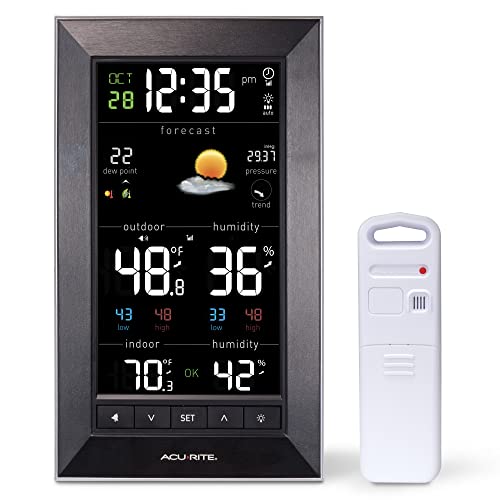
The vertical AcuRite display is built for flexible placement. A kickstand supports tabletop use, while a keyhole allows wall mounting, making it easy to place beside a desk, in an RV, or on a narrow shelf. It reports indoor and outdoor temperature and humidity, daily high and low values, date, time, and barometric pressure. The auto-dimming LCD keeps the presentation relatively calm as room lighting changes.
An outdoor sensor sends temperature and humidity to the console over a listed 433 MHz wireless connection, with a stated range of up to 330 feet or 100 meters. The system also provides a 12-hour personalized forecast and programmable temperature or humidity alarms. It does not include the wind and rain instruments found in the top two picks, and the product information does not identify app access. That makes its value strongest in compact spaces where clean placement matters more than a full sensor array.
Pros
- Monitors indoor and outdoor temperature and humidity.
- Includes daily high and low records and programmable alerts.
- Offers a kickstand and keyhole for tabletop or wall placement.
- Uses an auto-dimming display with time, date, and pressure information.
- Lists wireless transmission up to 330 feet or 100 meters.
Cons
- Wind and rainfall measurements are not identified.
- The outdoor sensor and console require separate battery planning, with battery details not fully specified in the supplied information.
This is the tidy, space-conscious choice for a smaller home or RV. It gives more placement flexibility than many console designs, yet its measurement set remains focused. Choose it over the La Crosse model if wall or tabletop positioning is a deciding factor, and choose a higher-ranked station if weather observation includes rain totals or wind direction.
To buy this product, click here.
9. DreamSky Wireless Indoor Outdoor Weather Station — Best Readable Atomic-Clock Console

DreamSky gives the console a broad, readable presentation with large numbers for indoor and outdoor temperature, forecast information, date, year, and calendar day. That layout is useful when the display sits several feet away, such as on a kitchen wall or dresser. It also supports high and low temperature alerts, which can help flag a cold garage or an overheated room without watching the screen constantly.
The system accepts up to three outdoor sensors, with one included, and uses pressure-based information for a 12- to 24-hour forecast after a seven-day calibration period. Its five-level backlight adjustment is more granular than many basic consoles, and the USB-powered design includes battery backup for power interruptions. The listing does not identify rainfall, wind, Wi-Fi, or remote access, so the station is best understood as a local temperature and humidity monitor with clock functions.
Pros
- Uses large numbers and a colorful display for viewing from a distance.
- Supports up to three outdoor sensors, with one included.
- Includes high and low temperature alerts.
- Offers five backlight brightness levels.
- Provides atomic time, auto daylight-saving adjustment, USB power, and battery backup.
Cons
- Only one outdoor sensor is identified as included.
- Wind and rainfall measurements, Wi-Fi, and app access are not identified.
DreamSky is a sensible pick for a clock-first household that still wants indoor and outdoor readings on the same screen. It trails the AcuRite 02077M in overall monitoring depth and the multi-sensor models in included coverage, but the large figures, five-level dimming, and atomic clock features make it comfortable for everyday room use. Buyers seeking property weather data should choose a station with wind and rain sensors instead.
To buy this product, click here.
Buying Guide
Decide Which Measurements Actually Matter
Temperature and humidity are enough for many indoor locations, including bedrooms, basements, garages, and greenhouse areas. A station such as the U UNNI adds dew point, heat index, and mold index information around those measurements. For a yard, cabin, or larger property, rainfall and wind speed may be more useful than extra clock functions. The AcuRite Iris and AIRAIN TECH are stronger choices because their outdoor systems include rain and wind instruments.
Wireless Does Not Mean Wi-Fi
Every station here uses wireless communication between an outdoor sensor and an indoor console, but that does not mean the console connects to a home network. The supplied information does not identify Wi-Fi, app access, cloud storage, or remote monitoring for these products. A wireless link lets the console receive nearby sensor data. It does not automatically let someone check the readings from work or while traveling.
Check Which Sensors Are Included
Several stations support up to three remote sensors while including only one. That distinction matters if the goal is monitoring a nursery, garage, cellar, and outdoors on the first day. The multiple-sensor station is unusual in this group because three remote sensors are identified as included. The large-display three-sensor model supports three but lists one included, so extra coverage may require additional purchases.
Treat Transmission Range as a Best-Case Figure
Listings describe ranges such as 200, 328, or 330 feet, but those figures generally assume open or unobstructed conditions. Interior walls, floors, metal siding, appliances, and terrain can reduce communication distance. Place the console where the signal can reach it without assuming that the maximum number will pass through a complex building.
Accuracy, Resolution, and Forecasts Are Different
A display showing more decimal places does not prove greater accuracy. The U UNNI listing provides temperature and humidity accuracy claims, while several other stations do not provide comparable figures. Forecast icons are also interpretations based on pressure trends and recent conditions. They can be useful for a quick local reference, but they are different from directly measured temperature, humidity, rainfall, or wind.
Plan the Outdoor Installation Around the Sensor
Temperature and humidity sensors need exposure to surrounding air, while rain gauges need an open collection path and wind instruments need suitable exposure to moving air. Nearby roofs, pavement, walls, trees, and heat sources can influence readings. A compact sensor with an integrated hanger is easier to place than a full wind-and-rain array, but the larger system provides more information when the installation location is appropriate.
Match the Power Setup to the Room
Many consoles stay continuously illuminated only when connected to an adapter. Battery mode may activate the screen briefly, which saves energy but is less convenient for a console meant to be visible all day. DreamSky uses USB power with battery backup, while Newentor and several large-display models use an adapter for a steady screen. Check whether batteries are included, since several outdoor sensors require batteries that are listed separately from the station.
Best Weather Stations with Indoor Outdoor Sensors FAQ
What is the best overall weather station with indoor and outdoor sensors?
The AcuRite Iris is the strongest overall choice in this comparison because it measures indoor and outdoor temperature and humidity along with wind speed, wind direction, rainfall, and barometric pressure. It requires a more involved outdoor installation than a simple remote thermometer, but it provides a much broader local weather record.
Do these wireless weather stations use Wi-Fi?
The supplied product information describes wireless sensor-to-console communication, but it does not identify Wi-Fi for the nine selected models. Wireless transmission and Wi-Fi solve different problems. These stations can send outdoor readings to a nearby console without providing Internet access or remote viewing.
Which station includes the most remote sensors?
The Weather Stations Wireless Indoor Outdoor Thermometer with Multiple Sensors lists three included remote sensors. It can monitor temperature and humidity in several locations from one console. Other models support up to three sensors but identify only one as included, so check the package contents before assuming that every channel is ready to use.
Are forecast icons the same as direct weather measurements?
No. Temperature, humidity, pressure, rainfall, and wind can come from physical sensors when the station includes them. Forecast icons are interpretations based on pressure trends and recent readings. They offer a convenient local reference, but they should not be treated as a direct measurement of future weather.
Which model measures rainfall and wind?
The AcuRite Iris and AIRAIN TECH listings identify rainfall, wind speed, and wind direction. These models require outdoor sensor placement suited to those measurements. The remaining selected stations focus mainly on indoor and outdoor temperature, humidity, pressure trends, and forecast information.
Can a weather station monitor a basement or greenhouse?
Yes, a station with additional temperature and humidity sensors can monitor enclosed locations, provided the sensors are compatible and placed appropriately. The multiple-sensor model includes three remote sensors, while the U UNNI station supports up to three channels and adds dew point and mold index information. Neither description should be read as proof of soil monitoring or plant-specific measurements.
Does a longer wireless range guarantee a stronger connection?
No. Listed transmission distances generally describe favorable conditions, often open space or no obstructions. Walls, floors, metal structures, terrain, and interference can reduce the usable distance. Place the console and outdoor sensor with the building layout in mind rather than treating the maximum listed range as guaranteed.
Do these stations provide remote monitoring away from home?
The supplied information does not identify cloud access, app connectivity, or remote monitoring for the selected models. Their primary function is sending outdoor sensor data to a local indoor console. A buyer who needs readings while away from the property should confirm explicit Wi-Fi, Internet, app, or cloud support before ordering.
Final Verdict
The AcuRite Iris is the strongest overall choice for readers who want a genuine local weather station rather than a basic indoor/outdoor thermometer. It combines temperature, humidity, rainfall, wind speed, wind direction, pressure, and calculated comfort readings in one system. The AIRAIN TECH station is a strong alternative for a large-screen setup with broad outdoor measurements, while the multiple-sensor station is better suited to homes that need temperature and humidity readings from several rooms.
For a lower-cost, focused monitor, the U UNNI offers useful published temperature and humidity specifications, plus dew point, heat index, and mold index information. The AcuRite vertical model, La Crosse station, and DreamSky console make more sense when clock functions and simple local readings matter more than rain and wind. Before choosing, match the sensor set to the property, confirm how many sensors are included, plan the outdoor placement, and treat wireless range as a listed maximum rather than a guarantee.