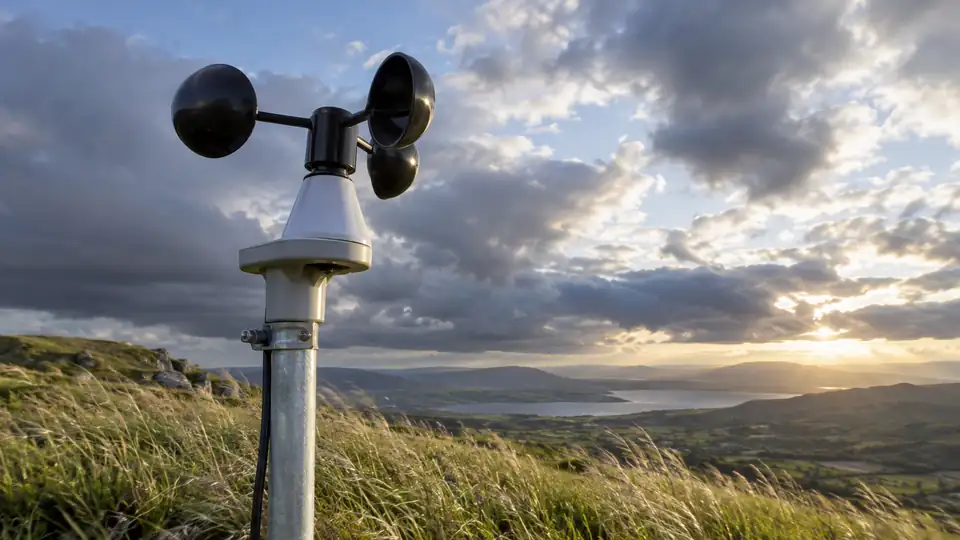
A weather station with an anemometer earns its place outdoors by showing more than temperature. Wind speed and direction help explain why a patio feels colder than the forecast, why a garden dries quickly, or whether a storm front is moving across the property. The strongest choices in this category combine a useful anemometer with rainfall, humidity, pressure, and a display or connected service that makes the readings easy to follow.
Wireless sensor transmission and Wi-Fi are separate features. A station can send readings from the outdoor sensor to a console without offering remote access, while a Wi-Fi model may upload observations to an app or weather network. Sensor placement matters too. A wind sensor needs open exposure, and a rain gauge needs a level, unobstructed position. More measurements are helpful only when they serve your purpose, so this guide weighs sensor coverage, connectivity, installation, display design, and data access rather than counting features alone.
The Ambient Weather WS-2902 is the strongest overall fit for buyers who want a broad set of local measurements plus Wi-Fi and smart-home connectivity. Other picks make more sense for a large display, a lower-cost connected setup, historical data, simple local monitoring, or advanced app-based records. The comparison below offers a quick way to narrow the field.
Quick Answer
- Best Overall: The Ambient Weather WS-2902 Wi-Fi Smart Weather Station combines wind speed and direction, rainfall, temperature, humidity, UV, solar radiation, Wi-Fi, and smart-home support.
- Best for Weather Underground: The AcuRite Iris 5-in-1 Home Weather Station connects to Weather Underground for remote monitoring and sharing.
- Best for Data Logging: The Sainlogic Smart Weather Station lists app alerts, two-year data storage, and Excel export.
- Best Local Display: The AIRAIN TECH Wireless Weather Station uses a large color screen and does not require Wi-Fi.
Best Weather Stations With Anemometer Comparison Table
| Product | Measurements | Connectivity | Best For |
|---|---|---|---|
| Ambient Weather WS-2902 | Wind, rain, temperature, humidity, UV, solar radiation | Wireless sensor link, Wi-Fi | Best overall connected setup |
| AcuRite Iris 01512MCB | Wind, rain, temperature, humidity, pressure | Wireless sensor link | Large local display and broad data |
| AcuRite Iris 5-in-1 01540M | Wind, rain, temperature, humidity, pressure | Wireless, Wi-Fi, Weather Underground | Remote weather sharing |
| AIRAIN TECH Wireless Station | Wind, rain, temperature, humidity, pressure, UV | Wireless only | Large screen without Wi-Fi |
| Urageuxy Wi-Fi Weather Station | Wind, temperature, humidity | Wireless, 2.4 GHz Wi-Fi | Lower-cost network uploads |
| Ambient Weather WS-1965 | Wind, rain, temperature, humidity, pressure | Wireless sensor link, Wi-Fi | Connected essentials |
| Sainlogic Smart Weather Station | Wind, rain, temperature, humidity, pressure, UV | 5 GHz and 2.4 GHz Wi-Fi, Bluetooth pairing | App alerts and data export |
| Sainlogic 12-in-1 Station | Wind, rain, temperature, humidity, pressure, calculated values | Wireless only | Large display and local records |
| Ambient Weather WS-2000 | Wind, rain, temperature, humidity, UV, solar radiation | Wireless sensor link, Wi-Fi | Advanced display and calibration |
The detailed reviews explain how these anemometer-equipped stations differ in measurements, data access, installation, and everyday use.
1. Ambient Weather WS-2902 – Best Overall
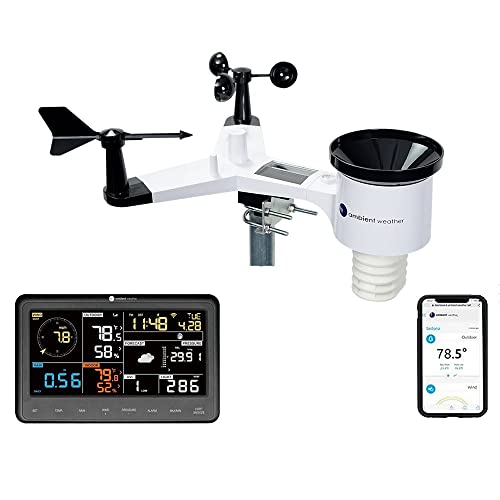
The WS-2902 covers the core measurements most homes want from a personal weather station. Its outdoor array reports wind speed, wind direction, temperature, humidity, rainfall, UV intensity, and solar radiation, while the included color display keeps those readings visible indoors. That broad sensor mix gives it an edge over stations that stop at wind, rain, and temperature.
Its Wi-Fi connection is the bigger dividing line. The product information says it supports remote access, alerts, smart-home programming through IFTTT, Google Home, and Alexa, plus optional sharing through the Ambient Weather Network. A buyer who wants to glance at conditions while away from home gets a more useful system than a local-only console, though proper network setup and outdoor sensor placement still matter.
Pros
- Measures wind speed and direction, rainfall, temperature, humidity, UV intensity, and solar radiation.
- Includes an outdoor Osprey sensor array and color LCD display.
- Supports Wi-Fi-based remote access and alerts.
- Lists IFTTT, Google Home, and Alexa compatibility.
- Can share data through the Ambient Weather Network.
Cons
- The console and outdoor array have different power needs, so installation is not completely cable-free.
- Wi-Fi and smart-home features add setup steps that local-only buyers may not need.
This is the strongest choice for a household that wants a full set of outdoor observations and connected access in one package. It is less compelling for someone who wants a simple clock-style display with no account or network setup. The integrated array also means placement decisions affect several measurements at once, so choose an open position rather than treating the station like a plug-and-play indoor sensor.
To buy this product, click here.
2. AcuRite Iris 01512MCB – Best for a Large Local Display
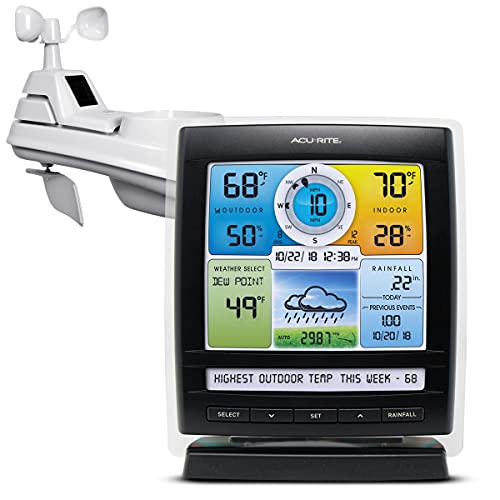
The AcuRite Iris 01512MCB is aimed at readers who prefer walking past a console and seeing the weather immediately. Its color screen shows indoor and outdoor conditions, time, and date, with an adjustable dimmer for different rooms. The outdoor sensor measures wind speed and direction, temperature, humidity, rainfall, and pressure, giving the station a solid set of direct observations.
The listing also describes more than 55 data points, including historical information, heat index, dew point, feels-like temperature, and pressure trends. Several of those are calculated or interpreted values rather than separate physical sensors, but they can still make the display more useful for everyday decisions. The personalized forecast uses elevation information and barometric pressure, so it should be treated as a station-based forecast rather than a replacement for a full weather service.
Pros
- Large color display with adjustable dimming.
- Measures wind speed and direction, rainfall, temperature, humidity, and barometric pressure.
- Provides historical readings and pressure trends.
- Displays calculated values such as dew point, heat index, and feels-like temperature.
- Includes an outdoor sensor mounting bracket.
Cons
- The supplied information does not identify Wi-Fi or remote access for this model.
- Buyers who mainly want app monitoring may prefer a connected station.
This model fits a kitchen counter, office, or living room where the screen is the main reason to own a weather station. It avoids the network dependency of connected alternatives, yet that simplicity also means the data stays centered on the local console. Choose it for visible, broad household monitoring rather than remote property checks.
To buy this product, click here.
3. AcuRite Iris 5-in-1 01540M – Best for Weather Underground
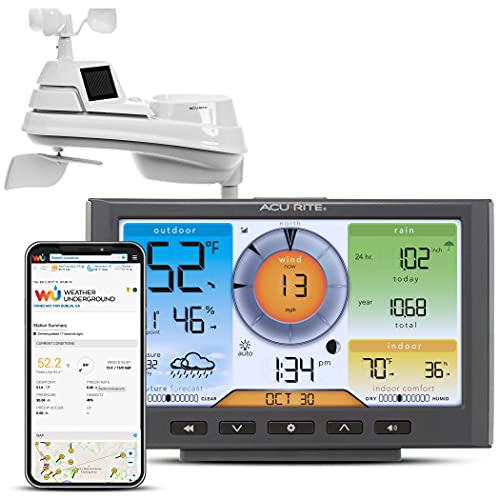
The 01540M earns its position through its specific Weather Underground connection. Its sensor array includes an anemometer, wind vane, thermometer, hygrometer, barometer, and rain gauge, while the indoor display presents the local conditions. That combination suits someone who wants a traditional station in the house plus a way to share or check observations through a supported weather platform.
The product information lists more than 25 data points, threshold alarms, historical readings, heat index, dew point, wind chill, and rainfall history. The “5-in-1” label should not be treated as a universal industry standard, but the listed measurements make the station’s purpose clear. Wi-Fi adds useful access, although buyers should distinguish platform connectivity from broad smart-home compatibility, which is not identified here.
Pros
- Includes a built-in anemometer, wind vane, barometer, hygrometer, rain gauge, and thermometer.
- Connects to Weather Underground for remote monitoring and data sharing.
- Offers threshold alarms and historical weather information.
- Displays heat index, dew point, wind chill, and rainfall history.
- Uses a color display with adjustable dimming.
Cons
- The listed measurement set is narrower than stations that add UV and solar radiation sensors.
- Weather Underground access requires network configuration rather than functioning as a local-only setup.
This is a good match for a neighborhood weather observer, gardener, or property owner who wants local wind and rain readings connected to a broader personal-weather network. It gives up some of the broader sensor coverage found on the WS-2902, but its platform-specific support makes the trade-off sensible for Weather Underground users.
To buy this product, click here.
4. AIRAIN TECH Wireless Weather Station – Best for a Large Screen Without Wi-Fi

AIRAIN TECH takes a straightforward local-monitoring approach. Its 8.5-inch color screen displays wind speed and direction, indoor and outdoor temperature and humidity, rainfall, pressure, moon phase, UV index, wind chill, and dew point. That large dashboard can be useful across a room, especially for someone who wants to read conditions without opening an app or logging into a service.
The listing gives the outdoor sensor a stated wireless transmission distance of up to 328 feet in favorable conditions. Walls, metal structures, trees, and placement can reduce actual communication distance, so the figure is best viewed as a published maximum. The listing also provides temperature and humidity ranges and accuracy claims, which are useful reference points, though they remain product-listing specifications rather than independent verification.
Pros
- Uses an 8.5-inch color display with adjustable brightness.
- Measures wind, rainfall, temperature, humidity, pressure, and UV-related information.
- Includes a mounting pole, bracket backplate, hardware, and power adapter.
- Lists a wireless transmission distance of up to 328 feet.
- Provides a local monitoring system without Wi-Fi requirements.
Cons
- The listing identifies this model as having no Wi-Fi.
- Remote app access and cloud data sharing are not listed.
Choose AIRAIN TECH for a room-focused station where a readable screen matters more than remote monitoring. It is also a practical fit for buyers who would rather avoid wireless-network setup. A reader managing a distant cabin or wanting phone alerts should look higher in the ranking, since this system’s strength is the local console rather than Internet access.
To buy this product, click here.
5. Urageuxy Wi-Fi Weather Station – Best for Lower-Cost Weather Network Uploads
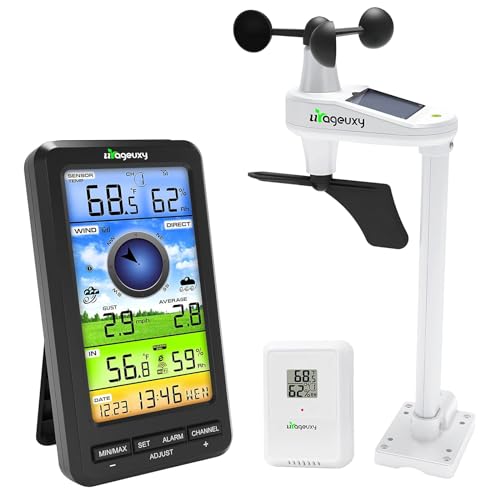
The Urageuxy station focuses on the measurements a smaller property usually needs first: wind speed, wind direction, indoor and outdoor temperature, and humidity. Its wireless outdoor array sends data to a 5-inch color console, while built-in Wi-Fi supports uploads to Weather Underground, PWSWeather, and Weathercloud according to the listing.
That platform coverage gives this model a useful angle for buyers who want network sharing without stepping up to a more elaborate station. The listing says it supports one additional remote thermo-hygro sensor and up to seven more, with those extra sensors not included. That distinction matters for a greenhouse, baby room, warehouse, or garden because the expansion potential adds cost and setup beyond the base package.
Pros
- Includes an anemometer, wind vane, indoor thermometer, and outdoor thermo-hygrometer.
- Supports uploads to Weather Underground, PWSWeather, and Weathercloud.
- Offers high and low alarms, minimum and maximum records, and calibration.
- Supports an additional remote thermo-hygro sensor and more optional sensors.
- Uses a 5-inch color display with imperial and metric units.
Cons
- The listing does not identify a built-in rain gauge for this model.
- Additional remote sensors are not included.
This is a sensible choice for someone who places wind and temperature monitoring above rainfall measurement and wants several possible weather-network destinations. It is less suitable for a reader who expects a full rain gauge in the main outdoor array. Check the sensor package carefully before ordering, especially if rainfall is central to your garden or farm records.
To buy this product, click here.
6. Ambient Weather WS-1965 – Best for Connected Essentials
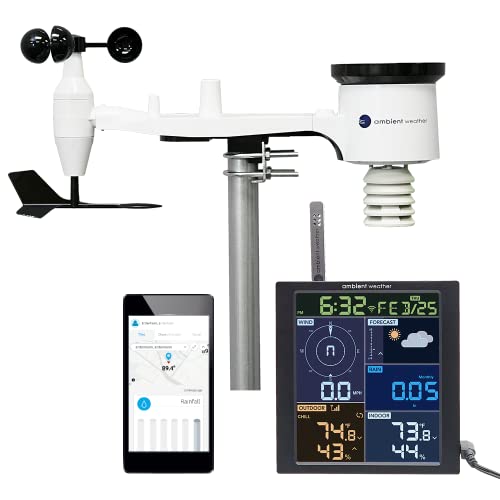
The WS-1965 trims the sensor package to essential home-weather variables while retaining Wi-Fi. Its all-in-one outdoor array measures temperature, humidity, barometric pressure, wind speed, wind direction, and rainfall. The console refreshes readings every 16 seconds according to the product information, which makes changing wind conditions easier to follow than a slow-refresh display.
It also connects to the Ambient Weather ecosystem, with listed support for remote access, alerts, IFTTT, Google Home, Alexa, and optional network sharing. Compared with the WS-2902, this model omits the listed UV and solar radiation measurements. That makes the choice fairly clear: pick the WS-1965 for connected core weather data, or move to the WS-2902 if sunlight-related measurements and a broader sensor package matter.
Pros
- Measures wind, rainfall, temperature, humidity, and barometric pressure.
- Lists 16-second real-time console updates.
- Supports Wi-Fi-based remote access and alerts.
- Lists IFTTT, Google Home, and Alexa compatibility.
- Connects with the Ambient Weather Network.
Cons
- It does not list UV or solar radiation measurement.
- The integrated array gives less flexibility than separate sensors placed around a property.
The WS-1965 works well for a connected home that wants the standard weather-station package without paying for every available environmental measurement. It is especially appealing if rapid console refreshes matter for watching wind shifts. Buyers tracking sun exposure or solar conditions should choose a model that explicitly includes UV and solar radiation sensors.
To buy this product, click here.
7. Sainlogic Smart Weather Station – Best for App Alerts and Data Export

Sainlogic gives data-focused buyers a different reason to choose it. The listing describes an Inercom app with weather maps, mobile alerts, current conditions, and environmental records. It also lists two-year local data storage and Excel export, which can be useful for comparing rainfall totals, temperature patterns, or seasonal wind conditions without relying solely on a live screen.
The station includes wind speed and direction, rainfall, temperature, humidity, pressure, UV, and an extra sensor. Its stated Wi-Fi support includes 5 GHz and 2.4 GHz networks, and Bluetooth pairing is listed for initial setup. The advertised open-area transmission distance reaches up to 443 feet, but building materials and terrain can reduce that figure. The listing also gives rainfall accuracy claims and a bubble level, making careful installation part of the measurement equation.
Pros
- Supports 5 GHz and 2.4 GHz Wi-Fi networks.
- Lists app alerts, weather maps, and remote access features.
- Stores up to two years of data and supports Excel export.
- Includes wind, rainfall, temperature, humidity, pressure, and UV measurements.
- Lists an extra sensor and a published open-area range of up to 443 feet.
Cons
- The full app and data features require more setup than a local console station.
- The listed transmission distance is a favorable open-area maximum, not a guarantee through walls or outbuildings.
This model is a strong fit for a greenhouse, garden, or larger property where historical records matter as much as today’s wind reading. Excel export gives the data a practical life beyond the app. Skip it if you want a simple, screen-first station and have no interest in alerts, archives, or spreadsheet analysis.
To buy this product, click here.
8. Sainlogic 12-in-1 Station – Best for a Large Local Information Panel

The Sainlogic 12-in-1 station puts a wide range of local information on a 6.5-inch color display. It shows wind speed and direction, rainfall, indoor and outdoor temperature, humidity, pressure, dew point, feels-like temperature, moon phase, and calendar information. The screen’s adjustable backlight and large fonts make it a practical choice for a frequently checked household console.
Its rainfall information is unusually detailed in the listing, with hourly, daily, weekly, monthly, and total records. The product information also provides temperature, humidity, pressure, and rainfall specifications. This is a wireless station rather than a Wi-Fi model, so readings move between the outdoor sensor and display, but the station is not presented as a remote-monitoring system.
Pros
- Uses a 6.5-inch HD color display with adjustable backlight.
- Tracks wind, rainfall, temperature, humidity, and pressure.
- Records hourly, daily, weekly, monthly, and total rainfall.
- Lists a wireless sensor system for homes, gardens, orchards, and farms.
- Displays calculated values such as dew point and feels-like temperature.
Cons
- The product is listed as having no Wi-Fi.
- Remote app access and online data export are not identified.
This station makes sense beside a desk, kitchen, or entryway where the screen can provide a quick weather snapshot. Its rain-history display adds useful context for garden care, while the lack of Wi-Fi keeps the system simpler. Buyers wanting phone alerts or away-from-home access should choose one of the connected alternatives.
To buy this product, click here.
9. Ambient Weather WS-2000 – Best for an Advanced Console
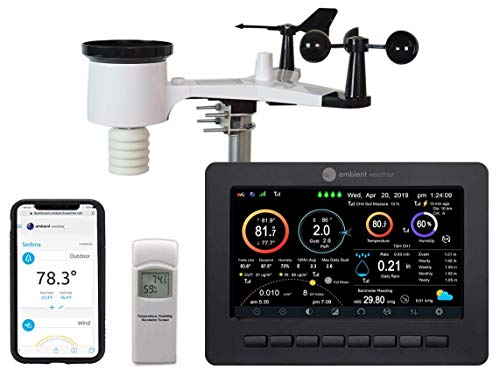
The WS-2000 is built around a TFT color display and a broad integrated sensor array. It measures wind speed and direction, temperature, humidity, rainfall, UV, and solar radiation, covering the same major outdoor categories that make the WS-2902 attractive. Imperial and metric units are supported, and the listing identifies calibration capability for the measurements.
Wi-Fi connectivity is described as an option that can send station data to a personal weather network. The console uses an included 5-volt adapter, while the sensor array requires three AAA batteries that are not included. That power detail is easy to overlook during installation. The station suits readers who value a richer console and calibration options, while the WS-2902 may be the more balanced choice for buyers placing greater emphasis on smart-home features as described in its listing.
Pros
- Measures wind, rainfall, temperature, humidity, UV, and solar radiation.
- Uses a TFT color display for local monitoring.
- Supports imperial and metric units.
- Lists calibration capability.
- Offers optional Wi-Fi connectivity to a personal weather network.
Cons
- The outdoor sensor requires three AAA batteries, which are not included.
- The supplied information does not identify smart-home compatibility for this model.
Select the WS-2000 if the console experience and calibration controls matter more than keeping the system simple. It gives a serious weather hobbyist a broad set of local measurements and optional network connectivity. A buyer seeking the clearest smart-home support should compare it closely with the WS-2902 before choosing.
To buy this product, click here.
Buying Guide
Wind Speed and Direction Need Proper Exposure
An anemometer measures wind speed, while a wind vane identifies direction. Both readings can be distorted by nearby roofs, walls, trees, and other obstructions. An integrated array is convenient because the wind instruments, rain gauge, and other sensors share one outdoor assembly, but that also means one mounting location affects several measurements. Follow the product’s mounting guidance and choose an exposed position that is practical and safe.
Wireless Does Not Always Mean Wi-Fi
Wireless sensor transmission usually means the outdoor array sends readings to an indoor console. Wi-Fi connects a station or console to a network and may support remote access, alerts, or weather-platform uploads. The AIRAIN TECH and Sainlogic 12-in-1 stations are wireless but are listed without Wi-Fi, while the WS-2902, WS-1965, WS-2000, and several other models add network features.
Choose Measurements That Match the Property
Wind and rain are central for many gardens, farms, and homes, but UV and solar radiation may matter for sun exposure or solar projects. Pressure can support trend displays and calculated forecasts. Dew point, wind chill, heat index, and feels-like temperature are derived values that can be convenient, yet they do not replace the underlying temperature, humidity, pressure, or wind measurements.
Remote Monitoring Requires Internet Features
A local console cannot tell you what is happening at a cabin while you are away. For that use, look for explicit Wi-Fi, app, cloud, or weather-network support. The AcuRite 01540M lists Weather Underground access, while the Sainlogic smart model lists app alerts and data export. Do not assume that a station with a wireless outdoor sensor can be checked from another location.
Advertised Range Is a Maximum, Not a Promise
Several listings provide wireless-distance figures, including AIRAIN TECH and Sainlogic. These figures generally describe favorable or open-area conditions. Walls, floors, metal siding, trees, terrain, and interference can reduce communication distance. Think about the actual path between the outdoor sensor and console before treating a published range as proof that any placement will work.
Accuracy, Resolution, and Update Speed Are Different
A display that shows small increments has high resolution, but that does not automatically mean the sensor is equally accurate. A fast refresh rate helps you follow changing wind conditions, but update speed is separate from measurement accuracy. Published accuracy claims should be matched to the exact model and measurement, and installation can affect readings regardless of the number on the product page.
Check What Is Included and What Is Optional
An extra sensor may be included, supported, or sold separately. The Sainlogic smart station lists an extra sensor, while the Urageuxy station describes additional thermo-hygro sensors that are not included. Likewise, a station may support a weather network without including every accessory needed for a particular mounting location. Review the package contents and power requirements before ordering.
Best Weather Stations With Anemometer FAQ
What Does an Anemometer Measure on a Weather Station?
An anemometer measures wind speed. Many personal weather stations pair it with a wind vane that reports wind direction. The wind sensor may be part of an integrated outdoor array that also includes temperature, humidity, rainfall, or pressure sensors.
Are Wireless Weather Stations the Same as Wi-Fi Weather Stations?
No. Wireless usually describes the link between the outdoor sensor and the indoor console. Wi-Fi connects the station or console to a home network and may enable remote access, weather-platform uploads, or alerts. A product can have one capability without the other.
Which Station Is Best for Remote Monitoring?
The Ambient Weather WS-2902, AcuRite Iris 01540M, Ambient Weather WS-1965, Urageuxy station, Sainlogic smart station, and Ambient Weather WS-2000 list network-related features. The Sainlogic model is particularly suited to readers who want app alerts, two-year storage, and Excel export. Confirm the exact service and setup requirements before ordering.
Do These Weather Stations Measure Rainfall?
Most of the reviewed stations include a rain gauge, including the WS-2902, AcuRite Iris models, AIRAIN TECH, WS-1965, Sainlogic smart station, Sainlogic 12-in-1, and WS-2000. The Urageuxy product information focuses on wind, temperature, and humidity and does not clearly list a rain gauge. A level, open installation helps a rain gauge produce more useful readings.
Can a Weather Station Forecast the Weather?
Some models generate forecast information from station readings such as barometric pressure and trends. That is different from directly measuring future weather or receiving a complete professional forecast. Treat forecast icons as an additional convenience rather than a guarantee.
Do More Sensors Automatically Make a Station Better?
No. UV and solar radiation may be useful for one property, while another household may care mainly about wind, rain, temperature, and humidity. A larger sensor list can also mean more setup and more information to interpret. Choose measurements that support the decisions you actually make outdoors.
What Should I Check Before Mounting the Outdoor Sensor?
Check the included bracket or pole, the required power source, the wireless path to the console, and the exposure around the installation point. Keep wind instruments away from major obstructions where practical, and place the rain gauge where roofs, trees, and nearby structures do not interfere with precipitation collection. Follow the product instructions and use safe mounting practices.
Final Verdict
The Ambient Weather WS-2902 is the strongest overall choice in this group because it combines an anemometer and rain gauge with temperature, humidity, UV, solar radiation, Wi-Fi, remote access, and listed smart-home support. It gives a home weather watcher more room to grow than a local-only display, while still providing a dedicated color console for quick checks indoors.
The AcuRite Iris 01540M is the better route for Weather Underground users, and the Sainlogic smart station stands out for app alerts, two-year storage, and Excel export. For a large screen without Wi-Fi, AIRAIN TECH or the Sainlogic 12-in-1 offers a simpler local experience. Match the station to the data you need, the location you can mount it safely, and whether you expect to check readings from the next room or from miles away.