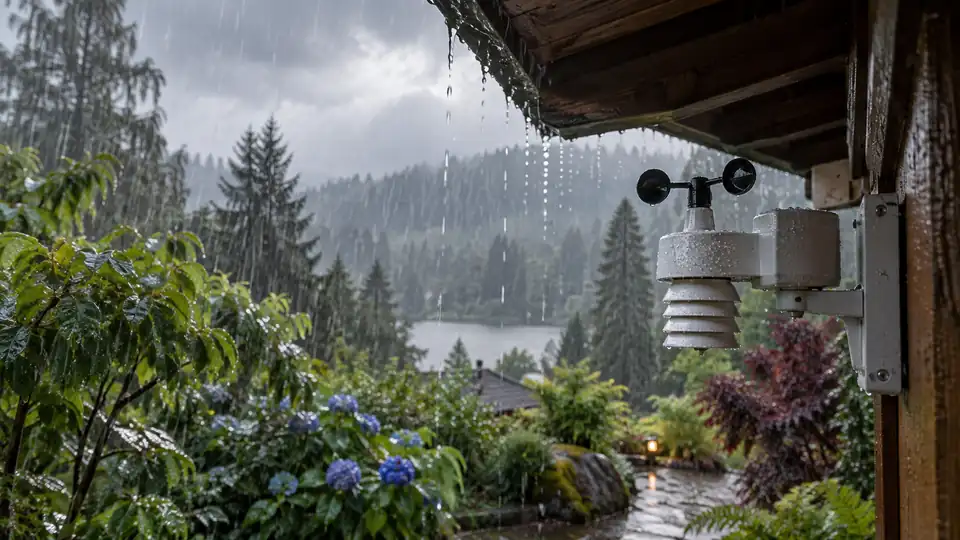
Rain can turn a simple forecast into a property-management problem. A sudden downpour may fill a garden bed, push water toward a basement window, or leave you wondering whether the rain gauge at the airport tells you anything useful about your own yard. The best weather stations for rainy climates bring local temperature, humidity, pressure, wind, and rainfall information together, but the products in this category vary sharply in what they actually measure.
For wet conditions, rainfall tracking matters, yet it is only one part of the decision. An integrated sensor array can simplify installation, while a console with Wi-Fi or app access lets you check conditions away from home. Wireless sensor transmission is a separate feature, however. A station can send readings from an outdoor sensor to an indoor display without offering Internet access. Placement matters too. A rain gauge needs open exposure and level installation, while a temperature sensor can be influenced by sun, walls, roofs, and nearby pavement.
This comparison gives priority to stations with genuine rainfall monitoring, useful outdoor measurements, practical data access, or sensible indoor and outdoor monitoring for damp properties. The Ambient Weather WS-2902 leads the group for connected local weather data, while the Tempest offers a more advanced maintenance-light design. Simpler console-based models remain useful for readers who mainly want a quick view of rain-related temperature and humidity conditions.
Quick Answer
- Best Overall: Ambient Weather WS-2902 combines rainfall, wind, temperature, humidity, UV, solar radiation, Wi-Fi, remote access, and smart-home support.
- Best Premium Option: Tempest Weather Station adds lightning detection, app access, solar-assisted outdoor power, frequent updates, and a sensor with no moving parts.
- Best for Weather Underground: AcuRite Iris 5-in-1 records rainfall and wind while supporting Wi-Fi connection to Weather Underground.
- Best for Rainfall Records Without Wi-Fi: Sainlogic 12-in-1 provides rainfall totals across several time periods, plus wind, pressure, temperature, humidity, and a long listed wireless range.
Best Weather Stations for Rainy Climates Comparison Table
| Product | Rain and Outdoor Measurements | Connectivity | Sensor and Display Details | Best For |
|---|---|---|---|---|
| Ambient Weather WS-2902 | Rainfall, wind, temperature, humidity, UV, solar radiation | Wi-Fi, Ambient Weather Network, Alexa, Google Home, IFTTT | Osprey array and color LCD | Connected home monitoring |
| Tempest Weather Station | Rainfall, wind, temperature, humidity, pressure, UV, solar radiation, lightning | App, Alexa, Rachio, IFTTT, smart-home platforms | Solar-powered outdoor sensor, no moving parts | Advanced remote monitoring |
| AcuRite Iris 5-in-1 | Rainfall, wind speed and direction, temperature, humidity, pressure | Wi-Fi connection to Weather Underground | Integrated sensor array and color LCD | Weather Underground users |
| Sainlogic 12-in-1 | Rainfall, wind, temperature, humidity, pressure, dew point | Wireless sensor-to-console, no Wi-Fi | 6.5-inch color display, included mounting hardware | Local rainfall records |
| AcuRite Iris 01512MCB | Rainfall, wind, temperature, humidity, pressure | Wireless sensor-to-console | Color screen and included mounting bracket | Detailed local observations |
| DreamSky Weather Station | Outdoor temperature and humidity, pressure-based forecast | Wireless sensor-to-console | Large color display, up to three outdoor sensors | Simple indoor and outdoor monitoring |
| Newentor Weather Station | Outdoor temperature and humidity, pressure-based forecast | Wireless sensor-to-console | Color LCD, up to three sensor channels | Bedrooms and multi-room monitoring |
| La Crosse Technology Advanced Weather Station | Outdoor temperature and humidity, forecast icons | Wireless sensor-to-console | Color LCD, weather-resistant sensor | Clear console readings |
| Weather Station with Large Color Display | Outdoor temperature and humidity, pressure-based forecast | Wireless sensor-to-console | 7.5-inch display, up to three sensors | Large at-a-glance display |
The detailed reviews below separate true rainfall-capable systems from simpler stations that monitor the temperature and humidity conditions surrounding a wet home.
1. Ambient Weather WS-2902 Best Overall
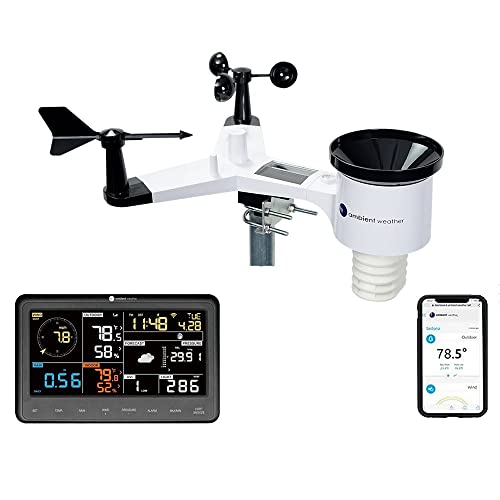
The WS-2902 is the strongest all-around match for a rainy property because its Osprey sensor array includes a rain cup alongside temperature, humidity, wind speed, wind direction, UV intensity, and solar radiation sensors. That combination gives a more complete picture than a console that only reports whether the day feels damp. When a storm rolls across the yard, the display can show local changes in wind and rainfall rather than relying on a distant forecast.
Its main advantage is data access. The station uses Wi-Fi, and the product information identifies remote access, alerts, Ambient Weather Network connectivity, and support for IFTTT, Google Home, and Alexa. That makes it a stronger fit for someone checking conditions from work, watching rain before opening a greenhouse vent, or connecting weather information to a smart-home routine. The color LCD still provides a local view, so Internet access is not the only way to see readings.
Pros
- Measures rainfall, wind speed, wind direction, temperature, humidity, UV, and solar radiation.
- Includes an Osprey outdoor sensor array and color LCD display.
- Supports Wi-Fi-based remote access and alerts.
- Lists Ambient Weather Network, IFTTT, Google Home, and Alexa support.
- Provides more useful storm information than temperature-and-humidity-only consoles.
Cons
- Wi-Fi setup creates more configuration work than a local-only station.
- The integrated array requires careful outdoor placement for useful rainfall and wind readings.
This is the right starting point for a home, garden, or small property where rain totals and remote access matter equally. It is less appealing if you only want a clock-style display beside the kitchen door. The sensor array also means that one outdoor location serves several measurements, so placement must balance open exposure for wind and rain with sensible protection for temperature and humidity.
To buy this product, click here.
2. Tempest Weather Station Best Premium Option
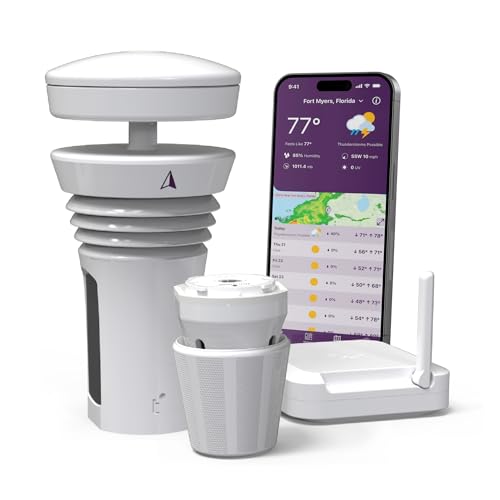
Tempest takes a different approach from a traditional cup-and-vane weather array. Its outdoor sensor monitors rainfall, temperature, humidity, pressure, wind speed and direction, dew point, solar radiation, UV index, and lightning strikes. The product information also describes a solar-powered sensor, wireless transmission beyond 1,000 feet, and updates every three seconds. Those details make it especially interesting for a larger property where rapidly changing storm conditions deserve attention.
The no-moving-parts design is a meaningful distinction in wet weather. There is no traditional rotating anemometer or tipping rain mechanism described in the supplied information, so buyers should read the current product details carefully if they specifically want a conventional gauge design. App access and integrations with Alexa, Rachio, IFTTT, and other smart-home platforms give it a strong role in irrigation and automation projects, while the solar-assisted outdoor unit can reduce routine attention to the sensor.
Pros
- Tracks rainfall, wind, temperature, humidity, pressure, UV, solar radiation, and lightning.
- Lists app access and integrations with Alexa, Rachio, and IFTTT.
- Outdoor sensor uses solar power according to the product information.
- Listed wireless transmission distance exceeds 1,000 feet.
- No-moving-parts sensor design may reduce mechanical components outdoors.
Cons
- Premium positioning makes it a larger commitment than console-only stations.
- The supplied information does not describe a traditional tipping-bucket rain-gauge mechanism.
Tempest suits a connected property where app access, frequent updates, lightning information, and automation matter more than a simple bedside display. A gardener watching irrigation during a storm or a property owner checking conditions from several rooms can make better use of its connected design. Someone who only wants a local screen and a basic rain total may find its broader feature set unnecessary.
To buy this product, click here.
3. AcuRite Iris 5-in-1 Best for Weather Underground
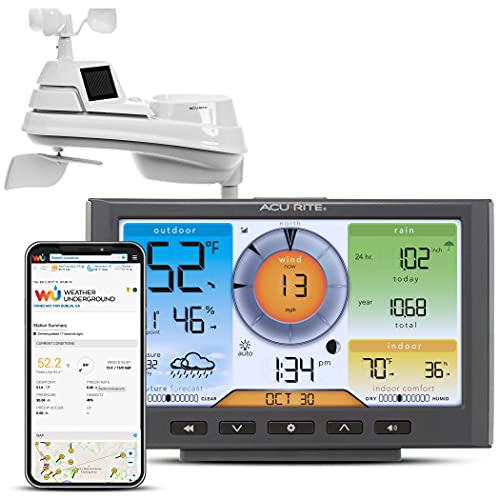
The AcuRite Iris 5-in-1 is built around the measurements that matter during wet weather: rainfall, wind speed, wind direction, temperature, humidity, and barometric pressure. Its integrated outdoor instruments send readings to a color LCD, while the product information also identifies Wi-Fi connection to Weather Underground. That makes the station more useful for someone who wants local observations available through a broader weather network.
Rainfall is only useful if the station also helps explain the conditions around it. Wind direction can show how a storm is moving across the property, while pressure and humidity add context to a changing afternoon. The station also provides historical information, threshold alarms, heat index, dew point, wind chill, and enhanced rainfall history. These latter values include calculated information, so they should be read as supplemental interpretation rather than extra physical sensors.
Pros
- Includes a rain gauge, anemometer, wind vane, barometer, hygrometer, and thermometer.
- Supports Wi-Fi connection to Weather Underground.
- Provides historical information and enhanced rainfall history.
- Displays calculated values such as dew point, heat index, and wind chill.
- Offers threshold alarms through the listed weather information.
Cons
- The product information does not identify support for Alexa, Google Home, or Home Assistant.
- Its integrated array requires one carefully selected outdoor installation location.
This model makes sense for readers who specifically want Weather Underground participation with a complete outdoor array. It gives up some of the broader smart-home claims associated with the Ambient and Tempest systems, but it keeps the core rainy-weather measurements intact. If you prefer a local-only station, the Wi-Fi capability may matter less, while the rain and wind sensors remain useful.
To buy this product, click here.
4. Sainlogic 12-in-1 Best for Local Rainfall Records
The Sainlogic 12-in-1 focuses on a detailed local console rather than Wi-Fi or cloud access. Its listed measurements include indoor and outdoor temperature and humidity, pressure, wind speed and direction, rainfall, dew point, feels-like temperature, and moon phase. Rainfall records can be viewed by hour, day, week, month, and cumulative total, giving a wet-weather observer more context than a single current total.
The product information lists rainfall measurement from 0 to 9,999 millimeters and a plus-or-minus 7 percent rainfall accuracy claim, along with temperature and humidity accuracy claims. Those are listing specifications, not independent verification, but they provide useful comparison points. The 6.5-inch color display, included mounting hardware, and listed 443-foot open-area transmission distance make this a practical local station for a yard, garden, or larger property where Wi-Fi is unnecessary.
Pros
- Records hourly, daily, weekly, monthly, and cumulative rainfall totals.
- Measures wind speed, wind direction, temperature, humidity, and pressure.
- Includes a 6.5-inch color display with adjustable backlight.
- Product information lists included mounting hardware.
- Provides a listed wireless transmission distance of up to 443 feet in open conditions.
Cons
- It does not include Wi-Fi or remote Internet access.
- The advertised range is a best-case open-area figure and may be reduced by walls or other obstructions.
Choose this station if rainfall history matters but your routine centers on an indoor console. It is a better fit for someone checking totals at breakfast than for a person managing a remote cabin from another city. A rain gauge still needs level, open placement, and regular attention to debris, regardless of how much information the console can display.
To buy this product, click here.
5. AcuRite Iris 01512MCB Best for Detailed Local Observations
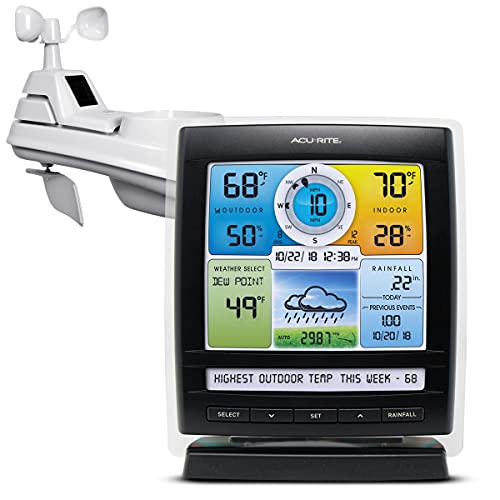
This AcuRite Iris model offers a complete outdoor array with rainfall, wind speed, wind direction, temperature, humidity, and barometric pressure. Its color display presents local readings, while the listing describes more than 55 data points that include historical data, pressure trends, heat index, dew point, and feels-like temperature. The large information set can be useful during a rainy week when current conditions alone do not tell the full story.
The included mounting bracket is a practical detail. It does not guarantee that every roof, post, or pole location will work, but it gives the buyer a clearer starting point for installation than a station with no described mounting hardware. The forecast combines elevation information with barometric pressure for a 12-hour personal forecast. That forecast is generated from station information, so it should not be treated as a substitute for measured rainfall or a regional weather service.
Pros
- Measures rainfall, wind speed, wind direction, temperature, humidity, and pressure.
- Lists more than 55 data points and historical information.
- Includes a wireless outdoor sensor and color display.
- Product information identifies an included mounting bracket.
- Displays pressure trends and calculated weather values.
Cons
- The supplied information does not identify Wi-Fi or app-based remote monitoring.
- The number of listed data points includes calculated and historical values, not 55 separate physical sensors.
This is a solid choice for a reader who wants a broad local record of wet-weather conditions without prioritizing Internet access. It sits below the connected stations because the data stays centered on the console according to the information provided. Select it over a simpler thermometer if rainfall and wind history matter, and skip it if the main requirement is checking data while away from the property.
To buy this product, click here.
6. DreamSky Weather Station Best Simple Multi-Room Monitor

DreamSky is a simpler choice for a home where the main question is how wet and cool the outdoor air feels, rather than how much rain has fallen. Its included outdoor sensor reports temperature and humidity, while the console adds pressure-based 12-to-24-hour forecast information, high and low alerts, time, date, and calendar details. The station supports up to three outdoor sensors, though only one sensor is included.
The large colorful display is useful across a room, especially in a kitchen, hallway, or mudroom where a small screen can disappear under the noise of daily life. It uses an adapter for a continuously illuminated display and offers battery backup, although the supplied information says the battery-only backlight dims after a short period and the backup batteries are not included. Five brightness levels help reduce glare during a dark, rainy morning.
Pros
- Displays indoor and outdoor temperature and humidity in large figures.
- Supports up to three outdoor sensors, with one sensor included.
- Provides high and low temperature alerts.
- Offers five backlight brightness levels and USB power.
- Includes atomic time and automatic daylight-saving adjustment.
Cons
- It does not measure rainfall, wind, or wind direction.
- Additional sensors are supported but are not included in the package described.
DreamSky belongs lower in a rainy-climate ranking because it monitors the atmosphere around the rain rather than the rain itself. That distinction matters for a gardener tracking precipitation totals. It is still a useful choice for a household that wants a readable indoor and outdoor humidity display, a weather trend, and alerts without installing a full outdoor array.
To buy this product, click here.
7. Newentor Weather Station Best for Bedrooms and Multiple Locations

Newentor keeps the focus on temperature and humidity while adding a useful set of household readings. The color LCD shows indoor and outdoor conditions, daily highs and lows, alerts, barometric pressure, forecast information, moon phase, time, and date. For a damp basement, bedroom, nursery, or living room, that combination can reveal whether indoor humidity is climbing after several rainy days.
Its three-channel design supports up to three remote sensors, with one included. That creates a path toward monitoring more than one location, but the extra sensors are not part of the described package. The console can remain continuously lit when connected to its DC adapter. On battery power, the display enters an energy-saving mode and lights briefly for a glance, which is convenient for temporary placement but less suitable if you want an always-on screen far from an outlet.
Pros
- Displays indoor and outdoor temperature and humidity.
- Supports up to three remote sensor channels.
- Includes daily high and low records and customizable alerts.
- Provides barometric pressure, forecast information, and moon phase.
- Offers atomic time, dual alarms, and snooze functionality.
Cons
- It does not include a rain gauge or wind sensors.
- Only one remote sensor is included, and batteries are not included.
This model suits a damp home where indoor comfort and room-to-room comparison matter more than measuring a storm. It can sit beside a bed and still function as an alarm clock, while the outdoor sensor gives the console a local reference. Choose a rainfall-capable array instead if you need to decide whether the garden received enough water or whether a downpour crossed a specific threshold.
To buy this product, click here.
8. La Crosse Technology Advanced Weather Station Best for Clear Local Readings

La Crosse Technology offers a straightforward indoor and outdoor monitoring setup with temperature, humidity, minimum and maximum records, alerts, forecast icons, and a color LCD. The included weather-resistant outdoor sensor has a listed transmission range of 330 feet with no obstructions. That figure can help with planning console placement, though walls, floors, metal, and other building materials can shorten the actual path.
The station is especially easy to understand at a glance. Color forecast icons and tendency indicators provide a quick visual cue beside the numerical readings, while adjustable backlight settings help adapt the screen to a bright kitchen or dim hallway. Its 5V adapter supports the full display, and three AAA batteries provide optional backup according to the product information. The limitation is significant for this category: rainfall and wind measurement are not listed.
Pros
- Includes indoor and outdoor temperature and humidity readings.
- Provides minimum and maximum records with customizable alerts.
- Includes a weather-resistant outdoor sensor.
- Lists a 330-foot unobstructed transmission range.
- Offers color forecast icons, backlight settings, and atomic time.
Cons
- Rainfall, wind speed, and wind direction are not identified in the supplied information.
- Full display operation uses the power adapter, while battery-only backlight is temporary.
La Crosse is a sensible fit for someone who wants to understand temperature and humidity changes around a rainy home without installing a rain gauge. It is less suitable for garden irrigation records or storm analysis. The weather-resistant sensor supports outdoor placement, but that description should not be expanded into an unsupported waterproof or extreme-weather rating.
To buy this product, click here.
9. Weather Station with Large Color Display Best for At-a-Glance Monitoring

The appeal here is visual simplicity. Its 7.5-inch display separates indoor and outdoor temperature, humidity, forecast, pressure, time, and date into clearly labeled areas. In a busy household, that large layout can be easier to read than a compact console full of tiny figures. The station supports up to three sensors, with extra sensors available separately according to the product information.
The forecast uses barometric pressure trends and requires a seven-to-10-day calibration period before the product information describes the local forecast as established. That is a useful reminder that forecast icons from a personal station are interpretations of local pressure changes, not direct rainfall measurements. The display stays lit with the adapter, while battery operation activates the screen briefly after a button press. A listed transmission distance of up to 328 feet in open areas gives placement guidance, not a guarantee through a house.
Pros
- Uses a large 7.5-inch color display.
- Shows indoor and outdoor temperature, humidity, pressure, and forecast information.
- Supports up to three sensors for multiple locations.
- Includes atomic clock and daylight-saving functions.
- Offers adjustable brightness and adapter or battery operation.
Cons
- Rainfall, wind speed, and wind direction are not listed.
- Additional sensors are optional rather than included in the described package.
This is a reasonable final choice for a home where a readable screen matters more than rainfall totals. It can help compare a basement, nursery, bedroom, and outdoor location if compatible extra sensors are added, but it cannot tell you how much rain reached the yard. A complete array such as the Ambient or AcuRite models is the better match for storm records and garden decisions.
To buy this product, click here.
Buying Guide
Rainfall Measurement Matters More Than a Forecast Icon
A weather forecast displayed on a console is not the same as locally measured rainfall. If your concern is whether a garden received enough water, whether a drainage channel overflowed, or how much rain fell during one storm, choose a station that explicitly includes a rain gauge and rainfall history. The Ambient, Tempest, AcuRite Iris, and Sainlogic models provide the clearest match for that need. Temperature and humidity stations can describe the damp air around a storm, but they cannot supply a rain total.
Wireless Sensor Links Are Different From Wi-Fi
Most of these products use a wireless connection between an outdoor sensor and an indoor console. That allows readings to travel across a yard without a cable. Wi-Fi adds another layer by connecting the console or station to a home network and, where supported, remote services. Ambient, Tempest, and the AcuRite 5-in-1 have clearly described connected functions. Sainlogic, AcuRite 01512MCB, DreamSky, Newentor, La Crosse, and the large-display model are primarily local console choices based on the supplied information.
Sensor Placement Shapes Rain and Wind Readings
An integrated sensor array is convenient because one outdoor assembly handles several measurements. It also means that one location must serve the rain gauge, wind instruments, temperature sensor, and humidity sensor. Roof edges, walls, trees, pavement, and nearby heat sources can affect readings. Rain gauges need unobstructed exposure and level placement, while wind instruments need moving air. Follow the product instructions and select a location that suits the measurements you actually care about.
Advertised Range Is a Best-Case Number
Transmission distances in the listings are generally described for open or unobstructed conditions. Sainlogic lists up to 443 feet, the large-display model lists up to 328 feet in open areas, and La Crosse lists 330 feet with no obstructions. A thick wall, metal siding, another floor, or a detached structure can change the result. Treat these figures as planning information rather than a promise that the signal will cross every building.
Separate Accuracy, Resolution, and Update Speed
A display that shows decimal places has higher resolution, but that does not automatically mean its sensor is more accurate. A fast update interval can make changing wind easier to follow, but speed and accuracy describe different characteristics. The Sainlogic listing provides specific rainfall, temperature, and humidity claims, while other products provide fewer numerical accuracy details. Those claims come from product information and should not be treated as independent testing.
Check What Is Included Before Planning Multiple Locations
DreamSky, Newentor, and the large-display station support up to three sensor channels, but the described packages include one outdoor sensor. Extra sensor support can be useful for a basement, greenhouse, nursery, or bedroom, but compatibility and availability should be confirmed before ordering. A station supporting several sensors is not the same as a package containing several sensors.
Choose Power Based on Where the Console Will Live
Several console-based stations use an adapter for a continuously illuminated screen and conserve energy when running on batteries. That matters if the display will sit on a desk beside an outlet, but it can be inconvenient in a location where wires are unwelcome. Backup batteries may preserve operation or settings during an outage, and the product information does not always include those batteries. Check the power arrangement before choosing a wall location.
Best Weather Stations for Rainy Climates FAQ
What Is the Best Weather Station for Rainy Climates?
The Ambient Weather WS-2902 is the strongest overall choice in this comparison because it combines rainfall, wind, temperature, humidity, UV, solar radiation, Wi-Fi, remote access, and smart-home support. It offers a broader rainy-weather picture than models that only monitor outdoor temperature and humidity.
Do All Wireless Weather Stations Have Wi-Fi?
No. Wireless usually describes the connection between the outdoor sensor and indoor console. Wi-Fi describes a connection to a home network. Sainlogic, DreamSky, Newentor, La Crosse, and the large-display station are wireless products based on the supplied information, but Wi-Fi is not identified for those models.
Which Stations Measure Rainfall?
The Ambient WS-2902, Tempest, AcuRite Iris 5-in-1, Sainlogic 12-in-1, and AcuRite Iris 01512MCB list rainfall measurement. The DreamSky, Newentor, La Crosse, and large-display stations list temperature and humidity monitoring but do not identify a rain gauge.
Can I Check These Weather Stations Away From Home?
The Ambient WS-2902 lists remote access through its connected system. Tempest lists app access and smart-home integrations. The AcuRite Iris 5-in-1 lists Wi-Fi connection to Weather Underground. The other models are presented primarily as local console systems, so the supplied information does not establish remote Internet monitoring for them.
Is a Larger Display Better for Rainy Weather?
A larger display can make temperature, humidity, pressure, and forecast information easier to read across a room. It does not improve the rain gauge or sensor accuracy. The large-display model is useful for at-a-glance household monitoring, while a smaller console can still be the better choice if you mainly use an app or need detailed rainfall history.
Do I Need Wind Measurements With a Rain Gauge?
Not every buyer needs wind data, but wind speed and direction add useful context during storms. They can help show how exposed a property is and how a weather system is moving across the area. If your main concern is irrigation, rainfall totals may be enough. For storm observation or larger properties, a complete array with wind measurement is more informative.
Are Pressure-Based Forecasts the Same as a Weather Forecast Service?
No. Personal stations may use pressure trends and other local readings to produce forecast icons or short-term predictions. Those are useful context, but they are not the same as a regional forecast service. A pressure-based icon also does not replace a rain gauge if you need to know how much precipitation actually fell.
How Should I Install a Weather Station in a Wet Area?
Use the product instructions and select an outdoor location with suitable exposure for the sensors. Keep rain measurement unobstructed and level, and avoid placing temperature or humidity sensors beside heat sources, roofs, walls, or pavement when those surfaces could influence readings. A transmission-range number should also be treated as an open-area maximum rather than a guaranteed indoor-to-outdoor result.
Final Verdict
The Ambient Weather WS-2902 is the strongest overall choice for rainy-climate monitoring because it connects local rainfall and wind information with Wi-Fi-based access, alerts, and smart-home support. It gives a household more than a wet-weather snapshot. The Osprey array also measures temperature, humidity, UV, and solar radiation, so the system can support garden planning, storm observation, and broader property monitoring. Its main trade-off is a more involved setup than a simple indoor and outdoor thermometer.
Tempest is the premium alternative for readers who value app access, lightning information, frequent updates, solar-assisted outdoor operation, and a no-moving-parts sensor. The AcuRite Iris 5-in-1 is a practical connected choice for Weather Underground users, while Sainlogic is the better local-console option for rainfall records across hourly, daily, weekly, and monthly periods. Match the station to the data you will actually use. If rain totals are central, choose a model with a genuine rain gauge. If you only need indoor and outdoor humidity during a long wet spell, a simpler console can save money and installation effort.