
On a boat, a weather station has a more practical job than displaying a sunny icon beside the kitchen clock. Wind direction, wind speed, barometric pressure, rainfall, temperature, and humidity can all shape how you plan a departure, read changing conditions, or decide whether to stay close to shore. The best weather stations for boating therefore need to match the way you actually monitor conditions, whether that means checking a console at home, watching a display aboard the boat, or reviewing readings remotely through an app.
The biggest divide in this category is connectivity. A wireless outdoor sensor can send readings to its console without Wi-Fi, while a Wi-Fi station can send selected data beyond the local display through an app or weather platform. Those are different functions. Sensor placement matters too. A wind sensor needs open exposure, a rain gauge needs a reasonably unobstructed and level position, and a barometer becomes more useful when you can watch pressure trends rather than relying on a forecast icon alone.
This comparison weighs wind information, pressure monitoring, rainfall, local displays, remote access, installation demands, and the limits of each system. The Ambient Weather WS-2902 is the strongest overall choice for a connected home or dockside setup, while the AcuRite Iris with Weather Underground is a useful alternative for readers who want a recognized route to remote data.
Quick Answer
- Best Overall: Ambient Weather WS-2902 combines wind, rainfall, pressure-related weather information, UV, solar radiation, Wi-Fi, remote access, and smart-home support.
- Best for Weather Network Uploads: AcuRite Iris 5-in-1 connects with Weather Underground for remote monitoring and includes a wind sensor, rain gauge, barometer, thermometer, and hygrometer.
- Best for App Alerts and Data Logging: Sainlogic WiFi Smart Weather Station adds dual-band Wi-Fi, app alerts, Wunderground synchronization, and local data storage with Excel export.
- Best Simple Local Display: Wireless Indoor Outdoor Weather Station provides a large display, wind readings, rainfall records, pressure, temperature, and humidity without Wi-Fi.
Best Weather Stations for Boating Comparison Table
| Product | Measurements | Connectivity | Display or Data Feature | Best For |
|---|---|---|---|---|
| Ambient Weather WS-2902 | Wind, rain, temperature, humidity, UV, solar radiation | Wireless sensor link, Wi-Fi | Color LCD, remote access, smart-home support | Connected home or dockside monitoring |
| Ambient Weather WS-2000 | Wind, rain, temperature, humidity, UV, solar radiation | Wireless sensor link, Wi-Fi option | TFT color display, metric and imperial units | Detailed local monitoring |
| Wireless Indoor Outdoor Weather Station | Wind, rain, temperature, humidity, pressure | Wireless, no Wi-Fi | 7.5-inch display, rainfall history | Large local display |
| Sainlogic 12-in-1 | Wind, rain, temperature, humidity, pressure | Wireless, no Wi-Fi | 6.5-inch display, 443-foot listed range | Broad local readings |
| AcuRite Iris 01512MCB | Wind, rain, temperature, humidity, pressure | Wireless | Color LCD, historical data, forecast display | Self-contained monitoring |
| AcuRite Iris 5-in-1 | Wind, rain, temperature, humidity, pressure | Wireless, Wi-Fi, Weather Underground | Color display, remote monitoring, alerts | Weather network access |
| Sainlogic WiFi Smart Weather Station | Wind, rain, temperature, humidity, pressure | 2.4G/5G Wi-Fi, Bluetooth pairing | App alerts, data storage, Excel export | App-based records |
| La Crosse Advanced Weather Station | Indoor and outdoor temperature, humidity | Wireless, 330-foot listed range | Color display, alerts, atomic time | Basic temperature and humidity checks |
| La Crosse C85845-INT | Temperature, humidity, dew point, heat index | Wireless | Large display, comfort charts, alerts | Simple cabin or home display |
The detailed reviews explain which stations offer useful wind and rain information, which ones support access away from the console, and where each model falls short for boating-related monitoring.
1. Ambient Weather WS-2902 : Best Overall
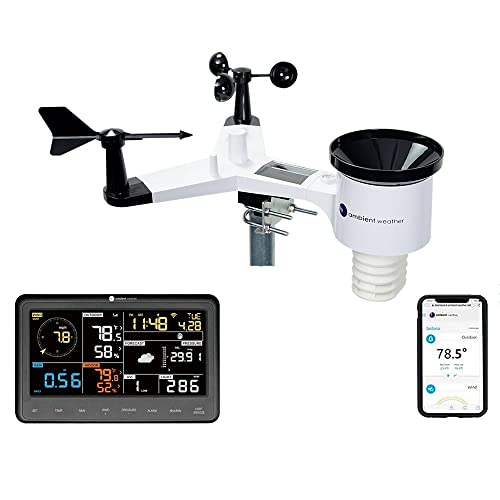
The WS-2902 earns the top position because it covers the measurements most relevant to a boat owner while also giving the data a route beyond the local console. Its Osprey sensor array measures wind speed and direction, temperature, humidity, rainfall, UV intensity, and solar radiation. That combination gives you more context than a basic indoor/outdoor thermometer, especially when a calm-looking morning starts to feel less inviting on the water.
Its wireless sensor array works with a color LCD display, while Wi-Fi enables remote access and optional transmission to the Ambient Weather Network. The listing also identifies support for IFTTT, Google Home, and Alexa, which may suit a home where weather alerts or routines matter. The station still needs sensible outdoor placement. A wind sensor tucked beside a wall will not represent open-water airflow, and a rain cup needs a clear, level position for useful totals.
Pros
- Measures wind speed and direction, rainfall, temperature, humidity, UV intensity, and solar radiation.
- Combines a wireless outdoor sensor array with a color LCD display.
- Wi-Fi supports remote access and optional Ambient Weather Network transmission.
- Listing identifies IFTTT, Google Home, and Alexa compatibility.
- Provides a broader weather picture than temperature-and-humidity-only stations.
Cons
- The outdoor sensor array and rain cup require careful placement for useful readings.
- The listing does not specify a detailed wireless transmission distance or update interval.
This is the strongest fit for a boater who wants a permanent station at home, near a dock, or at a waterfront property and expects to check conditions through more than one route. It is less compelling for someone who wants a small, battery-only instrument carried aboard for every trip, since the sensor array is intended for outdoor installation. The WS-2902 wins by balancing local observation with connected access, provided you are comfortable setting up the outdoor hardware and network features.
To buy this product, click here.
2. Ambient Weather WS-2000 : Best for Detailed Local Monitoring
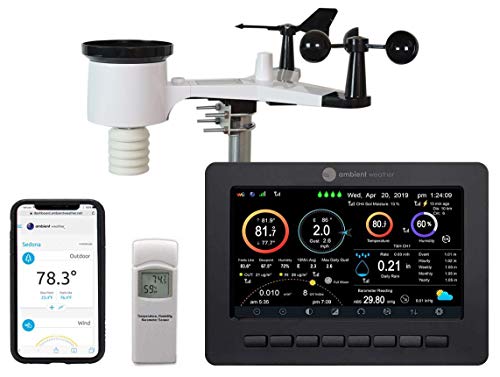
The WS-2000 follows the same broad weather-monitoring path as the top-ranked Ambient Weather station. Its integrated sensor array measures wind speed and direction, temperature, humidity, rainfall, UV, and solar radiation, so it can give a dockside household a useful snapshot before anyone loads the cooler or casts off. The support for imperial and metric units is a small but practical touch for readers who switch between measurement systems.
A TFT color display gives this model a more information-focused character, while the product information identifies enhanced Wi-Fi connectivity as an option for transmitting data to the Ambient Weather Network. That wording matters. The listing confirms the Wi-Fi connection feature, but it does not describe every remote-monitoring function in detail, so buyers should verify the current configuration before ordering. The console uses an included 5V DC adapter, and the sensor array requires three AAA batteries, which adds a routine maintenance point.
Pros
- Measures wind speed and direction, rainfall, temperature, humidity, UV, and solar radiation.
- Uses a TFT color display for local weather observation.
- Supports imperial and metric units of measure.
- Allows calibration according to the listing.
- Offers enhanced Wi-Fi connectivity for Ambient Weather Network transmission.
Cons
- The sensor array requires three AAA batteries, which are not included.
- Wi-Fi functionality is described as an option, so configuration details should be confirmed before purchase.
The WS-2000 suits someone who values a fuller local display and wants a connected Ambient Weather setup without giving up conventional wind and rain measurements. It ranks below the WS-2902 because the available information makes the Wi-Fi arrangement less clear, not because the measurement list is narrow. Place the array where wind and rainfall are exposed properly, then use the display as the quick-glance reference before heading toward the marina.
To buy this product, click here.
3. Wireless Indoor Outdoor Weather Station : Best for a Large Display

A 7.5-inch color display gives this station an immediate advantage for a home office, cabin, or dock building where the screen may be several steps away. It shows indoor and outdoor temperature, humidity, barometric pressure, wind speed and direction, rainfall, dew point, feels-like temperature, moon phase, and calendar information. The wind and pressure readings are especially relevant before boating, while the calculated dew point and feels-like values add context without replacing the direct measurements.
The station does not require Wi-Fi, so it keeps the setup focused on the outdoor sensor and indoor console. The listing describes a wireless signal suitable for large areas, including piers and rooftops, and says the sensor can be mounted on a fence, farm pole, or boat. That broad placement language is useful, but the station should still be installed where wind and rain can reach the sensors without nearby structures distorting readings. Hourly, daily, weekly, monthly, and total rainfall records make the display more useful after a wet spell.
Pros
- Large 7.5-inch color display uses bold information panels and adjustable backlighting.
- Shows wind speed and direction, rainfall, pressure, temperature, and humidity.
- Records rainfall across hourly, daily, weekly, monthly, and total periods.
- Wireless operation avoids a Wi-Fi setup requirement.
- Listing describes installation options for piers, rooftops, fences, poles, and boats.
Cons
- No Wi-Fi or remote Internet access is identified.
- The listing does not provide a detailed sensor-to-console transmission distance.
This is a sensible choice for someone who wants to walk past a large screen and see the local picture immediately, rather than open an app. It is a weaker fit for a boat owner who needs to check conditions from a distant location. The display and rainfall history make it useful at a fixed waterfront property, while the lack of Wi-Fi keeps it simpler and limits data access to the local system.
To buy this product, click here.
4. Sainlogic 12-in-1 Wireless Weather Station : Best for Broad Local Readings

The Sainlogic 12-in-1 puts a substantial amount of information on a 6.5-inch color display. The listed measurements include indoor and outdoor temperature and humidity, barometric pressure, wind speed and direction, rainfall, dew point, and feels-like temperature. For a boater, the useful core is the wind, pressure, rain, and temperature information. Moon phase, calendar, and alarm functions are secondary, but they can make the console handy in a cabin or home entryway.
Its advertised wireless transmission distance reaches up to 443 feet in open, unobstructed conditions. That is a listed maximum, not a guarantee through walls, metal siding, multiple floors, or other structures. The station also records hourly, daily, weekly, monthly, and cumulative rainfall. The product information lists temperature accuracy of ±0.2°C and humidity accuracy of ±1.8% RH, but those are listing claims rather than independent testing results, so they should be read in that context.
Pros
- Displays wind, rainfall, pressure, indoor and outdoor temperature, and humidity.
- Includes a 6.5-inch color display with three backlight levels.
- Records hourly, daily, weekly, monthly, and cumulative rainfall.
- Lists a wireless range of up to 443 feet in open conditions.
- Includes mounting hardware and automatic sensor synchronization.
Cons
- No Wi-Fi, app access, or remote monitoring is identified.
- The advertised transmission distance may be reduced by walls, metal, terrain, and interference.
This model fits a larger property where the console and outdoor sensor need some separation but the user is happy with local readings. Imagine checking the screen beside the back door after a night of rain, then deciding whether the water looks calm enough for a short run. It is less suitable for monitoring a property while traveling because the weather information stays within the local wireless system.
To buy this product, click here.
5. AcuRite Iris 01512MCB : Best Self-Contained Option
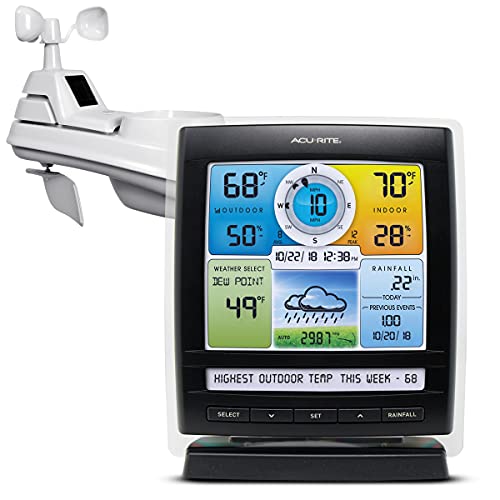
The AcuRite Iris 01512MCB keeps the experience centered on its indoor color display. It receives outdoor temperature and humidity, wind speed and direction, barometric pressure, and rainfall from the wireless outdoor sensor. The product information also describes more than 55 data points, including heat index, dew point, feels-like temperature, pressure trends, and historical information. That mix gives a reader more than a single current reading, especially when a pressure trend starts moving in an unfavorable direction.
Installation is described as a battery-and-mount process: install batteries, attach the outdoor sensor to a pole or post with the included bracket, and use the indoor console to view conditions. The station creates a personalized 12-hour forecast from elevation information and pressure data. That forecast is a station-derived indication, not a replacement for a marine forecast or official warning. Still, the combination of local wind, rain, and pressure readings can be useful beside a home or boat storage area.
Pros
- Measures outdoor temperature and humidity, wind speed and direction, pressure, and rainfall.
- Provides more than 55 listed data points, including historical information and pressure trends.
- Includes a color LCD display with adjustable dimming.
- Outdoor sensor mounting bracket is included according to the listing.
- Uses elevation and pressure information for a personalized 12-hour forecast.
Cons
- Wi-Fi and remote monitoring are not identified for this model.
- The forecast is derived from station information and should not replace marine weather sources.
The Iris 01512MCB is a good match for a reader who wants a broad local snapshot without building a cloud-connected system. It belongs near a door, in a cabin, or in a shore-side workshop where the color display can be checked quickly. Choose another model if you need to view the station while away, but choose this one if local pressure trends and a wide set of displayed information matter more than app access.
To buy this product, click here.
6. AcuRite Iris 5-in-1 : Best for Weather Network Uploads
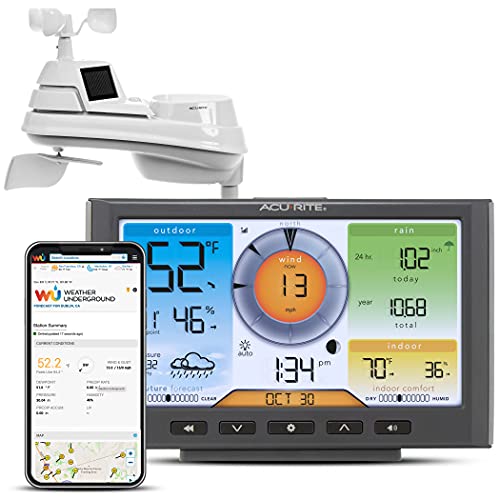
This Iris model separates itself from the standard color-screen version through its Wi-Fi connection to Weather Underground. The station measures indoor and outdoor temperature and humidity, wind speed and direction, barometric pressure, and rainfall, then provides access to the station data through the identified weather platform. For someone checking a waterfront property from another location, that distinction is substantial. A wireless outdoor sensor link alone would leave the readings tied to the local console.
The display also records more than 25 data points, with threshold alarms, historical records, heat index, dew point, wind chill, and enhanced rainfall history listed among the features. The five-in-one label should not be treated as a universal industry standard, so the actual measurement list matters more than the number. Here, the practical boating set is clear: wind, rain, temperature, humidity, and pressure, with calculated values adding context.
Pros
- Connects to Weather Underground for remote monitoring and data sharing.
- Includes an anemometer, wind vane, barometer, hygrometer, rain gauge, and thermometer.
- Provides threshold alarms and historical weather information.
- Tracks heat index, dew point, wind chill, and enhanced rainfall history.
- Uses a color display with adjustable dimming for local checks.
Cons
- The listing does not identify compatibility with other smart-home platforms.
- Remote access depends on the Wi-Fi and Weather Underground connection.
This is the more natural AcuRite pick for a boat owner who wants local measurements to travel beyond the house. A person leaving for a weekend can check the connected station before heading toward the marina, while someone standing in the kitchen can still use the console. The trade-off is platform dependence. If Weather Underground is not part of your preferred setup, one of the Ambient Weather or Sainlogic connected models may fit better.
To buy this product, click here.
7. Sainlogic WiFi Smart Weather Station : Best for App Alerts and Data Logging

The Sainlogic WiFi model is the most data-focused option in this group. It supports 2.4G and 5G Wi-Fi, uses Bluetooth for fast pairing, and provides real-time indoor and outdoor information through an app. The listing also identifies app alerts and Wunderground synchronization. For a boater who likes to review patterns instead of relying on a single glance at the console, those features create a more useful record of wind, rain, temperature, humidity, and pressure-related conditions.
Its local storage can retain up to two years of data, with Excel export covering up to 30 days per export. That makes it easier to examine changing conditions over time, although the product information does not explain every export workflow or app requirement. Rainfall is listed with different accuracy claims for light and heavier precipitation, and a built-in bubble level is intended to help with horizontal placement. Leveling still matters because a crooked gauge can make a tidy spreadsheet less meaningful.
Pros
- Supports both 2.4G and 5G Wi-Fi according to the listing.
- Provides app alerts, real-time weather data, and Wunderground synchronization.
- Offers up to two years of local data storage and Excel export.
- Lists a 443-foot open-area wireless transmission distance.
- Includes wind, rain, temperature, humidity, and pressure-related monitoring.
Cons
- The app and Wi-Fi connection are required for the remote data advantages.
- Each Excel export covers up to 30 days even though the device can store longer records.
This is the best choice here for someone who enjoys keeping records of weather before and after boating trips. You might compare rainfall totals after a storm, review temperature changes around a storage area, or check an alert while away from home. Buyers who want a simple console with no account or network setup should choose a local-only model instead, but data-minded users get more from this station than a basic forecast icon.
To buy this product, click here.
8. La Crosse Technology Advanced Weather Station : Best Compact Temperature and Humidity Monitor

The La Crosse Advanced Weather Station is a narrower tool than the leading stations because its listed outdoor measurements focus on temperature and humidity rather than wind and rainfall. That limitation is significant for boating, yet the product can still make sense at a cabin, garage, or home entry point where a quick temperature check helps with clothing, storage, or basic comfort decisions. It includes a weather-resistant outdoor sensor and a listed transmission range of up to 330 feet with no obstructions.
The color display adds forecast icons, tendency indicators, minimum and maximum records, customizable alerts, atomic time, and an alarm with snooze. The backlight can be adjusted, although battery operation illuminates it temporarily on demand. A 5V power adapter supports the full display feature set, with optional battery backup. It is a practical compact monitor, but it cannot replace a wind-and-rain station for someone making decisions around open-water conditions.
Pros
- Displays indoor and outdoor temperature and humidity.
- Includes customizable temperature and humidity alerts.
- Lists a wireless transmission range of up to 330 feet without obstructions.
- Provides minimum and maximum records for indoor and outdoor readings.
- Includes atomic time, adjustable backlight, and a color forecast display.
Cons
- Wind speed, wind direction, and rainfall measurement are not identified.
- The full display feature set uses a 5V power adapter, with battery operation handled differently.
This station belongs near the bottom of a boating-focused list because temperature and humidity alone leave out two of the most useful outdoor observations, wind and rainfall. Still, it may suit a reader who already gets marine wind information elsewhere and wants a small local monitor for a cabin or storage building. Skip it as your only weather station if your departure decisions depend on wind direction or rain totals.
To buy this product, click here.
9. La Crosse Technology C85845-INT : Best for Simple Comfort Monitoring

The C85845-INT is another compact station aimed at indoor and outdoor temperature and humidity rather than a full wind-and-rain picture. Its large display shows forecast icons, high and low records, dew point, heat index, and comfort charts covering indoor and outdoor humidity. Those calculated values can help in a cabin or home, where the goal may be knowing whether the building feels damp before storing gear or opening windows.
The display uses a constant backlight with adjustable brightness when connected to the included 5V power cord. Optional backup power requires three AA batteries, while the outdoor sensor requires two AA batteries. The station also includes customizable high and low alerts, atomic time, several time-zone settings, and a calendar. It is easy to place into a daily routine, but the feature list does not identify rainfall, wind speed, or wind direction, so its boating role is limited.
Pros
- Displays indoor and wireless outdoor temperature and humidity.
- Includes dew point, heat index, and indoor and outdoor comfort charts.
- Offers customizable high and low temperature and humidity alerts.
- Provides a large display with adjustable brightness.
- Includes atomic time, calendar functions, and multiple time-zone settings.
Cons
- Wind and rainfall measurements are not identified.
- The console uses an included 5V power cord for constant backlighting, while backup batteries are optional.
Choose this model for basic shore-side environmental awareness rather than complete departure planning. It can answer questions such as whether a cabin is humid or whether outdoor temperatures have crossed a chosen threshold, but it cannot tell you how the wind is shifting across the water. Its value comes from straightforward temperature and humidity alerts, while a full weather station should handle wind and rain duties.
To buy this product, click here.
Buying Guide: Choosing a Weather Station for Boating
Wind Information Matters More Than a Long Feature List
Wind speed and wind direction are central to many boating decisions, but the sensor must be placed where surrounding walls, trees, roofs, and dock structures do not distort airflow. The Ambient Weather and AcuRite models provide both wind speed and direction, while the La Crosse models reviewed here focus on temperature and humidity. A station that lists more calculated values cannot make up for missing wind data when wind is the measurement you actually need.
Wireless and Wi-Fi Solve Different Problems
Wireless communication usually describes the link between the outdoor sensor and the indoor console. Wi-Fi connects a station or console to a network and may support remote access, weather-network uploads, alerts, or app data. The WS-2902, AcuRite Iris 5-in-1, and Sainlogic WiFi model offer connected functions, while the large-display wireless stations keep readings local. A station can work perfectly well without Wi-Fi, but you will need to be near its console to see the information.
Remote Access Depends on the Specific Platform
Remote monitoring is more than placing a wireless sensor outside. The AcuRite Iris 5-in-1 identifies Weather Underground support, the WS-2902 identifies Ambient Weather Network access and smart-home compatibility, and the Sainlogic WiFi station lists app alerts and Wunderground synchronization. Those platforms are not interchangeable. Confirm that the service, app, and alert method fit your normal routine before choosing a connected system.
Rainfall Records Are Useful, but Placement Still Matters
A rain gauge can show how much precipitation fell at the property, which helps explain wet decks, runoff, and changing conditions around a launch area. The Sainlogic WiFi and 12-in-1 stations list rainfall history, while the large-display wireless station provides hourly through total rainfall records. Level the gauge and keep its exposure sensible. A detailed rainfall history cannot correct for a gauge positioned beside a wall, under an overhang, or where roof runoff can enter.
Accuracy, Resolution, and Range Are Different Specifications
A display that shows small increments does not automatically measure with matching accuracy. Likewise, a listed 443-foot transmission distance describes a best-case open-area communication claim, not a guarantee through a house or metal building. The Sainlogic stations list temperature and humidity accuracy claims, but those remain product-listing specifications rather than independent test results. Treat each number as one part of the buying decision instead of using a single figure as proof that a station is superior.
Check Which Power Sources Apply to Each Component
A console may use an AC adapter while the outdoor sensor relies on batteries. The Ambient WS-2000, for example, lists a 5V console adapter and three AAA batteries for its sensor array. The La Crosse C85845-INT also separates console power from outdoor-sensor batteries. That distinction matters at a dock, cabin, or seasonal property where replacing outdoor batteries may be less convenient than plugging in a display.
Best Weather Stations for Boating FAQ
What measurements matter most for boating?
Wind speed, wind direction, barometric pressure, temperature, and rainfall are the most useful measurements among the products reviewed here. Wind gives direct information about movement near the sensor, while pressure trends can add context to changing conditions. Dew point, heat index, and feels-like temperature are calculated values that may help describe comfort, but they do not replace direct wind or rain measurements.
Is a wireless weather station the same as a Wi-Fi weather station?
No. Wireless usually describes communication between the outdoor sensor and its local display. Wi-Fi connects the station or console to a network and may enable app access, remote monitoring, weather-network uploads, or alerts. The Sainlogic 12-in-1 is wireless without identified Wi-Fi, while the WS-2902 and AcuRite Iris 5-in-1 add network-related functions.
Can a Wi-Fi weather station be checked away from home?
It can, when the specific product supports remote access through its app or connected service. Wi-Fi alone does not prove that a station offers remote monitoring. The supplied information identifies remote access for the WS-2902, Weather Underground remote monitoring for the AcuRite Iris 5-in-1, and app alerts for the Sainlogic WiFi model.
Do these weather stations provide marine forecasts?
No. Their forecast icons and station-derived trends should not be treated as replacements for official marine forecasts, warnings, or local navigation information. A personal station measures conditions at its sensor location. That can be valuable near a home or dock, but it may not represent conditions several miles away on open water.
Where should the outdoor sensor be installed?
Use an exposed location where wind can reach the anemometer and rain can reach the gauge without nearby walls, roofs, trees, or other obstructions distorting the readings. A rain gauge should be positioned level, and the sensor should be mounted according to the product instructions. A boat-mounted sensor may be convenient, but the listing information does not establish marine-grade construction, salt-air resistance, or a waterproof rating for these stations.
Do I need a station with UV and solar radiation?
UV and solar radiation are useful for broader environmental monitoring, but they are secondary to wind, rainfall, temperature, and pressure for many boating decisions. The Ambient Weather WS-2902 and WS-2000 list both UV intensity and solar radiation. Choose those measurements when they matter to your property or record keeping, rather than assuming a longer sensor list automatically makes a station better.
Which station is best if I want historical data?
The Sainlogic WiFi Smart Weather Station is the clearest choice among these products for data-focused use because the listing describes two years of local storage and Excel export, with each export covering up to 30 days. The AcuRite Iris models also list historical information, while several local displays provide rainfall records. Check the exact storage and export method before ordering if long-term records are central to your plans.
Final Verdict
The Ambient Weather WS-2902 is the strongest overall choice for a connected home, dockside property, or shore-based boating setup. It measures wind speed and direction, rainfall, temperature, humidity, UV, and solar radiation, then adds Wi-Fi, remote access, Ambient Weather Network transmission, and listed smart-home support. Its main requirement is a thoughtful outdoor installation, since wind and rainfall readings depend heavily on sensor exposure. The AcuRite Iris 5-in-1 is the better alternative for readers who specifically want Weather Underground remote monitoring, while the Sainlogic WiFi model suits anyone who values app alerts, stored records, and Excel export.
For a simpler local setup, the large-display wireless station and Sainlogic 12-in-1 keep useful wind, rain, pressure, temperature, and humidity readings close at hand without requiring Wi-Fi. The two La Crosse models are better treated as basic temperature and humidity monitors because their listed features do not include wind or rainfall. Match the station to the way you make decisions: choose connected access if you check conditions away from home, a clear local console if you want quick dockside readings, and a full wind-and-rain sensor array if boating conditions are the main concern.