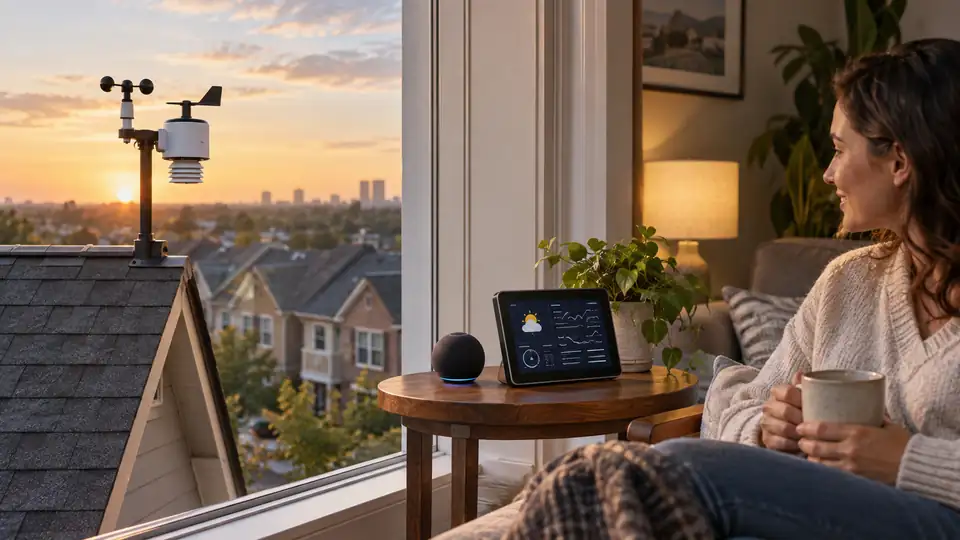
Alexa-compatible weather stations can turn a backyard sensor array into useful household information. You might ask for the temperature before leaving for work, check rainfall before watering a garden, or build an automation around wind, heat, or outdoor humidity. The meaningful differences sit beneath the familiar color screens: some stations measure wind, rain, UV, and solar radiation, while others focus on temperature and humidity. Some offer Wi-Fi and remote access, while others use wireless sensor-to-console communication only.
A wireless connection is not automatically Wi-Fi, and Wi-Fi is not automatically the same as remote monitoring or Alexa control. Sensor placement matters too. A rain gauge needs a level, open position, while wind sensors need exposure away from walls and obstructions. The Ambient Weather WS-2902 stands out as the strongest overall balance here because it combines a broad measurement set with Wi-Fi, Alexa support, remote access, and a dedicated color display.
This comparison weighs Alexa compatibility, local measurements, remote access, sensor design, console usability, data features, and installation trade-offs. The selection includes full outdoor weather stations alongside one compact Matter-based option for readers whose priority is simple smart-home temperature and humidity monitoring.
Quick Answer
Best Overall: The Ambient Weather WS-2902 offers the broadest all-around package for Alexa users, with wind, rainfall, temperature, humidity, UV, solar radiation, Wi-Fi, remote access, and a color display.
Best Premium Option: The Tempest Weather Station combines Alexa access with lightning detection, rapid three-second updates, solar-assisted outdoor power, and a sensor design with no moving parts.
Best for Remote Monitoring: The Ambient Weather WS-1553-IP includes a WEATHERHUB module and supports Wi-Fi or direct Ethernet, making its connectivity architecture particularly useful for checking conditions away from home.
Best for Data Logging: The Sainlogic Wi-Fi Smart Weather Station combines Alexa-related smart-home use with app alerts, rainfall records, two-year local storage, and Excel export.
Best Weather Stations for Alexa Comparison Table
| Product | Measurements | Connectivity | Sensor Design | Best For |
|---|---|---|---|---|
| Ambient Weather WS-2902 | Temperature, humidity, wind, rain, UV, solar radiation | Wi-Fi, Alexa, IFTTT, remote access | Integrated array with rain cup | Best overall balance |
| Tempest Weather Station | Temperature, humidity, pressure, wind, rain, UV, solar radiation, lightning | Wi-Fi, app, Alexa, IFTTT, Rachio | Solar-powered, no moving parts | Advanced smart-home monitoring |
| Ambient Weather WS-1965 | Temperature, humidity, pressure, wind, rain | Wi-Fi, Alexa, IFTTT, remote access | Integrated array | Connected essentials |
| Ambient Weather WS-2000 | Temperature, humidity, wind, rain, UV, solar radiation | Wi-Fi, Ambient Weather Network | Integrated array | Large color-console monitoring |
| AcuRite Iris 01540M | Temperature, humidity, pressure, wind, rain, derived readings | Wi-Fi, Weather Underground | 5-in-1 outdoor array | Weather Underground access |
| Ambient Weather WS-1553-IP | Temperature, humidity, wind, rain | Wi-Fi, Ethernet, Alexa, IFTTT, remote access | Array plus WEATHERHUB | Remote monitoring |
| Sainlogic Wi-Fi Smart Weather Station | Temperature, humidity, pressure, wind, rain | 2.4/5 GHz Wi-Fi, Bluetooth pairing, app | Wireless outdoor sensor | Data storage and export |
| AcuRite Iris 01512MCB | Temperature, humidity, pressure, wind, rain, derived readings | Wireless console | 5-in-1 outdoor array | Simple local setup |
| Eve Weather | Outdoor temperature and humidity | Matter, Thread, Alexa, Siri, Google Assistant | Compact wireless sensor | Simple smart-home readings |
The detailed reviews below show how each station handles Alexa access, local measurements, data viewing, sensor placement, and practical limitations.
1. Ambient Weather WS-2902: Best Overall
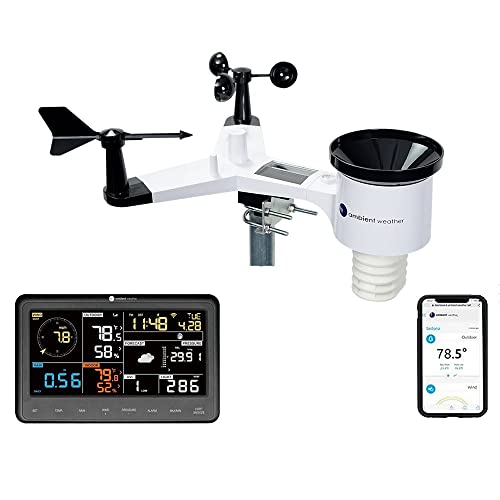
The WS-2902 is the most complete fit for an Alexa-equipped home that still wants a proper outdoor weather station. Its Osprey sensor array measures temperature, humidity, wind speed, wind direction, rainfall, UV intensity, and solar radiation, so the station can answer far more than “How warm is it outside?” A color LCD console keeps the information visible in the kitchen or office, while Wi-Fi adds remote access and smart-home automation.
That combination gives this model a useful middle ground. A gardener can check rain and UV conditions, someone managing irrigation can use weather-based alerts, and a household can ask Alexa for current conditions. The listing also identifies IFTTT support and Ambient Weather Network connectivity. The outdoor array still needs sensible placement, since nearby walls, roofs, trees, and direct heat can influence readings regardless of the station brand.
Pros
- Measures temperature, humidity, wind speed, wind direction, rainfall, UV, and solar radiation.
- Supports Wi-Fi, remote access, Alexa, and IFTTT.
- Includes a color LCD display for local monitoring.
- Uses an integrated sensor array with a rain cup.
- Can connect with the Ambient Weather Network.
Cons
- The sensor array requires outdoor installation in a suitable exposed location.
- The listing does not identify a detailed accuracy specification for every measurement.
This is the strongest choice for readers who want Alexa interaction without giving up rainfall, wind, UV, and solar-radiation data. The Tempest offers a more advanced sensor concept, while the WS-1965 costs less and omits UV and solar radiation. Choose the WS-2902 if you want a broad, familiar weather-station layout with connected features rather than a minimalist smart-home sensor.
To buy this product, click here.
2. Tempest Weather Station: Best Premium Option
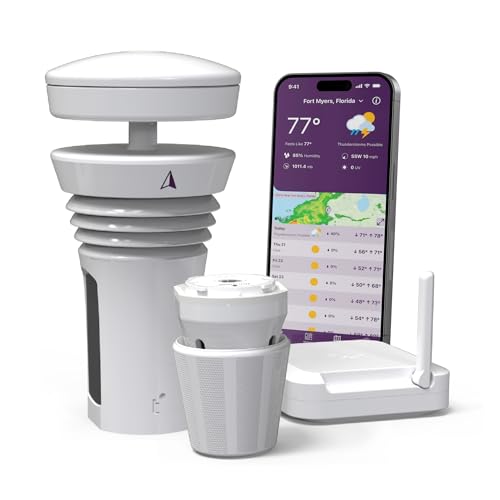
Tempest takes a different approach to outdoor sensing. Its single system measures temperature, humidity, barometric pressure, wind speed, wind direction, dew point, solar radiation, UV index, lightning strikes, and rainfall. The listing describes an outdoor sensor with no moving parts, which removes the cup and vane mechanisms found in many conventional arrays. That architecture is attractive for anyone who wants a clean installation with a broad measurement set.
Its smart-home credentials are equally important here. Tempest supports Alexa, IFTTT, Rachio, and other smart-home platforms, and the listing describes updates every three seconds. The solar-powered outdoor sensor has a published wireless transmission distance of more than 1,000 feet, though walls, metal structures, terrain, and placement can affect actual communication. This is a premium-priced option for connected monitoring, not a simple indoor/outdoor thermometer.
Pros
- Includes lightning detection alongside wind, rain, UV, and solar-radiation measurements.
- Supports Alexa, IFTTT, Rachio, and app-based monitoring.
- The outdoor sensor has no moving parts according to the listing.
- Provides listed three-second real-time updates.
- The outdoor sensor is solar powered and transmits wirelessly.
Cons
- Its higher price makes less sense for readers who need only temperature and humidity.
- The published wireless distance is a favorable maximum, not a guarantee through buildings.
Tempest is the better match for a smart-home setup that benefits from lightning information, rapid updates, and a broad set of weather variables. It may be more station than a small apartment or basic backyard requires. Readers who prefer a conventional color display included in the package may find the WS-2902 or WS-2000 easier to compare at a glance.
To buy this product, click here.
3. Ambient Weather WS-1965: Best Connected Essentials
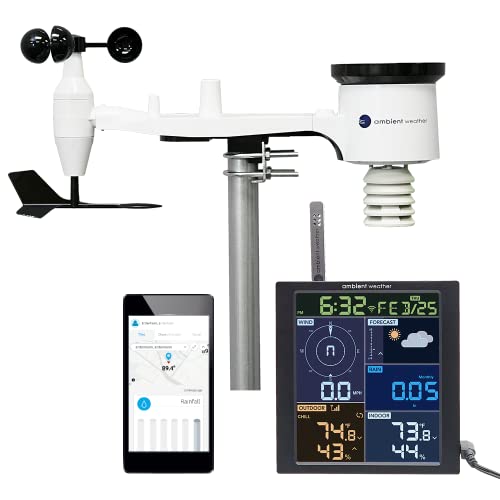
The WS-1965 trims the measurement list to the essentials while keeping the connected functions that make Alexa weather monitoring useful. Its all-in-one array measures temperature, humidity, barometric pressure, wind speed, wind direction, and rainfall. The console receives updates every 16 seconds according to the product information, giving a regular view of changing backyard conditions without adding UV or solar-radiation hardware.
That simpler sensor package can be a virtue. Someone checking rain before running sprinklers or asking about wind before opening a patio umbrella may have little use for solar-radiation data. Wi-Fi enables remote access, Alexa, IFTTT, and Ambient Weather Network features. The result is a sensible connected station for a home that wants local weather data and smart-home access without stepping into the Tempest’s broader feature set.
Pros
- Measures the core household variables, including rainfall and wind direction.
- Supports Wi-Fi, Alexa, IFTTT, and remote access.
- Provides a color LCD display.
- Lists 16-second real-time console updates.
- Connects with the Ambient Weather Network.
Cons
- It does not list UV or solar-radiation measurement.
- The integrated array offers less placement flexibility than separate sensors.
The WS-1965 suits a household that wants a connected weather station rather than a dense environmental dashboard. It ranks below the WS-2902 because its measurement set is narrower, yet that same simplicity may make it the cleaner purchase for basic rain, wind, temperature, and pressure monitoring. It is a strong alternative if Alexa access matters more than UV data.
To buy this product, click here.
4. Ambient Weather WS-2000: Best for a Detailed Color Console
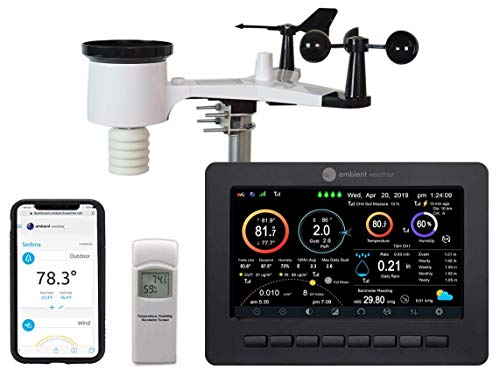
The WS-2000 centers the experience around a TFT color display and a broad integrated sensor array. It measures wind speed, wind direction, temperature, humidity, rainfall, UV, and solar radiation, giving it a similar core measurement range to the WS-2902. Imperial and metric units are supported, and the listing identifies calibration capability, which can matter for readers who want more control over how observations are displayed.
Wi-Fi connectivity allows the station to transmit data to the Ambient Weather Network, while the local display keeps the system useful when a phone is across the room. The console uses an included 5V DC adapter, and the outdoor array requires three AAA batteries that are not included. That split power arrangement is common for this product class, but it is worth planning for before mounting the sensor outdoors.
Pros
- Measures wind, temperature, humidity, rainfall, UV, and solar radiation.
- Includes a TFT color display for local readings.
- Supports imperial and metric units.
- Lists calibration capability.
- Offers Wi-Fi connectivity to the Ambient Weather Network.
Cons
- Three AAA batteries for the sensor array are not included.
- The product information does not describe Alexa support as directly as the WS-2902 listing.
Choose the WS-2000 if a detailed local console and broad weather coverage matter more than the clearest Alexa-specific listing language. The WS-2902 is the safer recommendation for readers buying primarily around Alexa automation, while the WS-2000 remains appealing for someone who prefers monitoring a dedicated screen. It also makes sense for households that want calibration and unit flexibility.
To buy this product, click here.
5. AcuRite Iris 01540M: Best for Weather Underground
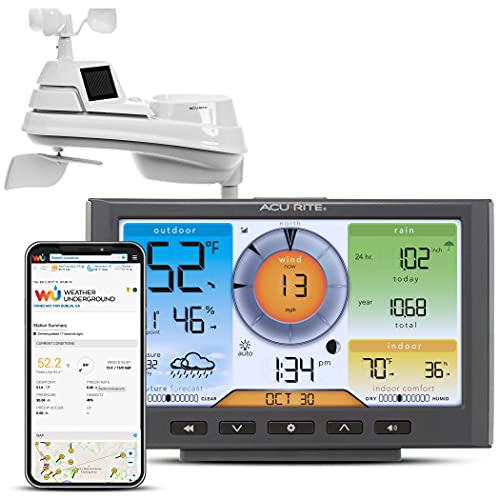
The AcuRite Iris 01540M is a 5-in-1 station that combines indoor and outdoor monitoring with a color display and Wi-Fi connection to Weather Underground. Its outdoor system measures temperature, humidity, wind speed, wind direction, and rainfall, while the station also provides barometric pressure and calculated information such as heat index, dew point, and wind chill. These derived values can make the console more useful during muggy afternoons or cold, windy mornings.
Weather Underground support is the key distinction. The product information describes remote monitoring and sharing data with the Weather Underground network. That is a different strength from direct Alexa support, which is not clearly identified in the listing provided here. For a reader who wants a station tied to that specific weather platform and still wants broad local observations, this model has a clear role.
Pros
- Connects to Weather Underground for remote monitoring.
- Measures indoor and outdoor temperature and humidity, wind, pressure, and rainfall.
- Provides more than 25 listed data points.
- Includes a large color display with adjustable dimmer.
- Offers threshold alarms and historical rainfall information.
Cons
- Direct Alexa compatibility is not clearly stated in the supplied product information.
- The 5-in-1 label does not describe the same measurement breadth as stations with UV or solar-radiation sensors.
This Iris model is best for someone who values Weather Underground access alongside a traditional console. It is a weaker match for a buyer whose central requirement is confirmed Alexa control, so the WS-2902, Tempest, or WS-1553-IP should come first for that use. Its derived readings and history still give it more analytical depth than a basic indoor/outdoor thermometer.
To buy this product, click here.
6. Ambient Weather WS-1553-IP: Best for Remote Monitoring

The WS-1553-IP is built around an outdoor sensor array and a WEATHERHUB module. That gateway-style arrangement matters for remote monitoring because the hub forms the bridge between the local sensor system and the network. The station measures temperature, humidity, wind speed, wind direction, and rainfall, with real-time updates listed at 16-second intervals.
Its connectivity options are unusually practical for a property where Wi-Fi placement is awkward. The listing identifies Wi-Fi and direct Ethernet, along with Alexa, IFTTT, remote access, and Ambient Weather Network support. Ethernet can be useful near a router or network switch, while Wi-Fi may simplify placement elsewhere. The trade-off is a more involved system than an all-in-one console, since the WEATHERHUB becomes another component that needs power and a suitable network location.
Pros
- Includes a WEATHERHUB module for connected monitoring.
- Supports Wi-Fi and direct Ethernet connections.
- Offers Alexa, IFTTT, remote access, and Ambient Weather Network support.
- Measures temperature, humidity, wind, and rainfall.
- Lists 16-second real-time updates.
Cons
- The system has an additional hub component to place and connect.
- It does not list UV or solar-radiation measurement.
The WS-1553-IP is a smart choice for a cabin, second home, or networked property where checking conditions away from the station matters. It gives up the WS-2902’s UV and solar-radiation readings, but the Ethernet option can be more useful than extra sensors in a connectivity-focused installation. Choose it when the hub architecture fits your network and remote-access plans.
To buy this product, click here.
7. Sainlogic Wi-Fi Smart Weather Station: Best for Data Logging

Sainlogic brings a data-focused angle to the connected weather-station category. The product supports 2.4 GHz and 5 GHz Wi-Fi, Bluetooth fast pairing, app alerts, rainfall records, and local storage for up to two years. Its listed measurements include indoor and outdoor temperature and humidity, barometric pressure, wind speed, wind direction, and rainfall. For someone who wants to study seasonal patterns instead of glancing at a current reading, the storage and Excel export are meaningful advantages.
The listing gives specific claims for its Swiss SHT40 temperature and humidity sensor and rainfall accuracy, but those remain published product information rather than independent verification. Its wireless range is listed at up to 443 feet in open conditions, so walls and structures may reduce that distance. The product also identifies Wunderground synchronization, making it a useful bridge between app-based monitoring, weather-network sharing, and personal records.
Pros
- Supports both 2.4 GHz and 5 GHz Wi-Fi.
- Offers app alerts and Bluetooth fast pairing.
- Stores up to two years of local weather data according to the listing.
- Supports Excel export for recorded data.
- Provides rainfall logs by hour, day, month, and year.
Cons
- Alexa compatibility is not explicitly identified in the supplied product information.
- The listed 443-foot wireless range applies to open conditions and may be reduced by obstructions.
This is the better pick for data-conscious users who want exportable records and modern Wi-Fi setup. It ranks below the Ambient Weather options for a purchase centered specifically on confirmed Alexa integration. For gardens, greenhouses, or properties where rainfall history matters, its logging features may matter more than a richer local display.
To buy this product, click here.
8. AcuRite Iris 01512MCB: Best for Simple Local Setup
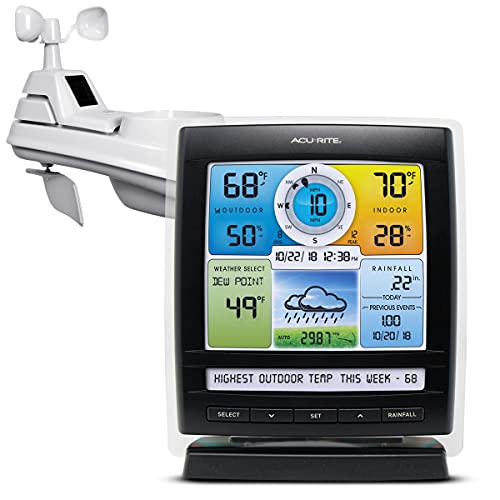
The AcuRite Iris 01512MCB focuses on local weather information through a wireless outdoor sensor and color console. It measures indoor and outdoor temperature and humidity, wind speed, wind direction, barometric pressure, and rainfall. The product information also lists more than 55 data points, including heat index, dew point, feels-like temperature, and pressure trends. Those extra readings are calculated or trend-based information, so they should not be confused with separate dedicated sensors.
Installation is presented as straightforward: insert batteries, attach the outdoor sensor to a pole or post with the included mounting bracket, and pair it with the display. The console includes an adjustable dimmer, while the station uses pressure and elevation information to create a 12-hour personal forecast. It does not offer the confirmed Wi-Fi and Alexa feature set of the top Ambient Weather models, but it remains a capable local station for someone who prefers a direct display.
Pros
- Includes a wireless outdoor sensor and color display.
- Measures temperature, humidity, wind, pressure, and rainfall.
- Lists more than 55 data points and historical information.
- Includes a mounting bracket for attaching the sensor to a pole or post.
- Provides adjustable display dimming and pressure-trend information.
Cons
- Alexa and Wi-Fi support are not identified in the supplied product information.
- It is primarily a local-display choice rather than a confirmed remote-monitoring station.
Choose this Iris model for a simple console-based setup where Alexa is secondary. It suits a living room, workshop, or office that needs current conditions and forecast information without a network gateway. Readers specifically shopping for Alexa routines should step up to a confirmed connected model instead of assuming wireless sensor communication provides smart-home access.
To buy this product, click here.
9. Eve Weather: Best Compact Smart-Home Option

Eve Weather is a different kind of weather station. Its compact sensor monitors outdoor temperature, humidity, and weather trend rather than wind, rainfall, pressure, UV, or solar radiation. That narrow measurement set makes it a poor substitute for a full backyard station, yet it can be exactly right for someone who wants a small smart-home sensor near a porch, patio, or exterior door.
Matter support allows access through Alexa, Siri, and Google Assistant, while Thread is intended to support smart-home communication with a compatible hub. The product is completely wireless, uses a replaceable battery, and carries an IPX4 water-resistance specification. The listing also identifies hub requirements, including specific Apple home-hub options and a hub for connecting to another platform. Those requirements deserve attention before purchase because Matter support does not eliminate the need for compatible smart-home hardware.
Pros
- Supports Matter for access through Alexa, Siri, and Google Assistant.
- Measures outdoor temperature and humidity.
- Uses Thread technology with a compatible hub.
- Completely wireless with a replaceable battery.
- Lists IPX4 water resistance.
Cons
- It does not measure wind, rainfall, barometric pressure, UV, or solar radiation.
- A compatible smart-home hub is required for the stated platform connections.
Eve Weather belongs at the end of this list because it serves a compact smart-home purpose rather than full weather-station monitoring. It is a good fit for a reader who mainly wants Alexa to report outdoor temperature and humidity from a small sensor. Anyone tracking rain, wind, or broader backyard conditions should choose one of the integrated outdoor stations above.
To buy this product, click here.
Buying Guide
Alexa Support Should Be Explicit
A station can use wireless communication between its outdoor sensor and console without offering Alexa access. That local radio link solves a sensor-to-display problem, while Alexa support usually depends on Wi-Fi, a hub, an app service, Matter, or a cloud connection. The WS-2902, Tempest, WS-1965, and WS-1553-IP explicitly identify Alexa support in their product information. Models that merely say “wireless” should not be treated as equivalent.
Wi-Fi, Remote Access, and Matter Are Different
Wi-Fi can connect a console or hub to a home network, but the useful outcome depends on the station’s software and supported services. The WS-1553-IP lists both Wi-Fi and direct Ethernet, while the Sainlogic model adds app alerts and data storage. Eve Weather uses Matter and Thread, but the listing identifies compatible hub requirements. Check the complete connection path rather than relying on one smart-home word in a product title.
Decide Which Measurements Matter
A full station with wind, rainfall, temperature, humidity, pressure, UV, and solar radiation gives a much richer view of outdoor conditions. A smaller system may still be the better fit if the only daily question is whether the porch is hot or humid. The WS-1965 covers core weather observations, while the WS-2902 and Tempest add UV and solar-related measurements. More variables increase capability, but they also increase installation and interpretation demands.
Sensor Placement Still Shapes the Reading
An Alexa command cannot correct a poorly placed sensor. Wind readings can be affected by walls, trees, roofs, and other obstructions. Rainfall measurements depend on a level, open position, while temperature and humidity readings can be influenced by nearby heat sources and direct sun. Integrated arrays simplify setup, but they also place several measurements in one outdoor location, so choose the mounting position carefully.
Check Whether the Console or Hub Fits Your Routine
A color console is useful if you want to glance across a room and see current conditions. The WS-2902, WS-1965, WS-2000, and AcuRite Iris models all include local displays. A hub-based station may be better for remote access, especially when Ethernet is useful, but it adds another component. If Alexa or an app will be your primary interface, a highly detailed console may matter less than a clear connection path.
Read Range Claims as Best-Case Figures
The Tempest listing gives a wireless distance of more than 1,000 feet, while Sainlogic lists up to 443 feet in open conditions. These figures describe favorable transmission conditions, not guaranteed performance through walls, floors, metal buildings, or dense construction. Place the console, gateway, and sensor with the actual property layout in mind, and avoid treating a longer published range as proof of greater measurement accuracy.
Separate Accuracy From Resolution and Derived Data
A display showing small increments does not automatically mean the sensor is more accurate. Likewise, dew point, wind chill, feels-like temperature, and forecast icons may be calculated from measured conditions rather than produced by separate sensors. Sainlogic lists specific temperature, humidity, and rainfall claims, while the AcuRite Iris models provide numerous calculated readings. Published figures are useful, but they should not be treated as independent test results.
Best Weather Stations for Alexa FAQ
What Is the Best Overall Weather Station for Alexa?
The Ambient Weather WS-2902 is the strongest overall choice in this comparison. It combines Alexa, Wi-Fi, remote access, IFTTT, a color display, rainfall, wind, temperature, humidity, UV, and solar-radiation measurements. Its integrated outdoor array still needs careful placement for useful readings.
Does Wireless Mean a Weather Station Works With Alexa?
No. Wireless often describes the radio connection between an outdoor sensor and an indoor console. Alexa access requires explicitly supported smart-home connectivity, such as the Wi-Fi, Alexa, IFTTT, or Matter support identified for particular models in this guide.
Which Weather Station Is Best for Remote Monitoring?
The Ambient Weather WS-1553-IP is a strong choice because it includes a WEATHERHUB module and supports Wi-Fi or direct Ethernet, along with remote access and Alexa. The Tempest and WS-2902 also provide connected access, but the WS-1553-IP’s hub and Ethernet options may fit a networked property especially well.
Can Alexa Report Rainfall From a Weather Station?
Alexa access depends on the station’s supported integration and the data exposed through that service. The WS-2902, Tempest, WS-1965, and WS-1553-IP identify Alexa support while also measuring rainfall. Confirm the current integration details before assuming that every available measurement can be requested through voice control.
What Is the Difference Between a Full Weather Station and Eve Weather?
A full station such as the WS-2902 measures several outdoor variables, including wind and rainfall. Eve Weather focuses on outdoor temperature, humidity, and weather trend, with Matter-based smart-home access. Eve is better for compact smart-home monitoring, while a full station suits backyard weather records and broader automation.
Are Weather Station Sensors Accurate if They Are Mounted Anywhere?
Placement affects readings. Wind sensors need exposure to moving air, rain gauges need a level and relatively open position, and temperature and humidity sensors should be kept away from direct heat sources. A station’s published capabilities do not remove the need for sensible installation.
Is a Longer Wireless Range Always Better?
Not necessarily. A longer listed range can provide more placement flexibility, but actual communication depends on walls, floors, metal, terrain, interference, and device locations. Transmission distance also says nothing by itself about sensor accuracy.
Final Verdict
The Ambient Weather WS-2902 is the strongest overall option for most Alexa-focused households because it combines broad local measurements with Wi-Fi, remote access, Alexa, IFTTT, and a dedicated color display. It gives a reader useful answers about rain, wind, humidity, UV, and solar radiation without requiring a separate instrument for each condition. Tempest is the more advanced premium alternative, particularly for lightning detection, rapid updates, and its no-moving-parts outdoor sensor.
The WS-1553-IP deserves attention for remote monitoring because its WEATHERHUB supports Wi-Fi or Ethernet, while the WS-1965 offers a simpler connected measurement set. Sainlogic is the better data-oriented choice if local storage and Excel export matter. Eve Weather makes sense only for a compact temperature and humidity sensor within a compatible Matter setup. Match the station to the readings you will actually use, the network available at the installation site, and the amount of outdoor mounting work you are prepared to handle.