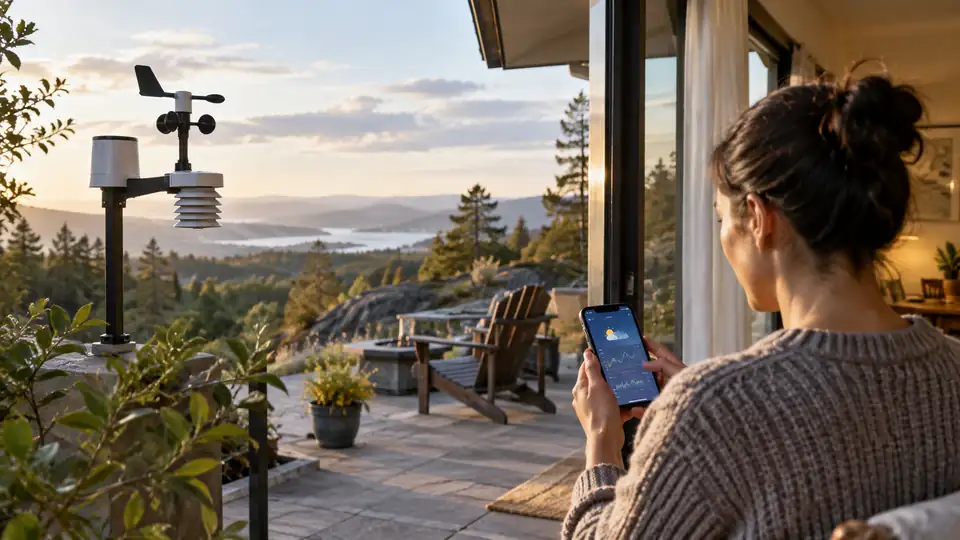
A weather station for remote monitoring has to do more than show temperature on a console in the kitchen. The outdoor sensor must collect useful local observations, while the station or gateway needs a supported path to Wi-Fi, an app, a cloud dashboard, or a weather network that you can reach away from home. Wind, rainfall, humidity, pressure, and sensor placement matter too, especially for a cabin, greenhouse, garden, farm, or property that may sit unattended for days.
A wireless sensor link and Wi-Fi are separate things. A sensor array may send readings to a nearby display without putting those readings on the Internet. Likewise, an app may offer local setup or Bluetooth access without providing true away-from-home monitoring. The strongest options here, led by the Ambient Weather WS-2902, combine a complete outdoor station with clearly described Wi-Fi or app-based access. Stations that emphasize a display but provide less detail about remote access rank lower.
This comparison weighs measurements, connectivity, data history, alerts, sensor design, power, range, and setup demands. Different properties need different balances. A large display may matter most in a home office, while a greenhouse owner may care more about humidity history and extra sensors. A remote cabin may benefit from broad wireless coverage and cloud access, while a backyard observer may prefer a simpler station with fewer dependencies.
Quick Answer
- Ambient Weather WS-2902 is the strongest overall choice because it combines Wi-Fi access, remote monitoring, smart-home support, rainfall, wind, humidity, UV, and solar-radiation measurements.
- La Crosse Technology V42-PRO-INT is a strong alternative for buyers who want an app, custom alerts, rainfall history, a stated 400-foot transmission range, and extended forecast information.
- Sainlogic 5G WiFi Weather Station stands out for dual-band Wi-Fi, long listed wireless range, two years of local records, and Excel export.
- Ambient Weather WS-1965 offers a more focused connected setup with a color console, 16-second console updates, and the core measurements many homes need.
For a quick side-by-side view, the table below shows how the leading choices differ before the detailed reviews.
Best Weather Stations for Remote Monitoring Comparison Table
| Product | Remote Access | Measurements | Data Features | Best For |
|---|---|---|---|---|
| Ambient Weather WS-2902 | Wi-Fi, app, smart-home support | Wind, temperature, humidity, rain, UV, solar radiation | Alerts, Ambient Weather Network | Best overall connected station |
| La Crosse Technology V42-PRO-INT | Wi-Fi and La Crosse View app | Wind, rain, temperature, humidity | Alerts, historical records, extended forecast | App alerts and forecast detail |
| Sainlogic 5G WiFi Weather Station | Dual-band Wi-Fi and app | Rain, wind, temperature, humidity | Two-year storage, Excel export | Data logging and larger properties |
| Sainlogic Smart Weather Station | Dual-band Wi-Fi, Bluetooth, app | Rain, wind, temperature, humidity | Two-year storage, Excel export | Historical monitoring |
| Ambient Weather WS-1965 | Wi-Fi, app, smart-home support | Wind, temperature, humidity, pressure, rain | 16-second console updates, alerts | Focused connected monitoring |
| AcuRite Iris 01544M | Direct-to-Wi-Fi, Weather Underground | Wind, temperature, humidity, pressure, rain | Alerts, heat index, dew point | Weather network sharing |
| AcuRite Iris 01536M | PC connection, My AcuRite, Weather Underground | Wind, temperature, humidity, pressure, rain | Remote monitoring, forecast | PC-connected monitoring |
| Ambient Weather WS-2000 | Wi-Fi network connection | Wind, temperature, humidity, rain, UV, solar radiation | Metric or imperial units, calibration | Detailed console viewing |
| Smart WiFi Weather Station | 2.4GHz Wi-Fi and Tuya app | Temperature and humidity | History, alerts, five-day forecast | Low-cost indoor/outdoor monitoring |
The reviews below explain the practical differences between these connected weather stations, including what each one measures and what its remote-monitoring setup requires.
1. Ambient Weather WS-2902 Wi-Fi Smart Weather Station — Best Overall
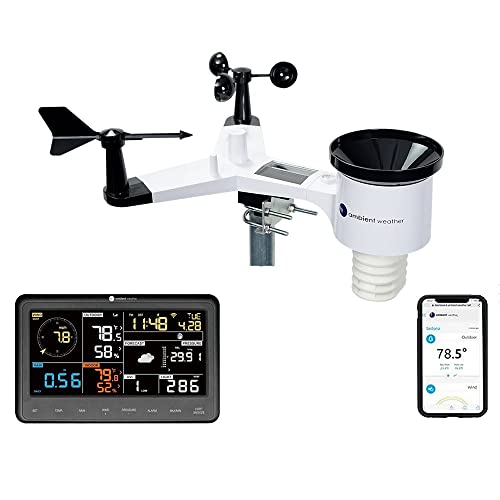
The WS-2902 earns the top position by matching the central need of remote monitoring with a genuinely complete sensor package. Its Osprey array measures outdoor temperature, humidity, wind speed, wind direction, rainfall, UV intensity, and solar radiation, then connects through Wi-Fi for remote access and alerts. That combination gives a property owner more useful context than a temperature-only monitor. A quick look at a phone can tell you whether a cold snap, wet garden, or strong wind event is developing, while the color display keeps local readings visible inside.
Its smart-home support adds another layer for users who want weather conditions to trigger routines through IFTTT, Google Home, Alexa, and other supported services identified in the listing. The station can also connect to the Ambient Weather Network, where users can customize dashboard tiles and share local observations. The outdoor array still needs thoughtful placement, and the listing does not remove the practical effects of walls, roofs, trees, or nearby heat sources. Still, this is the most balanced package for a connected home or property where broad local measurements matter.
Pros
- Wi-Fi supports remote access and weather-based alerts.
- Measures wind, temperature, humidity, rainfall, UV intensity, and solar radiation.
- Includes an Osprey sensor array and color LCD display.
- Supports IFTTT, Google Home, and Alexa integrations as listed.
- Can connect with the Ambient Weather Network.
Cons
- The outdoor array requires careful placement for useful wind, rain, and temperature readings.
- The listing does not specify a wireless transmission distance or detailed data-export method.
This is the best fit for someone who wants a complete personal weather station rather than a remote thermometer. It makes particular sense for gardens, backyards, and homes where rainfall, wind, and solar conditions are useful alongside temperature and humidity. Buyers who need a simple two-sensor monitor may find its broader array and connected features excessive, while users who mainly want a local console can spend less. For the widest combination of local sensing and remote access, however, the WS-2902 is the clearest starting point.
To buy this product, click here.
2. La Crosse Technology V42-PRO-INT Smart Wi-Fi Weather Station — Best for App Alerts
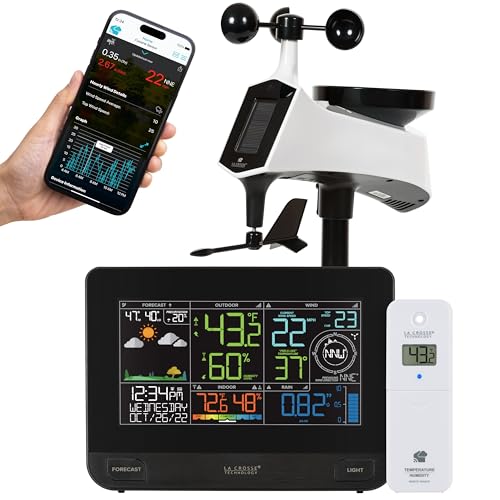
La Crosse takes a different route from Ambient Weather by putting considerable attention on forecast presentation, alerts, and historical views. The station displays wind speed and direction, rainfall records, indoor and outdoor temperature, and humidity. Once connected to Wi-Fi, the La Crosse View app provides backyard monitoring with customizable alerts and notifications. For a homeowner who wants a phone prompt when conditions cross a chosen threshold, that app-centered approach is especially practical.
The system also lists a transmission range of up to 400 feet and an outdoor temperature range of -40°F to 140°F. Those figures describe the product information, not a guarantee through walls or across every property. The station includes a temperature/humidity sensor and a wind/rain sensor, while the console uses a 5V adapter and includes a CR2032 backup battery that retains data rather than powering the system. Its Wi-Fi-enhanced information can include UV index, sunrise and sunset, thunderstorms, air quality, and extended forecast information, making it appealing to users who want a broader dashboard than raw sensor readings alone.
Pros
- La Crosse View app supports remote monitoring and customizable alerts.
- Includes wind, rain, temperature, and humidity monitoring.
- Lists up to 400 feet of transmission range in favorable conditions.
- Provides rainfall graphs, historical records, and high/low records.
- Wi-Fi adds forecast, UV, sunrise and sunset, thunderstorm, and air-quality information.
Cons
- The console needs the included 5V adapter for normal operation.
- Sensor batteries are required and are not included for the listed outdoor components.
The V42-PRO-INT suits a property owner who values alerts and readable forecast information as much as direct observations. It is a strong alternative to the WS-2902 if app notifications and forecast views are the main attraction. Buyers who want solar radiation data or a clearly described smart-home ecosystem may prefer Ambient Weather instead. Its stated range is useful for planning placement, but a detached building still deserves a careful signal check before final installation.
To buy this product, click here.
3. Sainlogic 5G WiFi Weather Station — Best for Data Export

Historical data is the reason to look closely at this Sainlogic model. The product information describes local storage for up to 24 months, with Excel export for reviewing temperature, humidity, rainfall, and other recorded conditions. That can be valuable at a garden or remote property where a single live reading only tells part of the story. A rain total from yesterday is useful, but a record of wet and dry periods across a season can inform watering, maintenance, or travel planning.
The station uses dual-band 5GHz and 2.4GHz Wi-Fi and Bluetooth pairing for setup, while the outdoor system has a listed open-area wireless range of up to 443 feet. Its sensor package measures temperature, humidity, rainfall, wind, and related weather information. The rain gauge includes a built-in bubble level, and the listing gives rainfall accuracy claims of ±1 mm for rain under 15 mm and ±7 percent above 15 mm. Those are listing claims rather than independent verification, and leveling remains important. Export supports up to 30 days of data per export within the two-year storage cycle, so users working with long records should expect a little file management.
Pros
- Supports both 5GHz and 2.4GHz Wi-Fi according to the listing.
- Stores up to two years of weather data locally.
- Exports records to Excel for personal analysis.
- Includes rainfall, wind, temperature, and humidity monitoring.
- Lists an open-area wireless range of up to 443 feet.
Cons
- Each export supports up to 30 days within the two-year storage cycle.
- Range and rainfall claims come from the listing and are affected by installation conditions.
This is a sensible pick for someone who wants to look back rather than merely glance at current conditions. The Excel capability gives it a clear edge over stations whose history stays inside an app or console. It may be more record-focused than a casual homeowner needs, and the 443-foot figure should be treated as a favorable open-area maximum. For a large yard, garden, or remote property where seasonal records matter, its data architecture is the main attraction.
To buy this product, click here.
4. Sainlogic Smart Weather Station — Best for Long-Term Backyard Records

This Sainlogic model is closely related in purpose to the dual-band station above, but its presentation emphasizes smart monitoring for home, garden, and backyard use. The listing describes a Swiss sensor chip with stated temperature precision of ±0.2°C and humidity precision of ±1.8 percent RH. Those figures should be read as published product claims, not as independent test results. The station also records rainfall, wind, temperature, and humidity, allowing the same system to follow both daily conditions and longer seasonal patterns.
Remote access uses dual-band Wi-Fi and a mobile app, while Bluetooth is described as a quick pairing method. The outdoor link is listed at up to 443 feet in open areas. A bubble level is built into the rain gauge, a small but useful installation aid because a tilted gauge can affect collection. Two years of local storage and Excel export make the station more useful for someone tracking a greenhouse environment, irrigation decisions, or recurring weather patterns. The listing says export is available in 30-day segments, so the feature is substantial but not a one-click archival solution for the entire record.
Pros
- Dual-band Wi-Fi supports connection to 5GHz and 2.4GHz networks.
- App provides remote access to indoor and outdoor readings.
- Stores up to two years of records without a listed subscription fee.
- Rainfall history can be reviewed by hour, day, month, and year.
- Includes a bubble level for rain-gauge installation.
Cons
- The listing does not clearly distinguish every detail between this model and closely related Sainlogic configurations.
- Temperature and humidity precision figures are published claims, not independent verification.
Choose this version if historical access and app monitoring matter more than a highly specialized measurement set. It is a practical fit for a garden, greenhouse-adjacent space, or home where humidity and rainfall records can guide routine decisions. Buyers who want UV or solar-radiation readings should look toward Ambient Weather instead. Buyers comparing the two Sainlogic models should confirm the exact listing and included configuration before ordering because the product descriptions are very similar.
To buy this product, click here.
5. Ambient Weather WS-1965 Wi-Fi Weather Station — Best Focused Ambient Weather Option
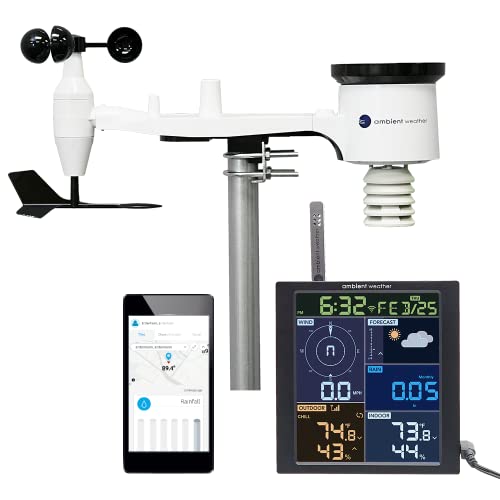
The WS-1965 trims the Ambient Weather measurement set to the core observations many properties actually use. Its all-in-one array measures temperature, humidity, barometric pressure, wind speed, wind direction, and rainfall. The console is described as receiving real-time updates every 16 seconds, which can make changing wind or temperature conditions easier to follow locally. Wi-Fi enables remote access, alerts, smart-home programming through supported services, and connection with the Ambient Weather Network.
Compared with the WS-2902, this model does not list UV intensity or solar radiation in its supplied feature information. That omission is meaningful for someone tracking sun exposure or solar conditions, but irrelevant for a user focused on rain, wind, temperature, and humidity. The all-in-one array keeps the physical system fairly straightforward, although a single assembly still means placement choices affect several measurements at once. Its color display and connected features create a well-balanced setup for a home that wants remote access without paying for every available weather variable.
Pros
- Wi-Fi supports remote access, alerts, and smart-home programming.
- Measures temperature, humidity, pressure, wind speed, wind direction, and rainfall.
- Lists 16-second real-time updates on the console.
- Connects with the Ambient Weather Network.
- Includes a color LCD display and all-in-one sensor array.
Cons
- UV intensity and solar radiation are not listed among this model’s measurements.
- The listing does not provide a transmission-range figure.
The WS-1965 makes sense for a home or property where the essential weather variables matter more than UV and solar-radiation data. It is easier to justify than a more elaborate station if the main questions are, “How windy is it?” “How much rain fell?” and “What are the indoor and outdoor conditions?” Buyers who need the broader sensor set should move up to the WS-2902. For a focused connected station, this is a clean and capable alternative.
To buy this product, click here.
6. AcuRite Iris 01544M 5-in-1 Weather Station — Best for Weather Underground
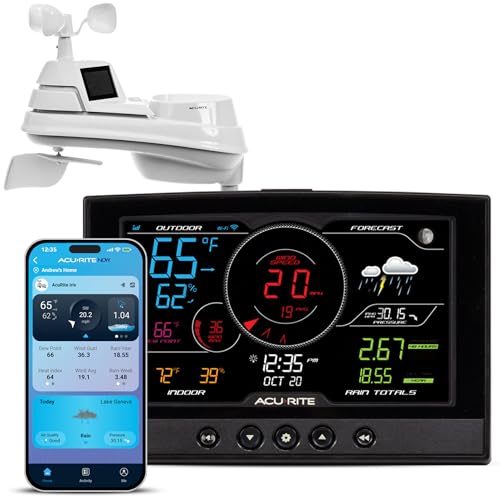
The AcuRite Iris 01544M is a direct-to-Wi-Fi option aimed at users who want local observations connected with Weather Underground. Its outdoor sensor reports temperature, humidity, wind speed, wind direction, barometric pressure trends, and rainfall totals. The display also presents heat index, dew point, and feels-like temperature. Those latter values are calculated or derived from measured conditions, so they should be understood as useful interpretations rather than separate sensor measurements.
Its in-sensor barometer contributes to a personalized 12-hour forecast, while Wi-Fi connectivity supports sharing data with Weather Underground. That makes this model a strong choice for someone already interested in contributing observations to a weather network. The supplied information does not describe every app, export, or alert function in detail, so buyers who want extensive historical files should look more closely at the Sainlogic choices. Still, the blend of five-in-one outdoor sensing, direct Wi-Fi language, and network compatibility gives it a clear identity.
Pros
- Direct-to-Wi-Fi design supports connection with Weather Underground.
- Measures outdoor temperature, humidity, wind speed, wind direction, pressure trends, and rainfall.
- Displays heat index, dew point, and feels-like temperature.
- Includes a personalized 12-hour forecast based on current conditions.
- Provides a clear path for sharing personal weather observations.
Cons
- The supplied information does not clearly specify a transmission-range figure.
- Detailed data-export and long-term storage capabilities are not identified.
Pick the 01544M if Weather Underground participation is more important than UV, solar-radiation, or extended export features. Its direct Wi-Fi positioning makes it more relevant to remote access than a local-only Iris station. Buyers who want spreadsheet-ready history should favor Sainlogic, while users interested in smart-home routines should look at Ambient Weather. The five-in-one label is product-specific, so its actual measurement list matters more than the number in the name.
To buy this product, click here.
7. AcuRite Iris 01536M 5-in-1 Weather Station — Best for PC-Connected Monitoring
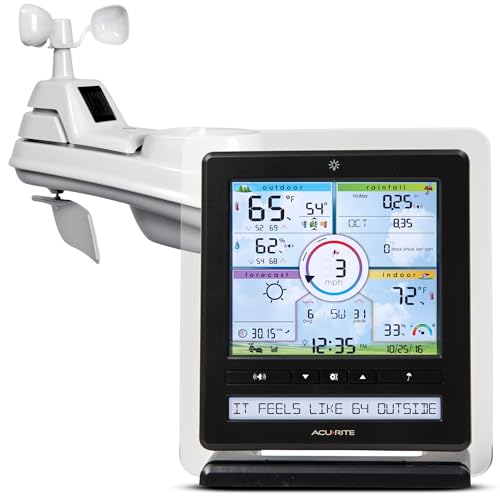
The 01536M is a useful choice for readers who want a traditional color display with a stated path to PC-connected remote monitoring. Its outdoor system measures temperature, humidity, wind speed, wind direction, barometric pressure, and rainfall, while the console shows time, date, and current conditions with an adjustable dimmer. The product information specifically describes connecting the display to a PC for access through the My AcuRite app and Weather Underground, which gives this station a stronger remote-monitoring case than a basic wireless console.
The station also uses pressure and temperature changes to create a personalized 12-hour forecast. Its built-in anemometer, wind vane, barometer, hygrometer, rain gauge, and thermometer provide a broad set of local observations in one system. The supplied information does not spell out every setup dependency for PC connection, so buyers should confirm the current connection requirements before ordering. Compared with the newer direct-to-Wi-Fi 01544M, this model is better suited to someone comfortable with a computer-linked monitoring arrangement.
Pros
- Supports PC connection for My AcuRite remote monitoring.
- Connects with Weather Underground according to the listing.
- Measures temperature, humidity, wind, pressure, and rainfall.
- Includes a large illuminated color LCD display with adjustable dimming.
- Provides a personalized 12-hour forecast from pressure and temperature changes.
Cons
- PC-connected monitoring may involve more setup than a direct app-based station.
- The supplied information does not specify long-term export or storage duration.
This model is best for a user who already prefers computer-based weather records or wants a station tied to the AcuRite ecosystem. It is less attractive for someone who wants the simplest possible phone setup, where a newer direct-Wi-Fi design may feel more natural. The station’s strength is its defined PC and Weather Underground pathway, not a large list of extra measurements. That focused role keeps it relevant for a particular monitoring workflow.
To buy this product, click here.
8. Ambient Weather WS-2000 Smart Weather Station — Best for Detailed Console Viewing
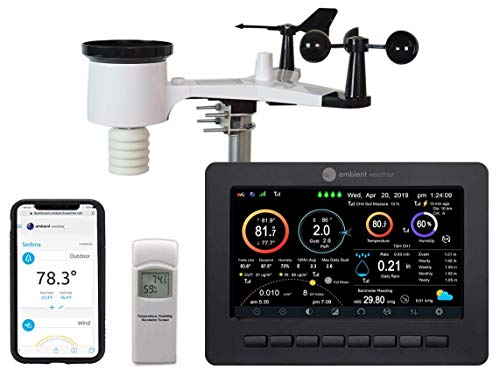
The WS-2000 is built around a TFT color display and an integrated outdoor sensor array that measures wind speed, wind direction, temperature, humidity, rainfall, UV, and solar radiation. It supports imperial and metric units, and the listing identifies calibration as available. That combination is useful for households where several people check the console during the day, since the screen can provide a broad local snapshot without opening a phone.
Its enhanced Wi-Fi connection can transmit station data to the Ambient Weather Network, giving the system a route beyond the room where the display sits. The supplied information is less specific than the top-ranked products about app behavior, alerts, and remote access, so it should not be selected solely on the assumption that every Wi-Fi feature is identical across models. The console uses a 5V DC adapter, while the outdoor sensor array requires three AAA batteries that are not included. Those details matter for a cabin or outbuilding where power and maintenance need planning.
Pros
- Measures wind, temperature, humidity, rainfall, UV, and solar radiation.
- Includes a TFT color display for detailed local viewing.
- Supports imperial and metric units.
- Allows calibration according to the product information.
- Can transmit data to the Ambient Weather Network through enhanced Wi-Fi.
Cons
- Outdoor sensor batteries are required and not included.
- The supplied information does not clearly detail every remote-access or alert function.
The WS-2000 suits a connected home that gives the display a central role. Its measurement set is broad, and calibration plus unit selection adds useful flexibility for different users. Buyers who plan to monitor a property primarily from away should compare its described remote functions carefully with the WS-2902 or WS-1965. It remains a credible choice for those who want a rich console and a path to networked data rather than a phone-only experience.
To buy this product, click here.
9. Smart WiFi Weather Station with Tuya App Control — Best Compact Budget Option

This compact station approaches remote monitoring from the indoor environment outward. It measures temperature and humidity, sends readings to a phone through the Tuya app, stores historical trends, and supports custom high and low alerts. A five-day forecast display, alarm clock, and adjustable four-level brightness make the console useful in a bedroom, office, or living room. The system supports up to three sensors, with one included, so additional locations can be monitored if compatible sensors are obtained.
There is a clear power distinction here. Battery operation provides basic weather data, while Wi-Fi and app functions require the station to be plugged into a power adapter. The listing also specifies 2.4GHz Wi-Fi only. That makes this model easier to place near an outlet than at an off-grid cabin, but it can be a tidy solution for checking a nursery, basement, garage, or greenhouse temperature from away. It does not measure wind, rainfall, or barometric pressure, so it is a remote environmental monitor rather than a full outdoor weather station.
Pros
- Tuya app supports remote temperature and humidity monitoring.
- Provides historical trends and custom temperature alerts.
- Supports up to three sensors, with one included.
- Offers a five-day forecast and adjustable screen brightness.
- Uses a USB port and provides two power modes.
Cons
- Wi-Fi and app functions require plug-in power.
- It does not measure wind, rainfall, UV, solar radiation, or barometric pressure.
This is the right choice for a reader whose remote-monitoring need is really about temperature and humidity at one or more indoor or sheltered locations. It costs less and demands less installation than a full sensor array, but its narrow measurement set makes it a poor match for rainfall or wind tracking. A greenhouse shelf, basement, or nursery may be a better setting than an exposed backyard. Check that the local network offers 2.4GHz access before buying.
To buy this product, click here.
Buying Guide
Remote Access Requires More Than a Wireless Outdoor Sensor
A sensor can communicate wirelessly with a console while remaining invisible from outside the property. True remote monitoring needs a supported Internet path through Wi-Fi, an app, a cloud service, a PC connection, or a named weather network. The WS-2902, WS-1965, La Crosse V42-PRO-INT, Sainlogic stations, and AcuRite models provide clearer evidence of connected access than a basic indoor/outdoor thermometer. Read the exact connection description rather than treating every use of the word “wireless” as Internet connectivity.
Wi-Fi and the Sensor Radio Solve Different Problems
Most complete weather stations use one link between the outdoor array and the console, then another link between the console and the home network. A listed transmission distance describes the first relationship, not guaranteed Internet access. Walls, metal buildings, floors, terrain, and interference can affect the actual result. The Sainlogic range figures and La Crosse range figure are useful for planning, but they should be treated as listed maximums under favorable conditions.
Choose Measurements That Match the Property
Temperature and humidity may be enough for a basement, nursery, or greenhouse corner. A garden or farm usually benefits more from rainfall, wind speed, and wind direction. UV and solar radiation are useful for readers who specifically track sun exposure or broader environmental conditions. The WS-2902 and WS-2000 list the broadest measurement sets here, while the Tuya station concentrates on temperature and humidity. More measurements add value only when they answer a real monitoring question.
Check Whether History Can Leave the App
Historical graphs are useful, but they are different from downloadable records. The Sainlogic models specifically describe two years of local storage and Excel export, although exports are handled in 30-day segments. Other products list historical records or app access without clearly identifying raw-data export. If you plan to compare rainfall across seasons, document greenhouse humidity, or maintain property records, storage and export deserve as much attention as the live dashboard.
Accuracy, Resolution, and Update Speed Are Separate
A display that changes in small increments does not automatically measure more accurately. Likewise, the WS-1965’s listed 16-second console updates describe refresh frequency, not sensor accuracy. Sainlogic publishes temperature and humidity precision claims, but those remain product-listing claims rather than independent verification. Compare like with like, and avoid treating extra decimal places or faster refreshes as proof of better measurement quality.
Installation Affects the Data
Rain gauges need level placement and an open exposure. Wind sensors need moving air rather than a sheltered corner beside a wall or roof. Temperature and humidity sensors can be affected by direct sun, pavement, walls, and nearby heat sources. An integrated array simplifies wiring and setup, but several measurements share the same placement. Before ordering, check where the array can go, how the console will receive its signal, and which components need batteries or continuous power.
Confirm Included Components and Power Requirements
A complete system may include the outdoor array, console, and power adapter while still requiring separate batteries. The WS-2000 listing specifies three AAA batteries for the sensor array, and La Crosse lists batteries for its outdoor sensors. The Tuya station offers battery operation for basic readings but requires plug-in power for Wi-Fi and app features. Remote properties need a realistic plan for console power, sensor batteries, network availability, and occasional maintenance.
Best Weather Stations for Remote Monitoring FAQ
What is the best weather station for remote monitoring?
The Ambient Weather WS-2902 is the strongest overall choice in this comparison because it combines Wi-Fi access with temperature, humidity, rainfall, wind, UV, and solar-radiation measurements. It also lists alerts, smart-home support, and Ambient Weather Network connectivity. A different station may fit better if you need Excel export, Weather Underground sharing, or only temperature and humidity.
Does wireless mean the weather station supports remote monitoring?
No. Wireless often describes the connection between an outdoor sensor and a nearby console. Remote monitoring requires an additional supported connection to Wi-Fi, an app, a cloud service, a PC, or a weather network. Check the product’s exact connectivity description before assuming you can view readings away from the property.
Which weather station is best for historical data?
The Sainlogic 5G WiFi Weather Station and Sainlogic Smart Weather Station list up to two years of local storage and Excel export. The product information says exports are handled in 30-day segments. That makes these models especially relevant for seasonal weather records, rainfall tracking, gardening notes, and property maintenance.
Can these weather stations monitor rainfall remotely?
Several can. The Ambient Weather WS-2902, WS-1965, and WS-2000, La Crosse V42-PRO-INT, both Sainlogic models, and the AcuRite Iris stations list rainfall measurement. The Tuya station does not list a rain gauge. Rainfall readings still depend on proper gauge placement, level installation, and unobstructed exposure.
What is the difference between Wi-Fi and Bluetooth on a weather station?
Wi-Fi normally connects a console or gateway to the home network and can support Internet-based access when the product and service provide it. Bluetooth usually assists with short-range setup or local device communication. The Sainlogic listings describe Bluetooth quick pairing alongside dual-band Wi-Fi, but those are separate functions.
Do these stations support Weather Underground?
The AcuRite Iris 01544M and 01536M listings specifically mention Weather Underground. The Sainlogic 5G model also names Weather Underground support. Ambient Weather products in this comparison identify Ambient Weather Network connectivity instead. Do not assume that a station supports every weather platform simply because it has Wi-Fi.
Is the advertised wireless range guaranteed inside a home?
No. The stated range is generally a favorable open-area maximum. Walls, floors, metal structures, terrain, and interference can reduce communication distance. La Crosse lists up to 400 feet, while the Sainlogic models list up to 443 feet in open areas. Use those figures for planning, not as a guarantee through a particular building.
Can a temperature and humidity monitor replace a full weather station?
Only when those are the measurements you need. The Tuya station can provide remote temperature and humidity readings, history, alerts, and multiple sensor channels. It does not list wind, rainfall, UV, solar radiation, or barometric pressure. A complete outdoor station is more suitable for garden, farm, or property monitoring that depends on wind and rain.
Final Verdict
The Ambient Weather WS-2902 is the strongest overall choice for remote monitoring because its supported connected features align with a broad set of real property questions. It measures temperature, humidity, wind, rainfall, UV, and solar radiation, while Wi-Fi provides remote access, alerts, smart-home options, and Ambient Weather Network connectivity. The La Crosse V42-PRO-INT is the best alternative for app alerts, forecast views, and rainfall history. Its listed 400-foot transmission range is useful for planning, although actual placement still matters.
For readers who care most about records, the Sainlogic 5G and Sainlogic Smart stations offer the clearest storage and Excel-export story. The Ambient Weather WS-1965 is a more focused choice for essential weather measurements and a connected console, while the AcuRite models make sense for Weather Underground or PC-based monitoring. If your needs stop at temperature and humidity, the Tuya station avoids the cost and installation demands of a full array. Match the station to the measurements, power, network, and data history you will genuinely use, then install the outdoor sensors where exposure supports useful readings.