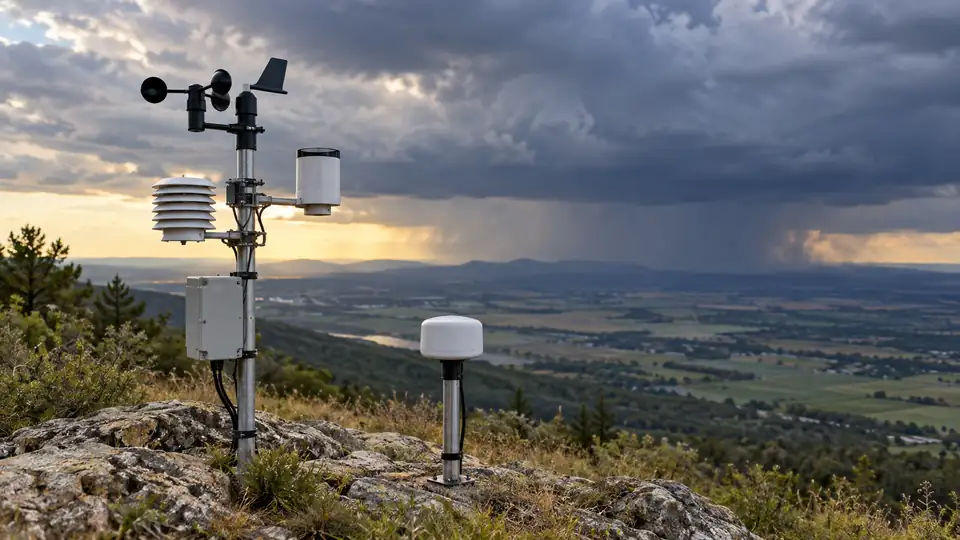
A lightning detector changes the buying decision. A basic home weather station can show temperature, humidity, wind, pressure, and rainfall, but a station suited to thunderstorm monitoring must also identify nearby lightning activity and communicate that information clearly. The useful details are the detection range, storm-distance estimate, strike counter, audible or visual alerts, and whether the system gives you a local display, app access, or both.
Connectivity also deserves careful attention. Wireless sensor transmission from an outdoor array to a console is different from Wi-Fi, and Wi-Fi does not automatically mean app access or remote monitoring. Sensor placement matters too. A wind sensor needs open exposure, a rain gauge needs a suitable location, and lightning alerts should be treated as awareness tools rather than a guarantee of safety. The AcuRite Iris 5-in-1 with Lightning Detection stands out as the strongest all-around starting point because it combines core weather measurements with lightning distance estimates, strike totals, alerts, and a dedicated color display.
The recommendations below range from full personal weather stations to compact lightning-monitoring devices and a compatible detector for an existing system. The rankings weigh genuine lightning capability first, then measurement coverage, data access, installation, portability, and the practical trade-offs that separate a backyard console from a device made for a golf bag or campsite.
Quick Answer
- Best Overall: AcuRite Iris 5-in-1 01022M combines indoor and outdoor weather readings, rainfall, wind, pressure, a color display, and onboard lightning detection.
- Best Connected Station: AcuRite Optimus 01216MCB adds Wi-Fi, mobile monitoring, smart-home compatibility, and a compact six-in-one sensor with lightning detection.
- Best for Wi-Fi and Weather Underground: AcuRite Iris 01532M brings lightning detection, a high-definition display, app alerts, and Weather Underground connectivity.
- Best Portable Option: AcuRite Portable Lightning Detector 02021 fits mobile outdoor use with a belt clip, backlit screen, audible alerts, and indoor and outdoor modes.
Best Weather Stations With Lightning Detector Comparison Table
| Product | Measurements or Detection | Connectivity and Display | Best For |
|---|---|---|---|
| AcuRite Iris 01022M | Temperature, humidity, wind, pressure, rain, lightning | Wireless color LCD, alerts | Complete home monitoring |
| AcuRite Atlas 01001M | Temperature, humidity, wind, pressure, rain, UV, light, lightning | Direct-to-Wi-Fi HD display, Weather Underground | Connected, detailed monitoring |
| AcuRite Weather Station Forecaster 01071 | Indoor/outdoor temperature and humidity, pressure, lightning | Wireless outdoor sensor, indoor alerts | Simple storm awareness |
| AcuRite Optimus 01216MCB | Temperature, humidity, rain, wind, lightning | Wi-Fi HD display, app, smart-home support | Connected compact installations |
| AcuRite Iris 01532M | Temperature, humidity, wind, pressure, rain, lightning | HD display, Wi-Fi, app, Weather Underground | Remote alerts and weather sharing |
| Tempest Weather Station | Temperature, humidity, pressure, wind, rain, UV, solar radiation, lightning | Wireless sensor, app, Alexa, smart-home platforms | Advanced connected monitoring |
| AcuRite Portable Lightning Detector 02021 | Lightning activity, distance estimate, strike count | Backlit display, audible and LED alerts, USB-C | Camping, golf, and job sites |
| AcuRite Portable Lightning Detector 02020 | Lightning activity, distance estimate, strike count | Audible alarm, warning light, backlight | Compact storm awareness |
| Ambient Weather WH31L | Lightning detection within listed range | 915 MHz sensor for WS-2000 and WS-5000 | Adding lightning detection to a compatible system |
The detailed reviews explain which products provide a complete weather picture and which focus more narrowly on lightning awareness, portability, or system expansion.
1. AcuRite Iris 5-in-1 01022M — Best Overall
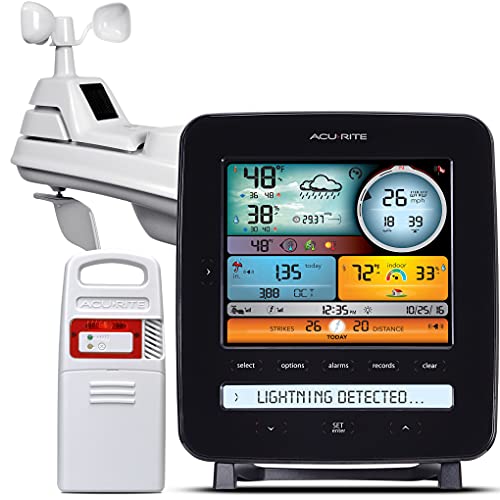
The AcuRite Iris 01022M brings the pieces most households actually use into one console. Its outdoor system reports temperature, humidity, wind speed, wind direction, barometric pressure, and rainfall, while the lightning function estimates the distance to lightning-producing storms and maintains running, weekly, and monthly strike totals. That combination gives a patio, garden, cabin, or backyard a much fuller weather picture than a standalone lightning alarm.
The color LCD display is built for at-a-glance checks, with time, date, auto-dimming brightness, programmable notifications, and a ticker that surfaces changing conditions and alerts. The system also provides derived information such as heat index, dew point, feels-like temperature, pressure trends, and a short hyperlocal forecast. Installation still affects the quality of wind and rain readings, so the included outdoor mounting arrangement should be placed where buildings, roofs, and trees interfere as little as practical.
Pros
- Measures indoor and outdoor temperature and humidity, wind, pressure, and rainfall.
- Detects lightning and estimates the distance to the producing storm.
- Tracks running, weekly, and monthly lightning totals.
- Color display includes alerts, auto-dimming, and a weather ticker.
- Provides a broad selection of historical and calculated weather information.
Cons
- The supplied information does not identify Wi-Fi or app-based remote access for this model.
- Outdoor readings depend on suitable placement and mounting exposure.
This is the strongest fit for someone who wants a complete local weather station with meaningful storm information and does not need phone access as the primary interface. Buyers focused on cloud monitoring or smart-home automation should look at the Optimus, Iris 01532M, or Tempest instead. For a kitchen counter or home office where a quick glance matters, though, the dedicated display and broad measurement set make this a balanced first choice.
To buy this product, click here.
2. AcuRite Atlas 01001M — Best for Detailed Connected Monitoring

The Atlas 01001M steps up the information density without losing the lightning-focused purpose of this roundup. Its outdoor system measures temperature, humidity, wind speed and direction, barometric pressure, rainfall, UV, and light intensity, while lightning detection reaches up to the listed 25-mile distance. For a property where changing wind, rain, sun exposure, and thunderstorm activity all matter, that wider sensor mix is useful.
Its direct-to-Wi-Fi HD display supports Weather Underground connectivity, so the system can share weather data with that platform rather than keeping every observation confined to the console. The display also has a battery-backup option for saving settings and data during a power interruption. The included mounting hardware and display stand simplify setup, but a system with this many outdoor measurements still benefits from thoughtful placement instead of being attached wherever it is most convenient.
Pros
- Combines lightning detection with UV and light-intensity measurements.
- Provides indoor and outdoor weather data, including wind and rainfall.
- Supports direct Wi-Fi connectivity to Weather Underground.
- Uses an HD display with tabletop and wall-mounting options.
- Offers an optional battery backup for the display.
Cons
- The larger measurement set may be more than needed for simple storm alerts.
- The available information does not specify the exact requirements for every connected service.
Atlas makes sense for a connected home, RV base, or larger property where local observations and online sharing belong in the same setup. It ranks below the top pick because its extra data and connectivity bring more configuration decisions. Choose it when UV, light intensity, Weather Underground, and a high-definition display matter more than keeping the system as simple as possible.
To buy this product, click here.
3. AcuRite Weather Station Forecaster 01071 — Best for Simple Storm Awareness
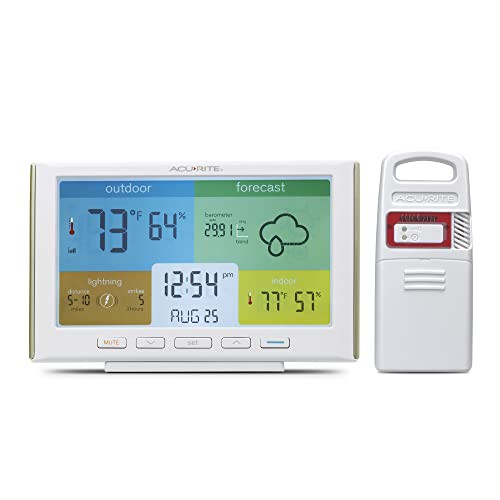
A thunderstorm monitor does not always need a rain gauge, wind vane, or crowded dashboard. The Weather Station Forecaster 01071 focuses on indoor and outdoor temperature, humidity, barometric pressure, and lightning detection. Its outdoor sensor detects cloud-to-cloud, cloud-to-ground, and intracloud lightning within the listed 25-mile range, then sends audible and visual alerts to the indoor display.
That narrower measurement set can be a virtue in a hallway, bedroom, workshop, or small home where the main question is whether storm activity is approaching. The station also estimates lightning distance, stores daily high and low temperature and humidity readings, and displays heat and freeze warnings at the stated thresholds. It gives up rainfall and wind monitoring, so it should be viewed as a focused weather-and-storm station rather than a full outdoor observation platform.
Pros
- Includes a wireless outdoor sensor with lightning detection.
- Detects several lightning types within the listed 25-mile range.
- Provides audible and visual indoor alerts.
- Shows estimated lightning distance and pressure trends.
- Includes heat-index and freeze alerts.
Cons
- It does not provide outdoor wind or rainfall measurements.
- The available information does not identify Wi-Fi, app, or remote-monitoring support.
This model suits someone who wants storm awareness without managing a full five-in-one array. It is particularly sensible for a smaller indoor display location where temperature and humidity are useful but rainfall totals are secondary. Select a more comprehensive station if you want to track garden watering, wind direction, or rain events alongside lightning.
To buy this product, click here.
4. AcuRite Optimus 01216MCB — Best Compact Connected Station

Optimus takes a modern, compact approach to full weather monitoring. Its outdoor sensor measures temperature, humidity, rainfall, wind speed, wind direction, and lightning, while the high-definition display presents more than 20 data points and a forecast covering the next 12 to 24 hours. The compact form is especially relevant for an apartment balcony, a deck, or a property with strict appearance rules.
The connected side is stronger than the basic Iris setup. The AcuRite NOW app provides current measurements, alerts, and historical data away from the display, while the listing also identifies compatibility with Google Home, Amazon Alexa, and smart thermostats. The sensor uses an internal aspirating fan for temperature and humidity readings, and the product information lists wind-direction precision within 1 degree. Those are useful specifications, but they do not remove the need for sensible placement around walls, roofs, and heat sources.
Pros
- Measures six key outdoor conditions, including lightning.
- Provides app access to current readings, alerts, and historical data.
- Supports Google Home, Amazon Alexa, and smart thermostats.
- Compact sensor design suits tighter outdoor spaces.
- Includes a high-definition display with a 12-to-24-hour forecast.
Cons
- The available information does not detail every app or smart-home function.
- A compact sensor may offer less placement flexibility than separate instruments.
Optimus is the better direction for someone who wants lightning detection tied to phone access and home automation without a visually large outdoor installation. It gives up some of Atlas’s listed UV and light-intensity measurements, but its connectivity and compact architecture may matter more in everyday use. Check the current listing for network and service requirements before ordering.
To buy this product, click here.
5. AcuRite Iris 01532M — Best for App Alerts and Weather Underground
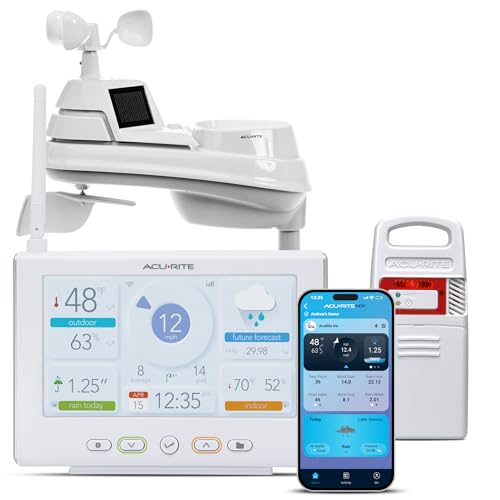
The Iris 01532M is built around the idea that a weather station should remain useful after you leave the house. Its sensor system measures indoor and outdoor temperature and humidity, wind speed and direction, pressure, rainfall, and lightning activity up to the listed 25-mile distance. The high-definition display keeps the local experience straightforward, with a fold-out tabletop stand, time, date, and full-color weather information.
Its Wi-Fi display connects with the AcuRite NOW app for notifications and away-from-home viewing, and the listing identifies Weather Underground connectivity as well. That distinction matters. The outdoor sensor link is wireless, while Wi-Fi is used for connected services. The station also supplies heat index, dew point, feels-like temperature, pressure trends, and a short personalized forecast, giving storm alerts useful surrounding context rather than presenting lightning as an isolated number.
Pros
- Combines lightning detection with rainfall, wind, pressure, temperature, and humidity.
- Supports AcuRite NOW app alerts and remote viewing according to the listing.
- Connects to Weather Underground.
- Uses a high-definition color display with tabletop support.
- Shows useful calculated conditions such as dew point and heat index.
Cons
- Wi-Fi-based features depend on the connected display and network setup.
- The available information does not specify data-export functions.
This is a strong choice for a household that wants a traditional console on the counter plus phone notifications when a storm is building. It ranks behind Optimus because the newer compact design and stated smart-home support may suit some connected homes better. Choose the Iris 01532M if Weather Underground and a familiar full-color display are more useful than a smaller outdoor sensor.
To buy this product, click here.
6. Tempest Weather Station — Best for Broad Connected Measurements
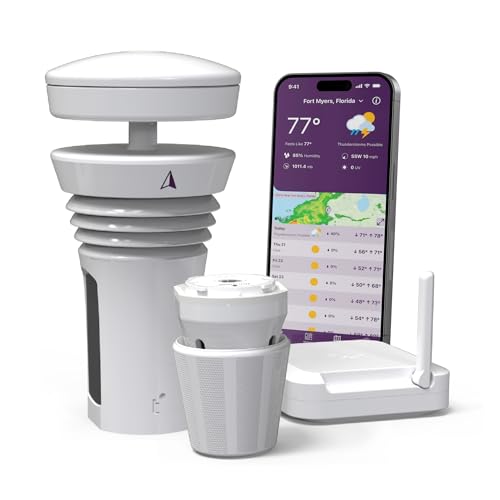
Tempest covers an unusually broad list of weather variables in one outdoor system. The product information identifies temperature, humidity, barometric pressure, wind speed and direction, dew point, solar radiation, UV index, rainfall, and lightning detection. It also reports real-time updates every three seconds and uses a wireless outdoor sensor with a listed range of more than 1,000 feet, though walls, terrain, and building materials can affect practical communication.
The solar-powered sensor has no moving parts, which may appeal to someone who wants a different maintenance profile from a conventional cup-and-vane array. Its connected ecosystem includes an app, Alexa, Rachio, IFTTT, and other smart-home platforms named in the listing. Solar power applies to the outdoor sensor described here, not automatically to every part of the system, so check the required console, network, and power arrangement before installation.
Pros
- Measures lightning alongside temperature, humidity, pressure, wind, rain, UV, and solar radiation.
- Lists real-time updates every three seconds.
- Uses a solar-powered outdoor sensor with no moving parts.
- Supports app access and named smart-home integrations.
- Lists a wireless outdoor transmission range of more than 1,000 feet.
Cons
- The broader feature set may be unnecessary for a reader who mainly wants local alerts.
- The available information does not detail every power and service requirement.
Tempest fits a larger property, automation project, or data-focused setup where UV, solar radiation, rapid updates, and lightning all have a place. It is less compelling for a simple indoor console because much of its appeal comes from connected access and the wider measurement list. Treat the published range as a favorable maximum, then plan sensor placement around the actual buildings and terrain on the property.
To buy this product, click here.
7. AcuRite Portable Lightning Detector 02021 — Best Portable Option

The 02021 is for the moment when a full backyard station is overkill. Its pocket-size body has a belt clip, backlit display, audible alert, red LED, storm-distance estimate, and running strike count. The detector identifies cloud-to-ground, cloud-to-cloud, and intracloud lightning activity within the listed 25-mile distance, giving someone at a golf course, campsite, fishing spot, job site, or sideline a compact way to watch storm activity.
Indoor and outdoor modes are useful because portable electronics can face different interference conditions in a house, vehicle, or open area. The listing also identifies enhanced interference rejection, battery operation, and a USB-C power input. This is a lightning monitor rather than a complete weather station, so it does not replace temperature, rainfall, wind, or pressure measurements. Its strength is mobility and quick awareness, with controls and information that can be read without carrying a console.
Pros
- Detects three listed types of lightning activity within 25 miles.
- Combines audible, visual, and on-screen storm alerts.
- Includes a belt clip and compact portable design.
- Offers indoor and outdoor modes with interference rejection.
- Provides battery operation and USB-C power input.
Cons
- It does not measure temperature, humidity, rainfall, wind, or pressure.
- The available information does not identify app or cloud access.
This is the right tool for mobile storm awareness, not for building a weather record at home. Someone who spends weekends outdoors may prefer its belt clip and quick alert system, while a homeowner wanting rainfall and wind data should choose a complete station above. The 02021 earns its place because portability changes how lightning information can be used.
To buy this product, click here.
8. AcuRite Portable Lightning Detector 02020 — Best Compact Basic Detector
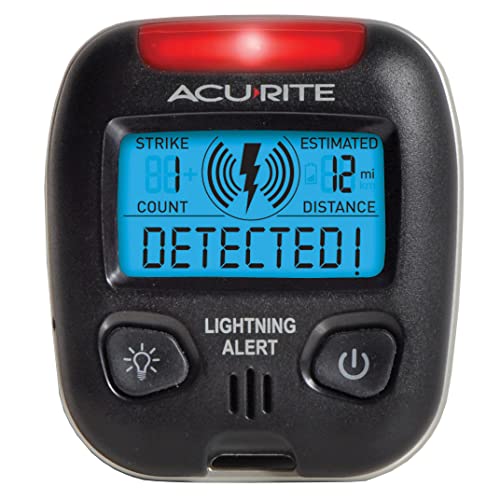
The AcuRite 02020 keeps the focus tight: detect lightning and make the information easy to notice. It identifies lightning bolts and storms within the listed 25 miles, estimates storm distance, counts detected strikes, and uses a warning light and audible alarm. A momentary backlight helps with low-light checks, such as looking at the display from a porch after the sky turns dark.
Its compact dimensions make it easier to carry than a full weather console, but the available information does not identify a belt clip or USB-C input for this model. That makes the newer 02021 more appealing for frequent travel, while the 02020 remains suitable for a drawer, porch table, campsite kit, or occasional outdoor event. It provides no wind, rain, temperature, or humidity data, so its value depends on whether lightning awareness is the primary need.
Pros
- Detects lightning and storms within the listed 25-mile range.
- Provides an estimated distance to the storm.
- Maintains a running lightning strike count.
- Uses both a warning light and audible alarm.
- Includes a momentary backlight for low-light viewing.
Cons
- It does not provide the measurements of a complete weather station.
- The available information does not identify USB-C power or a belt clip.
Choose the 02020 when a simple, dedicated lightning alert device is more useful than a multi-sensor system. It is easier to understand than a crowded weather dashboard, but less capable than the 02021 for active travel. For a fixed home installation, the Weather Station Forecaster offers more context through temperature, humidity, and pressure readings.
To buy this product, click here.
9. Ambient Weather WH31L Lightning Detector — Best Add-On for Compatible Systems

The WH31L serves a different buyer from the complete stations above. It is a dedicated lightning detector for Ambient Weather WS-2000 and WS-5000 systems, allowing an owner of one of those compatible stations to add lightning information without replacing the rest of the weather setup. The detector identifies lightning within the listed 25-mile range and communicates over 915 MHz to the compatible receiving system.
The sensor measures 4.75 by 1.5 by 0.6 inches and uses two included AA batteries. Its listed RF range reaches up to 330 feet, with the product information adding that 100 feet is typical in most conditions. That distinction is useful because walls, metal structures, and other obstacles can reduce communication distance. The stated 79-second refresh rate also makes this an add-on sensor for system-level monitoring rather than a handheld alert device.
Pros
- Adds lightning detection to compatible WS-2000 and WS-5000 systems.
- Detects lightning within the listed 25-mile range.
- Uses 915 MHz wireless communication.
- Includes two AA batteries.
- Lists both maximum and typical communication-distance figures.
Cons
- Compatibility is limited to the listed Ambient Weather models.
- It does not function as a standalone complete weather station.
The WH31L is a sensible purchase only for someone with the compatible Ambient Weather platform or a clear plan to build around it. It is more specialized than the other entries and cannot replace a display, outdoor sensor array, or full set of weather measurements. Its advantage is avoiding a complete system change when lightning detection is the missing piece.
To buy this product, click here.
Buying Guide
Start With the Lightning Function
Lightning detection should be a real onboard function, not a forecast icon or an Internet weather alert. Look for a stated detection range, strike counter, estimated storm distance, and the type of alert provided. A local audible or visual alert can be useful when you are working in another room, while a mobile notification matters more for someone away from the property. None of these features replaces sensible storm precautions.
Wireless Sensor Links Are Different From Wi-Fi
Most complete stations use a wireless link between the outdoor sensor and indoor console. That does not mean the station connects to your home network. Wi-Fi becomes relevant when you want app access, Weather Underground uploads, cloud history, or smart-home functions. The Atlas, Iris 01532M, Optimus, and Tempest offer connected features identified in their listings, while the local Iris 01022M focuses more on its dedicated display.
Choose Measurements That Match the Property
Rainfall and wind matter for a garden, farm, or exposed yard. Temperature and humidity may matter more in a greenhouse or garage-adjacent setup. UV and solar radiation can be useful for broader environmental monitoring, but they add little if your only question is whether lightning is approaching. More measurements make sense when you have a reason to use them.
Give Sensor Placement Real Attention
A weather station cannot correct every poor installation. Buildings and trees can disturb wind readings, roofs and pavement can affect temperature, and obstructions can alter rainfall collection. Wireless range is also a best-case communication figure. The Tempest listing gives a range above 1,000 feet, while the Ambient WH31L identifies both a maximum and a typical figure, but neither number guarantees performance through every wall or structure.
Check What Is Included
A complete station may include an outdoor sensor, display, and mounting hardware, while an add-on detector may require a compatible console. The Ambient WH31L is specifically for WS-2000 and WS-5000 systems. By comparison, the AcuRite portable detectors are self-contained lightning-monitoring devices. Before ordering, confirm whether batteries, mounting parts, a gateway, or a compatible console are part of the package.
Separate Accuracy From Resolution
A display that shows frequent updates or extra decimal places is not automatically more accurate. Accuracy describes closeness to a reference, while resolution describes the size of the displayed increment. The supplied product information does not provide comparable accuracy figures for every model here, so rankings should focus on supported measurements, sensor design, connectivity, and intended use rather than unsupported precision claims.
Best Weather Stations With Lightning Detector FAQ
What Is the Best Overall Weather Station With Lightning Detection?
The AcuRite Iris 5-in-1 01022M is the strongest overall choice for a local home setup. It combines temperature, humidity, wind, pressure, rainfall, lightning distance estimates, strike totals, alerts, and a color display. Choose the Optimus or Iris 01532M if app access and connected monitoring matter more than a primarily local console.
Do Wireless Weather Stations Have Wi-Fi?
No. Wireless usually describes the connection between an outdoor sensor and its indoor display. Wi-Fi connects a component to your home network and may enable app access or online sharing. A station can be wireless without offering Wi-Fi, so check the exact product description for network features.
Can These Stations Detect Lightning Far Away?
Several products list lightning detection within 25 miles, including the AcuRite Iris 01022M, Atlas, Weather Station Forecaster, Optimus, Iris 01532M, and portable detectors. The listed distance is a detection specification, not a guarantee of perfect performance in every environment. Treat alerts as storm awareness and follow appropriate safety guidance.
Which Models Offer Remote Monitoring?
The AcuRite Optimus lists the AcuRite NOW app for current measurements, alerts, and historical data. The Iris 01532M also identifies AcuRite NOW access and Weather Underground connectivity. Tempest lists app and smart-home support. The available information does not identify comparable remote access for the local-display Iris 01022M or Weather Station Forecaster.
Is a Portable Lightning Detector a Complete Weather Station?
No. The AcuRite 02020 and 02021 focus on lightning activity, storm distance, strike counts, and alerts. They do not provide the complete temperature, rainfall, wind, humidity, and pressure coverage of a personal weather station. Their advantage is portability for outdoor activities and temporary monitoring.
Can I Add Lightning Detection to an Existing Weather Station?
The Ambient Weather WH31L is identified as a lightning detector for WS-2000 and WS-5000 systems. The AcuRite 06045M is also described as a compatible replacement sensor for several AcuRite models, but it is not included among the ranked products here because it is a replacement sensor rather than a complete station. Confirm exact model compatibility before ordering an add-on.
Does a Lightning Detector Replace Severe Weather Alerts?
No. A detector gives local awareness of detected lightning activity, but it should not be treated as a complete warning service or a safety guarantee. A station’s estimated distance and strike count help you understand nearby activity, while official emergency information remains important during threatening weather.
Final Verdict
The AcuRite Iris 5-in-1 01022M is the best balanced choice for most homes because it combines the measurements people use daily with dedicated lightning detection, storm-distance estimates, strike history, and an easy-to-read color display. It gives you more context than a standalone detector without forcing every buyer into an app-centered setup. For connected monitoring, the AcuRite Optimus and Iris 01532M are stronger alternatives, with app access and online weather features identified in their listings.
Tempest is the more expansive option for broad connected measurements and smart-home projects, while the Weather Station Forecaster keeps the focus on temperature, humidity, pressure, and storm awareness. Outdoor travelers should choose the Portable Lightning Detector 02021, and owners of compatible Ambient Weather systems can use the WH31L as an add-on. Match the choice to the data you will actually use, the space available for sensors, and whether alerts need to reach you away from the console.