
A cellular weather station serves a very specific purpose: it keeps sending useful observations when the property does not have dependable local Wi-Fi. That makes cellular connectivity relevant for cabins, farms, construction sites, remote gardens, outbuildings, and locations where nobody can check a console every afternoon. Temperature, humidity, rainfall, wind, pressure, solar radiation, and alerts can matter far more than a colorful display sitting indoors.
The key distinction is easy to miss. A wireless sensor array usually communicates with its console over a short-range radio link, while Wi-Fi connects that console or gateway to a local network. Cellular hardware uses a mobile network instead. The ECOWITT WH6006E is the only product in this comparison that clearly provides 4G/3G cellular communication with SMS alerts, so it takes the top spot. The other selections are useful alternatives for properties with Wi-Fi or for buyers who value local monitoring, data logging, or broader smart-home access.
Installation still matters. A rain gauge needs level placement, wind sensors need clear exposure, and a solar-assisted outdoor array may still use backup batteries. This guide weighs genuine connectivity, measurements, alert options, data storage, power arrangements, and practical setup rather than treating every seven-in-one label as equivalent.
Quick Answer
- Best Overall: ECOWITT WH6006E for genuine 4G/3G monitoring, SMS alerts, local storage, and solar-assisted outdoor sensing.
- Best Wi-Fi Alternative: Ambient Weather WS-2902 for remote access, smart-home connections, and a broad set of local measurements where Wi-Fi is available.
- Best for Data Logging: Sainlogic 5G/2.4G WiFi Smart Weather Station for two-year local storage and Excel export.
- Best for Low-Maintenance Monitoring: Tempest Weather Station for solar-powered sensing, app access, lightning detection, and a no-moving-parts outdoor design.
Best Cellular Weather Stations Comparison Table
| Product | Connectivity | Measurements and Data | Best For |
|---|---|---|---|
| ECOWITT WH6006E | 4G/3G cellular, SMS | Temperature, humidity, pressure, wind, rain, UV, solar radiation, microSD | Remote properties without dependable Wi-Fi |
| Ambient Weather WS-2902 | Wi-Fi, wireless sensor link | Temperature, humidity, pressure, wind, rain, UV, solar radiation | Connected home monitoring |
| Sainlogic 5G/2.4G WiFi Smart Weather Station | 5 GHz and 2.4 GHz Wi-Fi, Bluetooth pairing | Temperature, humidity, pressure, wind, rain, two-year storage, Excel export | App alerts and recorded weather data |
| Tempest Weather Station | Wireless, app, Alexa, smart-home integrations | Temperature, humidity, pressure, wind, rain, UV, solar radiation, lightning | Low-maintenance connected monitoring |
| Sainlogic 10-in-1 WiFi Weather Station | 2.4 GHz Wi-Fi, Weatherseed app | Temperature, humidity, pressure, wind, rain, two-year storage, Excel export | App alerts and long-term records |
| VEVOR YT60234 | Wi-Fi, wireless sensor link | Wind, temperature, humidity, rain, light, pressure, dew point | Budget Wi-Fi and weather-network access |
| Ambient Weather WS-2000 | Wi-Fi option, wireless sensor link | Temperature, humidity, pressure, wind, rain, UV, solar radiation | Color-console monitoring and calibration |
| AcuRite Iris 01540M | Wi-Fi, Weather Underground | Temperature, humidity, pressure, wind, rain, historical data | Weather Underground users |
| AIRAIN TECH Wireless Weather Station | Wireless sensor link, no Wi-Fi | Temperature, humidity, pressure, wind, rain, UV, dew point | Two-display local monitoring |
The detailed reviews below separate true cellular capability from Wi-Fi and local wireless alternatives, so the connectivity trade-off stays clear.
1. ECOWITT WH6006E – Best Overall

Cellular monitoring is the reason to choose this ECOWITT system. Its 4G/3G connection and programmable SMS alerts allow selected weather information to reach up to three phones without relying on a property’s Wi-Fi router. That is a meaningful difference for a cabin where the internet drops, a garden several miles from home, or a site where the only reliable connection comes from a mobile network.
The integrated outdoor sensor measures temperature, humidity, barometric pressure, wind speed and direction, precipitation, solar radiation, and ultraviolet radiation. It also calculates dew point, gust, and heat index. Data can be stored on a separately purchased microSD card, while USB software provides access to analysis tools on a PC. The software is listed as incompatible with Mac computers, so this system suits Windows-oriented users better.
Pros
- Genuine 4G/3G cellular connectivity rather than Wi-Fi-only remote access.
- SMS alerts can be configured for temperature, humidity, wind, rain, dew point, and gust thresholds.
- Messages can be sent to as many as three mobile phones.
- Solar-assisted seven-in-one sensor measures weather variables useful for remote properties.
- MicroSD storage and USB PC software support longer-term data analysis.
Cons
- MicroSD card is not included.
- Listed PC software is not compatible with Mac computers.
This is the clearest match for a true cellular weather station. It gives up some of the polished smart-home convenience found on Wi-Fi models, but its SMS-first approach is practical where a router cannot be trusted or does not exist. Check mobile-network coverage and the exact service requirements before ordering, since cellular monitoring depends on the local network environment.
To buy this product, click here.
2. Ambient Weather WS-2902 – Best Wi-Fi Alternative
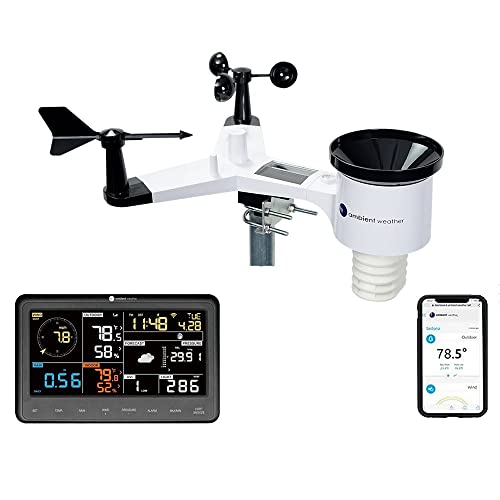
The WS-2902 is a strong choice when the property already has dependable Wi-Fi. Its Osprey sensor array records wind speed and direction, temperature, humidity, rainfall, UV intensity, and solar radiation, while the color LCD keeps the information visible indoors. That mix covers the measurements most households want without requiring several separate instruments.
Its connected features reach beyond a basic console. The product information identifies remote access, alerts, IFTTT, Google Home, Alexa, and optional uploads to the Ambient Weather Network. Those features make it useful for checking conditions away from the house or linking weather observations with other connected routines. It is still a Wi-Fi station, not a cellular unit, so an internet connection and compatible local network remain part of the setup.
Pros
- Measures wind, temperature, humidity, rainfall, UV, and solar radiation.
- Includes a color LCD display and a wireless outdoor sensor array.
- Supports remote access and weather alerts through its connected platform.
- Lists IFTTT, Google Home, and Alexa compatibility.
- Can optionally transmit data to the Ambient Weather Network.
Cons
- Requires Wi-Fi for its connected and remote-monitoring functions.
- It does not provide cellular SMS monitoring when local internet service is unavailable.
Choose this model over the ECOWITT when the property has stable Wi-Fi and smart-home compatibility matters more than cellular independence. It is a practical connected-home station, but the distinction should remain plain: its wireless outdoor sensor link does not make it cellular.
To buy this product, click here.
3. Sainlogic 5G/2.4G WiFi Smart Weather Station – Best for Data Logging

For a greenhouse, garden, or larger residential property, the Sainlogic model brings an unusually useful record-keeping angle. The listing states that it stores up to two years of local weather data and can export records to Excel, with each export covering up to 30 days. That makes it easier to inspect seasonal temperature, humidity, rainfall, and extreme-weather patterns instead of relying on memory.
The station supports 5 GHz and 2.4 GHz Wi-Fi, plus Bluetooth fast pairing. Its product information lists temperature accuracy of ±0.2°C and humidity accuracy of ±1.8% RH for the specified Swiss SHT40 sensor, along with rainfall figures of ±1 mm below 15 mm and ±7% above that amount. Those are listing claims, not independent verification. The open-area wireless transmission distance is listed as up to 443 feet, so walls, metal structures, and terrain can change the result.
Pros
- Supports both 5 GHz and 2.4 GHz Wi-Fi.
- Bluetooth pairing is intended to simplify initial setup.
- Stores up to two years of local weather records.
- Exports recorded data to Excel for analysis.
- App logs rainfall by hour, day, month, and year.
Cons
- It depends on Wi-Fi rather than a cellular network for connected access.
- Advertised transmission distance is an open-area maximum, not a guaranteed building-to-building result.
This station makes the most sense for someone who wants records they can examine later. It is less suitable for a disconnected remote site, but its storage and export functions can be more valuable than a larger display for anyone tracking irrigation, greenhouse conditions, or changing weather patterns.
To buy this product, click here.
4. Tempest Weather Station – Best for Low-Maintenance Monitoring
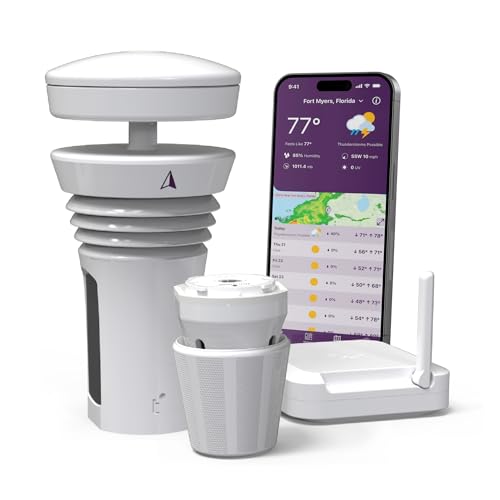
Tempest takes a different hardware approach by putting a wide range of measurements into a single outdoor device with no moving parts. The listed sensors cover temperature, humidity, pressure, wind speed and direction, rainfall, solar radiation, UV index, and lightning strikes. That design can reduce the number of mechanical components exposed outside, an appealing detail for a property where routine maintenance is a nuisance.
The outdoor sensor is solar powered and sends data wirelessly up to a listed 1,000-plus feet, with updates every three seconds according to the product information. App, Alexa, Rachio, IFTTT, and other smart-home integrations are also identified. These strengths make it a serious connected alternative, though the listing does not describe cellular connectivity. It belongs here as a remote-monitoring option only where the required internet-connected setup is available.
Pros
- Measures lightning strikes along with common weather variables.
- Outdoor sensor uses solar power and has no moving parts.
- Listed wireless transmission distance exceeds 1,000 feet.
- Updates are listed at three-second intervals.
- Supports Alexa, Rachio, IFTTT, and other smart-home platforms.
Cons
- Cellular connectivity is not identified in the supplied product information.
- Its broad smart-home feature set may be unnecessary for local-only monitoring.
Tempest is the appealing pick for a connected property where low mechanical complexity and lightning information matter. It should not replace the ECOWITT for a site specifically requiring cellular SMS alerts, but it offers a cleaner path for users already invested in app-based or smart-home monitoring.
To buy this product, click here.
5. Sainlogic 10-in-1 WiFi Weather Station – Best for App Alerts

The Weatherseed app is the central reason to choose this Sainlogic station. The listing describes smartphone alerts for changes in temperature, humidity, and barometric pressure, along with 24/7 forecasts and recorded weather information. It also identifies two-year storage with Excel downloads, which gives this model a useful bridge between quick phone checks and longer-term records.
Rainfall data is recorded hourly, daily, weekly, monthly, and yearly, with listed accuracy figures of ±1 mm below 15 mm and ±7% from 15 to 9,999 mm. The station uses 2.4 GHz Wi-Fi only, a limitation worth checking before installation. Its display uses enlarged fonts, while the outdoor sensor communicates wirelessly with the console. Wi-Fi access and app functions should not be confused with cellular service.
Pros
- Weatherseed app provides alerts for temperature, humidity, and pressure changes.
- Supports two years of stored weather data and Excel downloads.
- Records rainfall across hourly, daily, weekly, monthly, and yearly periods.
- Large display fonts can help with quick indoor reading.
- Listing describes a three-step 2.4 GHz Wi-Fi setup.
Cons
- Supports only 2.4 GHz Wi-Fi according to the listing.
- App connectivity does not provide the cellular independence required for a remote site without internet service.
This is a practical choice for a home, garden, or agricultural property with a functioning 2.4 GHz network and an interest in alerts and exported records. Buyers who need text messages over a mobile network should choose the ECOWITT instead.
To buy this product, click here.
6. VEVOR YT60234 WiFi Weather Station – Best Budget Wi-Fi Option

VEVOR offers a broad measurement set in a comparatively straightforward package. Its seven-in-one sensor monitors wind speed, wind direction, temperature, humidity, rainfall, and light, while the display also shows pressure, dew point, wind chill, and moon phase. Since “seven-in-one” labels vary between brands, the actual measurements matter more than the number itself.
The station supports Wi-Fi, Weather Underground, and WeatherCloud according to the listing. The sensor transmission distance is listed as up to 150 meters, and the large display has four brightness levels. Solar assistance powers the outdoor unit on sunny days, with batteries taking over during nighttime or cloudy conditions. The adapter must remain plugged in for Wi-Fi connection and date synchronization, an important power detail for remote installations.
Pros
- Supports Weather Underground and WeatherCloud connections.
- Measures wind, temperature, humidity, rainfall, and light.
- Includes a 7.5-inch display with four dimming levels.
- Solar panel assists outdoor sensor power, with batteries as backup.
- Published transmission distance reaches up to 150 meters in suitable conditions.
Cons
- Wi-Fi and date synchronization require the adapter to remain plugged in.
- It is not a cellular weather station and cannot replace mobile-network alerts.
VEVOR fits a property with Wi-Fi where weather-network uploads are more useful than SMS. Its solar-assisted sensor and large display add practical flexibility, but the console power requirement makes it a weaker choice for a fully off-grid installation.
To buy this product, click here.
7. Ambient Weather WS-2000 – Best for Console Monitoring
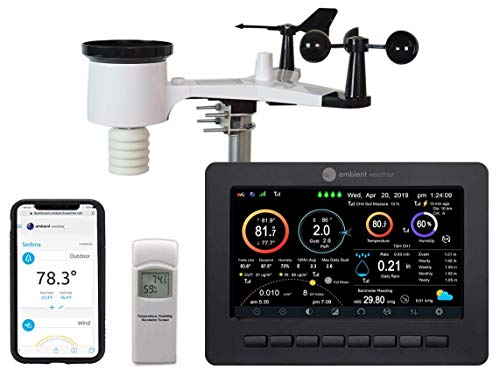
The WS-2000 keeps the familiar complete-station format while adding a TFT color display and Wi-Fi connectivity options. Its integrated outdoor array measures wind speed and direction, temperature, humidity, rainfall, UV, and solar radiation. Imperial and metric units are supported, and the product information identifies calibration capability, which gives careful users more control over how readings are presented and adjusted.
Its console uses a supplied 5V DC adapter, while the outdoor array requires three AAA batteries that are not included. That split power arrangement is ordinary for a home station, but it matters for a remote property where battery access may be inconvenient. The Wi-Fi feature enables transmission to the Ambient Weather Network, but the supplied information does not make this a cellular system.
Pros
- TFT color display presents local weather observations indoors.
- Integrated sensor measures wind, temperature, humidity, rain, UV, and solar radiation.
- Supports imperial and metric units.
- Calibration capability is identified in the product information.
- Can transmit data to the Ambient Weather Network through Wi-Fi.
Cons
- Outdoor sensor requires three AAA batteries, which are not included.
- Console needs the included 5V DC adapter for power.
This model suits someone who wants a capable local console and connected network access without moving to the more specialized cellular design. It ranks below the WS-2902 here because the cellular requirement favors independent mobile communication, while the WS-2000 remains a sensible Wi-Fi-based alternative.
To buy this product, click here.
8. AcuRite Iris 01540M – Best for Weather Underground
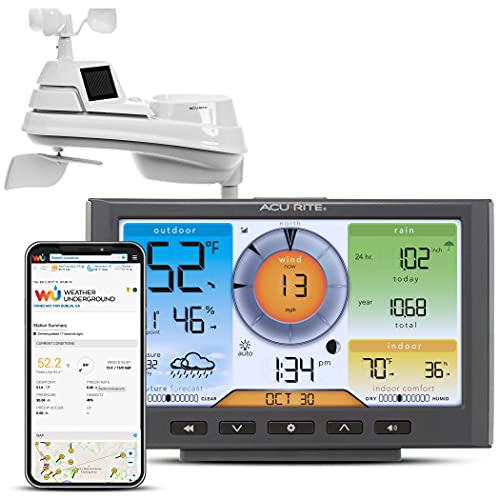
The AcuRite Iris 01540M is built around familiar household weather observations: indoor and outdoor temperature, humidity, pressure, wind, direction, and rainfall. Its color LCD also works as a weather clock with adjustable dimming. For someone who wants a console on the kitchen counter and a way to view the station through Weather Underground, that combination is easy to understand.
The listing identifies more than 25 data points, threshold alarms, historical records, heat index, dew point, wind chill, and enhanced rainfall history. Those calculated values can be useful, but they are not additional dedicated sensors. Wi-Fi connects the display to Weather Underground for remote monitoring, so the system remains dependent on a suitable internet connection rather than cellular coverage.
Pros
- Explicitly supports Weather Underground remote monitoring.
- Measures temperature, humidity, pressure, wind, wind direction, and rainfall.
- Includes a color LCD with adjustable dimming.
- Provides threshold alarms and historical weather information.
- Displays calculated heat index, dew point, and wind chill values.
Cons
- Wi-Fi and Weather Underground access do not provide cellular independence.
- Several listed data points are calculated values rather than separate physical measurements.
AcuRite is a good fit for a home already organized around Weather Underground. It is less compelling for an isolated cabin where a cellular alert is the central requirement, yet its clear platform support gives it a stronger case than a generic Wi-Fi station with no named weather-network connection.
To buy this product, click here.
9. AIRAIN TECH Wireless Weather Station – Best for Two Local Displays
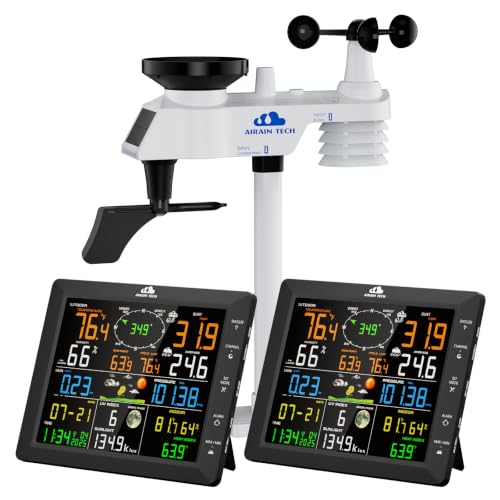
AIRAIN TECH is the local-monitoring outlier in this group. It has no Wi-Fi, but it includes two main display units, allowing weather information to be viewed in separate rooms. The outdoor sensor reports temperature, humidity, rainfall, wind speed and direction, pressure, UV, dew point, wind chill, and moon phase. That arrangement can be handy in a house, workshop, or small property where people want a screen nearby rather than an app.
The product information lists a temperature range from -40°F to 140°F, humidity from 10% to 99%, and a wireless transmission distance of up to 328 feet. It also includes a mounting pole, brackets, hardware, and a power adapter. The listed temperature and humidity accuracy claims are ±2°F/1°C and ±5%, respectively. These are product-listing specifications, and the absence of Wi-Fi means the station cannot provide true away-from-home access.
Pros
- Includes two display units for viewing conditions in separate locations.
- Reports temperature, humidity, rain, wind, pressure, UV, and calculated values.
- Lists a temperature range from -40°F to 140°F.
- Outdoor sensor transmission is listed at up to 328 feet.
- Includes mounting hardware, a pole, brackets, and screws.
Cons
- No Wi-Fi, cellular, or app-based remote monitoring is identified.
- Published humidity accuracy is ±5%, which is less specific than the tighter claim listed for some competing models.
This station belongs near the bottom because cellular and remote access are central to the search intent, but it remains a legitimate choice for local observation. Two screens and included mounting parts may matter more than internet connectivity for someone who wants weather information available at home without configuring a network.
To buy this product, click here.
Buying Guide
Cellular, Wi-Fi, and Wireless Sensor Links Are Different
The ECOWITT uses 4G/3G cellular communication for SMS-based monitoring. Most other products here use Wi-Fi for internet access or a separate wireless link between the outdoor sensor and indoor display. A station can be wireless without being connected to the internet, and a Wi-Fi model can still fail to provide useful remote access if the console or router loses power.
Start With the Required Form of Remote Access
SMS alerts are useful when a phone needs to receive a threshold warning from a property without a local Wi-Fi system. App access is better suited to a connected home with dependable internet. Weather Underground, WeatherCloud, Ambient Weather Network, and Weatherseed are separate platforms, so named compatibility matters more than a vague claim that a station is “smart.”
Choose Measurements That Match the Property
Rainfall and wind are central for gardens, farms, and exposed sites. Temperature and humidity may matter most inside a greenhouse or storage building. UV and solar radiation are useful for broader environmental records, while lightning detection is a specialized feature. A higher sensor count does not automatically make a station more useful, especially when some displayed values are calculated from other measurements.
Transmission Distance Is a Maximum, Not a Promise
Several listings give an open-area maximum distance. Walls, metal siding, floors, terrain, signal interference, and the placement of the console can reduce communication distance. Treat the published number as a favorable-condition reference rather than a guarantee that the sensor will communicate through every building.
Check Which Component Uses Solar Power
Solar assistance commonly applies to the outdoor sensor rather than the complete system. The ECOWITT and VEVOR listings describe solar-related outdoor power arrangements, while consoles may still require an adapter or other power source. A solar panel also does not automatically eliminate batteries, since backup cells may be used during darkness or cloudy conditions.
Data Logging Can Be More Valuable Than a Large Screen
If you want to compare rainfall across seasons, inspect humidity changes, or keep records for a garden, look for local storage and export options. The Sainlogic models identify two-year storage and Excel export, while the ECOWITT supports microSD storage and PC software. Confirm whether a card, computer, adapter, or specific operating system is required.
Install Sensors Where Their Readings Make Sense
A rain gauge needs level placement and an unobstructed collection area. Wind sensors need exposure to moving air, while temperature and humidity readings can be affected by direct sun, roofs, pavement, and nearby heat sources. A feature-rich station cannot correct a poor installation location, so check the mounting arrangement before deciding where the outdoor array will go.
Best Cellular Weather Stations FAQ
What Is The Best Cellular Weather Station?
The ECOWITT WH6006E is the strongest choice in this comparison because its product information specifically identifies 4G/3G cellular connectivity, SMS alerts, and support for up to three mobile phones. It also measures temperature, humidity, pressure, wind, rain, UV, and solar radiation. Confirm local mobile coverage and any service requirements before purchase.
Are Wi-Fi Weather Stations The Same As Cellular Weather Stations?
No. Wi-Fi models connect through a local internet network, while a cellular model communicates through a mobile network. The Ambient Weather, Sainlogic, VEVOR, AcuRite, and Tempest products provide connected alternatives, but their supplied information does not make them cellular stations.
Can A Wireless Weather Station Be Used For Remote Monitoring?
Wireless sensor communication alone usually connects an outdoor array to a nearby console. Remote monitoring requires an additional internet or cellular path that sends data away from the property. Check whether the specific model identifies SMS, app, cloud, or web access rather than assuming that “wireless” means accessible from anywhere.
Do Cellular Weather Stations Need Wi-Fi?
The ECOWITT WH6006E is presented with 4G/3G cellular communication and SMS functions, so it is aimed at situations where Wi-Fi is unavailable or unsuitable. Other systems in this guide rely on Wi-Fi for their connected features. The exact power and service requirements should be checked in the current listing before installation.
What Measurements Should A Remote Property Station Have?
Temperature, humidity, rainfall, wind speed, and wind direction cover many practical monitoring needs. Barometric pressure can add trend information, while UV, solar radiation, and lightning detection serve more specialized purposes. Choose according to the decisions you need to make rather than selecting the longest list of displayed values.
Does A Solar-Powered Weather Station Work Without Batteries?
Not necessarily. Solar power may assist or recharge an outdoor sensor while batteries provide power at night or during cloudy conditions. The console may still need an adapter or separate power source. Read the power description for each component rather than treating the entire system as battery-free.
How Important Is A Weather Station’s Advertised Wireless Range?
Range matters when the outdoor sensor must sit far from the display or gateway, but the listed figure normally reflects open conditions. Walls, floors, metal, terrain, and interference can reduce the actual distance. Place the console and sensor with the communication path in mind, and avoid treating the maximum as guaranteed.
Are Dew Point And Heat Index Separate Sensors?
Usually, dew point and heat index are calculated from measurements such as temperature and humidity. They can be useful indicators, but they should not be counted as additional physical sensors unless the product information clearly identifies dedicated hardware for them.
Final Verdict
The ECOWITT WH6006E is the strongest overall choice for Best Cellular Weather Stations because it addresses the defining requirement directly. Its 4G/3G connection, SMS alerts, solar-assisted outdoor array, broad measurement set, and microSD storage create a practical package for a remote property that cannot depend on local Wi-Fi. The Mac software limitation and separate storage card are real trade-offs, but they are easier to plan around than the absence of cellular communication.
For a connected home with dependable internet, the Ambient Weather WS-2902 is the better fit, while Tempest stands out for solar-powered sensing, lightning information, and smart-home connections. Sainlogic’s Wi-Fi models deserve attention if Excel exports and long-term records matter. Before ordering, match the system to the available network, power source, mounting location, and measurements that actually affect your property. A cellular station is valuable because it solves a connectivity problem, not because it carries the longest feature list.