
Choosing a weather station without WiFi usually means choosing simpler, local monitoring over phone alerts and cloud dashboards. The practical question is whether you need a complete sensor array with a console in the house, or a basic indoor and outdoor monitor that avoids network setup altogether. Temperature, humidity, rainfall, wind, and barometric pressure can all matter, but the useful combination depends on whether you are watching a backyard, garden, farm, greenhouse, or second property.
Wireless does not automatically mean WiFi. A station can send readings from an outdoor sensor to an indoor display through a local radio link while never connecting to the internet. That setup is often appealing for cabins, older homes, privacy-conscious buyers, and anyone who wants weather readings to remain available during an internet outage. Several stations below also include WiFi, but their local console can still serve as the primary display. The Sainlogic 12-in-1 is the clearest fit for a genuinely WiFi-free setup, while the Ambient Weather WS-2902 is the strongest broader option if optional connectivity is acceptable.
This comparison weighs local operation, sensor coverage, display quality, rainfall and wind monitoring, power requirements, and the difference between an advertised wireless range and a guaranteed connection through walls. Some picks favor simplicity, while others make sense for readers who want a local display today and app access later.
Quick Answer
- Best Overall for No-WiFi Use: Sainlogic 12-in-1 Wireless Weather Station. It provides a local display, broad measurements, a listed 443-foot open-area transmission range, and no WiFi requirement.
- Best Flexible Connected Alternative: Ambient Weather WS-2902. Its local console covers temperature, humidity, wind, rain, UV, and solar radiation, with optional WiFi features available for buyers who later want remote access.
- Best Simple Budget Option: Smart WiFi Weather Station with App Control. Battery mode provides basic local readings, while plugging in enables its Tuya app functions.
- Best for a Large Display and Solar-Assisted Sensor: VEVOR YT60234. It has a 7.5-inch display and a solar-assisted outdoor sensor, though its WiFi functions require the adapter.
Best Weather Stations Without WiFi Comparison Table
| Product | Local Operation | Measurements | Best For |
|---|---|---|---|
| Sainlogic 12-in-1 Wireless Weather Station | Yes, no WiFi | Temperature, humidity, pressure, wind, rain, dew point | Best overall no-WiFi setup |
| Smart WiFi Weather Station | Basic battery mode | Temperature and humidity | Simple indoor and outdoor monitoring |
| AcuRite Iris 5-in-1 | Local console | Temperature, humidity, pressure, wind, rain | Weather Underground users |
| Ambient Weather WS-2902 | Local console | Temperature, humidity, wind, rain, UV, solar radiation | Broad measurement coverage |
| Ambient Weather WS-2000 | Local console | Temperature, humidity, wind, rain, UV, solar radiation | Advanced display and calibration |
| Grillum Smart WiFi Weather Station | Local display | Temperature, humidity, pressure, wind, rain, UV | Large display with optional app use |
| Sainlogic 10-in-1 Weather Station | Local display | Temperature, humidity, pressure, wind, rain | Data storage and alerts |
| VEVOR YT60234 | Local display | Temperature, humidity, wind, rain, light | Solar-assisted outdoor sensor |
| VEVOR 7-in-1 SmartLife Weather Station | Local display | Temperature, humidity, wind, rain, sunlight | SmartLife app option |
The detailed reviews below separate genuinely WiFi-free operation from stations that offer a local console alongside optional network features.
1. Sainlogic 12-in-1 Wireless Weather Station: Best Overall
The strongest match for a no-WiFi setup is the Sainlogic 12-in-1 because its core arrangement is straightforward: an outdoor sensor sends information to a local indoor display, and the product is specifically identified as having no WiFi. That matters for a cabin or backyard where the goal is to glance at conditions without pairing an app, creating an account, or keeping a router involved. The 6.5-inch color display shows temperature, humidity, pressure, wind speed, wind direction, rainfall, dew point, feels-like temperature, moon phase, calendar, and alarm functions in one place.
The listing gives a wireless transmission distance of up to 443 feet in open, unobstructed conditions. That figure can make placement easier across a large yard, although walls, metal siding, floors, and other obstructions can reduce the actual distance. Temperature accuracy is listed as ±0.2°C and humidity accuracy as ±1.8% RH. Rainfall records can be viewed hourly, daily, weekly, monthly, and cumulatively, with a listed range of 0 to 9,999 millimeters and ±7% accuracy. The outdoor sensor includes mounting hardware, but careful placement and leveling still matter more than a long range number.
Pros
- WiFi-free design with local indoor display.
- Measures temperature, humidity, pressure, wind speed, wind direction, and rainfall.
- Listed 443-foot open-area wireless transmission distance.
- 6.5-inch display has adjustable backlighting.
- Rainfall history includes hourly, daily, weekly, monthly, and cumulative records.
Cons
- Does not provide app-based remote access or cloud uploading.
- The published wireless distance is an open-area maximum, not a guaranteed indoor result.
This is the sensible pick for someone who wants a complete local weather station rather than a connected gadget. It has enough information for garden watering, backyard planning, and general observation without making WiFi part of the installation. Buyers who want phone alerts or historical data exports should look at the connected Sainlogic and Ambient Weather models instead. For a quiet, console-first setup, though, this one keeps the experience refreshingly simple.
To buy this product, click here.
2. Smart WiFi Weather Station with App Control: Best Budget Local Monitor

Someone who only wants indoor and outdoor temperature and humidity may find a full wind-and-rain station excessive. This compact model takes a simpler route, with one included sensor, a clear LCD, an alarm clock, and support for up to three sensors. Its battery mode provides basic weather data without WiFi, while the adapter activates the network and app features. That split makes it useful for a bedroom, nursery, office, or small greenhouse where temperature and humidity matter more than wind direction.
The station works with the Tuya app for current readings, historical trends, high and low alerts, and unit changes. The display also offers a five-day forecast screen with weather icons, but those forecast elements should be treated separately from the locally measured temperature and humidity. A four-level brightness adjustment helps in a dim room, while the three-channel design leaves room for additional locations if compatible sensors are added. Its main appeal is the ability to stay basic on batteries, though the local-only mode gives up the app and WiFi functions.
Pros
- Battery mode provides basic readings without WiFi.
- Supports temperature and humidity monitoring in up to three channels.
- Tuya app offers history and high or low alerts when connected.
- Display has four brightness levels.
- Compact feature set suits rooms, offices, and small growing spaces.
Cons
- WiFi and app functions are disabled in battery mode.
- The included sensor setup does not provide wind or rainfall measurements.
This is the lower-cost choice for a reader who uses “without WiFi” to mean “I want the station to work locally when I need it.” It is not a complete outdoor weather station, so it should not be selected for rainfall or wind monitoring. Choose it for temperature and humidity zones, and choose the Sainlogic 12-in-1 if you want a broader outdoor picture without network connectivity.
To buy this product, click here.
3. AcuRite Iris 5-in-1 Home Weather Station: Best for a Familiar Local Console
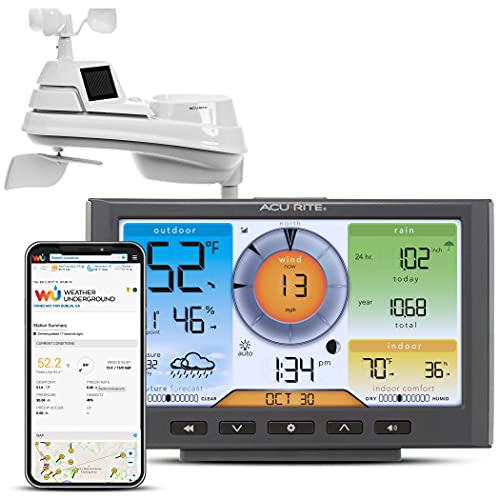
The AcuRite Iris brings the classic personal weather station layout to the comparison. Its outdoor system measures temperature, humidity, wind speed, wind direction, and rainfall, while the indoor color console adds barometric pressure and weather-history information. For a kitchen counter or home office, that combination provides a broad local snapshot without requiring a phone for every glance. The display includes an adjustable dimmer, time, and date, so it can function as a weather clock as well as a monitoring console.
WiFi connects the display to Weather Underground for remote monitoring and sharing, but the station still presents readings on its local console. That makes it more flexible than a strictly offline station, though the WiFi functionality will appeal only to buyers who want the platform connection. The listing also describes more than 25 data points, including dew point, heat index, wind chill, rainfall history, and threshold alarms. Some of those are calculated values rather than separate sensor measurements, a useful distinction when comparing it with stations that include UV or solar-radiation sensing.
Pros
- Local color console displays indoor and outdoor conditions.
- Outdoor system measures temperature, humidity, wind, and rainfall.
- Includes barometric pressure and weather-history functions.
- Adjustable display dimmer suits different rooms and lighting conditions.
- Supports Weather Underground remote monitoring through WiFi.
Cons
- Weather Underground access requires using its WiFi connection.
- The five-in-one label does not include UV or solar-radiation measurements.
Choose the Iris when a local console is the main priority but Weather Underground remains a useful optional extra. It makes more sense than a basic thermometer for someone who wants wind and rain, while the Ambient WS-2902 covers more solar-related measurements. If you want a station that never uses WiFi, the Sainlogic 12-in-1 remains a cleaner match.
To buy this product, click here.
4. Ambient Weather WS-2902: Best Flexible Full-Feature Station
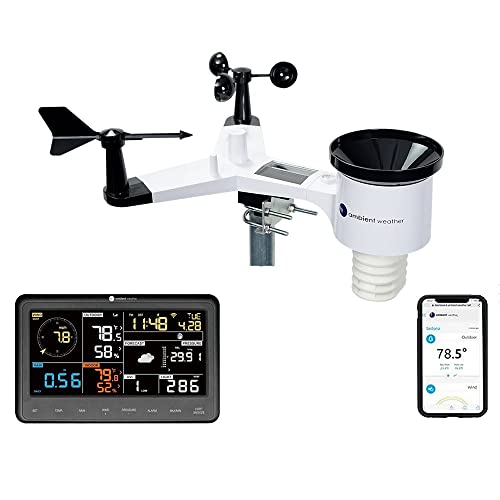
The WS-2902 is a strong choice for readers who want a local display now but do not want to close the door on connected monitoring later. Its Osprey sensor array measures wind speed, wind direction, temperature, humidity, rainfall, UV intensity, and solar radiation. That is a broader set of direct outdoor measurements than the simpler temperature-and-humidity units in this group, and it gives a garden or backyard more context during a hot afternoon or passing storm.
The color LCD console is the main local interface, while the station’s WiFi features can provide remote access, alerts, smart-home functions, and optional sharing through the Ambient Weather Network. The supplied information also identifies IFTTT, Google Home, and Alexa support. Those features are useful only to readers who choose to connect the station, so they should not be confused with its local wireless sensor link. The all-in-one array also means the outdoor instruments occupy one installation point, which can simplify setup while limiting the ability to place rain, temperature, and wind sensors independently.
Pros
- Measures wind, temperature, humidity, rainfall, UV, and solar radiation.
- Includes an Osprey sensor array and color LCD display.
- Can operate as a local display station without requiring remote access.
- WiFi adds alerts, remote access, and listed smart-home support.
- Optional Ambient Weather Network sharing expands data access.
Cons
- It is a connected model rather than a dedicated no-WiFi station.
- The integrated array requires several weather functions to share one outdoor location.
This is the best broader recommendation for a buyer who says “without WiFi” but really means “I do not want WiFi to be mandatory.” The local console remains useful by itself, while connected features are available if priorities change. For strict offline operation, choose the Sainlogic 12-in-1 instead. For the widest set of local outdoor measurements with optional expansion into smart-home monitoring, the WS-2902 earns its position.
To buy this product, click here.
5. Ambient Weather WS-2000: Best for Display and Calibration Options
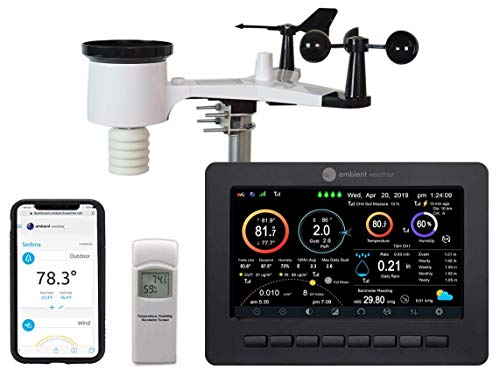
The WS-2000 follows the same broad measurement idea as the WS-2902, with an integrated outdoor array for wind speed, wind direction, temperature, humidity, rainfall, UV, and solar radiation. Its TFT color display is the reason to choose it over a simpler console. At a glance, the screen keeps the outdoor readings together, which can be handy beside a back door or in a home office where the display becomes part of the daily routine.
It supports imperial and metric units and includes calibration capability. Calibration does not guarantee a reading will match a reference instrument, but it gives the user a way to adjust measurements when a known comparison or installation preference calls for it. The console uses a supplied 5V DC adapter, while the outdoor sensor array requires three AAA batteries that are not included. WiFi is available as an enhanced connection option for sharing data with the personal weather station network, yet the station’s local display remains the central reason to choose it.
Pros
- Measures temperature, humidity, wind, rain, UV, and solar radiation.
- TFT color display presents a broad set of readings locally.
- Supports imperial and metric measurement units.
- Provides calibration capability in the listed product information.
- WiFi network sharing is available as an optional connection path.
Cons
- Outdoor sensor array requires three AAA batteries, which are not included.
- WiFi and network features make it less suitable than the Sainlogic for strict offline buyers.
The WS-2000 is a sensible premium-leaning alternative for someone who values the console and calibration controls more than a bare-bones installation. It does not offer a meaningful advantage for a buyer who wants to avoid all WiFi-capable hardware, and it still uses an integrated outdoor array. Pick it when display presentation and measurement adjustment matter; otherwise, the WS-2902 offers a similar measurement profile with a different balance of features.
To buy this product, click here.
6. Grillum Smart WiFi Weather Station: Best Large Display

The Grillum is built around a large 7.5-inch HD VA display that places a lot of information in view at once. Its screen shows temperature, humidity, wind speed, rainfall, barometric pressure, UV index, feels-like temperature, and a 12-hour forecast. That layout suits a reader who would rather glance across a console than open an app, although the station also offers app access when connected to a 2.4GHz network.
The outdoor sensor combines a wind vane, wind cups, rain funnel, temperature and humidity sensing, light sensing, UV sensing, and a solar panel. The listed wireless transmission range is up to 328 feet, measured under favorable conditions rather than through every wall and floor. The station can support up to three additional standard sensors, but those extras are not included. A key power detail is easy to miss: WiFi works only while the station is plugged in. Battery operation keeps the display off except for brief wake-ups, so it is not the best match for a fully cordless local console.
Pros
- 7.5-inch display shows a wide range of weather information.
- Outdoor sensor includes wind, rain, temperature, humidity, light, and UV functions.
- Solar panel assists the outdoor sensor power system.
- Supports up to three additional standard sensors.
- App provides current and historical information when connected to 2.4GHz WiFi.
Cons
- WiFi works only when the station is plugged into its adapter.
- Additional sensors are supported but not included.
The Grillum suits a living room, workshop, or office where a large screen earns its space. It is less attractive for someone seeking a small, battery-first station that never touches WiFi. Its solar-assisted outdoor sensor and broad display create a useful middle ground, but the power behavior deserves attention before installation. For an uncomplicated offline setup, the Sainlogic is easier to recommend.
To buy this product, click here.
7. Sainlogic 10-in-1 Weather Station: Best for Data Logging

The Sainlogic 10-in-1 is aimed at readers who want more than a momentary reading. Its Weatherseed app can send alerts for changes in temperature, humidity, and barometric pressure, while the station stores up to two years of weather data and supports Excel export. The listing says each export can cover up to 30 days, so the long archive is useful for trend review, but it is not the same as downloading the entire history in one action.
The local display uses enlarged, high-contrast numbers that make temperature and humidity easier to scan from across a room. The outdoor system includes rainfall and wind monitoring, with listed rain accuracy of ±1 millimeter below 15 millimeters and ±7% above that threshold. WiFi is limited to 2.4GHz, and the product’s app and forecast functions require that connection. Buyers who want a no-network station can still compare its sensor coverage with the Sainlogic 12-in-1, but the main reason to choose this model is its history and alert workflow.
Pros
- Stores up to two years of listed weather data.
- Supports Excel export for reviewing recorded trends.
- App alerts cover temperature, humidity, and barometric pressure changes.
- High-contrast display uses enlarged numbers.
- Rainfall history can be organized by hour, day, week, month, and year.
Cons
- App and alert features require 2.4GHz WiFi.
- Each listed export covers up to 30 days rather than the full archive at once.
This station is a better fit for a garden journal, seasonal weather record, or property where alerts matter than for a purely offline installation. The Sainlogic 12-in-1 is simpler and more directly aligned with no-WiFi use, while this model offers stronger data access. Choose it when records and notifications justify the network connection, and skip it if a local display is all you need.
To buy this product, click here.
8. VEVOR YT60234 WiFi Weather Station: Best Solar-Assisted Option

The VEVOR YT60234 combines a local 7.5-inch display with a solar-assisted outdoor sensor. Its listed measurements include wind speed, wind direction, temperature, humidity, rainfall, and light, while the display also presents pressure, dew point, wind chill, moon phase, and calendar information. That mixture is worth reading carefully: some displayed values are calculated or contextual information rather than separate outdoor sensor channels.
The outdoor sensor uses a solar panel with rechargeable Ni-MH batteries, while the display uses its adapter for WiFi connection and date synchronization. The listing gives a transmission distance of up to 150 meters, or roughly 492 feet, and identifies compatibility with Weather Underground and WeatherCloud. The aluminum rod bracket is supplied as part of the sensor arrangement, but the installation location still needs to avoid interference sources such as televisions, signal towers, and high-voltage lines. Solar assistance applies to the outdoor sensor system, not the entire station.
Pros
- 7.5-inch display has four brightness settings.
- Solar panel assists the outdoor sensor and rechargeable Ni-MH batteries.
- Measures wind, temperature, humidity, rainfall, and light.
- Listed support for Weather Underground and WeatherCloud.
- Published transmission distance reaches up to 150 meters in favorable conditions.
Cons
- WiFi and date synchronization require the adapter to remain plugged in.
- The large published range can be reduced by interference, walls, and building materials.
This is a practical choice for someone who wants a large local screen and reduced routine battery replacement at the outdoor sensor. It is still a WiFi-capable system, so strict offline buyers should choose the Sainlogic 12-in-1 instead. The VEVOR makes more sense for a property where a solar-assisted outdoor array and weather-platform access are useful, especially if the console will remain near an outlet.
To buy this product, click here.
9. VEVOR 7-in-1 SmartLife Weather Station: Best SmartLife Alternative

This VEVOR model has a similar local-display and solar-assisted approach, but its connected side uses the SmartLife app rather than the platform combination identified for the YT60234. The 7.5-inch display shows temperature, humidity, rainfall, wind speed, wind direction, sunlight, dew point, moon phases, and a six-to-12-hour forecast. For a kitchen or bedroom, the four brightness levels make it easier to keep the screen visible without leaving it glaring at night.
The outdoor sensor has a listed 150-meter transmission distance and includes an aluminum alloy rod bracket and charging box. The listing says it supports 2.4GHz WiFi only, and the adapter must remain connected for WiFi and date synchronization. Solar power assists the outdoor sensor, with batteries taking over at night or in cloudy conditions. The product information also says the SmartLife app can view, store, analyze, and share real-time data. That gives it a clear reason to exist beside the YT60234, although neither is the right choice for someone determined to avoid WiFi completely.
Pros
- SmartLife app supports viewing, storing, analyzing, and sharing readings.
- 7.5-inch display includes four brightness levels.
- Solar-assisted outdoor sensor uses batteries during darker conditions.
- Listed transmission distance reaches up to 150 meters in open conditions.
- Includes wind, rainfall, temperature, humidity, and sunlight measurements.
Cons
- Supports 2.4GHz WiFi only.
- WiFi and date synchronization require the power adapter.
The SmartLife version is useful for households already using that app environment and for readers who want a local screen with optional remote data access. Its local console means it can still display weather without someone reaching for a phone, but the station is more network-dependent than the no-WiFi Sainlogic. Choose this model for SmartLife compatibility and solar-assisted sensor power, not for an entirely disconnected setup.
To buy this product, click here.
Buying Guide
Wireless Sensor Links Are Different From WiFi
A local weather station commonly uses a wireless link between the outdoor sensor and indoor console. That link can work without a router or internet connection. WiFi serves a separate purpose, usually sending console data to an app, cloud service, or weather platform. The Sainlogic 12-in-1 is the clearest example here because its product identity is explicitly no WiFi, while the Ambient Weather and VEVOR models provide local displays alongside optional connected functions.
Decide Whether You Need Wind and Rain
A temperature-and-humidity monitor can be enough for a bedroom, nursery, or greenhouse corner. Outdoor planning, gardening, and property monitoring usually benefit from wind speed, wind direction, and rainfall as well. The Sainlogic 12-in-1, AcuRite Iris, and Ambient Weather systems include those measurements, while the compact Smart WiFi model focuses on temperature and humidity. A higher sensor count is useful only when those additional readings have a job to do.
Read Transmission Range as a Best-Case Figure
Several products list long sensor-to-console distances, including 443 feet, 492 feet, or 150 meters. These figures generally describe open, unobstructed conditions. Brick, concrete, metal siding, multiple floors, terrain, and electrical interference can reduce the actual link. Before mounting an outdoor array at the far end of a property, think about the walls and structures between the sensor and console.
Check Which Component Uses Solar Power
The solar-assisted VEVOR and Grillum systems apply solar power to the outdoor sensor arrangement. Their indoor displays still use adapters or another power source, and connected features may require the adapter to remain plugged in. Solar assistance can reduce routine battery replacement for the sensor, but it does not automatically make the complete station independent of household power.
Separate Accuracy From Resolution
A display that shows decimal places is reporting resolution, not proof of equivalent accuracy. The Sainlogic listings provide specific temperature, humidity, and rainfall accuracy claims, but those remain published product information rather than independent verification. Sensor placement also matters. Direct sun, nearby roofs, pavement, walls, and poor rain-gauge leveling can influence readings regardless of the display’s precision.
Check the App and Platform Before Buying
App access varies widely. The AcuRite Iris identifies Weather Underground support, the VEVOR YT60234 identifies Weather Underground and WeatherCloud, and the other connected models use their own named apps or services. WiFi alone does not prove compatibility with a particular platform. If remote viewing, alerts, or historical exports matter, verify that the station’s listed service provides the function you actually need.
Best Weather Stations Without WiFi FAQ
What Is the Best Weather Station Without WiFi?
The Sainlogic 12-in-1 Wireless Weather Station is the strongest direct match because it is identified as a no-WiFi model and still measures temperature, humidity, pressure, wind, and rainfall. Its local display provides the information without app setup or internet access.
Can a Weather Station Work Without WiFi?
Yes. A weather station can use a local wireless connection between its outdoor sensor and indoor console without connecting to a home network. The Sainlogic 12-in-1 is built around that arrangement. Connected models may also show readings locally, but their app, cloud, and alert features depend on WiFi.
Is Wireless the Same as WiFi?
No. Wireless usually describes the sensor-to-console radio link, while WiFi connects a device to a home network. A station can be wireless without WiFi, which is why the outdoor sensor in a local console system can send readings indoors without a router.
Do Weather Stations Without WiFi Provide Rainfall and Wind Readings?
Some do, and some only measure temperature and humidity. The Sainlogic 12-in-1 includes rainfall, wind speed, and wind direction. The compact Smart WiFi model does not provide those outdoor measurements through its included sensor, so buyers should check the sensor list rather than relying on the word “weather” in the product name.
Will a Weather Station Still Work During an Internet Outage?
A local console can continue displaying sensor readings during an internet outage if the sensor and console have power. App alerts, cloud dashboards, weather-network uploads, and remote monitoring may stop because those functions require network access. A dedicated no-WiFi model avoids that particular dependency.
Does a Solar-Powered Weather Station Need Batteries?
Solar-assisted systems may still use batteries, especially at night or during cloudy conditions. The VEVOR YT60234 uses a solar panel with rechargeable Ni-MH batteries for the outdoor sensor, while the indoor display still has its own power requirement. Solar assistance should not be interpreted as a guarantee that every part of the station runs without batteries or an adapter.
Does a Longer Wireless Range Mean Better Accuracy?
No. Transmission range describes how far data may travel between the sensor and console under stated conditions. Accuracy describes how close a measurement may be to a reference. A station with a long listed range can still be affected by walls, interference, placement, or sensor exposure.
Final Verdict
The Sainlogic 12-in-1 Wireless Weather Station is the strongest overall choice for readers who genuinely want weather monitoring without WiFi. It provides a broad local measurement set, a readable 6.5-inch display, rainfall history, and a listed open-area transmission range without making an app or router part of the basic setup. That makes it a natural fit for a home, garden, cabin, or property where local readings matter more than remote alerts.
For a more connected system that can still be used through a local console, the Ambient Weather WS-2902 is the most capable alternative, especially with its UV and solar-radiation measurements. The Smart WiFi model is better for basic temperature and humidity monitoring, while the VEVOR stations suit readers who value a large display and solar-assisted outdoor hardware. Match the station to the information you will actually use, and pay close attention to power, placement, and whether a listed feature requires WiFi.