Bluetooth weather stations appeal to buyers who want local weather readings without treating every outdoor sensor as a full smart-home system. The useful distinction is between a short-range Bluetooth connection, a wireless sensor-to-console link, Wi-Fi access, and true Internet-based monitoring. Temperature, humidity, rainfall, wind, UV, pressure, and data history also vary sharply between models, so a bright display alone tells you very little about the station’s practical value.
For a greenhouse, garden, or wine cellar, temperature and humidity data may matter most. A larger property may benefit from a long listed sensor range, rainfall totals, and wind readings. Someone checking conditions from work needs app or cloud access rather than Bluetooth alone. The Sainlogic dual-band station stands out overall because it combines Bluetooth pairing with Wi-Fi, rain and wind measurements, app alerts, and local data export, although its advertised wireless range still depends on placement and building conditions.
The comparison below weighs genuine connectivity, sensor coverage, display design, data access, expandability, and installation trade-offs. Some entries are full outdoor stations, while simpler models suit indoor/outdoor temperature monitoring rather than detailed weather records.
Quick Answer
- Best Overall: Sainlogic 5G/2.4G WiFi Smart Weather Station combines Bluetooth fast pairing with dual-band Wi-Fi, app alerts, rain, wind, local storage, and Excel export.
- Best Smart-Home Option: Tempest Weather Station adds Bluetooth-related wireless convenience, app access, Alexa, IFTTT, Rachio, lightning detection, and a solar-assisted outdoor sensor.
- Best for Weather Networks: AcuRite Iris 5-in-1 supports Wi-Fi connection to Weather Underground and records a broad set of local observations.
- Best Compact Bluetooth Display: Kalawen Home Weather Station offers Bluetooth in a simpler indoor/outdoor clock-style system with a large color display.
Best Bluetooth Weather Stations Comparison Table
| Product | Measurements | Connectivity | Sensor Design | Best For |
|---|---|---|---|---|
| Sainlogic WiFi Smart Weather Station | Temperature, humidity, rain, wind | Bluetooth pairing, 5GHz/2.4GHz Wi-Fi | Integrated outdoor array | Best overall connected monitoring |
| Tempest Weather Station | Temperature, humidity, pressure, rain, wind, UV, solar, lightning | App, Alexa, IFTTT, Rachio | Solar-powered outdoor sensor | Smart-home automation |
| AcuRite Iris 5-in-1 | Temperature, humidity, pressure, rain, wind | Wi-Fi, Weather Underground | 5-in-1 outdoor array | Weather-network uploads |
| Sainlogic AI Forecast Station | Temperature, humidity, pressure, rain, wind, UV | Bluetooth pairing, 5GHz/2.4GHz Wi-Fi | Outdoor array plus extra sensor | Data logging and larger properties |
| Sainlogic Smart Weather Station | Temperature, humidity, rain, wind | Bluetooth pairing, 5GHz/2.4GHz Wi-Fi | Integrated outdoor array | Greenhouses and garden tracking |
| Ambient Weather WS-2902 | Temperature, humidity, rain, wind, UV, solar | Wi-Fi, Ambient Weather Network | Osprey integrated array | Broad home weather monitoring |
| Kalawen Home Weather Station | Temperature, humidity, pressure, forecast | Bluetooth listed, local console | One included remote sensor | Simple display-based monitoring |
| Smart WiFi Weather Station | Temperature, humidity, forecast | 2.4GHz Wi-Fi, Tuya app | Up to three channels | Low-cost app monitoring |
| Ecowitt WS90 7-in-1 | Temperature, humidity, wind, rain, UV, illuminance | Bluetooth, Zigbee, Shelly gateway required for app | Ultrasonic and haptic sensing | Smart irrigation setups |
For a closer look, the reviews explain which stations genuinely benefit from Bluetooth, which rely mainly on Wi-Fi or a local console, and where each system’s installation or data-access trade-offs appear.
1. Sainlogic 5G/2.4G WiFi Smart Weather Station: Best Overall

The strongest fit for this roundup is the Sainlogic station’s combination of Bluetooth fast pairing and genuine dual-band Wi-Fi. Bluetooth helps with initial setup, while Wi-Fi connects the system to its app for real-time indoor and outdoor readings and alerts. That distinction matters in a busy home, where a short pairing step is convenient but remote access is what makes the station useful after installation.
The sensor package covers temperature, humidity, rainfall, and wind. The listing gives temperature accuracy as ±0.2°C and humidity accuracy as ±1.8%RH, while its rain information includes a built-in bubble level and listed accuracy figures that vary with rainfall amount. It also stores up to two years of local data and supports Excel export, making it more suitable for garden records or seasonal comparisons than a basic clock-style console.
Pros
- Bluetooth fast pairing simplifies initial setup.
- Supports both 5GHz and 2.4GHz Wi-Fi according to the listing.
- Measures temperature, humidity, rainfall, and wind.
- Stores up to two years of local data with Excel export.
- Lists an open-area wireless transmission distance of up to 443 feet.
Cons
- The listed maximum range is an open-area figure and may change around walls, floors, and metal structures.
- The product information does not clearly identify every supported smart-home platform.
This is the most balanced choice for someone who wants a complete station, Bluetooth-assisted setup, app access, rainfall history, and useful records without moving into a specialized ecosystem. The sensor still needs careful outdoor placement, particularly for the rain gauge and wind readings, and Bluetooth itself should not be mistaken for the station’s long-distance or remote connection. If data export matters as much as live readings, this model has a clear advantage over simpler display units.
To buy this product, click here.
2. Tempest Weather Station: Best for Smart-Home Automation
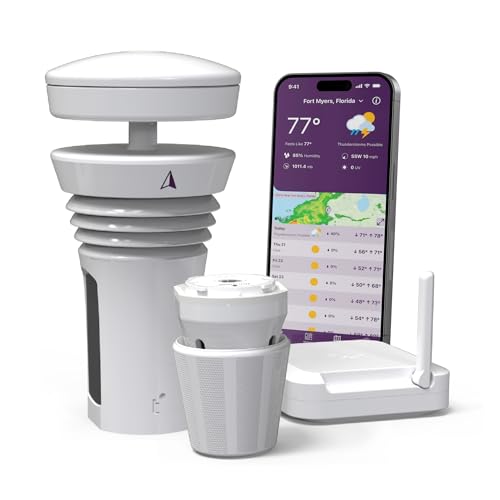
Tempest takes a different approach from a traditional weather station with a large indoor console. Its outdoor sensor measures temperature, humidity, pressure, rainfall, wind speed and direction, dew point, solar radiation, UV, and lightning strikes, then sends information through its connected system. For someone who prefers checking a phone or using weather data in home automation, the reduced hardware footprint may be more appealing than a crowded wall display.
The listing describes a solar-powered outdoor sensor with wireless transmission up to 1,000 feet and updates every three seconds. It also identifies Alexa, Rachio, IFTTT, and other smart-home connections. Those integrations give rainfall and wind information a practical role, such as adjusting irrigation or triggering an automation, although the product data does not specify every gateway or account requirement.
Pros
- Measures a broad range of weather variables, including lightning strikes.
- Lists updates every three seconds.
- Outdoor sensor uses solar power with the supplied system architecture.
- Supports Alexa, Rachio, IFTTT, and other smart-home platforms.
- Outdoor sensor has no moving parts according to the listing.
Cons
- The listing does not present Bluetooth pairing as clearly as the Sainlogic and Ecowitt models.
- It is less suitable for shoppers who specifically want a traditional always-on indoor console.
Tempest makes sense for a connected home, irrigation setup, or property where broad sensor coverage matters more than a bedside display. The lightning measurement is a useful distinction, but it should be treated as weather information rather than a safety guarantee. The long wireless figure is also a listed maximum, so mounting location and obstructions still deserve attention before installation.
To buy this product, click here.
3. AcuRite Iris 5-in-1 Home Weather Station: Best for Weather Underground
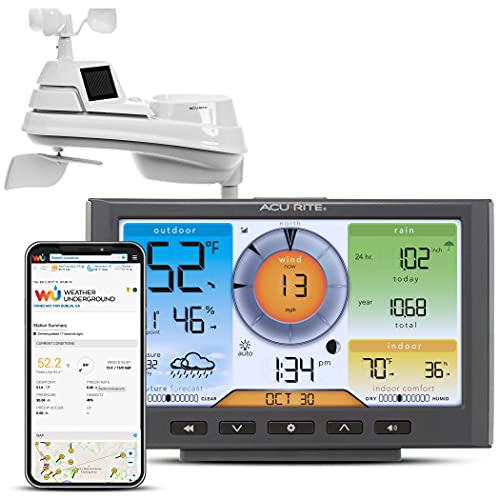
AcuRite Iris earns its place through a clearly identified Wi-Fi connection to Weather Underground, rather than through Bluetooth pairing. That makes it a useful alternative for readers whose priority is sharing or checking local observations through a weather network. Its sensor array measures indoor and outdoor temperature and humidity, wind speed and direction, barometric pressure, and rainfall.
The large color display shows weather information alongside time and date, while the listing identifies more than 25 data points, threshold alarms, historical information, heat index, dew point, wind chill, and rainfall history. Some of these are calculated values, so they should not be treated as separate physical sensors. The result is a broad personal weather record in a familiar console format.
Pros
- Explicitly supports Wi-Fi connection to Weather Underground.
- Includes temperature, humidity, pressure, wind, and rainfall measurements.
- Provides a large color LCD display with adjustable dimmer.
- Lists historical data and threshold alarms.
- Includes calculated information such as dew point and wind chill.
Cons
- The supplied information does not identify Bluetooth support.
- The listing does not specify the exact accuracy of each sensor.
This station suits a reader who wants local measurements and Weather Underground access in one established-style system. It is less compelling for someone who specifically wants Bluetooth setup or a dual-band connection. The broad data display is useful, but the station still depends on sensible outdoor placement, especially because wind and rain readings are strongly affected by exposure.
To buy this product, click here.
4. Sainlogic 5G/2.4G WiFi Smart Weather Station with Extra Sensor: Best for Data Logging

This Sainlogic model builds on the same useful Bluetooth and dual-band Wi-Fi idea while adding an extra sensor to the package. The listing identifies temperature, humidity, pressure, rainfall, wind speed, and UV information, plus app alerts and a weather map. That combination gives it a wider monitoring role than a simple indoor/outdoor thermometer.
Its stated temperature and humidity figures match the other Sainlogic models in this group, and the system records hourly, daily, monthly, and yearly rainfall. Two years of local storage and Excel export will appeal to someone tracking garden conditions or comparing seasonal changes. The extra sensor is especially relevant when two locations need monitoring, although the product data does not fully describe every sensor channel or placement arrangement.
Pros
- Combines Bluetooth pairing with 5GHz and 2.4GHz Wi-Fi.
- Includes an extra sensor in the listed package.
- Measures UV, rainfall, wind, pressure, temperature, and humidity.
- Stores up to two years of local weather data.
- Supports Excel export and mobile alerts.
Cons
- The extra sensor’s full measurement role is not clearly detailed in the supplied information.
- The product’s AI forecast description is promotional and should not replace local sensor readings.
Choose this version over the standard Sainlogic model if the included extra sensor and UV measurement matter more than keeping the system simple. It is a strong fit for a property with more than one monitoring point, but the added hardware also means more placement and power details to manage. Buyers should confirm exactly which readings the extra sensor supplies before ordering.
To buy this product, click here.
5. Sainlogic Smart Weather Station: Best for Gardens and Greenhouses

For temperature and humidity tracking around a garden, greenhouse, or wine cellar, this Sainlogic station focuses on the information that often matters first. Its listed Swiss sensor chip claims temperature accuracy of ±0.2°C and humidity accuracy of ±1.8%RH. Those are product-listing specifications, not independent test results, but they give the buyer more concrete information than a generic promise of precision.
Bluetooth fast pairing helps with setup, while dual-band Wi-Fi sends readings to the mobile app for remote checking and alerts. The outdoor system also measures rainfall and wind, with rainfall totals organized by hour, day, month, and year. A listed open-area range of 443 feet gives placement flexibility, though walls and other structures can reduce actual transmission distance.
Pros
- Lists Bluetooth fast pairing and dual-band Wi-Fi.
- Provides stated temperature and humidity accuracy figures.
- Tracks rainfall across hourly, daily, monthly, and yearly periods.
- Includes app-based remote weather viewing and alerts.
- Supports up to two years of local storage and Excel export.
Cons
- The listing does not clearly identify support for third-party smart-home platforms.
- Rainfall accuracy depends on proper leveling and installation.
This is a sensible choice for environmental monitoring where humidity trends and rainfall records are more useful than an elaborate display. It also avoids the assumption that a Bluetooth connection alone provides remote access. Skip it if you need a clearly documented Weather Underground or Alexa connection, but choose it over a basic thermometer if historical records and rain data belong in the plan.
To buy this product, click here.
6. Ambient Weather WS-2902 Wi-Fi Smart Weather Station: Best Broad Home Coverage
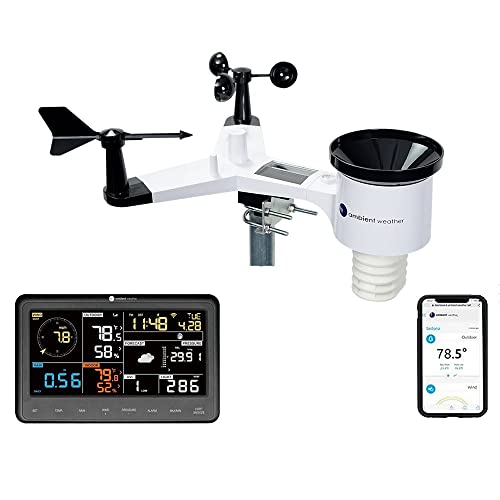
The WS-2902 is aimed at readers who want a traditional color console alongside Wi-Fi-enabled access. Its Osprey sensor array measures temperature, humidity, wind speed and direction, rainfall, UV intensity, and solar radiation. That broader outdoor measurement set gives it more weather context than the simpler Bluetooth clock-style products in this comparison.
The listing also identifies remote access, alerts, IFTTT, Google Home, Alexa, and optional connection to the Ambient Weather Network. Those platform references are meaningful, but they should not be stretched into a claim of Bluetooth support. This is primarily a Wi-Fi smart station with a wireless sensor array, which may be a better match for home automation than for someone who specifically wants phone-to-station Bluetooth pairing.
Pros
- Measures wind, rain, temperature, humidity, UV, and solar radiation.
- Includes an integrated outdoor sensor array and color LCD display.
- Supports remote access and alerts according to the listing.
- Identifies IFTTT, Google Home, and Alexa compatibility.
- Can connect to the Ambient Weather Network.
Cons
- The supplied information does not identify Bluetooth functionality.
- The listing does not provide exact sensor accuracy figures.
The WS-2902 is a good alternative for a connected home that values platform integration and a dedicated display. It gives up the clear Bluetooth setup story found on the Sainlogic models, but it offers a well-defined collection of outdoor measurements and smart-home connections. Verify the preferred platform and current service requirements before purchase, especially if automation is central to the setup.
To buy this product, click here.
7. Kalawen Home Weather Station: Best Compact Bluetooth Display

Kalawen keeps the experience closer to a weather clock than a cloud-connected station. The listing identifies Bluetooth, a large 7.4-inch color LCD, indoor and outdoor temperature and humidity, barometric pressure, forecast icons, an atomic clock, and alerts. The one-press control layout may suit a room where the goal is to glance at the screen rather than build a long-term weather database.
The system supports up to three remote sensors and includes one, with a listed open-area transmission range of up to 200 feet. That can help monitor a basement, nursery, garage, or backyard location, although the product information does not explain the Bluetooth role in detail. Battery operation dims the screen after 10 seconds, while the included AC adapter allows the display to remain on.
Pros
- Bluetooth is identified in the product title and listing.
- Large 7.4-inch color display uses oversized numbers.
- Supports up to three remote sensors.
- Includes temperature alerts, pressure information, and forecast icons.
- Offers AC and battery power modes with adjustable brightness.
Cons
- It does not provide rainfall or wind measurements.
- AA batteries are not included.
Kalawen is best for a bedroom, living room, or small property where immediate temperature and humidity visibility matters more than app history. Its Bluetooth label makes it relevant to this search, but it should not be treated as equivalent to a Wi-Fi weather station. Choose a Sainlogic or Tempest system if you need rain, wind, remote alerts, or richer records.
To buy this product, click here.
8. Smart WiFi Weather Station with App Control: Best Low-Cost App Option

This compact station targets phone-based temperature and humidity monitoring rather than full outdoor weather observation. It connects through 2.4GHz Wi-Fi and works with the Tuya app for current readings, historical trends, custom alarms, and high or low temperature alerts. The distinction is useful: it offers app connectivity, but the supplied information does not identify Bluetooth support.
The included display shows weather icons, time, temperature, and humidity, with four brightness levels. Up to three sensor channels are supported, though only one sensor is included. Battery power handles basic weather data, while the Wi-Fi and app functions require the station to be connected to its power adapter. That power distinction could matter on a shelf or in a location without a convenient outlet.
Pros
- Supports Tuya app access through 2.4GHz Wi-Fi.
- Provides historical trends and custom temperature alarms.
- Supports up to three sensor channels.
- Includes a clear display with four brightness settings.
- Offers a lower-complexity route to app-based monitoring.
Cons
- Wi-Fi and app features are disabled when operating on batteries alone.
- It measures temperature and humidity rather than rain and wind.
This model fits a nursery, room, greenhouse shelf, or other spot where temperature and humidity alerts matter more than a full outdoor array. It is a practical lower-cost choice for app access, but Bluetooth shoppers should understand that Wi-Fi and Bluetooth are separate features. Select a complete station if rainfall, wind direction, or outdoor property coverage is part of the requirement.
To buy this product, click here.
9. Ecowitt WS90 7-in-1 Weather Station: Best for Smart Irrigation

The Ecowitt WS90 is the most distinctive sensor design in this group. Its listed Bluetooth and Zigbee connectivity sits alongside ultrasonic wind monitoring and haptic rain detection. It measures temperature, humidity, wind speed and direction, rainfall, UV, and illuminance. The seven-in-one label is product-specific, so the actual measurements matter more than comparing the number seven with another brand’s count.
The haptic rain sensor avoids the moving mechanism used in many traditional rain gauges, while the listing gives transmission distances of up to 500 feet with obstacles or 1,000 feet in open spaces. The outdoor unit is described as IPX5-rated and solar powered with backup batteries. For Shelly automation, the listing says a gateway is required, and compatibility depends on the specified Shelly devices and gateways.
Pros
- Combines Bluetooth and Zigbee connectivity.
- Uses ultrasonic wind monitoring and haptic rain detection.
- Measures temperature, humidity, wind, rain, UV, and illuminance.
- Lists solar power with backup batteries for the outdoor sensor.
- Supports Shelly-based irrigation and home automation setups with the required gateway.
Cons
- A gateway is required for use with the Shelly Smart Control app.
- The product information does not identify a traditional indoor display as included.
This is the specialist choice for a garden or irrigation system already using Shelly equipment. The lack of a clearly listed conventional console may be inconvenient for someone who wants a quick glance at the kitchen counter, and gateway requirements add another part to the setup. For buyers who want Bluetooth, Zigbee, unusual rain sensing, and automation potential, however, it offers a more technical path than the basic display stations.
To buy this product, click here.
Buying Guide
Bluetooth, Wireless Sensor Links, and Wi-Fi Solve Different Problems
Bluetooth usually helps a phone or nearby device connect to a station, while a wireless sensor link sends outdoor readings to a console or gateway. Wi-Fi connects that console or gateway to a home network. The Sainlogic models list Bluetooth fast pairing and dual-band Wi-Fi, while the Kalawen listing identifies Bluetooth without presenting the same remote app architecture. Check the exact role of each connection before treating two products as equivalent.
Choose Measurements Before Counting Features
A complete station may measure temperature, humidity, pressure, wind, rain, UV, or solar radiation. A compact indoor/outdoor system may stop at temperature and humidity. Rainfall matters for watering decisions, wind matters for exposed properties, and humidity can matter more than outdoor wind in a greenhouse. A larger sensor list only helps when those measurements support the actual monitoring task.
Remote Access Requires More Than a Wireless Outdoor Sensor
A local console can receive outdoor data without offering access away from home. Wi-Fi, an app, cloud access, and platform support are separate claims. Ambient Weather and AcuRite identify specific network or platform connections, while the Sainlogic models describe app access and alerts. Confirm whether the preferred station supports current readings, alerts, historical records, and remote viewing rather than assuming one function includes all four.
Advertised Transmission Range Needs Context
The listed ranges in this group range from 200 feet for the Kalawen system to much longer open-area figures for Sainlogic, Tempest, and Ecowitt. These numbers describe favorable conditions, not a guarantee through concrete walls, floors, metal buildings, or dense vegetation. Place the outdoor sensor with the receiving unit or gateway in mind, and avoid treating range as a measurement of sensor accuracy.
Accuracy, Resolution, and Update Speed Are Separate
A display showing decimal places does not prove that the sensor is accurate to the same decimal. Likewise, a fast update interval does not automatically produce better measurements. The Sainlogic listings provide specific temperature, humidity, and rainfall accuracy claims, while several other products do not provide comparable figures. Use supplied accuracy information carefully and avoid comparing unsupported numbers.
Check Included Sensors, Gateways, and Power Sources
The Ecowitt WS90 requires a gateway for Shelly Smart Control use, and the Smart WiFi station includes one sensor while supporting up to three channels. The Kalawen system includes one remote sensor and supports up to three. These distinctions affect the real setup. Also check whether the console requires an adapter, whether batteries are included, and whether solar power applies to the outdoor sensor rather than the entire system.
Installation Still Shapes the Readings
Rain gauges need a level, unobstructed position, while wind sensors need exposure to moving air. Temperature and humidity sensors can be affected by direct sun, pavement, walls, and nearby heat sources. A station with better connectivity cannot correct poor placement. Follow the product’s installation instructions and use appropriate care around roofs, ladders, electrical power, and elevated mounting.
Best Bluetooth Weather Stations FAQ
What is the best Bluetooth weather station in this comparison?
The Sainlogic 5G/2.4G WiFi Smart Weather Station is the strongest overall choice because its listing combines Bluetooth fast pairing with dual-band Wi-Fi, app alerts, rainfall, wind, two years of local storage, and Excel export. Bluetooth handles setup, while Wi-Fi provides the broader app connection.
Does Bluetooth mean a weather station can be monitored from anywhere?
No. Bluetooth is generally a nearby connection. Remote access requires a station or gateway with Internet connectivity and a supported app or service. The product information for the Sainlogic, Tempest, Ambient Weather, AcuRite, and Smart WiFi models describes different forms of app, Wi-Fi, or platform access, but those functions should not be assumed for every Bluetooth product.
Which station has the best app and smart-home potential?
Tempest lists Alexa, Rachio, IFTTT, and other smart-home connections, while Ambient Weather identifies IFTTT, Google Home, Alexa, and its weather network. Ecowitt’s WS90 targets Shelly automation but requires a compatible gateway for Shelly Smart Control. Confirm the platform and any required bridge before purchasing.
Are the Sainlogic weather stations Bluetooth-only?
No. The supplied Sainlogic information identifies Bluetooth fast pairing along with 5GHz and 2.4GHz Wi-Fi. The Bluetooth feature helps with setup, while Wi-Fi supports app-based weather access. The outdoor sensor also uses a wireless connection to the display or receiving system.
Which models measure rainfall?
The Sainlogic, Tempest, Ambient Weather WS-2902, AcuRite Iris, and Ecowitt WS90 listings all identify rainfall measurement. The Ecowitt uses haptic rain detection, while the Sainlogic models list a rain gauge with a bubble level and rainfall accuracy figures. Proper leveling and unobstructed placement remain important.
Can these stations monitor multiple locations?
The Smart WiFi model supports up to three channels with one sensor included. Kalawen and Dream-style clock stations in this category also use multiple sensor channels, while the Sainlogic model with an extra sensor includes more hardware in its package. Supported channels, included sensors, and optional sensors are different details, so confirm what comes in the box.
Does a large wireless range guarantee a connection through a house?
No. Listed ranges are commonly open-area or favorable-condition figures. Walls, floors, metal structures, terrain, and interference can reduce the usable distance. The Sainlogic, Tempest, and Ecowitt figures should therefore be treated as published maximums rather than guaranteed indoor performance.
What should I check before installing a weather station?
Check the required power for the console, outdoor sensor, and gateway. Confirm the sensor can be placed where rain and wind are exposed without nearby obstructions, and keep temperature and humidity sensors away from direct heat or sun where the instructions require it. Roof or elevated installations also call for appropriate mounting and electrical safety precautions.
Final Verdict
The Sainlogic 5G/2.4G WiFi Smart Weather Station is the strongest overall match for this roundup. It gives Bluetooth pairing a practical role without stopping there, adding dual-band Wi-Fi, app alerts, rainfall and wind readings, stated temperature and humidity figures, two years of local storage, and Excel export. It is a particularly sensible fit for a home, garden, greenhouse, or larger backyard where both live access and historical records matter.
Tempest is the more compelling premium alternative for smart-home automation and broad sensor coverage, while AcuRite Iris is the better route to Weather Underground support. Ecowitt WS90 deserves attention for Shelly irrigation projects, and Kalawen keeps the experience simple with a large local display and Bluetooth listed in its product information. Match the station to the connection you actually need, the measurements you will use, and the outdoor placement you can support. A station with fewer features in the right location will usually be more useful than a feature-heavy system installed where its sensors cannot observe conditions properly.