
A campsite weather station should answer practical questions quickly: Is rain moving in? How cold did the night get? Is wind picking up around the tent, trailer, or cabin? The strongest choices here measure local conditions instead of relying on a generic forecast, but they differ sharply in portability, power, sensor coverage, display design, and data access. A full sensor array can track rain and wind, while a compact system may be easier to pack and deploy beside an RV.
Wireless sensor communication is another detail worth separating carefully. A station can send readings from an outdoor sensor to its display without offering Wi-Fi or remote access. Wi-Fi models add a path to online dashboards, weather networks, and supported smart-home features, while battery-powered systems may be more practical for a temporary campsite. Placement matters too. Sun-heated surfaces, nearby trees, buildings, and poor wind exposure can affect readings regardless of the station’s feature list.
This roundup gives the strongest fit to the Ambient Weather WS-2902 for connected, broad weather monitoring, while the AcuRite Iris with Mini Display is more appealing for mobile use. The Sainlogic 12-in-1 earns attention for rainfall records and a wide listed wireless range. Simpler indoor-outdoor stations remain useful beside a tent or in a cabin, and the NOAA radio is included as a separate alert-focused companion rather than a substitute for sensor-based measurement.
Quick Answer
- Best Overall: Ambient Weather WS-2902 combines local measurements for wind, rain, temperature, humidity, UV, and solar radiation with Wi-Fi access and supported integrations.
- Best for Portable Camping: AcuRite Iris with Wireless Mini Display uses battery-powered components and is specifically described for road trips, RV camping, and mobile weather monitoring.
- Best for Rainfall Records: Sainlogic 12-in-1 records hourly, daily, weekly, monthly, and cumulative rainfall, although it does not provide Wi-Fi.
- Best Alert Companion: Digital AM/FM Shortwave Radio receives NOAA weather broadcasts and alerts, but it does not measure campsite conditions.
Best Weather Stations for Camping Comparison Table
| Product | Best For | Measurements or Alerts | Connectivity and Power |
|---|---|---|---|
| Ambient Weather WS-2902 | Connected campsite, cabin, or RV base | Temperature, humidity, rain, wind, UV, solar radiation | Wireless sensor array, Wi-Fi, color display |
| AcuRite Iris 5-in-1 | Weather Underground users | Temperature, humidity, pressure, rain, wind | Wireless display, Wi-Fi, Weather Underground |
| Sainlogic 12-in-1 | Rainfall tracking without Wi-Fi | Temperature, humidity, pressure, rain, wind, dew point | Wireless link, listed 443-foot open-range maximum |
| AcuRite Iris with Mini Display | RV travel and mobile setups | Temperature, humidity, pressure, rain, wind | Battery-powered wireless system |
| AcuRite Iris Color Screen | Detailed local records | More than 55 listed data points, rain, wind, pressure | Wireless color display |
| Fokey Wireless Weather Station | Large readable display | Temperature, humidity, pressure trends | Wireless, up to three remote sensors |
| Newentor Wireless Weather Station | Simple campsite or cabin monitoring | Temperature, humidity, pressure, forecast | Wireless, AC display with battery-saving mode |
| DreamSky Wireless Weather Station | Large display and alerts | Temperature, humidity, pressure-based forecast | Wireless, USB or adapter power, battery backup |
| Digital AM/FM Weather Alert Radio | NOAA alerts and emergency information | NOAA broadcasts, AM, FM, shortwave | Rechargeable battery or 4D batteries |
The detailed reviews explain which systems are practical for a temporary campsite, which are better for a semi-permanent cabin, and where each option’s connectivity or measurement trade-offs become noticeable.
1. Ambient Weather WS-2902: Best Overall
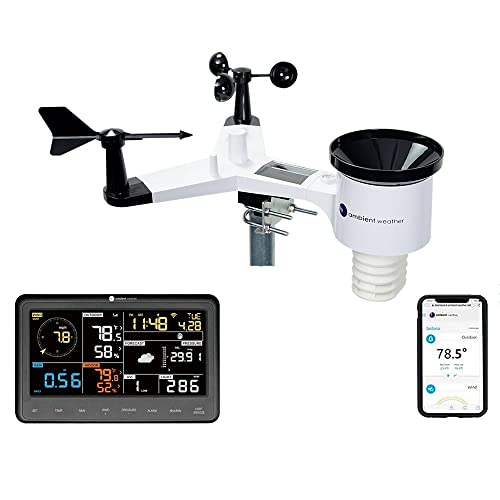
A campsite near a cabin or RV benefits from more than a temperature reading. The Ambient Weather WS-2902 uses an outdoor sensor array with a rain cup and tracks wind speed, wind direction, temperature, humidity, rainfall, UV intensity, and solar radiation. That breadth makes it the most complete choice in this group for someone who wants to watch changing conditions around a semi-permanent outdoor base.
Its Wi-Fi connection gives the system a useful advantage for a property where the display is not always within reach. The listing describes remote data access, alerts, Ambient Weather Network connectivity, and compatibility with IFTTT, Google Home, and Alexa. That does not make the sensor array portable in the same sense as the battery-powered AcuRite Iris Mini, but it does make the WS-2902 more useful for a cabin or RV site that stays in one place.
Pros
- Measures wind speed and direction, temperature, humidity, rainfall, UV intensity, and solar radiation.
- Includes an outdoor sensor array, rain cup, and color LCD display.
- Provides Wi-Fi connectivity for remote access and alerts.
- Listing identifies IFTTT, Google Home, and Alexa support.
- Can connect with the Ambient Weather Network.
Cons
- Its sensor array requires a more involved outdoor setup than a compact campsite thermometer.
- Wi-Fi usefulness depends on having network access at the campsite, cabin, or RV base.
This is the strongest overall selection for a campsite that functions as a recurring base rather than a quick overnight stop. It gives the reader a broad local weather picture and online access, but the installation and network requirements make it less convenient for backpacking or constantly moving between sites. Mount the sensors with attention to wind exposure and rain collection, then use the display or connected services for day-to-day checks.
To buy this product, click here.
2. AcuRite Iris 5-in-1 Home Weather Station: Best for Weather Underground
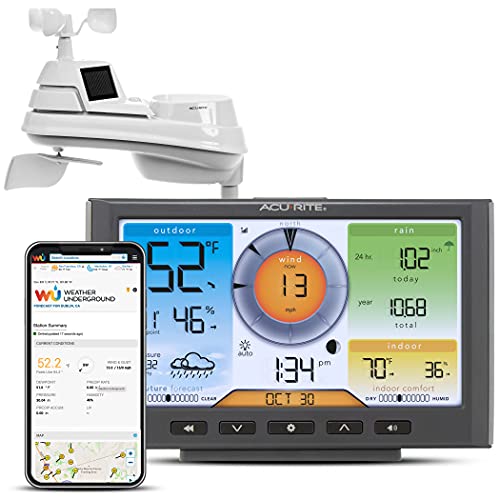
The AcuRite Iris 5-in-1 suits a fixed campsite, cabin, or RV pad where online sharing matters. Its outdoor system measures temperature, humidity, wind speed, wind direction, barometric pressure, and rainfall, while the color display adds time, date, adjustable dimming, and weather information. The inclusion of a built-in anemometer, wind vane, rain gauge, barometer, hygrometer, and thermometer gives it a broad local monitoring role.
Its clearest distinction is the stated Wi-Fi connection to Weather Underground. The listing also describes more than 25 data points, threshold alarms, historical data, heat index, dew point, wind chill, and rainfall history. These extra values include calculated readings, so they should be viewed as useful interpretations of the sensor data rather than separate physical sensors.
Pros
- Measures temperature, humidity, wind speed, wind direction, pressure, and rainfall.
- Supports Wi-Fi connection to Weather Underground.
- Tracks historical information and rainfall history.
- Provides heat index, dew point, and wind chill information.
- Color display includes an adjustable dimmer.
Cons
- Its fixed outdoor sensor arrangement is less convenient for frequent campsite moves.
- The listing does not describe battery-powered portability for the complete system.
Choose this model if your camping setup has a regular location and you want local observations available through a weather network. It is more data-oriented than the basic indoor-outdoor consoles, yet it does not offer the same stated smart-home breadth as the Ambient Weather model. For a temporary site without dependable Wi-Fi, the AcuRite Iris Mini is a more natural fit.
To buy this product, click here.
3. Sainlogic 12-in-1 Wireless Weather Station: Best for Rainfall Records

Rain can determine whether a campsite remains comfortable or turns into a muddy scramble, and the Sainlogic 12-in-1 gives rainfall unusually prominent treatment. The listing states that it records hourly, daily, weekly, monthly, and cumulative totals across a 0 to 9999 mm range, with a listed accuracy of plus or minus 7 percent. That makes it useful for watching a campsite, garden, or cabin property over several days.
The station also reports indoor and outdoor temperature and humidity, barometric pressure, wind speed and direction, dew point, and feels-like temperature. Its 6.5-inch color display has three backlight levels, and the outdoor sensor’s listed wireless maximum reaches 443 feet in open, unobstructed conditions. Treat that distance as a favorable-condition figure, since trees, walls, terrain, and metal structures can reduce communication distance.
Pros
- Records rainfall by hour, day, week, month, and cumulative total.
- Tracks temperature, humidity, pressure, wind, dew point, and feels-like temperature.
- Includes a 6.5-inch color display with adjustable backlight.
- Listing states a 443-foot open, unobstructed wireless maximum.
- Includes mounting hardware according to the product information.
Cons
- No Wi-Fi is identified, so readings remain tied to the local display.
- The listed rainfall accuracy is a specification claim, not independent testing.
This is a sensible selection for a campsite with room for an outdoor sensor and a strong interest in rain history. It gives more rainfall detail than the simpler console stations, though users wanting access from several miles away will need a Wi-Fi model instead. Level the rain sensor carefully and keep the outdoor array clear of obstructions for more representative readings.
To buy this product, click here.
4. AcuRite Iris 01122M with Wireless Mini Display: Best for Portable Camping
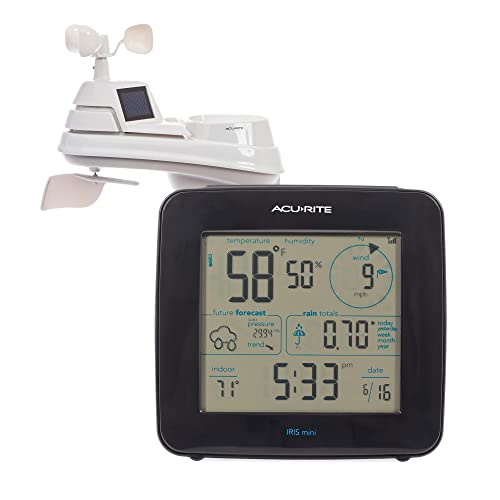
Portability changes the buying decision. A system that needs a fixed display and a permanent installation can be awkward beside a tent, while the AcuRite Iris Mini is described specifically for road trips, RV camping, and storm chasing. Both the mini display and outdoor sensor are wireless and battery-powered, which removes the need to keep the console beside an outlet.
The measurement set remains useful for a mobile setup. It tracks indoor and outdoor temperature, outdoor humidity, wind speed, wind direction, pressure trends, and rainfall totals. The display also stores daily and all-time minimums and maximums for temperature and humidity, wind records, and rainfall totals across several time periods. A freeze indicator appears when the outdoor temperature reaches 32 degrees Fahrenheit or below.
Pros
- Battery-powered display and outdoor sensor support mobile use.
- Designed in the listing for road trips, RV camping, and storm chasing.
- Measures temperature, humidity, wind, pressure trends, and rainfall.
- Stores daily and longer-term historical records.
- Includes a freeze indicator at 32 degrees Fahrenheit or below.
Cons
- Wi-Fi or remote Internet access is not identified.
- The mini display provides less information at a glance than larger color consoles.
This is the most convincing choice for someone who changes locations often and wants actual local readings rather than a phone forecast alone. It gives up online access and some display real estate, but the battery-powered architecture is a major practical advantage at a site with no convenient electrical service. Pack spare batteries as part of the station’s field kit, since the supplied information does not state battery life.
To buy this product, click here.
5. AcuRite Iris 01512MCB Color Screen Weather Station: Best for Detailed Local Records
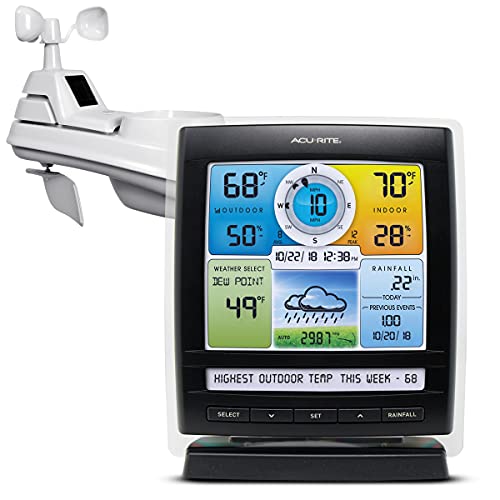
The AcuRite Iris Color Screen model is aimed at readers who want a larger, information-rich view at a cabin or established campsite. The product information lists more than 55 data points, including indoor and outdoor temperature and humidity, wind speed and direction, barometric pressure, rainfall, heat index, dew point, feels-like temperature, and pressure trends. That is a substantial local information set for planning a morning hike, checking a storm front, or reviewing conditions after a wet night.
Its wireless outdoor sensor and color display simplify the basic arrangement, and the listing describes battery installation plus an included mounting bracket for attaching the sensor to a pole or post. The forecast combines elevation information with barometric pressure for a personalized 12-hour forecast. That forecast is derived from station information, so it should not be confused with direct measurement of future weather.
Pros
- Lists more than 55 available data points.
- Measures temperature, humidity, pressure, rainfall, wind speed, and wind direction.
- Displays calculated values such as dew point and feels-like temperature.
- Includes a color screen with adjustable dimmer.
- Product information describes a mounting bracket for a pole or post.
Cons
- Wi-Fi and remote access are not identified for this exact model.
- Its larger information set is better suited to a semi-permanent base than lightweight travel.
This model makes sense beside a cabin, long-term tent platform, or RV site where local records matter more than online access. It offers more displayed information than the compact Iris Mini, but the Mini is easier to justify for moving trips. Check the mounting location before installation, since wind and rain readings depend heavily on sensor exposure.
To buy this product, click here.
6. Fokey Wireless Indoor Outdoor Weather Station: Best for a Large Readable Display

At a campsite, a display that can be read from across a cabin or picnic shelter can save repeated trips to a phone or small console. The Fokey uses a listed 7.6-inch VA display and includes a remote sensor with its own 2-inch digital screen. That second readout is handy when the sensor is placed outside and the main display remains inside an RV or cabin.
The station monitors temperature, humidity, and pressure trends, with absolute and relative pressure modes identified in the listing. It supports up to three remote sensors and gives a listed wireless pairing maximum of 328 feet. The advertised temperature error margin should be treated as a product-listing claim rather than independent verification, but it is still useful information to compare with models that provide no comparable figure.
Pros
- Uses a 7.6-inch display for at-a-glance viewing.
- Remote sensor includes a 2-inch display.
- Supports up to three remote sensors according to the listing.
- Tracks pressure trends and offers absolute and relative pressure modes.
- Supports several time zones and atomic time synchronization.
Cons
- It does not provide the rainfall, wind, or UV measurement set of the full sensor arrays.
- The listed 328-foot range is a maximum under favorable conditions, not a guarantee through a campsite structure.
Pick the Fokey when temperature, humidity, pressure, and visibility matter more than rainfall and wind instruments. It is a particularly practical fit for a cabin-style camping setup with several indoor or outdoor locations to monitor. A reader planning serious rain and wind observation should move up to an integrated array instead.
To buy this product, click here.
7. Newentor Wireless Indoor Outdoor Weather Station: Best Simple Multi-Location Option

The Newentor is a sensible choice for a campsite, cabin, or gear shed where the main question is the temperature and humidity inside versus outside. Its color LCD shows indoor and outdoor readings, daily highs and lows, alerts, time, date, forecast information, moon phase, and barometric pressure. The first outdoor sensor is included, while the system supports up to three remote sensors for additional locations.
The display can remain continuously lit through the included DC adapter. On battery power alone, it enters an energy-saving mode and lights for a short 15-second glance before dimming. That distinction matters at a campsite because a battery-powered console behaves differently from an outlet-powered one. The forecast covers the next 12 to 24 hours after a calibration period, so it is a local station estimate rather than a replacement for official alerts.
Pros
- Displays indoor and outdoor temperature and humidity.
- Supports up to three remote sensors, with one included.
- Provides daily high and low records plus customizable alerts.
- Includes pressure, forecast, moon phase, clock, and calendar information.
- Offers an always-on display through the included DC adapter.
Cons
- It does not measure rainfall, wind speed, or wind direction.
- Batteries are not included, and battery-only operation dims after a brief display period.
This station works best for straightforward shelter monitoring, especially when frost, indoor comfort, or temperature changes matter more than wind and rain totals. It is easier to understand than a full array, but its limited measurement set makes it a poor choice for detailed storm tracking. Add the optional sensor locations only if monitoring separate areas genuinely helps your setup.
To buy this product, click here.
8. DreamSky Wireless Indoor Outdoor Weather Station: Best for Large Numbers and Alerts

DreamSky takes a display-first approach that suits a cabin wall, RV counter, or sheltered campsite table. The large colorful screen shows indoor and outdoor temperature, forecast information, atomic time, date, year, and calendar day. Its high and low temperature alerts can draw attention to a cold night or a warmer-than-expected interior without requiring constant checks.
The station supports up to three outdoor sensors, with one included, and uses pressure information for a 12 to 24-hour forecast after calibration. Five brightness levels let the display be adjusted for daytime or nighttime use. It runs from an adapter, includes a USB port, and can retain operation through backup batteries, although the batteries are not included and battery-only use dims the screen after a short period.
Pros
- Uses large numbers that are easy to check from a distance.
- Supports high and low temperature alerts.
- Accepts up to three outdoor sensors, with one included.
- Offers five backlight brightness levels.
- Includes atomic time, automatic daylight-saving adjustment, USB, and battery backup.
Cons
- It does not include wind or rainfall measurement.
- Continuous bright display use requires adapter power.
Choose DreamSky for simple temperature and humidity awareness around a comfortable base camp. It is more useful than a basic clock because the outdoor sensor, alerts, and pressure-based forecast add context, but it cannot replace a rain-and-wind array. Its screen and adjustable brightness are the main reasons to select it over the closely related Newentor.
To buy this product, click here.
9. Digital AM/FM Shortwave Weather Alert Radio: Best Alert Companion

This radio serves a different camping need from the sensor stations above. It does not measure temperature, rainfall, wind, or pressure. Instead, it receives NOAA weather broadcasts along with AM, FM, and shortwave programming, giving a campsite a way to hear official weather information and emergency alerts when a phone signal or Internet connection is unavailable.
The rechargeable 4000mAh battery is intended for portable use, and the radio also accepts four D-cell batteries. The listing states up to 40 preset stations, a USB and microSD MP3 function, a backlit LCD, and a sleep timer from 10 to 90 minutes. Those entertainment features are secondary here, but the multiple power options are relevant during a long trip or outage.
Pros
- Receives NOAA weather broadcasts and alerts from seven NOAA stations.
- Uses a rechargeable 4000mAh battery and supports four D-cell batteries.
- Offers AM, FM, shortwave, USB, and microSD playback.
- Stores up to 40 preset stations.
- Includes a backlit display, lock function, and sleep timer.
Cons
- It does not provide local sensor measurements.
- Weather information depends on broadcast reception and does not create campsite weather records.
This is best carried alongside a weather station, especially for trips where official alerts matter more than local readings. Use a sensor system to learn what is happening directly around the tent, then use the radio for broadcast warnings and broader regional information. Readers seeking a complete personal weather station should choose one of the first eight products instead.
To buy this product, click here.
Buying Guide
Choose Portable or Semi-Permanent Monitoring First
The AcuRite Iris Mini is the clearest match for a moving campsite because its display and outdoor sensor are described as battery-powered. A full array such as the Ambient Weather WS-2902 or Sainlogic 12-in-1 makes more sense when the tent, RV, or cabin stays in one location long enough to justify mounting and sensor placement. Portability is more than a small box. It includes power, setup time, sensor handling, and how quickly the system can be packed away.
Wireless Does Not Mean Wi-Fi
Every wireless station in this group can send information from an outdoor sensor to a local display, but only some provide a stated Internet connection. The Ambient Weather WS-2902 offers Wi-Fi, while the AcuRite Iris 5-in-1 identifies Weather Underground support. The Sainlogic, Fokey, Newentor, DreamSky, and Iris Mini descriptions focus on local wireless communication. A wireless campsite system can work without a router, but it will not automatically provide remote access.
Decide Which Measurements Matter at Camp
Temperature and humidity may be enough for checking sleeping conditions, frost, or an enclosed RV. Wind speed and direction become more useful for exposed sites, while rainfall history helps with multi-day trips and cabin maintenance. UV and solar radiation are available on the Ambient Weather WS-2902. More measurements create a broader picture, but they also tend to bring larger sensor arrays and more involved placement.
Read Transmission Range as a Maximum
Sainlogic lists a 443-foot wireless maximum in open, unobstructed conditions, while Fokey lists up to 328 feet. These figures describe the communication link between the outdoor sensor and display, not guaranteed distance through an RV, cabin, trees, hills, or metal structures. Place the display where the sensor link has the clearest practical path, and avoid assuming that a longer advertised figure automatically means a better station.
Separate Direct Measurements from Calculated Information
Temperature, humidity, wind, pressure, and rainfall can come from dedicated sensors. Dew point, wind chill, heat index, feels-like temperature, pressure trends, and forecast icons are calculated or interpreted from available readings. Those values can be useful for camping decisions, but they do not represent additional physical sensors. A station advertising many data points may be presenting a mixture of measured and derived information.
Plan Power Before You Leave Home
The portable Iris Mini and the weather radio are the easiest options to associate with battery-based travel from the supplied information. Newentor and DreamSky can use batteries, but their displays enter a power-saving mode when operating without an adapter. A connected Ambient Weather station is more suitable where Wi-Fi and steady power are available. Check battery requirements before departure, since several listings specify that batteries are not included.
Give the Outdoor Sensors a Fair Location
A temperature sensor beside a hot vehicle, a rain gauge beneath a tree, or a wind sensor blocked by a cabin wall can produce readings that describe the placement more than the surrounding weather. Use an open location appropriate to the sensor type, keep rainfall collection clear, and remember that an outdoor-use label does not provide a specific waterproof, freeze, or corrosion rating. Better placement often matters as much as choosing a longer feature list.
Best Weather Stations for Camping FAQ
What Is the Best Weather Station for Camping?
The Ambient Weather WS-2902 is the strongest overall choice for a recurring campsite, cabin, or RV base because it measures temperature, humidity, rainfall, wind, UV intensity, and solar radiation while adding Wi-Fi features. For frequently changing campsites, the battery-powered AcuRite Iris with Mini Display is more practical.
Are Weather Stations Useful at a Campsite?
Yes, a local station can show conditions around the campsite that may differ from a town-level forecast. Temperature, humidity, wind, and rainfall are especially useful for deciding when to pack away gear, protect food and equipment, or adjust sleeping arrangements.
Do Wireless Weather Stations Need Wi-Fi?
No. Wireless usually describes the connection between the outdoor sensor and the local display. Wi-Fi is a separate network connection that can support remote access, online weather platforms, or connected alerts when the exact model provides those functions.
Which Camping Weather Station Is Most Portable?
The AcuRite Iris 01122M with Wireless Mini Display is the strongest portable option in this group. Its product information describes both the display and outdoor sensor as wireless and battery-powered, with road trips, RV camping, and storm chasing among the intended uses.
Can a Weather Station Replace a NOAA Alert Radio?
A sensor station and an alert radio serve different purposes. A weather station measures local conditions, while the radio receives NOAA broadcasts and alerts. The digital AM/FM shortwave model does not measure campsite temperature, wind, or rain, so it should be treated as a companion rather than a replacement.
Are Calculated Weather Values the Same as Measurements?
No. Dew point, heat index, wind chill, feels-like temperature, and some forecast information are calculated from measured readings. They can help interpret conditions, but they are different from direct measurements from a thermometer, hygrometer, barometer, anemometer, or rain gauge.
Does a Longer Wireless Range Guarantee Better Performance?
No. The listed maximum usually reflects open, unobstructed conditions. Buildings, trees, terrain, metal siding, and interference can reduce the practical distance between the sensor and display. Treat the published figure as a comparison point rather than a guarantee.
Final Verdict
The Ambient Weather WS-2902 is the strongest overall selection for a connected campsite, cabin, or RV base. Its sensor array covers the measurements most useful for broader outdoor awareness, including wind, rain, temperature, humidity, UV, and solar radiation. Wi-Fi, alerts, Ambient Weather Network access, and listed smart-home compatibility give it a meaningful advantage when the site has dependable power and Internet access.
For mobile trips, the AcuRite Iris with Mini Display is the better match because its battery-powered design is easier to move. Sainlogic is a useful alternative for detailed rainfall history without Wi-Fi, while the simpler Newentor, DreamSky, and Fokey models suit temperature and humidity monitoring around a shelter. Carry the NOAA radio when official alerts matter, but keep its role clear: it broadcasts weather information rather than measuring the air around your campsite.