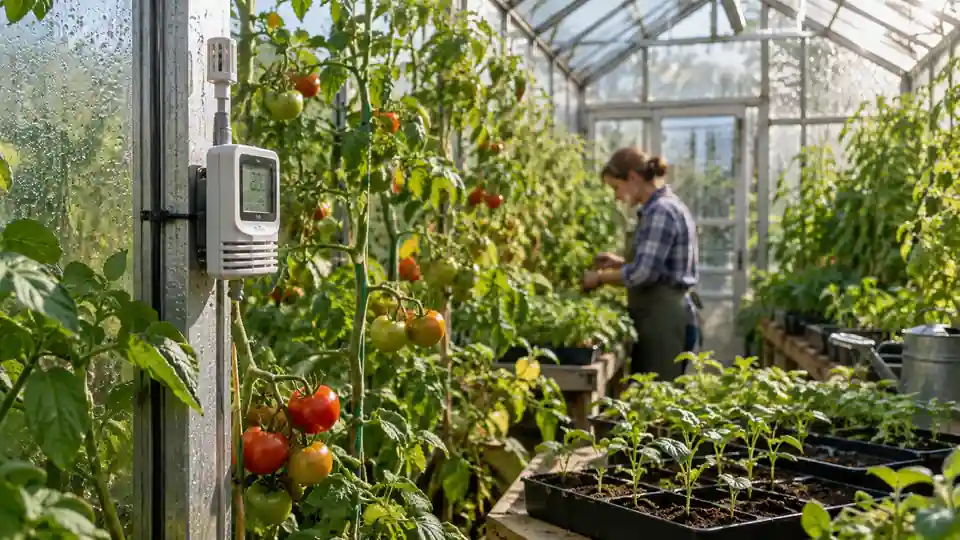
A greenhouse can swing from cool and damp to hot and stuffy in a surprisingly short time. A weather station helps turn those changes into usable information, especially when temperature and relative humidity affect ventilation, watering, frost protection, and plant stress. For this setting, a large outdoor weather array is useful only when it also gives you practical greenhouse readings, clear alerts, or enough sensor flexibility to monitor more than one location.
The biggest buying distinction is the difference between local and remote monitoring. A wireless sensor can send readings to a console across a property, while Wi-Fi can add app access, email alerts, and stored history. Those are separate capabilities. Accuracy claims, sensor placement, and the number of included sensors matter as well. A station with several outdoor measurements may be less useful inside a greenhouse than a system that places temperature and humidity sensors exactly where conditions change.
The products below range from compact temperature and humidity monitors to full weather stations with rainfall, wind, UV, Wi-Fi, and historical records. The Sainlogic SA9 Plus earns the strongest overall position for readers who want a complete connected system, while GoveeLife is the more focused choice for greenhouse temperature and humidity zones.
Quick Answer
- Sainlogic SA9 Plus: Best overall for a greenhouse setup that benefits from Wi-Fi, alerts, rainfall, wind, UV, and historical data.
- GoveeLife WiFi Thermometer Hygrometer: Best for monitoring multiple temperature and humidity zones with app alerts through its gateway.
- Sainlogic SA1: Best for lower-cost Wi-Fi monitoring with app and email alerts, two years of stored trends, and data export.
- Sainlogic 12-in-1: Best for rainfall and outdoor weather information without an app, gateway, or monthly service.
If you want a fast comparison before reading the detailed reviews, the table below shows how the leading greenhouse-friendly options differ.
Best Weather Stations for Greenhouses Comparison Table
| Product | Best For | Measurements And Data | Connectivity Or Sensor Setup |
|---|---|---|---|
| Sainlogic SA9 Plus | Complete connected monitoring | Temperature, humidity, pressure, wind, rain, UV, sunlight | Wi-Fi, Bluetooth, app, email alerts, optional Weather Underground |
| GoveeLife WiFi Thermometer Hygrometer | Multiple greenhouse zones | Temperature, humidity, trends, comfort indicator | Three-piece kit with gateway, app alerts, email alerts |
| Sainlogic SA1 | Wi-Fi data logging | Temperature, humidity, pressure, forecasts | 2.4GHz Wi-Fi, app, email alerts, two-year history |
| Sainlogic SA3 | Compact remote monitoring | Temperature, humidity, pressure, forecasts | 2.4GHz Wi-Fi, Bluetooth, app, email alerts |
| BaldrTherm WiFi Thermometer Hygrometer | Compact greenhouse alerts | Temperature, humidity, trends, weather icons | Wi-Fi and Bluetooth, phone alerts |
| OBET Wireless Weather Station | Several local sensor locations | Temperature, humidity, pressure, frost alerts | Three sensor channels, 500-foot listed range |
| Jollyz Weather Station | Large local display | Temperature, humidity, dew point, heat index, mold risk | Up to three sensors, one included, no Wi-Fi identified |
| UNNI Indoor Outdoor Weather Station | Focused temperature and humidity readings | Temperature, humidity, dew point, heat index, mold index | Up to three sensors, 330-foot listed range |
| Sainlogic 12-in-1 | Rainfall and outdoor weather | Temperature, humidity, pressure, wind, rain, dew point | Wireless console, 443-foot listed range, no Wi-Fi |
The reviews below explain where each station fits, what its greenhouse-related strengths are, and which limitations deserve attention before ordering.
1. Sainlogic SA9 Plus Smart WiFi Weather Station — Best Overall

The SA9 Plus is the most complete fit for a greenhouse that needs more than a single temperature and humidity reading. Its outdoor sensor measures temperature, humidity, barometric pressure, wind speed, wind direction, rainfall, UV, and sunlight, while the indoor unit adds another temperature and humidity reference. That combination helps connect greenhouse conditions with the weather outside. A hot afternoon, rising wind, or incoming rain can explain why ventilation or watering decisions change.
Remote access is the main reason this model ranks first. The listing describes Wi-Fi and Bluetooth connectivity through the Weatherseed app, along with custom temperature and humidity alerts, email notifications, two years of historical data, and Excel export in periods of up to 30 days. The 8.5-inch display also keeps local monitoring easy, with readings for wind, rain, UV, pressure, dew point, and moon phase. The outdoor array needs suitable mounting and exposure, so it is a stronger choice for a permanent installation than for a temporary plant shelf.
Pros
- Measures greenhouse-relevant temperature and humidity alongside wind, rainfall, pressure, UV, and sunlight.
- Supports Wi-Fi app access, email alerts, and historical data viewing.
- Listing states that data can be exported to Excel in 30-day periods.
- Large 8.5-inch display shows many readings at once.
- Optional Weather Underground connection is identified in the product information.
Cons
- The full outdoor array requires more involved placement than a compact temperature and humidity sensor.
- The listed measurement accuracy varies by variable, and humidity accuracy is given as plus or minus 5 percent RH.
This is the strongest choice for a greenhouse where outside weather context and remote alerts matter as much as the reading inside the growing space. It may be more equipment than needed for someone who only wants a second humidity sensor, and its outdoor array should be mounted where buildings, roofs, and direct obstructions do not distort wind or rain readings. Choose it for a broad monitoring system, not merely for a large screen.
To buy this product, click here.
2. GoveeLife WiFi Thermometer Hygrometer 5-in-1 — Best for Multiple Greenhouse Zones
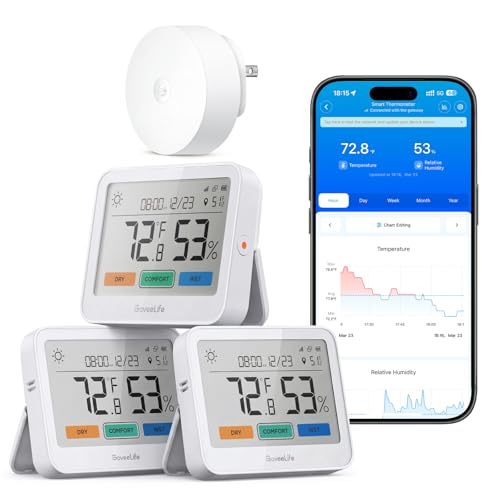
Greenhouse conditions can vary between a shaded corner, a sunny bench, and the area near a door. GoveeLife addresses that problem with a three-pack of thermometer-hygrometer units and a gateway. The available information lists temperature and humidity monitoring, real-time trends, a color-coded comfort indicator, and a local forecast feature that requires gateway H5044. For plant protection, that focused measurement set can be more useful than a weather station filled with outdoor readings you rarely check.
The stated temperature accuracy is up to plus or minus 0.36 degrees Fahrenheit, with humidity accuracy of plus or minus 2 percent RH. The sensors refresh rapidly according to the listing, and the gateway enables push, app, email, and buzzer alerts. The listed open-air range through the gateway reaches up to 1,640 feet, though building materials and placement can affect any wireless system. Battery life is listed as up to two years on Bluetooth or one year with the gateway, using two AA alkaline batteries per unit.
Pros
- Three monitoring units make it practical to compare separate greenhouse zones.
- Product information lists temperature accuracy of up to plus or minus 0.36 degrees Fahrenheit.
- Supports push, app, email, and gateway buzzer alerts.
- Large LCD units show readings and a color-coded comfort indicator locally.
- Gateway-based system is specifically identified for greenhouse and other sensitive environments.
Cons
- The local weather forecast feature requires the H5044 gateway.
- This system focuses on temperature and humidity rather than rainfall, wind, or UV measurement.
Pick GoveeLife when plant-zone monitoring is the priority. Three units let you spot a warm upper shelf or damp corner before a single central sensor hides the difference. It is less suitable if you want rainfall totals or wind direction from the same system, and the gateway requirement should be included in the setup plan. For a greenhouse with several distinct microclimates, its focused architecture is a real advantage.
To buy this product, click here.
3. Sainlogic SA1 Smart Weather Station — Best for Data Logging

The SA1 takes a more balanced approach to greenhouse monitoring. It records indoor and outdoor temperature, humidity, and air pressure, then places those readings in the Weatherseed app. The listing identifies email and app alerts, two years of historical storage, online graphs, and export capability. That history can help reveal recurring overnight humidity spikes or temperature drops that are easy to miss when checking a console for a few seconds.
Its 8.15-inch color display makes local checks straightforward, while Wi-Fi time synchronization keeps the clock current. The wireless outdoor sensor gives placement flexibility, but the product information specifically says the sensor is not waterproof. That detail matters in a greenhouse because condensation, irrigation spray, and direct exposure can be harsher than a dry indoor room. The SA1 is best placed where it can sample the intended air without sitting in a wet path.
Pros
- Provides app and email alerts for temperature and humidity thresholds.
- Stores up to two years of indoor and outdoor temperature, humidity, and pressure history.
- Supports graph viewing and data export, with exports limited to 30 days at a time.
- Large 8.15-inch color display is useful for local checks.
- Wi-Fi time synchronization and automatic daylight-saving adjustment are included in the listed features.
Cons
- The listing states that the wireless sensor is not waterproof.
- It does not list wind or rainfall measurement, limiting its outdoor weather coverage.
This model suits a grower who wants records and notifications without moving to a full wind-and-rain array. Its biggest practical caution is sensor exposure. Keep the sensor away from irrigation spray and direct wetting, and confirm that the intended mounting location fits the product’s environmental limitations. Choose the SA1 over a local-only station when historical trends are central to your decisions.
To buy this product, click here.
4. Sainlogic SA3 Smart Portable Weather Station — Best Compact Remote Monitor

Some greenhouse setups have little room for a large console or fixed installation. The SA3 is a compact Wi-Fi thermometer-hygrometer that also measures barometric pressure and connects to the Weatherseed app. It supports app and email alerts for custom temperature, humidity, and pressure thresholds, which gives a remote warning when conditions move outside the range you set. The included lanyard loop allows drill-free placement, a useful detail for temporary structures or rented spaces.
The app stores up to two years of trends and allows graph exports, although each export can cover up to 30 days. It supports 2.4GHz Wi-Fi and Bluetooth, so buyers should confirm that their network uses the required band. The product information also says the sensor is not waterproof and that batteries are not included. Those details keep the SA3 from ranking higher, but they do not erase its usefulness as a small monitor for a sheltered greenhouse area.
Pros
- Compact format works where a large weather console would be awkward.
- Provides app and email alerts for temperature, humidity, and pressure.
- Stores up to two years of trends in the Weatherseed app.
- Supports graph export in periods of up to 30 days.
- Drill-free lanyard mounting is suited to temporary or movable placements.
Cons
- The sensor is identified as not waterproof.
- It requires 2.4GHz Wi-Fi and does not list rainfall or wind measurement.
The SA3 is a sensible pick for compact remote monitoring, especially when the goal is to receive a warning rather than operate a full outdoor weather installation. It should be kept sheltered from direct water and placed where the reading represents the growing area rather than a hot wall or sunlit surface. Choose it over the SA1 when size and portability matter more than a large display.
To buy this product, click here.
5. BaldrTherm WiFi Thermometer Hygrometer — Best Compact Alert System
BaldrTherm keeps the focus on two measurements that matter constantly inside a greenhouse: temperature and humidity. The 3.9-inch LCD shows those readings, the time, and weather icons, while the app provides remote notifications when custom comfort limits are exceeded. Historical 24-hour, maximum, and minimum trends are also listed, giving you a quick way to spot whether a night was unusually cold or a humid spell lasted too long.
The product information identifies dual Bluetooth and Wi-Fi setup, 2.4GHz Wi-Fi, and a temperature accuracy claim of plus or minus 0.5 degrees Fahrenheit. Its solar-hybrid design is described as supporting up to one year of battery life, but that does not mean the entire system is independent of batteries or that every placement receives equal solar exposure. The compact housing can sit on a table or hang on a wall, which makes it easier to position near a growing area than a large outdoor array.
Pros
- Provides Wi-Fi phone alerts for temperature and humidity limits.
- Tracks 24-hour, maximum, and minimum trends in the app.
- Compact 3.9-inch display shows greenhouse conditions at a glance.
- Product information lists dual Bluetooth and Wi-Fi setup.
- Solar-hybrid design is listed with up to one year of battery life.
Cons
- The measurement set is limited to temperature and humidity rather than rain or wind.
- The Wi-Fi connection is identified as 2.4GHz only.
BaldrTherm makes sense for a small greenhouse, indoor grow room, or sheltered plant area where alerts matter more than a weather array. It is easier to place than a full station, though a single monitor cannot reveal conditions at several benches at once. Buyers who want rainfall, outdoor wind, or multi-zone sensing should step up to a different design.
To buy this product, click here.
6. OBET Wireless Indoor Outdoor Weather Station — Best for Three Local Sensors

OBET is built around local multi-location monitoring rather than app-based remote access. Its color console displays indoor and outdoor temperature and humidity, minimum and maximum records, pressure, trends, and a 12-hour forecast. The system supports three outdoor sensor channels, which could help compare a greenhouse with an adjacent garden, shed, or garage. For a property where someone regularly checks the console, that arrangement is pleasantly straightforward.
The listing gives a 500-foot maximum wireless range and advises placing sensors vertically away from direct sun, rain, and the ground. That placement guidance is especially relevant in a greenhouse, where a sensor against a clear panel or near wet soil may record the surrounding surface influence rather than representative air conditions. Frost and snowflake alerts add seasonal usefulness. The listed temperature and humidity accuracy is less specific than some alternatives, so this is better viewed as a practical monitoring console than a precision instrument.
Pros
- Supports up to three outdoor sensors for separate locations.
- Large 7.68-inch color display shows readings, trends, and forecast information.
- Includes customizable temperature and humidity alerts.
- Offers USB or battery power for the console.
- Includes frost and snowflake indicators tied to listed temperature thresholds.
Cons
- Remote app or email access is not identified in the product information.
- The listed sensor accuracy is plus or minus 1.8 degrees Fahrenheit and plus or minus 5 percent RH.
Choose OBET when the console will live near the greenhouse and multiple local readings matter. It is less appropriate for someone who needs notifications while away from the property, since the available information describes wireless sensor communication rather than Wi-Fi or cloud access. The USB adapter is also not included, so plan around the selected power arrangement.
To buy this product, click here.
7. Jollyz Wireless Weather Station — Best Large Local Display
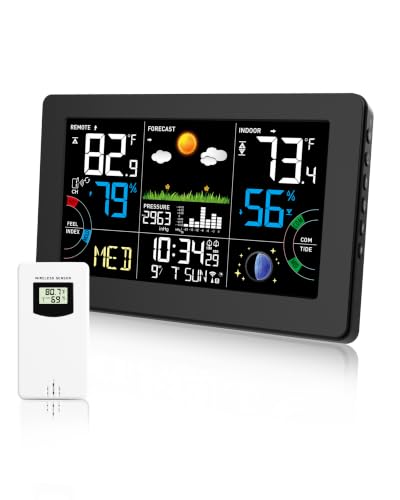
Jollyz puts a wide range of greenhouse-friendly information on a 7.5-inch color display. Alongside indoor and outdoor temperature and humidity, it identifies frost warnings, dew point, heat index, mold risk, and minimum and maximum records. Dew point and humidity trends can help show when condensation risk is rising, while a frost warning can draw attention to a cold overnight forecast. These values are useful decision aids, though several are calculated or forecast-related rather than separate direct sensor measurements.
The station supports up to three wireless sensors, but only one is included according to the listing. Additional sensors are sold separately, so the multi-zone capability has an extra acquisition step. Its WWVB atomic clock, five-level backlight, tabletop stand, and wall-mounting hole make the console easy to keep visible near a workbench or greenhouse entrance. The system uses DC power with battery backup, which maintains the display and settings through a power interruption according to the product information.
Pros
- 7.5-inch color display presents greenhouse-related readings clearly.
- Supports up to three wireless sensors for multiple locations.
- Includes dew point, mold risk, heat index, and frost-related information.
- Offers five backlight levels and both tabletop and wall placement.
- Battery backup is listed for timekeeping and settings during power outages.
Cons
- Only one sensor is included, with extra sensors sold separately.
- Wi-Fi, app access, and remote alerts are not identified in the product information.
Jollyz is a good local display station for someone who wants readable information without setting up a network account. Its extra calculated indicators can make quick checks more useful, but they should not be confused with additional physical measurements. Select it when a visible console is central to the routine, and look elsewhere if remote access is a requirement.
To buy this product, click here.
8. UNNI Indoor Outdoor Thermometer Hygrometer — Best Focused Monitor

UNNI keeps the hardware simple: one display, one outdoor sensor, and support for up to three sensors on separate channels. It measures indoor and outdoor temperature and humidity, then adds heat index, dew point, mold index, and forecast information on the console. The product listing gives temperature accuracy as plus or minus 0.5 degrees Fahrenheit and humidity accuracy as plus or minus 2 percent, with updates every 30 seconds and a listed 330-foot transmission radius.
That combination is useful for a greenhouse where the primary question is whether the air is getting too cold, too humid, or too warm. The display can sit on a table or mount on a wall, and its backlight activates for 10 seconds when needed. The system is battery powered, and the package includes the display and one outside sensor. It does not provide Wi-Fi or the rainfall and wind data found on a full weather array, so its appeal comes from focused monitoring and the option to add sensors.
Pros
- Measures temperature and humidity indoors and outdoors with listed accuracy figures.
- Supports up to three sensors on separate channels.
- Displays dew point, heat index, and mold index alongside core readings.
- Lists a 330-foot wireless transmission radius and 30-second updates.
- Compact display supports tabletop or wall placement.
Cons
- It does not provide Wi-Fi, app access, or remote alerts.
- Rainfall, wind, and UV measurements are not included.
UNNI is a practical fit for a nearby greenhouse that needs temperature and humidity information without app setup. It can be more appropriate than a full weather station when rain and wind are secondary, while its expandable sensor count gives it room to cover another bench or outbuilding. It is a poor match for unattended monitoring because the available information describes local wireless transmission only.
To buy this product, click here.
9. Sainlogic 12-in-1 Wireless Weather Station — Best for Rainfall And Outdoor Weather

The Sainlogic 12-in-1 is aimed at readers who want a broad outdoor weather picture without Wi-Fi, app accounts, or a gateway. It measures indoor and outdoor temperature and humidity, pressure, wind speed and direction, rainfall, dew point, and feels-like temperature. The rain gauge records hourly, daily, weekly, monthly, and cumulative totals, while the listing gives a rainfall accuracy of plus or minus 7 percent across its stated range. Those records can help compare natural rainfall with greenhouse watering schedules.
The 6.5-inch color screen uses adaptive backlighting and displays the measurements together. Its listed wireless range reaches 443 feet, though trees, walls, metal, and other obstructions can change actual transmission performance. The outdoor sensor mounts to a pillar or railing with the included bracket, and the product information says the system needs no Wi-Fi, app, hub, or monthly fee. That simplicity is appealing, but it also means no remote alerts or online history are identified.
Pros
- Measures temperature, humidity, pressure, wind, rainfall, dew point, and feels-like temperature.
- Rainfall records include hourly, daily, weekly, monthly, and cumulative totals.
- 6.5-inch color display uses adjustable backlighting.
- Listed wireless transmission range reaches up to 443 feet.
- Operates without Wi-Fi, an app, a gateway, or a monthly service.
Cons
- Remote monitoring and app alerts are not identified.
- The outdoor sensor requires suitable mounting and rain-gauge placement for useful readings.
This station is the better fit for a greenhouse routine built around a local console and outdoor rainfall context. It gives more environmental information than the focused temperature and humidity monitors, but less remote convenience than the connected Sainlogic and Govee options. Choose it when you want automatic rainfall records and a broad display without adding network equipment.
To buy this product, click here.
Buying Guide
Temperature And Humidity Are The Starting Measurements
For most greenhouse decisions, temperature and relative humidity deserve priority over a long list of outdoor features. They help you notice cold nights, hot afternoons, and damp conditions that may call for ventilation. A station such as GoveeLife or UNNI focuses on these variables, while the Sainlogic SA9 Plus and 12-in-1 add outdoor context. More measurements are useful when they change what you do, not simply because they increase the product’s feature count.
Wi-Fi And Wireless Sensor Links Solve Different Problems
A wireless sensor can communicate with a nearby console without connecting to the Internet. Wi-Fi may send readings to an app or service, but the exact functions vary by model. The SA9 Plus, SA1, SA3, BaldrTherm, and GoveeLife listings identify app-related features, while the OBET, Jollyz, UNNI, and Sainlogic 12-in-1 are presented primarily as local wireless systems. Check whether you need a console in the house, notifications while away, or both.
Sensor Placement Can Change The Reading
Keep temperature and humidity sensors where air can circulate, away from direct sun, wet soil, heating equipment, and irrigation spray. The OBET listing specifically advises placing sensors vertically away from sun, rain, and the ground. The SA1 and SA3 listings identify their sensors as not waterproof, so a sheltered location is particularly important. A well-positioned simpler sensor can be more useful than an advanced station placed against a hot greenhouse panel.
Decide Whether Outdoor Weather Measurements Matter
Wind, rain, pressure, and UV can help explain greenhouse conditions and guide watering or ventilation decisions. The SA9 Plus provides the broadest connected measurement set here, while the Sainlogic 12-in-1 offers rainfall and wind without Wi-Fi. A compact humidity monitor is a better use of money when the greenhouse is small and outside weather is already available elsewhere.
Accuracy, Range, And Resolution Are Different Specifications
Accuracy describes how close a reading may be to the relevant reference. Measurement range describes the values a sensor can report. Transmission range describes communication distance, and display resolution describes the increments shown on screen. A station that displays more decimal places is not automatically more accurate, and a 500-foot or 1,640-foot listed wireless range is not a guarantee through every wall or greenhouse structure.
Check Included Sensors And Required Accessories
GoveeLife is presented as a three-unit kit with a gateway, while Jollyz supports up to three sensors but includes one according to the listing. UNNI supports up to three sensors and includes one outside sensor. These arrangements are very different purchases. Also check batteries, power adapters, gateways, and mounting hardware before assuming the complete installation is ready.
Rainfall Requires Appropriate Installation
A rain gauge can help compare natural precipitation with greenhouse watering, but it needs an exposed and appropriately positioned location. Leaves, roofs, walls, and nearby structures can interfere with collection. The Sainlogic 12-in-1 records multiple rainfall periods and gives a listed accuracy figure, while the SA9 Plus also includes rainfall measurement. Neither feature removes the need for sensible placement.
Best Weather Stations for Greenhouses FAQ
What Is The Best Weather Station For A Greenhouse?
The Sainlogic SA9 Plus is the strongest overall choice in this selection because it combines temperature and humidity monitoring with rainfall, wind, UV, pressure, Wi-Fi, app alerts, email alerts, and historical records. GoveeLife is a better fit when the main task is comparing temperature and humidity across several greenhouse zones.
Do I Need Wi-Fi For A Greenhouse Weather Station?
No. Wireless stations such as the UNNI, Jollyz, OBET, and Sainlogic 12-in-1 can send readings to a local console without Wi-Fi. Wi-Fi becomes useful when you want app access, email alerts, online history, or notifications while away. Confirm those functions for the exact model because wireless sensor communication alone does not provide them.
Is Temperature Or Humidity More Important In A Greenhouse?
Both matter, and their importance changes with the plants, season, and ventilation routine. Temperature helps identify heat and frost risks, while humidity and dew point provide clues about damp conditions and condensation. A station that monitors both at the same location is generally more useful than a thermometer that omits relative humidity.
Can I Put The Sensor Inside The Greenhouse?
Yes, provided the product’s environmental limitations and placement requirements allow it. Avoid direct sunlight, irrigation spray, standing water, and contact with hot glazing or metal. The SA1 and SA3 listings identify their sensors as not waterproof, so they require extra care around greenhouse moisture.
Are Wi-Fi Weather Stations Better Than Wireless Models?
They are better for remote access, app alerts, and stored data when those features are supported. A local wireless station can be simpler and may avoid network setup, accounts, or gateway requirements. The right choice depends on whether you need to see a console nearby or receive a warning while away.
Do More Sensors Always Make A Weather Station Better?
No. Additional sensors help when a greenhouse has distinct areas with different conditions. A three-sensor system can reveal variation between benches, doors, and shaded corners, but it also adds batteries, placement decisions, and possible accessory costs. One well-positioned sensor may be enough for a compact growing space.
Can A Greenhouse Weather Station Measure Soil Moisture?
None of the selected products is identified as including a soil-moisture sensor. The reviewed systems focus on air temperature, humidity, and, in some cases, outdoor weather measurements. Do not assume that a station measuring greenhouse air conditions also measures soil or plant moisture.
Does A Weather Station Need To Measure Rainfall Inside A Greenhouse?
Rainfall is measured outside, not inside the greenhouse. An outdoor rain gauge can help you understand natural precipitation and adjust watering decisions, but it does not tell you how much water reached plants under cover. The Sainlogic 12-in-1 and SA9 Plus include rainfall measurement for that broader outdoor context.
Final Verdict
The Sainlogic SA9 Plus is the strongest overall choice for a greenhouse that benefits from a complete outdoor weather picture and remote access. It combines temperature and humidity with rain, wind, pressure, UV, app alerts, email notifications, historical data, and a large local display. Its outdoor sensor array requires more careful installation than a compact monitor, but that trade-off brings a much broader view of conditions around the growing space.
GoveeLife is the more focused alternative for several greenhouse zones because its three monitoring units emphasize temperature and humidity. The Sainlogic SA1 and SA3 suit readers who want Wi-Fi history and alerts in smaller formats, while the Sainlogic 12-in-1 is the better local choice for rainfall and wind without online services. Match the station to the decisions you make each day, place sensors away from heat and spray, and verify which sensors, gateways, batteries, and adapters are included before ordering.