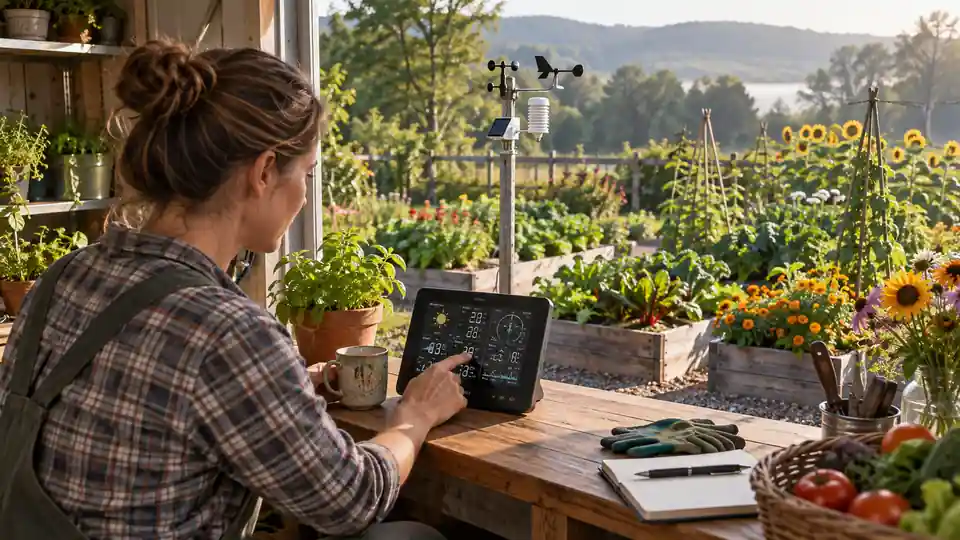
A garden can look calm while conditions at plant level change quickly. A sudden drop in overnight temperature, a stretch of dry air, a burst of wind, or a passing shower can affect watering, frost protection, greenhouse ventilation, and outdoor work. The best weather stations for gardeners bring those local observations into one place by measuring useful variables such as temperature, humidity, rainfall, wind, and barometric pressure.
The buying decision is more involved than counting sensors. A wireless station may send data to a console without offering Wi-Fi or remote access. A Wi-Fi model may add app alerts and data sharing, while an integrated outdoor array can simplify mounting but limit how separately each sensor is positioned. Rainfall accuracy also depends on level placement and exposure, and a bright display may matter more than cloud access if you mainly check conditions from the kitchen window.
This roundup gives the strongest weight to garden-relevant measurements, rainfall tracking, humidity information, installation practicality, and useful data access. The Ambient Weather WS-2902 leads the group because it combines a broad sensor set with Wi-Fi, smart-home support, and a local color display. Several lower-ranked models make better sense for a simpler garden, a larger property, or a grower who wants stored records rather than a feature-heavy console.
Quick Answer
- Ambient Weather WS-2902 is the strongest overall choice for gardeners who want rainfall, wind, temperature, humidity, UV, solar radiation, Wi-Fi, and smart-home options in one system.
- Sainlogic Wi-Fi Smart Weather Station is the most useful pick for garden records, with app alerts, rainfall history, two Wi-Fi bands, and Excel export from stored data.
- Sainlogic 12-in-1 Wireless Weather Station suits growers who want a large local display and detailed rainfall records without Wi-Fi.
- Tempest Weather Station is the premium alternative for app-based monitoring, smart-home automation, solar-assisted outdoor operation, and lightning information.
Best Weather Stations for Gardeners Comparison Table
| Product | Measurements | Connectivity | Sensor Design | Best For |
|---|---|---|---|---|
| Ambient Weather WS-2902 | Temperature, humidity, rain, wind, UV, solar radiation | Wi-Fi, smart-home support | Integrated outdoor array | Best overall garden monitoring |
| Sainlogic Wi-Fi Smart Weather Station | Temperature, humidity, rain, wind, pressure, dew point | 2.4/5 GHz Wi-Fi, Bluetooth pairing, app | Outdoor sensor array | Data logging and remote alerts |
| Tempest Weather Station | Temperature, humidity, rain, wind, UV, solar radiation, lightning | App, Alexa, Rachio, IFTTT | Solar-powered outdoor sensor | Premium connected gardens |
| AcuRite Iris 5-in-1 Wi-Fi | Temperature, humidity, rain, wind, pressure | Wi-Fi, Weather Underground | Integrated 5-in-1 array | Weather-network sharing |
| Sainlogic 12-in-1 Wireless Weather Station | Temperature, humidity, rain, wind, pressure, dew point | Wireless console, no Wi-Fi | Outdoor sensor array | Large-display garden monitoring |
| Sainlogic 12-in-1 Large-Display Weather Station | Temperature, humidity, rain, wind, pressure, heat index | Wireless console, no Wi-Fi | Solar-assisted outdoor sensor | Large properties and simple setup |
| Ambient Weather WS-2000 | Temperature, humidity, rain, wind, UV, solar radiation | Wi-Fi-capable | Integrated outdoor array | Color-console monitoring |
| Wireless Color-Display Weather Station | Temperature, humidity, rain, wind, pressure, dew point | Wireless, no Wi-Fi | Outdoor sensor with mounting bracket | Simple rainfall records |
| AcuRite Iris 01512MCB | Temperature, humidity, rain, wind, pressure | Wireless console | Outdoor sensor with mounting bracket | Local historical information |
The detailed reviews below show where each station earns its place, where it falls short, and which garden setup it suits best.
1. Ambient Weather WS-2902 — Best Overall
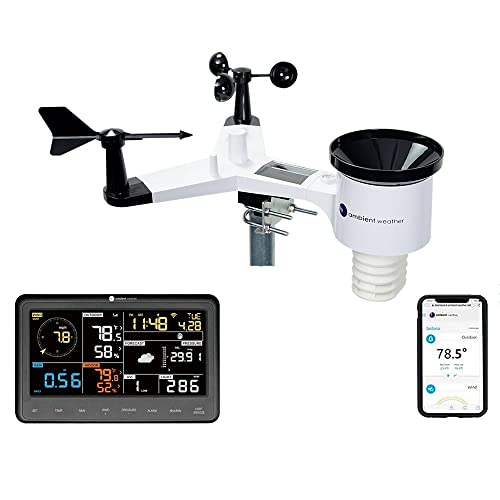
The WS-2902 is a strong fit for a garden because its outdoor array covers the measurements that shape everyday growing decisions. It reports temperature, humidity, rainfall, wind speed, wind direction, UV intensity, and solar radiation, while the indoor color display keeps those readings visible without reaching for a phone. A grower checking whether beds need water or whether a shade cloth should go up gets a wider picture than a basic indoor-outdoor thermometer can provide.
Wi-Fi gives this model a second layer of usefulness. The listing describes remote data access, alerts, Ambient Weather Network sharing, and compatibility with IFTTT, Google Home, and Alexa. Those features can connect weather observations with a broader home setup, although the supplied information does not specify every automation condition or app function. The integrated sensor array also makes the system relatively straightforward to plan, provided the chosen mounting location gives the rain and wind sensors suitable exposure.
Pros
- Measures temperature, humidity, rainfall, wind speed, wind direction, UV intensity, and solar radiation.
- Includes an outdoor Osprey sensor array and a color LCD display.
- Provides Wi-Fi access for remote data viewing and alerts.
- Supports IFTTT, Google Home, and Alexa according to the listing.
- Can share data with the Ambient Weather Network.
Cons
- The integrated array requires one carefully chosen outdoor mounting location for several sensors.
- The listing does not clearly identify every app function or the requirements for each smart-home automation.
This is the best match for a gardener who wants one station to cover both local observation and connected monitoring. It is more capable than a console-only model, yet its usefulness still depends on thoughtful placement and a nearby Wi-Fi connection. A small garden that only needs temperature and rainfall may not need its broader sensor set, but for a backyard with irrigation decisions, exposed beds, and changing sun or wind conditions, the WS-2902 offers the most balanced package here.
To buy this product, click here.
2. Sainlogic Wi-Fi Smart Weather Station — Best for Garden Data Logging

Gardeners who like to spot patterns in a spreadsheet will find a lot to examine here. The Sainlogic station records temperature, humidity, rainfall, barometric pressure, wind speed, wind direction, dew point, feels-like temperature, and moon phase. Its app records hourly, daily, monthly, and yearly rainfall totals, while the product information says the station stores up to two years of local data and can export records to Excel in 30-day sections.
The connectivity details are unusually relevant for a garden spread across a larger yard. This model supports 2.4 GHz and 5 GHz Wi-Fi, uses Bluetooth for fast pairing, and lists real-time app alerts. The outdoor transmission range is given as up to 443 feet in open conditions, which is a listed maximum rather than a guarantee through walls, trees, or outbuildings. A built-in bubble level is also identified for the rain sensor, a small but useful detail because an uneven gauge can distort rainfall records.
Pros
- Supports both 2.4 GHz and 5 GHz Wi-Fi networks.
- Offers app access, real-time alerts, and Bluetooth pairing.
- Stores up to two years of local data according to the listing.
- Supports Excel export for reviewing weather trends.
- Lists temperature and humidity accuracy figures and rainfall accuracy information.
Cons
- The stated 443-foot transmission distance applies to open, unobstructed conditions.
- Export is described in 30-day sections, which may require multiple files for longer records.
This station deserves its high ranking for anyone who wants to compare rainfall with temperature and humidity over a growing season. It gives a more useful record-keeping path than a simple console, especially for tracking when irrigation was needed or how conditions changed around a greenhouse. Readers who prefer a completely local display and no app setup can choose a lower-ranked Sainlogic model, while this one is the better tool for garden journals built from real observations.
To buy this product, click here.
3. Tempest Weather Station — Best Premium Connected Option
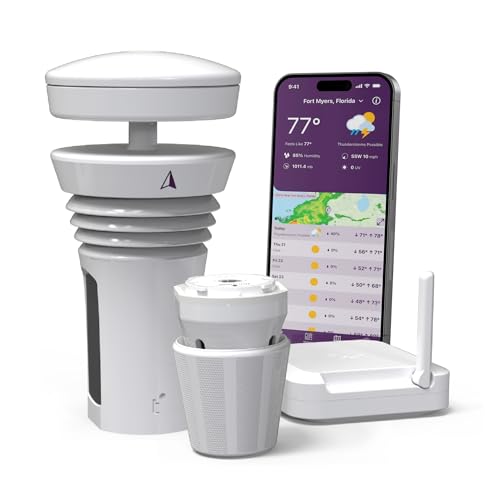
Tempest takes a different approach from stations built around a traditional console. Its outdoor unit measures temperature, humidity, barometric pressure, wind speed and direction, rainfall, UV index, solar radiation, dew point, and lightning strikes, then sends the information through its connected system. For a garden with automated irrigation or weather-triggered routines, that broader data set can be more valuable than a screen filled with numbers that must be checked manually.
The outdoor sensor is solar powered and the listing gives a wireless transmission distance of more than 1,000 feet, with updates every three seconds. Those are useful specifications for a larger property, though actual communication depends on placement and obstructions. The product information also describes a design with no moving parts and compatibility with Alexa, Rachio, IFTTT, and other smart-home platforms. It is the most automation-focused choice here, but its premium position makes sense mainly for someone who will use app access, alerts, or connected garden controls.
Pros
- Measures rainfall, wind, temperature, humidity, pressure, UV, solar radiation, and lightning strikes.
- Lists app access and smart-home compatibility.
- Supports Alexa, Rachio, and IFTTT according to the product information.
- Uses a solar-powered outdoor sensor.
- Provides listed updates every three seconds and wireless transmission beyond 1,000 feet.
Cons
- The premium feature set may be excessive for a small garden that only needs local readings.
- The supplied information does not detail every app feature or the exact requirements for each third-party integration.
Tempest is best suited to a connected garden where weather data can influence irrigation, lighting, or other routines. The lightning measurement also adds information that the other selected stations do not list. A buyer seeking a large always-on console may prefer the Ambient or Sainlogic options, while someone who wants a low-maintenance outdoor sensor and a strong automation angle will find Tempest more compelling.
To buy this product, click here.
4. AcuRite Iris 5-in-1 Wi-Fi — Best for Weather Underground Sharing
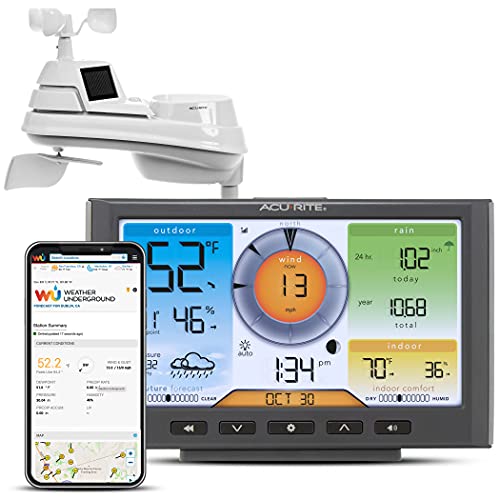
The AcuRite Iris 5-in-1 focuses on the core measurements most useful around beds, lawns, and outdoor structures. Its sensor package measures temperature, humidity, wind speed, wind direction, and rainfall, while the system also provides barometric pressure and a color display. The listing identifies more than 25 data points, including heat index, dew point, wind chill, enhanced rainfall history, and threshold alarms. Some of these are calculated values, so they should be read as additional interpretations of the measured conditions.
Its clearest distinction is Weather Underground connectivity. The product information says the display can connect to Weather Underground for remote monitoring and data sharing. That gives this model a defined platform purpose rather than vague internet marketing. The adjustable display dimmer is handy in a kitchen, potting shed, or living room, though the supplied information does not specify how far away the console can be placed from the outdoor sensor.
Pros
- Measures indoor and outdoor temperature and humidity, wind, rainfall, and barometric pressure.
- Supports Weather Underground for remote monitoring and data sharing.
- Includes a color LCD display with adjustable dimming.
- Provides threshold alarms and rainfall history.
- Lists calculated heat index, dew point, and wind chill information.
Cons
- The 5-in-1 label does not mean the system measures every variable included by larger multi-sensor stations.
- The supplied information does not specify the wireless transmission distance or app details beyond Weather Underground access.
This model makes sense for a grower who wants a recognized weather-sharing platform and a traditional display. It sits below the Ambient and Tempest options because its listed measurement set is narrower, but that can be an advantage for anyone who prefers a simpler system. Choose it over a local-only station if sharing observations or checking the garden while away matters more than UV and solar-radiation data.
To buy this product, click here.
5. Sainlogic 12-in-1 Wireless Weather Station — Best Local Station for Rainfall Records

A large, readable console can be more useful than a sophisticated app when the station sits near a back door or in a potting area. This Sainlogic model uses a 6.5-inch HD color display with adjustable backlighting and presents indoor and outdoor temperature and humidity, pressure, wind, rainfall, dew point, feels-like temperature, moon phase, calendar information, and an alarm clock. The screen is suited to a quick glance while carrying trays, pruning tools, or a watering can.
Rainfall tracking is a major reason to choose it. The listing describes hourly, daily, weekly, monthly, and cumulative records, along with a rainfall range from 0 to 9,999 millimeters and a listed accuracy of plus or minus 7 percent. Temperature and humidity accuracy figures are also supplied. Those claims come from the product information and should not be treated as independent testing. The outdoor sensor has a listed wireless range of up to 443 feet in open conditions, while the station itself does not provide Wi-Fi.
Pros
- Includes a 6.5-inch color display with three backlight levels.
- Records hourly, daily, weekly, monthly, and cumulative rainfall.
- Lists temperature accuracy of plus or minus 0.2 degrees Celsius and humidity accuracy of plus or minus 1.8 percent RH.
- Tracks temperature, humidity, pressure, wind, rain, dew point, and feels-like temperature.
- Offers a listed wireless range of up to 443 feet in open conditions.
Cons
- It has no Wi-Fi or app-based remote monitoring.
- The listed wireless range may be reduced by walls, trees, metal structures, and other obstructions.
This is a practical choice for a garden where someone regularly walks past the console and wants rainfall history without building a connected data system. It gives up remote access, yet that trade-off keeps the day-to-day experience straightforward. If the main question is “How much rain did the beds receive this week?” rather than “Can I export two years of records?”, this model offers a sensible middle ground.
To buy this product, click here.
6. Sainlogic 12-in-1 Large-Display Weather Station — Best for a Large Property

The eight-inch display gives this Sainlogic station a clear role for anyone who wants weather information visible from across a room. Its bold, high-contrast type and three-level backlight show temperature, humidity, pressure, rainfall, wind speed, wind direction, dew point, and heat index. The listed outdoor temperature range extends from minus 40 to 60 degrees Celsius, while the indoor range is listed as 32 to 140 degrees Fahrenheit. Those are measurement specifications in the product information, not a promise that every reading will have the same accuracy throughout the range.
This version also brings a solar-assisted element to the outdoor sensor, with backup battery support identified in the listing. Batteries are sold separately, so the power arrangement deserves attention before installation. The rain sensor lists plus or minus 1 millimeter for light rain up to 15 millimeters and plus or minus 7 percent for heavier totals from 15 to 9,999 millimeters. Manual calibration and mounting options for poles, fences, rooftops, farms, and orchards add flexibility, though the exact installation hardware should be checked before ordering.
Pros
- Uses an eight-inch display with large, high-contrast fonts.
- Measures temperature, humidity, pressure, wind, rainfall, dew point, and heat index.
- Lists a solar-powered outdoor sensor with backup battery support.
- Provides manual rainfall calibration.
- Supports mounting on poles, pillars, fences, rooftops, farms, ranches, and orchards according to the listing.
Cons
- Batteries for the outdoor sensor are sold separately.
- It does not offer Wi-Fi or remote app access.
The large display is the reason to choose this model over the otherwise similar local stations. It works well for a property where the console needs to be readable from a distance or where several people check conditions during the day. A connected greenhouse setup will be better served by the Sainlogic Wi-Fi model, while this station suits a simpler routine built around local readings and manually responding to rainfall or wind.
To buy this product, click here.
7. Ambient Weather WS-2000 — Best for a Detailed Color Console
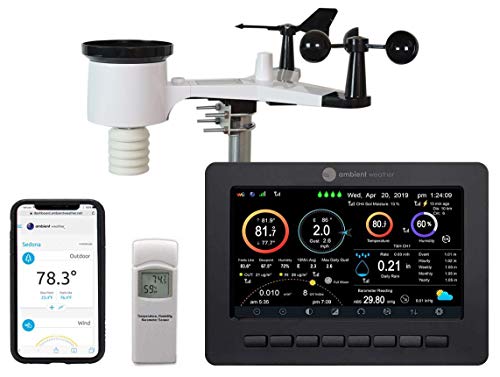
The WS-2000 provides the same kind of broad outdoor observation that makes a station useful around a garden. Its integrated array measures wind speed and direction, temperature, humidity, rainfall, UV, and solar radiation, while the TFT color display puts those readings in one local view. UV and solar radiation information can help explain why a bed dries quickly or why a shaded corner behaves differently, although the station cannot replace direct observation of soil moisture or plant condition.
Imperial and metric units are supported, and the listing identifies calibration capability. The system also has an enhanced Wi-Fi connection option for sending data to the Ambient Weather network. The word “option” matters here. The supplied information confirms Wi-Fi-related network transmission, but it does not spell out every remote-access function or smart-home integration for this exact model. The console uses a 5-volt adapter, and the outdoor array requires three AAA batteries, which creates two separate power considerations.
Pros
- Measures wind, temperature, humidity, rainfall, UV, and solar radiation.
- Includes a TFT color display for local monitoring.
- Supports imperial and metric units.
- Provides calibration capability according to the listing.
- Offers an enhanced Wi-Fi connection option for Ambient Weather network transmission.
Cons
- The console requires the included 5-volt adapter, while the outdoor array needs three AAA batteries.
- The supplied information does not fully detail remote access or smart-home functions for this exact model.
This is a good fit for someone who values a broad sensor array and a capable color console but does not need the WS-2902’s more clearly described smart-home emphasis. It ranks lower because its Wi-Fi wording leaves more of the connected experience unspecified. Gardeners who mainly want local UV, solar, rain, and wind observations will still find it attractive, especially if they are comfortable confirming the current network features before ordering.
To buy this product, click here.
8. Wireless Color-Display Weather Station — Best for Simple Rainfall History

This station concentrates on practical information without adding Wi-Fi setup. Its 7.5-inch color display shows indoor and outdoor temperature, humidity, pressure, wind speed and direction, rainfall, dew point, feels-like temperature, moon phase, and calendar information. The large type and three-level backlight make it a natural candidate for a kitchen, workshop, or garden room where readings need to be visible at a glance.
Rainfall is the strongest garden-specific detail in the listing. The station records hourly, daily, weekly, monthly, and total rainfall, with listed accuracy of plus or minus 1 millimeter for light rain below 15 millimeters and plus or minus 7 percent from 15 to 9,999 millimeters. It includes a mounting bracket and is described for fences, farm poles, boats, and other outdoor locations. Those placement choices still require attention to level and exposure, particularly if nearby structures could interfere with rainfall or wind readings.
Pros
- Includes a 7.5-inch color display with large fonts and adjustable backlighting.
- Records hourly, daily, weekly, monthly, and total rainfall.
- Lists temperature, humidity, pressure, wind, rain, dew point, and feels-like readings.
- Includes a mounting bracket for outdoor installation.
- Offers a local setup that does not require Wi-Fi.
Cons
- It does not support Wi-Fi or remote monitoring.
- The generic product information does not clearly identify a brand or detailed sensor architecture.
Choose this model for a straightforward local view of rain and outdoor conditions. It is less suitable for a gardener who wants historical data on a phone or a connected irrigation routine, but the large screen and rainfall records are useful for a garden office or nearby utility room. Its lower ranking reflects the limited connectivity and less detailed product identity, not a lack of relevant measurements.
To buy this product, click here.
9. AcuRite Iris 01512MCB — Best for Local Historical Readings
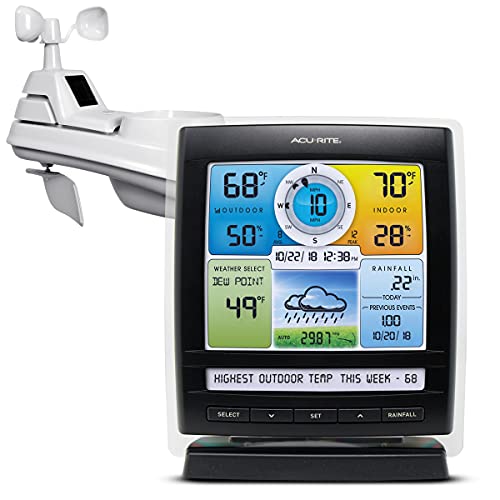
The AcuRite Iris 01512MCB is built around a conventional wireless sensor and color console, with no Wi-Fi feature identified in the supplied information. It measures indoor and outdoor temperature and humidity, wind speed and direction, barometric pressure, and rainfall. The listing describes more than 55 data points, including heat index, dew point, feels-like temperature, pressure trends, historical information, and a 12-hour personalized forecast based on elevation and pressure readings.
Setup is described as a matter of installing batteries and attaching the outdoor sensor to a pole or post with the included mounting bracket. That simpler installation can appeal to a backyard grower who wants local information without accounts or network configuration. It does mean the station cannot compete with the connected models for remote alerts, data sharing, or spreadsheet export, and the supplied product information does not identify the exact storage period for its historical readings.
Pros
- Measures indoor and outdoor temperature, humidity, wind, pressure, and rainfall.
- Lists more than 55 data points, including calculated weather information.
- Includes historical data and pressure-trend readings.
- Provides a color display with adjustable dimming.
- Includes a mounting bracket for pole or post installation.
Cons
- The supplied information does not identify Wi-Fi, app, or remote-monitoring support.
- The exact retention period for historical data is not clearly stated.
This station is a reasonable local-monitoring choice for someone who wants more information than a basic thermometer but has no interest in connected features. It ranks behind the larger-display Sainlogic models because the console size is not specified in the supplied information, and behind the connected stations because data access is local. Its strongest use is a simple backyard installation where pressure trends, rainfall, and wind are useful at a glance.
To buy this product, click here.
Buying Guide
Decide Which Garden Measurements Actually Matter
Temperature and rainfall are the starting points for most gardens, but humidity and wind can add useful context. Humidity affects how quickly foliage dries, while wind can increase evaporation and make containers lose moisture faster. UV and solar radiation are available on the Ambient and Tempest models, yet those measurements are secondary if the real question is whether a raised bed needs watering. A station with more measurements is useful only when those readings influence a decision.
Wireless Sensor Links Are Different From Wi-Fi
Every wireless station in this roundup can send outdoor readings to an indoor display without a cable, but that does not mean every model connects to the internet. The Sainlogic 12-in-1, the large-display Sainlogic, the generic color-display unit, and the AcuRite 01512MCB are local wireless systems. Ambient, Tempest, the Wi-Fi AcuRite Iris, and the Sainlogic smart model add internet-related capabilities. Choose the second group if you want garden data while away from home.
Remote Monitoring Requires Supported Online Access
A local console is enough for a garden beside the house. A greenhouse at the far end of a property or a vacation home requires more thought. The Ambient WS-2902 lists remote access, the AcuRite 5-in-1 identifies Weather Underground monitoring, the Sainlogic Wi-Fi model lists app alerts, and Tempest describes app and smart-home support. These are separate systems with different features. Confirm the exact service you plan to use rather than assuming that any Wi-Fi label provides the same experience.
Rainfall Records Depend on Placement
A rain gauge needs an open, level position where leaves, roof runoff, walls, and branches do not distort the collection. Several products list rainfall totals across hourly, daily, weekly, monthly, or cumulative periods, but a detailed record cannot correct for poor placement. The Sainlogic Wi-Fi model identifies a built-in bubble level, while the other stations still need careful installation. Rainfall accuracy claims from product listings should be treated as published specifications, not independent verification.
Compare Sensor Architecture Before Planning the Mount
Most selected models use an integrated outdoor array, meaning temperature, humidity, wind, and rain hardware share one outdoor assembly. That can simplify installation, but the location must suit several measurements at once. The garden may have a perfect sunny spot for one sensor and a better open-air position for another. An integrated array is usually easier to manage than several separate devices, while a larger property may justify more deliberate planning before the mounting bracket goes up.
Accuracy, Resolution, Range, and Transmission Distance Are Separate
A display showing small increments does not automatically mean its sensor is more accurate. Measurement range describes where a sensor can report, while transmission range describes communication between the outdoor unit and console. The Sainlogic models list up to 443 feet in open conditions, and Tempest lists more than 1,000 feet, but walls, metal buildings, trees, and terrain can reduce actual performance. Treat those figures as published maximums rather than guaranteed distances.
Check Power Requirements at Both Ends
A station can have a battery-powered outdoor sensor and an AC-powered console, or a solar-assisted outdoor unit with backup batteries. The Ambient WS-2000 lists a 5-volt adapter for its console and three AAA batteries for the sensor array. The large-display Sainlogic model identifies solar power and backup battery support, with batteries sold separately. These details matter if the console will sit in an outbuilding or if the sensor will be mounted where changing batteries is inconvenient.
More History Is Useful When You Will Review It
A season of rainfall and humidity records can reveal patterns that a daily glance misses. The Sainlogic Wi-Fi model stands apart with listed two-year local storage and Excel export, while several local stations offer historical or cumulative readings through the console. If you plan to compare weather with harvest dates, irrigation, or greenhouse changes, prioritize a station with clearly described storage and export functions rather than assuming that every “historical” label means downloadable files.
Best Weather Stations for Gardeners FAQ
What Is the Best Overall Weather Station for a Garden?
The Ambient Weather WS-2902 is the strongest overall choice in this selection. It measures temperature, humidity, rainfall, wind, UV, and solar radiation, then adds Wi-Fi, remote access, alerts, and listed smart-home support. Its integrated outdoor array requires thoughtful placement, but it gives a garden more useful local and connected information than the simpler console-only models.
Do Garden Weather Stations Need Wi-Fi?
No. A wireless station can send readings from an outdoor sensor to an indoor console without Wi-Fi. Models such as the Sainlogic 12-in-1 and AcuRite Iris 01512MCB work as local systems. Wi-Fi matters if you want app access, remote monitoring, online sharing, alerts, or data export, and each product handles those functions differently.
Which Measurements Matter Most for Gardening?
Outdoor temperature, rainfall, and humidity are usually the most useful starting points. Temperature helps with frost and heat decisions, rainfall supports irrigation planning, and humidity provides context for drying conditions. Wind can affect evaporation and spray work, while UV and solar radiation can help explain differences between sunny and shaded areas. Soil moisture still requires a separate soil sensor or direct inspection unless the station specifically supports that accessory.
Can a Weather Station Tell Me When to Water?
A station can show rainfall and environmental conditions that inform watering, but it does not automatically know the moisture level in every bed. Rainfall totals can help you estimate how much water arrived, while temperature, humidity, wind, and solar radiation explain how quickly surfaces may dry. Check whether the station supports a compatible soil sensor before assuming it can measure soil moisture directly.
Are Wi-Fi and Wireless Weather Stations the Same?
No. Wireless usually describes the link between the outdoor sensor and the display. Wi-Fi describes a network connection, often through a console or gateway. A wireless-only station can work without a router, while a Wi-Fi station may send data to an app, online weather network, or smart-home service. The product description should identify each capability separately.
Which Station Is Best for Keeping Garden Records?
The Sainlogic Wi-Fi Smart Weather Station is the clearest choice for record keeping because its listing identifies two years of local storage, Excel export, app access, and rainfall history across several time periods. The Ambient and AcuRite connected models also support online data features, but the supplied information is less specific about downloadable files for those exact products.
How Should I Interpret a Published Rainfall Accuracy Claim?
Treat it as a product-listing specification rather than independent proof. Rainfall readings also depend on level placement, exposure, debris, and the type of precipitation. A listed resolution or accuracy figure does not guarantee identical results in every installation. Keep the gauge clear, level, and away from locations that can block rain or add runoff.
Which Weather Station Is Best Without Internet Access?
The Sainlogic 12-in-1 Wireless Weather Station is a strong local choice because it offers a large color display, rainfall history, wind, temperature, humidity, pressure, and calculated readings without Wi-Fi. The larger Sainlogic model and AcuRite Iris 01512MCB are also suitable for local monitoring. None of these options provides the remote access associated with the connected models.
Final Verdict
The Ambient Weather WS-2902 is the strongest overall choice for most gardeners who want a complete view of backyard conditions. Its sensor array covers temperature, humidity, rainfall, wind, UV, and solar radiation, while Wi-Fi adds remote access, alerts, network sharing, and listed smart-home support. The Sainlogic Wi-Fi Smart Weather Station is the better alternative for someone who cares most about saved records, app alerts, and Excel export. Tempest moves ahead for a premium connected installation with solar-assisted outdoor hardware, lightning information, rapid listed updates, and smart-home integrations.
A local setup can still be the smarter purchase. The Sainlogic 12-in-1 models offer large displays and useful rainfall records without the extra network layer, and the AcuRite Iris models provide familiar core measurements for straightforward backyard monitoring. Before ordering, decide whether you will check a console every day or need information while away, then choose the sensor set, power arrangement, mounting plan, and data access that match that routine. A station placed well and used consistently will tell you more about a garden than a longer feature list left unopened.