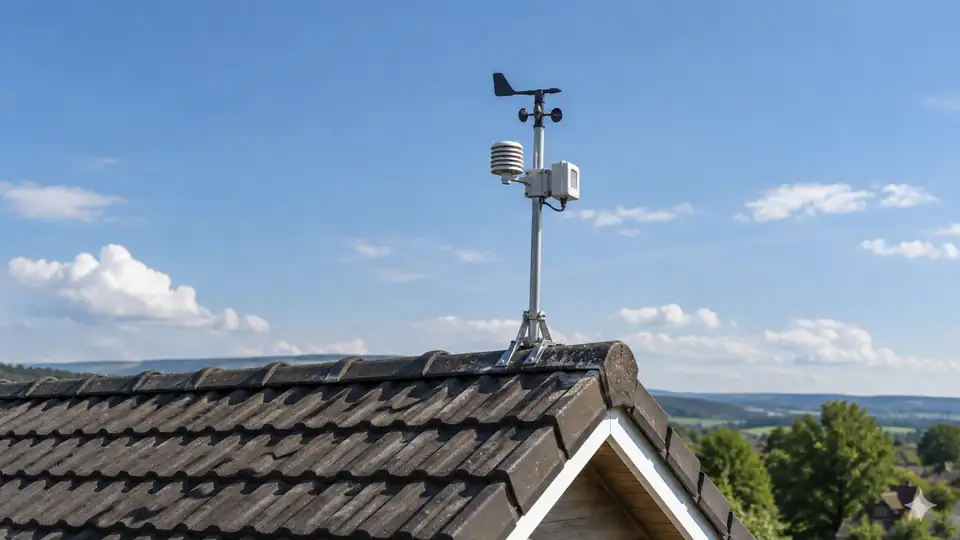
Yes, you can put a weather station on a roof, but the roof is a compromise rather than an automatic ideal location. It may provide clear wind exposure and a useful wireless path, while roofing materials, roof edges, nearby walls, and turbulent airflow can distort temperature, rainfall, or wind readings.
The right answer depends on what you want the station to measure. An anemometer may benefit from extra exposure above a roof, while an outdoor temperature sensor can become too warm over sunlit shingles. A rain gauge may collect reasonably well in an open position, yet runoff, splash, and nearby roof structures can still affect its total.
When a Roof Can Work Well
A roof can be practical when the yard is crowded with trees, fences, sheds, or tall buildings. Picture a small lot where every ground-level spot sits beside a wall or under branches. Raising the sensor array above the roof may give the wind vane a clearer view and reduce blockage from those nearby obstacles, which can produce more useful local wind observations.
Roof mounting may also help with communication. An outdoor array commonly sends data by a local radio link to a console or gateway. Elevation can sometimes improve that path, particularly when walls, floors, or dense construction interfere. It does not guarantee a reliable connection, though. The console or gateway may still need a suitable location for power and Wi-Fi, and sensor-to-console communication remains separate from Internet access.
A roof installation can be reasonable for someone who cares mainly about wind conditions at the property. For example, a homeowner checking gusts near a rooftop antenna may accept some turbulence because the roof places the anemometer above a line of nearby trees. That reading still describes the airflow at the roof-mounted sensor, rather than perfectly representing wind across the entire property.
Another practical case involves a modular station. Its anemometer might go on a roof mast, while the temperature and humidity sensor stays in a shaded, ventilated location and the rain gauge sits away from roof runoff. Separate sensor placement can reduce the compromises found in an integrated all-in-one array, provided the system supports those separate mounting locations and communication paths.
Why Roofs Can Distort Weather Measurements
A roof changes the air and heat around a sensor. Its surface absorbs sunlight, warms the air close to the shingles or membrane, and can release heat after sunset. A temperature sensor positioned too close to that surface may report a value influenced by the roof rather than representative outdoor air.
Roof geometry also creates irregular airflow. Wind approaching a ridge, parapet, chimney, solar panel, or roof edge can speed up, slow down, separate, or swirl. An anemometer installed in one of those disturbed areas may show gusts and directions that differ from the broader airflow nearby. Higher placement does not automatically solve that problem, because the mounting point itself may remain inside roof-generated turbulence.
Rainfall has its own set of traps. A gauge near a sloping surface can receive splashing water, runoff, or drips from an edge. A nearby parapet can block rain from one direction, while a chimney or rooftop equipment can create additional shelter. A gauge that looks wide open from the ladder may still have an uneven exposure once wind-driven rain reaches the roof.
Consider two common roof layouts. On a low-slope roof with a clear surrounding horizon, a properly leveled gauge may have fairly open exposure. On a steep roof beside a tall gable, the same gauge can sit in a pocket where rain is deflected and wind swirls. The hardware has not changed, but the measurement environment has.
| Measurement | Roof-related influence | Practical response |
|---|---|---|
| Temperature and humidity | Heat from roofing, walls, equipment, and trapped air can affect readings. | Use shade and ventilation where possible, and keep the sensor away from heated surfaces and exhaust. |
| Wind speed and direction | Ridges, edges, parapets, trees, and rooftop structures can create turbulence or blockage. | Seek the clearest exposure available and interpret the reading as site-specific. |
| Rainfall | Runoff, splash, overhangs, and nearby structures can change what reaches the collector. | Keep the gauge level, unobstructed, and away from dripping or shedding surfaces. |
| Barometric pressure | Roof height itself is usually less troublesome than incorrect pressure configuration or comparison with a different reference. | Check whether the station reports station, relative, or sea-level pressure before changing an offset. |
Integrated Arrays Create a Placement Compromise
Many personal weather stations combine wind, rain, temperature, humidity, and sometimes light or UV sensors in one outdoor assembly. That arrangement makes installation simpler, but the sensors do not share identical exposure needs. The best place for wind may be a poor place for temperature, while the best rain-gauge position may be lower and easier to reach.
Suppose an all-in-one array is mounted on a pole above a roof ridge. The anemometer may enjoy a more open view, but the temperature sensor can still receive heat rising from the roof. The rain collector may also sit close enough to a chimney, parapet, or roof edge to experience disturbed precipitation. The station can function normally while producing measurements with different site-specific biases.
A different homeowner may have a flat roof surrounded by a low parapet. Moving the array above the parapet could improve wind exposure, yet the parapet may still shelter the rain gauge from some directions. If the array cannot be separated, the installation may provide useful trend information without matching the exposure of a dedicated observing site.
That does not make a roof-mounted station useless. It means the readings need sensible interpretation. Local temperature trends, rainfall timing, pressure changes, and wind events can remain valuable, while comparisons with an open field station, airport, or weather app may show differences caused by location rather than defective equipment.
How to Decide Whether Your Roof Is Suitable
Before choosing the mounting point, inspect the roof as a measurement environment rather than simply asking where the bracket will fit. Look for surfaces and objects that could influence each sensor.
- Roof material and color: Dark or heat-absorbing surfaces can warm nearby air, especially under direct sun.
- Edges and parapets: These can alter airflow and shelter a rain gauge from some directions.
- Chimneys, vents, and HVAC equipment: Exhaust and warm surfaces can affect temperature and humidity readings.
- Solar panels and rooftop equipment: They can create additional heat, obstruction, splash, or turbulence.
- Trees and neighboring structures: These may block wind or create swirling flow despite the roof’s elevation.
- Access: Batteries, debris, moving anemometer parts, and rain collectors may require periodic inspection.
- Mounting stability: The bracket, mast, and attachment method must suit the exact station and roof structure.
- Communication: Check the path to the console or gateway, since walls, metal, floors, and equipment can affect the radio link.
A station mounted beside a rooftop vent may produce a warmer temperature reading during equipment operation. A station mounted near a parapet may show a quiet wind period that reflects shelter rather than calm conditions across the neighborhood. Small site details can leave a surprisingly large fingerprint on the data.
Read the installation instructions for the exact model before selecting poles, clamps, brackets, or fasteners. Mounting hardware is not universal, and roof attachment can involve waterproofing, structural, or electrical issues that a product manual cannot resolve for every building.
Roof Installation Without Creating a New Problem
Choose calm, dry conditions for installation and avoid working on a wet, icy, or wind-exposed roof. Keep the work away from overhead electrical conductors. If the installation requires roof penetration, a tall mast, structural alterations, electrical wiring, or complicated access, a qualified installer may be the safer choice.
- Confirm the sensor layout. Identify which measurements come from the outdoor array and whether any sensors can be installed separately.
- Compare possible roof positions. Look for the clearest exposure while avoiding vents, chimneys, edges, parapets, runoff paths, and heat-producing equipment.
- Check model-specific mounting requirements. Verify pole diameter, clamp style, orientation, leveling needs, and any restrictions in the manual.
- Plan access before fixing the hardware. A collector that cannot be reached safely will be difficult to clean or inspect later.
- Mount and level the assembly carefully. A tilted rain gauge can affect collection, and a misaligned wind vane can affect direction readings.
- Check the communication path. Confirm that the console or gateway receives fresh data after the outdoor unit is installed.
- Record the site conditions. Note nearby roof structures, the approximate sensor location, and any exposure limitations so future readings are easier to interpret.
Do not assume that a solar panel makes the entire station independent of batteries, or that an outdoor sensor is suitable for every extreme condition. Power arrangements and environmental limits vary by model. Check which component the panel powers, how the backup supply works, and what the manufacturer specifies for the equipment.
Grounding, surge protection, mast bonding, and lightning protection are separate subjects with requirements that can depend on the building, installation, equipment, and local rules. Do not improvise a grounding connection from a generic online diagram. Follow the station documentation and applicable local requirements, and seek qualified electrical guidance where the roof installation introduces those concerns.
What to Expect From the Finished Installation
After setup, watch for patterns rather than judging the station from one isolated reading. A temperature value that rises sharply on sunny afternoons may point to roof heating or nearby equipment. A rain total that seems low during wind-driven showers may reflect shelter or poor exposure. A wind direction that changes abruptly near a ridge may indicate turbulence rather than a failing vane.
Compare readings only with suitable references and similar exposure. A weather app may combine forecasts, regional observations, radar, or other external data, while the roof station measures conditions at one specific point. A nearby official station can also sit at a different elevation, surface type, or exposure. Disagreement alone does not prove that the roof-mounted sensor needs calibration.
If the roof is the only practical location, keep the installation and describe its limitations in your records. A station that consistently observes conditions at the same roof location can still reveal local rainfall, temperature changes, pressure trends, and wind events. The data becomes more useful when its surroundings are understood rather than treated as a perfect representation of every point on the property.