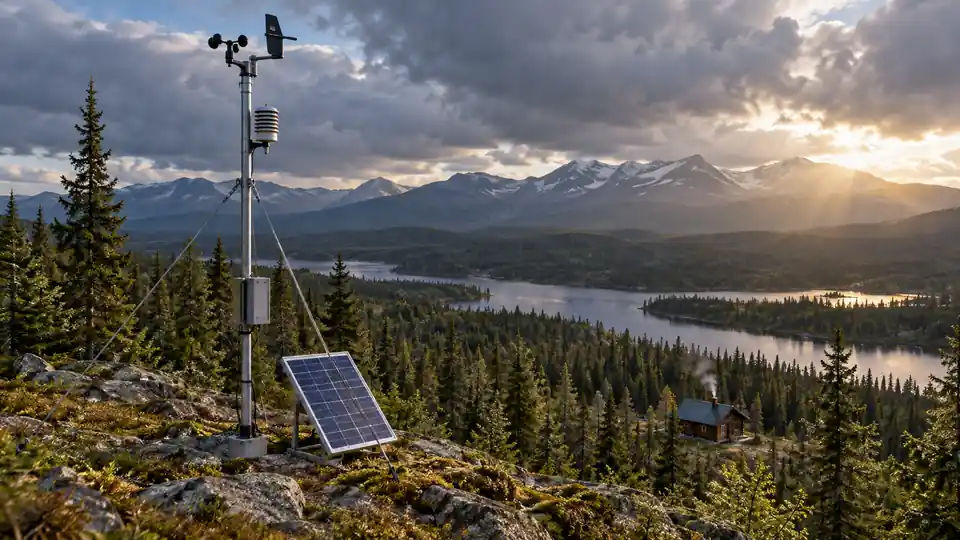
A remote property needs more than a clock with an outdoor temperature reading. A useful station may need to track rainfall, wind, humidity, pressure, and temperature across a cabin, garden, outbuilding, or large parcel, then make those observations available when nobody is standing beside the console. That makes sensor placement, power, transmission method, and Internet access central buying decisions rather than minor details.
Wireless sensor communication and Wi-Fi solve different problems. A station can send readings from an outdoor array to a nearby display without offering any access from town. For genuine off-site monitoring, look for a product with Wi-Fi, an app, cloud access, alerts, or a supported weather network. The Sainlogic 5G/2.4G WiFi Smart Weather Station is especially compelling for this use because its listing combines app access, rainfall and wind measurements, data storage, Excel export, and a long stated open-area transmission range.
The stations below cover two very different needs. The first group is aimed at connected property monitoring, while the simpler units suit a cabin owner who mainly wants local temperature and humidity readings in a building. Weigh the measurements you need, the amount of installation you can handle, and whether remote access is essential before choosing.
Quick Answer
Best overall: The Sainlogic 5G/2.4G WiFi Smart Weather Station is the strongest fit for a remote property because its listing specifies app access, real-time alerts, rainfall and wind data, local storage, and Excel export.
Best connected alternative: The Ambient Weather WS-2902 adds Wi-Fi, remote access, smart-home support, rainfall, wind, UV, and solar-radiation readings.
Best for a broad measurement set: The Ambient Weather WS-2000 measures the same major outdoor variables as the WS-2902 and includes a TFT color display, metric and imperial units, and calibration options.
Best local multi-location option: The Weather Stations Wireless Indoor Outdoor Thermometer with Multiple Sensors includes three remote sensors for monitoring several locations, though its listing does not identify Wi-Fi or off-site access.
Best Weather Stations for Remote Property Comparison Table
| Product | Measurements | Connectivity | Sensor Design | Best For |
|---|---|---|---|---|
| Sainlogic 5G/2.4G WiFi Smart Weather Station | Temperature, humidity, pressure, rain, wind | Wi-Fi, Bluetooth pairing, app alerts | Integrated outdoor system | Remote monitoring and data logging |
| Ambient Weather WS-2902 | Temperature, humidity, rain, wind, UV, solar radiation | Wi-Fi, remote access, smart-home support | Osprey sensor array | Connected all-around monitoring |
| Ambient Weather WS-2000 | Temperature, humidity, rain, wind, UV, solar radiation | Wi-Fi connectivity option | Integrated sensor array | Detailed local observations |
| Ambient Weather WS-1965 | Temperature, humidity, pressure, rain, wind | Wi-Fi, remote access, smart-home support | All-in-one sensor array | Connected monitoring without UV data |
| Weather Stations Wireless Indoor Outdoor Thermometer | Temperature, humidity, pressure, forecast trends | Local wireless sensors | Three remote sensors included | Several buildings or indoor zones |
| Newentor Wireless Indoor Outdoor Thermometer | Temperature, humidity, pressure, forecast | Local wireless sensor link | One sensor included, three channels supported | Simple cabin monitoring |
| DreamSky Wireless Weather Station | Temperature, humidity, pressure, forecast | Local wireless sensor link | One sensor included, three channels supported | Large readable display |
| Weather Station Wireless Indoor Outdoor Digital | Temperature, humidity, pressure, forecast | Local wireless sensors | One sensor included, three channels supported | Large display and alerts |
| La Crosse Technology Advanced Weather Station | Temperature, humidity, forecast trends | Local wireless sensor link | One outdoor sensor | Basic local readings and long open-air range |
The detailed reviews explain which stations can genuinely support off-site monitoring and which are better suited to local checks inside a cabin or outbuilding.
1. Sainlogic 5G/2.4G WiFi Smart Weather Station — Best Overall

Remote-property monitoring becomes much more useful when the station can preserve a record instead of showing a handful of numbers on a wall. The Sainlogic listing identifies app access, real-time alerts, hourly through yearly rainfall records, and two years of local data storage. It also supports Excel export, with each export covering up to 30 days, giving a property owner a practical way to review temperature swings, humidity changes, or rainfall over time.
The measurement set is well matched to a cabin, garden, or larger parcel. The system tracks temperature, humidity, barometric pressure, wind speed, wind direction, and rainfall. Its listing also gives a stated open-area wireless range of up to 443 feet and identifies dual-band 5 GHz and 2.4 GHz Wi-Fi, plus Bluetooth pairing for setup. Walls, trees, terrain, and metal buildings can affect actual communication, but the stated architecture is considerably more suitable for checking conditions away from the property than a local-only console.
Pros
- Supports Wi-Fi-based app access and real-time alerts.
- Measures temperature, humidity, pressure, rainfall, wind speed, and wind direction.
- Stores up to two years of local data according to the listing.
- Offers Excel export for reviewing recorded weather information.
- Lists dual-band Wi-Fi and Bluetooth fast pairing.
Cons
- The advertised 443-foot wireless range applies to open-area conditions and is not a guarantee through buildings or terrain.
- The listing does not clearly identify smart-home platform compatibility beyond its app and Wi-Fi features.
This is the clearest match for a property owner who wants more than a local glance at the console. Rainfall records can help with garden planning, while wind and pressure data add context to changing conditions around a cabin. The station requires more setup and connectivity planning than a basic thermometer, and its usefulness away from home depends on a working Internet connection and the service behind the app. For a remote property with network access, that trade-off is sensible.
To buy this product, click here.
2. Ambient Weather WS-2902 Wi-Fi Smart Weather Station — Best for Connected All-Around Monitoring
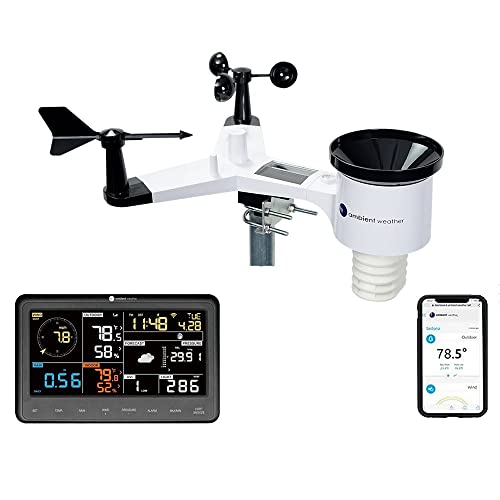
The WS-2902 earns a high position because it covers the measurements that matter around an exposed property, then adds a Wi-Fi path for remote access. Its Osprey sensor array measures temperature, humidity, rainfall, wind speed, wind direction, UV intensity, and solar radiation. That wider set can be useful when a remote home includes gardens, solar equipment, outdoor work areas, or weather-sensitive plans.
The color LCD display gives a local reference point, while the listing describes remote access, alerts, and smart-home support through IFTT, Google Home, Alexa, and more. Those capabilities separate it from the many wireless stations that stop at a nearby console. The product also connects with Ambient Weather Network, although users should distinguish that service from a direct guarantee of every desired third-party platform or automation.
Pros
- Includes Wi-Fi connectivity with remote access and alert features.
- Measures rainfall, wind, temperature, humidity, UV intensity, and solar radiation.
- Includes an integrated Osprey sensor array and color LCD display.
- Lists IFTT, Google Home, and Alexa support.
- Can connect to Ambient Weather Network for online weather data sharing.
Cons
- The listing does not specify a wireless transmission distance for the outdoor array.
- The broad feature set requires more installation and configuration than a simple indoor/outdoor thermometer.
This station makes sense for someone who wants a complete outdoor picture and expects to check the property from elsewhere. UV and solar-radiation readings are meaningful extras, though they should not be treated as substitutes for specialized solar or environmental equipment. Buyers who need only temperature and humidity may be paying for measurements they will rarely use, while those managing a connected cabin or garden can make better use of the wider sensor set.
To buy this product, click here.
3. Ambient Weather WS-2000 Smart Weather Station — Best for Detailed Local Observations
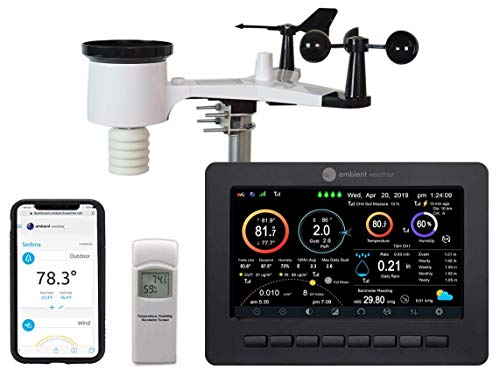
For a remote property where the console will be checked regularly, the WS-2000 offers a broad measurement package without reducing the system to a simple temperature display. Its integrated sensor array measures wind speed and direction, temperature, humidity, rainfall, UV, and solar radiation. The TFT color display puts those readings in one local view, which can be handy after arriving at a cabin or walking in from an outbuilding.
Wi-Fi connectivity gives this station a path toward online access and weather-network sharing, while support for imperial and metric units helps households that use different measurement preferences. The listing also identifies calibration capability, a useful feature for an owner who wants to adjust readings based on the station’s placement or local monitoring practice. The outdoor array requires three AAA batteries, and the console uses the included 5V DC adapter, so power planning still matters at an off-grid location.
Pros
- Measures wind, temperature, humidity, rainfall, UV, and solar radiation.
- Includes a TFT color display for local monitoring.
- Offers imperial and metric measurement units.
- Lists calibration capability for the station.
- Provides Wi-Fi connectivity for online weather data sharing.
Cons
- The outdoor sensor array requires three AAA batteries, which adds a maintenance task at a remote site.
- The product information does not provide a detailed description of app functions or remote alerts.
The WS-2000 is a good fit for someone who values a detailed console and a complete outdoor sensor set, especially where Wi-Fi is available but the local display remains important. It ranks below the strongest remote-monitoring choices because the supplied information gives less detail about off-site app functions. A property owner who wants UV and solar data, calibration, and a clear local screen may still prefer it over a simpler connected station.
To buy this product, click here.
4. Ambient Weather WS-1965 Wi-Fi Weather Station — Best for Connected Core Measurements
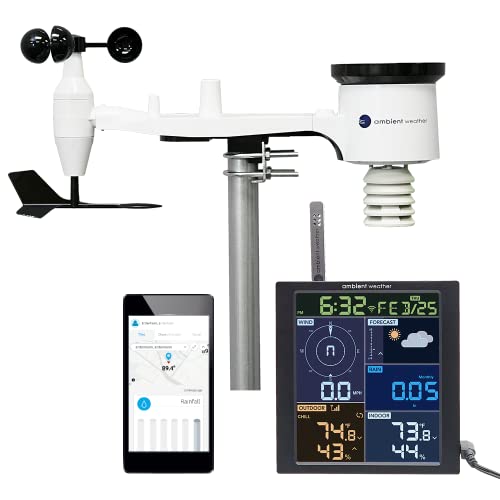
Some remote properties need the essentials more than they need UV or solar-radiation information. The WS-1965 focuses on temperature, humidity, barometric pressure, wind speed, wind direction, and rainfall, then adds Wi-Fi, remote access, alerts, and smart-home features. Its all-in-one sensor array keeps the outdoor system consolidated, which can simplify the number of pieces that need to be mounted and powered.
The console is listed with 16-second real-time updates, so changing wind or rainfall conditions appear promptly on the local display. That update figure describes refresh behavior, not measurement accuracy, but it does make the station better suited to watching active weather than a slow-changing indoor thermometer. The Ambient Weather Network connection is optional according to the listing, giving the owner some choice about online sharing.
Pros
- Provides Wi-Fi connectivity with remote access and alerts.
- Measures the core outdoor variables for property monitoring.
- Lists 16-second real-time updates on the console.
- Supports IFTT, Google Home, Alexa, and Ambient Weather Network features.
- Uses an all-in-one outdoor sensor array.
Cons
- It does not list UV or solar-radiation measurement.
- The available information does not specify the outdoor array’s transmission distance.
This model suits a cabin, workshop, or garden where rainfall and wind matter but UV and solar data do not. Its connected design gives it a substantial advantage over local-only stations, especially when the property may be empty for days. Buyers should still plan the console’s power and outdoor sensor maintenance, since Wi-Fi access cannot compensate for a dead sensor battery or a poorly placed array.
To buy this product, click here.
5. Weather Stations Wireless Indoor Outdoor Thermometer with Multiple Sensors — Best for Multiple Local Zones

A remote property often has more than one useful temperature point. A main house, garage, storage room, greenhouse, and outdoor area can all behave differently, particularly when buildings are separated by open ground. This station includes three remote sensors and presents temperature and humidity readings from three locations alongside the indoor reading. Its local wireless architecture is built for comparing zones rather than checking rainfall and wind across a large parcel.
The display also provides pressure trends, forecast icons, temperature and humidity alerts, frost alerts, historical maximum and minimum records, sunrise and sunset times, moon phase, and tide indicators. The listing gives a wireless transmission distance of up to 200 feet in open spaces. That can be useful around nearby buildings, but it is a published open-area figure, not a promise through thick walls, metal siding, or uneven terrain.
Pros
- Includes three remote sensors for monitoring several locations.
- Shows temperature and humidity from multiple areas.
- Offers frost, temperature, and humidity alerts.
- Lists pressure trends, forecast icons, and historical high and low records.
- Provides four display brightness levels and dual power options.
Cons
- The listing does not identify Wi-Fi, app access, or off-site monitoring.
- The stated 200-foot transmission distance applies to open spaces and may be reduced by buildings or obstructions.
This is a strong choice for someone who visits the property and wants a single console to compare several rooms or outbuildings. It is less suitable for a property owner who needs a phone alert from miles away because the supplied information describes local wireless sensors rather than Internet connectivity. The three included sensors are its central advantage, and that arrangement can be more useful than a larger forecast feature list if location-to-location temperature differences are the real concern.
To buy this product, click here.
6. Newentor Wireless Indoor Outdoor Thermometer — Best Budget-Oriented Cabin Option

The Newentor is aimed at the property owner who mainly wants a clear local view of indoor and outdoor conditions. Its color LCD shows temperature, humidity, daily high and low records, alerts, time, date, pressure, moon phase, and forecast information. One remote sensor is included, while the system supports up to three sensor channels. That distinction matters: adding more locations may require separately obtained compatible sensors.
Power behavior is practical for a cabin with a regular outlet near the console. The included DC adapter allows an always-on display, while battery operation uses a brief illuminated view before entering an energy-saving mode. The station also functions as an atomic clock with dual alarms. Its forecast is based on station information and requires a calibration period listed as seven to ten days, so the icons should be treated as a local trend aid rather than a substitute for remote weather data.
Pros
- Shows indoor and outdoor temperature and humidity on a color display.
- Supports up to three remote sensor channels.
- Includes daily high and low records and customizable alerts.
- Offers an always-on display with the included power adapter.
- Provides atomic time, dual alarms, pressure, and forecast information.
Cons
- Only one remote sensor is included.
- The listing does not identify Wi-Fi, app access, or remote Internet monitoring.
This station fits a small cabin where someone will read the display after arriving, especially if the priority is indoor comfort and outdoor temperature rather than rainfall or wind. It does not replace a connected weather station for an unattended property. The ability to support additional sensor channels gives it room to grow, but buyers should confirm the correct sensor options before planning a multi-building setup.
To buy this product, click here.
7. DreamSky Wireless Weather Station — Best for a Large Readable Display

At a remote property, a weather console may sit across a room from the chair, doorway, or workbench. The DreamSky addresses that simple but real problem with large numbers for temperature, forecast information, time, and calendar details. It monitors indoor and outdoor temperature and humidity, while the pressure-based forecast covers the next 12 to 24 hours after a listed seven-day calibration period.
The station supports three outdoor sensor channels, although one sensor comes with the package. Its high and low temperature alerts can help flag a cold storage area or a warmer-than-expected outbuilding when someone is nearby to see the console. Five backlight levels, USB connectivity, and battery backup add practical flexibility. Battery-only use dims the display after a short period, so continuous viewing requires the adapter.
Pros
- Uses large, readable numbers for at-a-glance viewing.
- Supports up to three outdoor sensor channels.
- Includes high and low temperature alerts.
- Offers five adjustable backlight levels.
- Provides atomic time, automatic daylight-saving adjustment, and battery backup.
Cons
- Only one outdoor sensor is included.
- The product information does not specify Wi-Fi or remote access away from the property.
Choose this model for a local display that can be read quickly from across a cabin or utility room. It is a poor match for checking a vacant property from a distant phone, since the supplied information describes a wireless sensor-to-console system. Its pressure-based icons may help with short-term planning, but direct rainfall, wind, and online data are absent from the listed measurement set.
To buy this product, click here.
8. Weather Station Wireless Indoor Outdoor Digital with Remote Sensor — Best for Display Flexibility

The 7.5-inch HD VA display makes this station appealing for a kitchen, lodge, or shared room where several people may glance at the screen during the day. It shows indoor and outdoor temperature, humidity, pressure, time, date, and forecast information in a divided layout. Five brightness levels help adapt the console to changing light, while the adapter keeps the display illuminated for continuous viewing.
The system supports up to three wireless sensor locations, with one sensor included. The listing describes high and low temperature alerts and a forecast based on pressure trends after a seven-to-ten-day calibration period. Atomic time synchronization supports seven North American time zones. Those features are useful for local property routines, but the product information does not identify Wi-Fi, cloud access, or a phone app, so it should not be confused with a remote-monitoring station.
Pros
- Includes a 7.5-inch HD VA display with five brightness levels.
- Shows indoor and outdoor temperature, humidity, pressure, and forecast information.
- Supports up to three wireless sensor locations.
- Offers high and low temperature alerts.
- Provides dual power modes and atomic time synchronization.
Cons
- One remote sensor is included, so extra locations require additional compatible sensors.
- The listing does not identify Wi-Fi, app access, or off-site data viewing.
This model is a sensible local console for a remote home that is occupied often enough for someone to read it. Its large screen is the main reason to choose it over smaller displays, especially for quick checks from several feet away. It gives up rainfall and wind measurement, so property owners concerned with storm conditions, irrigation, or exposed terrain should move toward one of the integrated outdoor arrays above.
To buy this product, click here.
9. La Crosse Technology Advanced Weather Station — Best for Simple Local Monitoring

The La Crosse Technology station keeps the focus on indoor and outdoor temperature, humidity, minimum and maximum records, alerts, and a color forecast display. Its weather-resistant outdoor sensor is listed with a 330-foot transmission range in open air without obstructions. That figure may help with a detached garage or nearby workshop, though walls, metal siding, and terrain can reduce the usable distance.
The console uses a 5V power adapter for its full display features, with three AAA batteries available as backup. Adjustable backlight settings include high, low, and off, while the atomic clock automatically sets the time and adjusts for daylight saving time. It does not list Wi-Fi or app access, so the station is best viewed as a local monitoring tool rather than a way to receive conditions from an empty property.
Pros
- Measures indoor and outdoor temperature and humidity.
- Includes minimum and maximum records and customizable alerts.
- Lists a 330-foot open-air transmission range without obstructions.
- Offers adjustable backlight settings and a full-color display.
- Includes atomic time, calendar, alarm, and snooze functions.
Cons
- The listed measurement set does not include rainfall or wind readings.
- The product information does not identify Wi-Fi, app access, or remote monitoring.
This is the straightforward choice for a nearby outbuilding where temperature and humidity are enough. It has fewer outdoor measurements than every integrated array in this guide, yet that simplicity can be welcome in a room where the station is checked occasionally rather than managed as a data system. Select a connected model instead if frost alerts, rainfall totals, wind changes, or off-site access matter.
To buy this product, click here.
Buying Guide
Wi-Fi and Sensor Radio Solve Different Problems
A wireless outdoor sensor usually sends readings to a console through a local radio link. That is useful when the sensor sits outside and the display sits inside, but it does not automatically provide phone access from another location. The Sainlogic, WS-2902, WS-2000, and WS-1965 listings identify Wi-Fi-related functionality, while the Newentor, DreamSky, large-display, multiple-sensor, and La Crosse models are presented primarily as local wireless systems.
For a cabin several hours away, Wi-Fi matters only if the property has a suitable Internet connection and the product’s service supports the access you need. A console in the living room cannot tell you about a frozen pipe from town unless the station has a supported path to the Internet and the app or online service can deliver that information.
Choose Measurements That Match the Property
Temperature and humidity may be enough for a small cabin, workshop, or storage building. A larger parcel usually benefits from rainfall and wind data, particularly where irrigation, exposed structures, gardening, or storm awareness are part of the routine. UV and solar radiation are additional measurements, not automatic proof that a station is better for every use.
The WS-2902 and WS-2000 cover the broadest listed outdoor measurement set here. The Sainlogic, with pressure, rainfall, wind, temperature, and humidity, concentrates on variables that are especially useful for records and remote alerts. The simpler stations focus on local temperature and humidity, so they make more sense when a full outdoor array would create unnecessary installation and maintenance.
Remote Access Requires Power and a Network
A connected station can still go silent if its console loses power, its outdoor sensor batteries run down, or the property’s Internet service drops. Check which component uses the adapter and which component uses batteries. The Sainlogic listing describes app access and local data storage, while the Ambient Weather products describe console displays, wireless sensor arrays, and Wi-Fi features. Their long-term usefulness depends on keeping those parts operating.
For an off-grid location, examine the complete power arrangement rather than focusing on the word Wi-Fi. A battery backup may keep a console alive briefly, but the supplied information does not establish how long any product will operate on backup power. Plan access for battery changes and sensor inspection before mounting the system in a hard-to-reach location.
Transmission Range Is a Best-Case Figure
The listed range values in this group include open-air figures for some models. La Crosse identifies 330 feet without obstructions, the multiple-sensor station lists 200 feet in open spaces, and Sainlogic lists up to 443 feet in an open area. These numbers help compare the stated communication designs, but they are not guaranteed distances through walls, floors, dense trees, hills, or metal structures.
A sensor positioned on the far side of a metal-sided workshop may behave very differently from one placed across an unobstructed yard. Think about the path between the outdoor array, console, and router before choosing based on the largest number.
Integrated Arrays Simplify the System
An all-in-one array combines several outdoor measurements in one assembly. That can reduce the number of separate devices around a property, but it also means the temperature, rain, and wind sensors share one installation position. A location that exposes the wind sensor may not be ideal for the temperature sensor, and nearby roofs, pavement, walls, trees, and heat sources can affect readings.
Rainfall measurement also depends on appropriate exposure and leveling. The Sainlogic listing specifically identifies a bubble level for its rain-monitoring system, while the Ambient Weather products list rain cups as part of their outdoor arrays. Follow the product instructions and avoid treating the console’s forecast icons as a replacement for careful sensor placement.
Check Included Sensors Before Planning Multiple Locations
Several local stations support three sensor channels, but that does not mean three sensors are included. The Newentor, DreamSky, and large-display stations each list one included sensor while describing support for additional locations. The multiple-sensor model listed here includes three remote sensors, making it the more direct choice for a main building, garage, and separate storage area.
Additional temperature and humidity points can be more useful than extra forecast icons on a property with several enclosed spaces. Confirm the correct sensor model before ordering, since compatibility is not universal across brands or product generations.
Data Storage and Export Matter for Long Absences
Current readings answer what is happening now. Historical records help answer whether the property experienced repeated freezing, unusual rainfall, or a sustained humidity change while nobody was there. Sainlogic lists two years of local storage and Excel export, which gives it a clear advantage for record keeping. The other connected stations offer online access or network sharing in their listings, but the supplied information does not provide the same detailed export description.
If you plan to keep a weather log for a garden, cabin, or rural property, check whether the station records data locally, stores it in an app, or simply displays current readings. Those are different capabilities.
Best Weather Stations for Remote Property FAQ
What Is the Best Weather Station for a Remote Property?
The Sainlogic 5G/2.4G WiFi Smart Weather Station is the strongest overall fit from this selection. Its listing identifies app access, real-time alerts, rainfall and wind measurements, two years of local storage, and Excel export. The Ambient Weather WS-2902 is a strong alternative for buyers who want UV, solar-radiation readings, and smart-home support.
Do Wireless Weather Stations Work Without Wi-Fi?
Yes. A wireless station can send outdoor readings to a local console through a sensor radio link without connecting to a home network. That arrangement supports local viewing, but it does not automatically provide off-site access. Wi-Fi or another supported Internet connection is needed for the remote-monitoring functions identified by connected products.
Can These Stations Monitor a Property From Another Location?
The Sainlogic, WS-2902, WS-2000, and WS-1965 listings identify Wi-Fi-related features, remote access, app functions, or online weather-network connectivity. The Newentor, DreamSky, large-display, multiple-sensor, and La Crosse listings describe local wireless monitoring instead. Confirm the exact app and service functions before relying on any station for unattended-property alerts.
Are Three Sensors Included With Every Three-Channel Station?
No. The Newentor, DreamSky, and large-display models support up to three sensor channels but list one included sensor. The multiple-sensor station in this guide lists three remote sensors. Supported channels and included hardware are separate details, so check the package contents before planning several monitoring locations.
What Should a Remote Property Weather Station Measure?
Temperature and humidity are useful starting points for indoor spaces. Rainfall matters for gardens and drainage, while wind speed and direction help track exposed conditions around structures. Barometric pressure can support trend displays and forecast icons. UV and solar radiation are useful for more specialized outdoor observation, but they are unnecessary if your main goal is temperature, humidity, and frost awareness.
Does a Larger Wireless Range Guarantee Better Performance?
No. A published range normally describes favorable open-air conditions. Buildings, metal siding, floors, terrain, trees, and interference can reduce communication distance. Place the console, outdoor array, and router with the actual property layout in mind rather than assuming the maximum advertised figure will apply everywhere.
Do Forecast Icons Measure Future Weather Directly?
No. The local stations in this guide describe forecast information based partly on pressure trends and calibration. Those icons are derived guidance from the station’s readings. They are different from direct measurements such as temperature, humidity, rainfall, wind speed, or pressure.
What Power Issues Matter at an Unattended Property?
Check the power source for the console and the outdoor sensor separately. Several stations use an adapter for a continuously lit display and batteries for the outdoor sensor or backup operation. The supplied product information does not establish battery life for these systems, so plan periodic visits for battery checks and inspect the sensor array after installation.
Final Verdict
The Sainlogic 5G/2.4G WiFi Smart Weather Station is the strongest overall choice for a remote property because it connects the practical pieces of the job: temperature, humidity, pressure, rainfall, wind, app access, alerts, stored records, and Excel export. Its stated dual-band Wi-Fi and open-area transmission range make it particularly relevant where the owner wants to review conditions without standing beside the display. The Ambient Weather WS-2902 is the better alternative for UV and solar-radiation monitoring, plus the listed smart-home connections.
For a property that mainly needs a local display, the multiple-sensor station offers the most useful location coverage, while the Newentor, DreamSky, large-display, and La Crosse models keep temperature and humidity monitoring straightforward. The WS-2000 and WS-1965 sit between those extremes with fuller outdoor measurement systems and Wi-Fi-related features. Match the station to the actual property, confirm the network and power situation, and treat wireless range as a planning figure rather than a guarantee.