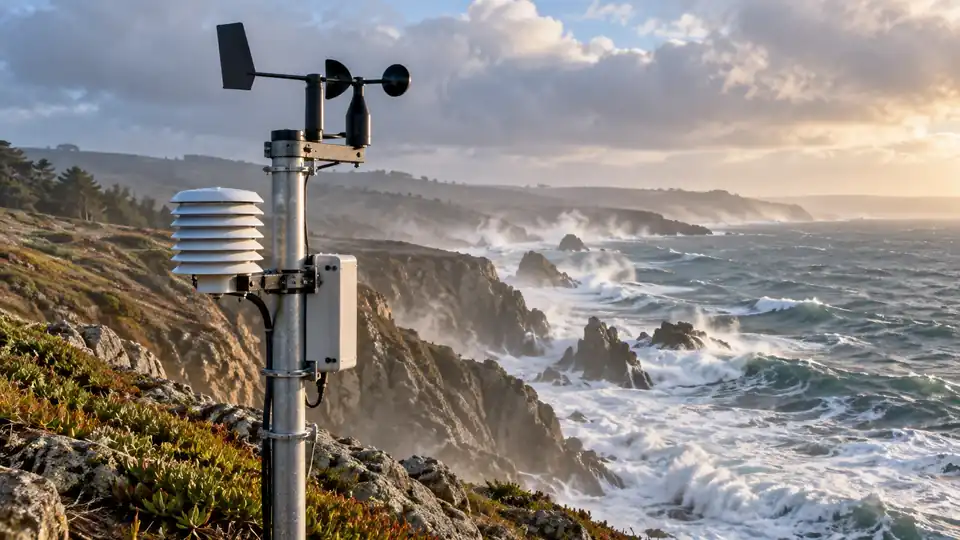
Coastal weather can shift from bright sun to hard rain and sharp wind before the patio furniture has time to dry. A useful station for this setting needs more than an indoor temperature reading. Wind speed and direction, rainfall, humidity, barometric pressure, and dependable outdoor sensor communication all matter, while mounting and exposure become especially important near open water.
The biggest specification on a product page is rarely the whole story. Wireless sensor transmission is different from Wi-Fi, and Wi-Fi is different from remote access through an app or weather platform. A long advertised range describes favorable conditions, not a guarantee through concrete walls or metal structures. Sensor placement matters too. A rain gauge needs clear exposure and leveling, while a temperature and humidity sensor can report misleading values if it sits in direct sun or against a warm wall.
This guide compares complete weather stations with different approaches to coastal monitoring. The Ambient Weather WS-2902 earns the top spot because it combines local measurements with Wi-Fi access, weather-network connectivity, smart-home support, wind, rain, UV, and solar-radiation readings. Several local-only stations make sense for simpler setups, while the AcuRite Iris 5-in-1 is a strong middle path for readers who want Weather Underground access without moving into the more connected Ambient Weather system.
Quick Answer
- Best Overall: Ambient Weather WS-2902 Wi-Fi Smart Weather Station for connected coastal monitoring, including wind, rain, humidity, UV, solar radiation, remote access, and smart-home features.
- Best for Weather Underground: AcuRite Iris 5-in-1 Home Weather Station for local readings plus Weather Underground sharing and remote monitoring.
- Best for a Large Display: Sainlogic SA68 12-in-1 Weather Station with an 8-inch display, rainfall history, wind data, and solar-assisted outdoor hardware.
- Best for a Lower-Cost Full Station: Sainlogic 12-in-1 Wireless Weather Station for readers who want broad local measurements without Wi-Fi.
Best Weather Stations for Coastal Areas Comparison Table
| Product | Measurements | Connectivity | Sensor and Display Details | Best For |
|---|---|---|---|---|
| Ambient Weather WS-2902 | Temperature, humidity, rain, wind, UV, solar radiation, pressure | Wireless sensor link, Wi-Fi, Ambient Weather Network | Integrated Osprey array, color LCD | Best overall connected setup |
| Sainlogic 12-in-1 Wireless | Temperature, humidity, pressure, rain, wind, dew point, feels-like | Wireless, no Wi-Fi | 6.5-inch color display, up to 443 feet in open conditions | Broad local monitoring |
| AcuRite Iris 01512MCB | Temperature, humidity, pressure, rain, wind, calculated weather data | Wireless, local console | Color LCD, historical information, adjustable dimmer | Detailed local records |
| AcuRite Iris 5-in-1 01540M | Temperature, humidity, pressure, rain, wind | Wireless, Wi-Fi to Weather Underground | Integrated sensor array, color LCD | Weather Underground users |
| AcuRite Wireless Home Station 02077M | Temperature, humidity, pressure trends, forecast data | Wireless, local console | Color display, outdoor temperature and humidity sensor | Simpler coastal conditions |
| Sainlogic SA68 12-in-1 | Temperature, humidity, pressure, rain, wind, dew point, perceived temperature | Wireless, no Wi-Fi | 8-inch display, solar-assisted outdoor system | Large, readable console |
| AcuRite Iris 01535M | Temperature, humidity, pressure, rain, wind, calculated weather data | Wireless, local console | HD display, custom alarms, optional lightning sensor support | Wind and rain alerts |
| AcuRite Iris Classic | Temperature, humidity, pressure trends, rain, wind | Wireless, local console | Color LCD, rainfall rate and historical rainfall | Straightforward full-station readings |
| Sainlogic Wireless Weather Station | Temperature, humidity, pressure, rain, wind, dew point, feels-like | Wireless, no Wi-Fi | 6.5-inch color display, hourly through total rainfall records | Rain-focused local monitoring |
The detailed reviews below explain how the sensor systems, connectivity, displays, and rainfall features differ in practical coastal use.
1. Ambient Weather WS-2902 Wi-Fi Smart Weather Station — Best Overall
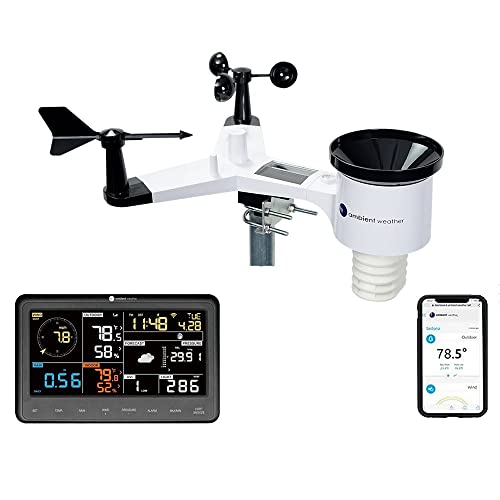
Coastal monitoring gets much more useful when the station can be checked from inside the house, from a phone away from the property, or through a connected dashboard. The WS-2902 brings that flexibility through a wireless Osprey sensor array, Wi-Fi connectivity, and access to the Ambient Weather Network. Its outdoor system measures temperature, humidity, rainfall, wind speed, wind direction, UV intensity, and solar radiation, giving a broader picture than a station focused on temperature and rain alone.
The connected functions are the main reason this model ranks first. The product information identifies remote data access, alerts, Ambient Weather Network sharing, and integrations with IFTTT, Google Home, and Alexa. That creates useful possibilities for a beach house, rental property, or primary home where a sudden rise in wind or rain matters while nobody is standing beside the console. The included color LCD still gives a quick local read, so checking the porch conditions does not require opening an app every time.
Pros
- Measures wind speed, wind direction, temperature, humidity, rainfall, UV intensity, and solar radiation.
- Genuine Wi-Fi connectivity supports remote access and Ambient Weather Network features.
- Product information identifies IFTTT, Google Home, and Alexa compatibility.
- Includes an Osprey sensor array, rain cup, and color LCD display.
- Combines local console viewing with online weather data access.
Cons
- The connected features depend on Wi-Fi and related online services.
- The outdoor array needs thoughtful mounting and exposure in a windy, wet location.
This is the strongest choice for a coastal property where remote visibility matters as much as the readings themselves. It also suits anyone who wants UV and solar-radiation information alongside the more familiar rain and wind data. A local-only station may be simpler if the console will always be nearby, and the listing does not provide a salt-air or corrosion-resistance rating, so placement and routine inspection still matter.
To buy this product, click here.
2. Sainlogic 12-in-1 Wireless Weather Station — Best Local Monitoring
A local console can be a good fit for a cottage, workshop, or home where the main goal is seeing conditions without building an online setup. This Sainlogic station displays indoor and outdoor temperature and humidity, barometric pressure, wind speed and direction, rainfall, dew point, feels-like temperature, and moon phase. Its 6.5-inch color screen keeps the numbers visible across a room, while the adjustable backlight helps with bright daytime viewing and dim evening conditions.
Rainfall is a particularly useful feature for a coastal garden or low-lying property, and the listing describes hourly, daily, weekly, monthly, and cumulative records. It also gives a rainfall accuracy claim of ±7 percent and lists temperature accuracy of ±0.2°C and humidity accuracy of ±1.8% RH. Those are product-listing claims rather than independent verification, but they provide more specification detail than many basic stations. The stated wireless transmission distance reaches up to 443 feet in open, unobstructed conditions. Walls, metal siding, terrain, and other structures can reduce that distance.
Pros
- Tracks rainfall across hourly, daily, weekly, monthly, and cumulative periods.
- Measures wind speed and direction alongside temperature, humidity, and pressure.
- Large 6.5-inch color display has three backlight levels.
- Listing provides specific temperature, humidity, and rainfall accuracy claims.
- Published wireless transmission distance reaches up to 443 feet in open conditions.
Cons
- No Wi-Fi or remote monitoring is identified in the product information.
- The advertised transmission distance is a favorable open-air figure, not a guaranteed indoor result.
This model makes sense for someone who wants a wide measurement set and rainfall history without paying for cloud access. It is less suitable for a remote beach house that must be checked from another location. For local use, the combination of a readable screen, wind data, and rainfall records is practical, but the outdoor sensor still needs a clear site away from building interference and poorly exposed rain collection.
To buy this product, click here.
3. AcuRite Iris 01512MCB Indoor/Outdoor Weather Station — Best for Detailed Local Data
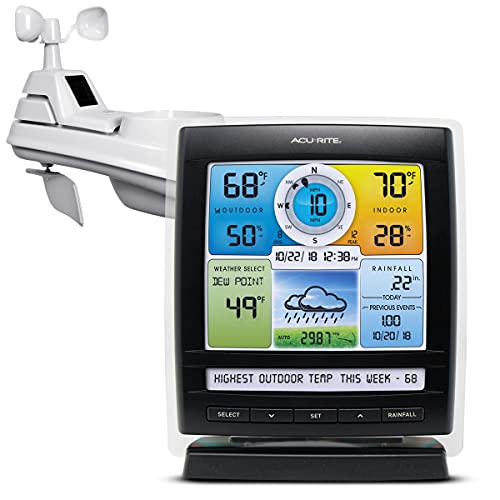
The Iris 01512MCB is aimed at readers who want a substantial amount of information on a local color screen. The listing identifies more than 55 data points, including indoor and outdoor temperature and humidity, wind speed and direction, barometric pressure, rainfall, heat index, dew point, feels-like temperature, and historical information. For a porch, sunroom, or kitchen console, that broader view can make a weather shift easier to follow than a simple temperature display.
Setup is presented as a straightforward process involving batteries, the outdoor sensor, and the included mounting bracket. The station produces a personalized 12-hour forecast from outdoor sensor information and the console’s barometric pressure data. That forecast is a calculated interpretation, not a replacement for direct wind or rainfall measurement, but pressure trends can still add useful context before a squall arrives. The adjustable display dimmer is a small practical touch for a room that stays bright during the day and quiet at night.
Pros
- Listing identifies more than 55 data points and historical information.
- Measures temperature, humidity, wind, pressure, and rainfall.
- Displays calculated heat index, dew point, and feels-like readings.
- Includes a color LCD with adjustable dimmer.
- Outdoor sensor includes mounting hardware according to the listing.
Cons
- Wi-Fi, app access, and remote monitoring are not identified.
- The large amount of displayed information may feel busy beside a simpler console.
This is a strong choice for a coastal home where the console is the main viewing point and historical readings matter. It offers more local detail than the simpler AcuRite 02077M, while the Ambient Weather WS-2902 remains the better fit for online access. Choose the Iris when you prefer a self-contained display and do not need the station to send observations beyond the property.
To buy this product, click here.
4. AcuRite Iris 5-in-1 Home Weather Station 01540M — Best for Weather Underground
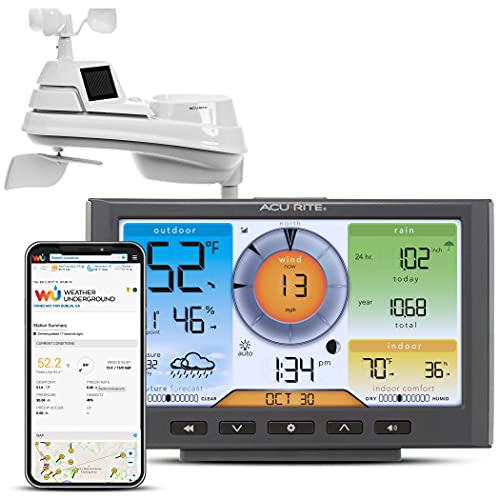
This AcuRite Iris model earns its position through a specific connectivity feature rather than an unusually large measurement list. The product information identifies Wi-Fi connection to Weather Underground, remote monitoring, and the ability to share station data. For a coastal property that contributes observations to a weather network or needs access away from the console, that distinction matters more than another forecast icon on the screen.
The local system measures indoor and outdoor temperature and humidity, barometric pressure, wind speed and direction, and rainfall. The listing also identifies more than 25 data points, threshold alarms, historical rainfall, heat index, dew point, and wind chill. The included sensor array combines an anemometer, wind vane, rain gauge, barometer, hygrometer, and thermometer. Since the station uses an integrated outdoor arrangement, mounting location affects several readings at once. A clear site helps the wind and rain instruments, while direct solar exposure can affect temperature readings.
Pros
- Wi-Fi connection to Weather Underground is explicitly identified.
- Supports remote monitoring and sharing of station data through the stated platform.
- Measures wind, rain, temperature, humidity, and barometric pressure.
- Includes a color display with adjustable dimmer.
- Provides rainfall history, threshold alarms, heat index, dew point, and wind chill.
Cons
- The product information does not identify support for Alexa, Google Home, or IFTTT.
- The 5-in-1 label does not describe an identical sensor standard across brands, so compare the actual measurements instead.
This model is the better choice than a local-only Iris if Weather Underground access is central to the setup. It gives up the Ambient Weather WS-2902’s listed UV and solar-radiation measurements and broader smart-home connections, but it may be enough for someone who mainly wants local conditions shared through one named weather platform. Confirm current account and setup requirements before ordering.
To buy this product, click here.
5. AcuRite Wireless Home Weather Station 02077M — Best for Simple Setup
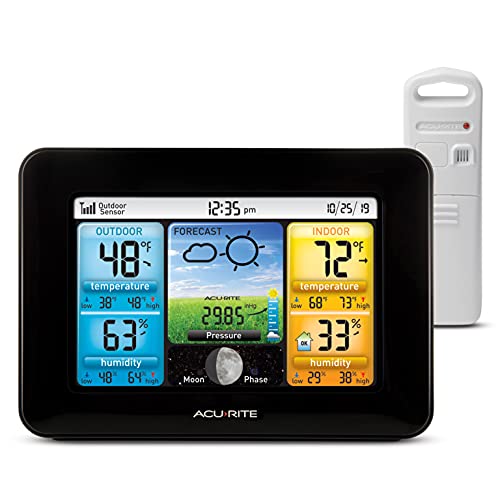
A coastal station does not always need Wi-Fi, rainfall totals, and a page of historical charts. Sometimes the job is simpler: check the temperature outside, glance at humidity and pressure trends, and see a short local forecast before heading down to the water. The AcuRite 02077M takes that route with an outdoor temperature and humidity sensor, indoor readings, pressure trends, forecast icons, high and low records, and more than 15 listed data points.
The outdoor sensor is described as easy to hang on a post or tree branch, and the display has an adjustable dimmer. That is convenient for a rental, office, RV, or small home where a full integrated wind and rain array would create more installation work than the property needs. It does not provide the wind speed, wind direction, or rainfall measurement listed for the higher-ranked full stations, so it should be viewed as a compact condition monitor rather than a complete coastal observation system.
Pros
- Simple wireless outdoor temperature and humidity monitoring.
- Displays indoor conditions, pressure trends, high and low records, and forecast information.
- Color LCD includes an adjustable dimmer.
- Outdoor sensor has an integrated hanger for straightforward placement.
- Product information identifies more than 15 data points.
Cons
- Does not list outdoor wind speed, wind direction, or rainfall measurement.
- Two AA batteries for the outdoor sensor are not included.
This is a sensible fit for a sheltered coastal home where temperature and humidity are the main concerns. It ranks below the full stations because it cannot document rain or wind, two conditions that often matter near open water. Pick it for an uncomplicated local display, and skip it if you need to compare gusts, track rainfall, or monitor conditions while away.
To buy this product, click here.
6. Sainlogic SA68 12-in-1 Weather Station — Best for a Large Display

An 8-inch display can be useful in a busy kitchen, a workshop, or a house where the console sits several feet away. The SA68 puts bold, high-contrast information on that larger screen, including indoor and outdoor temperature, humidity, pressure, wind, rainfall, dew point, and perceived temperature. Three backlight levels help adapt the console to different rooms, though the product information does not identify remote app access or Wi-Fi.
Its rainfall specifications are unusually detailed in the listing. The product information gives a stated error range of ±1 mm for light rain up to 15 mm and ±7 percent for heavier totals through the listed range. It also identifies manual rain-gauge calibration. These are listing claims, not independent verification, and placement still matters. The outdoor system is described as solar powered with battery backup, but that wording refers to the outdoor system rather than proving that the complete station, including the indoor display, runs without another power source.
Pros
- Large 8-inch display uses bold, high-contrast information.
- Measures wind speed and direction, rainfall, temperature, humidity, and pressure.
- Listing identifies light- and heavy-rain accuracy claims plus manual calibration.
- Outdoor system is described as solar powered with battery backup.
- Supports rainfall, dew point, perceived temperature, and historical-style monitoring information.
Cons
- No Wi-Fi or remote monitoring is identified.
- Batteries are not included, and the product information does not clearly define the power arrangement for every component.
The SA68 works well for a property where the console needs to be readable at a glance and rainfall deserves close attention. It offers more screen real estate than the 6.5-inch Sainlogic models, while the Ambient Weather station remains the stronger option for online access. Coastal buyers should also treat the solar feature as component-specific and confirm the mounting location before assuming it needs no routine power maintenance.
To buy this product, click here.
7. AcuRite Iris 01535M Weather Station — Best for Wind and Rain Alerts
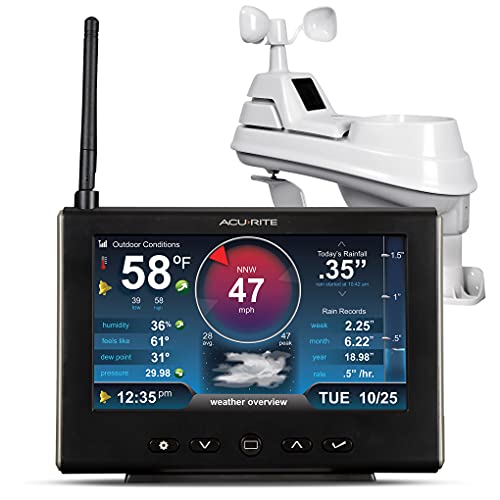
The Iris 01535M focuses on conditions that can change quickly around a coastal property. Its listed measurements include temperature, humidity, rainfall, wind speed, wind direction, and barometric pressure, while the display adds rainfall history, heat index, frost point, dew point, and moon phase. Custom alarms can be set for temperature, humidity, wind speed, and rainfall, and the listing also identifies a storm alarm triggered by a drop in barometric pressure.
Those alerts make this model more practical for someone who wants a prompt when outdoor conditions cross a chosen threshold. The product still uses a local wireless sensor and console, so the information does not automatically become remote monitoring. An optional AcuRite lightning sensor is listed as an upgrade sold separately. That means lightning detection is not included in this station, a distinction that matters for anyone comparing coastal storm equipment.
Pros
- Supports custom alarms for temperature, humidity, wind speed, and rainfall.
- Includes a storm alarm based on falling barometric pressure.
- Measures wind, rain, temperature, humidity, and pressure.
- HD display shows rainfall, moon phase, heat index, frost point, and dew point.
- Optional lightning sensor support is identified for future expansion.
Cons
- The optional lightning sensor is sold separately and is not included.
- Wi-Fi, app access, and remote monitoring are not identified for this model.
This station suits a reader who wants local alerts for changing wind, rain, or pressure without committing to a connected weather platform. It has a more event-focused console than the basic 02077M, but the Ambient Weather WS-2902 and AcuRite 01540M are better choices for online access. Treat the pressure-based storm alarm as an alert based on a measured trend, not a guarantee that a particular storm will arrive.
To buy this product, click here.
8. AcuRite Iris Wireless Home Weather Station Classic — Best for Rainfall Rate Information

The Classic Iris takes a balanced approach for readers who want a complete local station without a long list of specialized extras. It measures indoor and outdoor temperature and humidity, wind speed and direction, barometric pressure trends, and rainfall totals. The console also displays current rainfall rate, historical rainfall data, wind rose information, heat index, wind chill, dew point, and feels-like temperature, giving a coastal property more context during a wet or windy day.
Its color LCD has an adjustable dimmer, and the listing identifies included mounting hardware for the outdoor sensor. That makes the installation path fairly clear, although the best location still depends on unobstructed wind and rain exposure. Compared with the 01535M, the Classic model emphasizes a clear set of weather readings rather than the separately listed custom wind and rain alarms. It is a local station, so a user checking a second home from another city would need a connected model instead.
Pros
- Displays current rainfall rate as well as historical rainfall information.
- Measures wind speed, wind direction, temperature, humidity, pressure, and rain.
- Shows wind rose, heat index, wind chill, dew point, and feels-like temperature.
- Color LCD has an adjustable dimmer.
- Included mounting hardware is identified in the product information.
Cons
- Wi-Fi and remote monitoring are not identified.
- The listing does not provide detailed sensor accuracy specifications for direct comparison.
Choose this model if rainfall rate and a straightforward local display matter more than smart-home features. It occupies a useful middle position between the simpler AcuRite 02077M and the more connected stations. Readers who need a weather-network upload should move to the AcuRite 01540M or Ambient Weather WS-2902, while readers who simply want to see how hard it is raining can make good use of the Classic console.
To buy this product, click here.
9. Sainlogic Wireless Weather Station With Rain Gauge — Best for Rainfall Records
Rain can be the difference between a dry walkway and a flooded low spot near a coastal property, so rainfall history deserves more attention than a single daily number. This Sainlogic station records rainfall by hour, day, week, month, and total, while also showing temperature, humidity, pressure, wind speed, wind direction, dew point, feels-like temperature, and moon phase. Its 6.5-inch color display uses large fonts and adjustable backlighting.
The listing gives the same rainfall claims found on the related Sainlogic model, including ±1 mm for rainfall below 15 mm and ±7 percent across the listed 15 to 9,999 mm range. It also identifies temperature, humidity, and pressure ranges. These specifications describe the product information, not independent field results. The station uses wireless transmission rather than Wi-Fi, and the listing does not identify an app or online dashboard. The outdoor sensor can be mounted on a fence, cabin roof, or pier pillar according to the product description, but the most suitable location still needs clear rain and wind exposure.
Pros
- Records rainfall by hour, day, week, month, and cumulative total.
- Measures wind direction and speed alongside rain, temperature, humidity, and pressure.
- 6.5-inch color display uses large fonts and adjustable backlighting.
- Product information lists rainfall accuracy claims and measurement ranges.
- Wireless setup avoids a cable between the outdoor sensor and console.
Cons
- No Wi-Fi, app, or remote monitoring is identified.
- Batteries are not included according to the product information.
This station is a sensible choice for a local rainfall log, especially where a large property benefits from seeing recent totals at a glance. It gives up the connected access of the top two Wi-Fi options, and the similar Sainlogic SA68 offers a larger 8-inch screen. Pick this one when rainfall history is the priority and a 6.5-inch console fits the room better than a larger display.
To buy this product, click here.
Buying Guide
Coastal Exposure Makes Sensor Placement Matter
A weather station can report only what its sensors experience. A wind sensor tucked beside a wall may see disrupted airflow, while a rain gauge beneath an overhang can miss precipitation. Roofs, pavement, trees, fences, and sun-heated siding can also influence temperature and humidity readings. Look for a mounting location with appropriate exposure, keep the rain collector level, and follow the station’s installation directions rather than assuming any convenient post will produce comparable data.
Salt air deserves restraint too. Outdoor placement near the coast does not prove that a station has corrosion resistance, marine certification, or a specific waterproof rating. None of those protections should be assumed from the product category alone. Routine inspection, sensible mounting, and keeping the console protected indoors remain practical parts of ownership.
Wireless Does Not Always Mean Wi-Fi
Every station in this comparison uses a wireless relationship between the outdoor sensor and indoor display, but only some also identify Wi-Fi. The Sainlogic and local AcuRite models send readings to a nearby console. The Ambient Weather WS-2902 adds Wi-Fi for online access, while the AcuRite 01540M identifies connection to Weather Underground. These are different functions, so select based on where you need to read the data.
A wireless console may be perfectly adequate for a home where someone checks the screen each morning. It cannot automatically provide remote access from a city several hours away. For a vacation property, rental, or second home, look for explicit information about Wi-Fi, remote monitoring, and the named platform rather than relying on the word “wireless.”
More Measurements Are Useful Only If You Need Them
Wind, rain, temperature, humidity, and pressure are the core measurements for many coastal properties. UV and solar radiation can add useful context for outdoor exposure, while rainfall history helps with drainage and gardening. Dew point, heat index, wind chill, and feels-like temperature are calculated values that interpret direct measurements. They can be convenient, but they do not replace the underlying sensors.
A station with a longer feature list is therefore not automatically the better purchase. The WS-2902’s UV and solar-radiation readings are meaningful for someone who wants a broader environmental picture. A reader who mainly wants rainfall and wind may prefer a less connected Sainlogic or AcuRite model with a simpler console.
Accuracy, Resolution, and Range Describe Different Things
Accuracy describes how close a reading is expected to be to a reference under stated conditions. Resolution describes the smallest displayed increment. Measurement range describes the values a sensor is intended to report. Transmission range describes communication distance. A display showing decimal places does not prove equivalent accuracy, and a wireless range advertised for open space does not guarantee communication through walls, floors, metal siding, or dense structures.
The Sainlogic listings provide specific accuracy claims for temperature, humidity, and rainfall. Those claims are useful for comparison, but they remain listing specifications rather than independent testing. Treat the stated 443-foot transmission distance in the same way. It describes the listed maximum under open, unobstructed conditions, not a promise for every coastal home.
Check Which Features Are Included
The Ambient Weather WS-2902 includes its Osprey sensor array, rain cup, and color display. The AcuRite systems list outdoor sensor hardware or mounting hardware depending on the model. The AcuRite 01535M identifies support for an optional lightning sensor, but that sensor is sold separately. The Newentor and basic temperature-focused models can support a different kind of monitoring, but they are outside this ranking because a complete coastal station should measure more than indoor and outdoor temperature.
Solar language needs the same care. The SA68 listing describes the outdoor system as solar powered with battery backup. That does not establish that the indoor console is solar powered or that all batteries can be forgotten. Check the power requirements for each component before installing a station at a location that is difficult to visit.
Decide Whether You Need a Weather Network
Weather Underground and the Ambient Weather Network serve different product ecosystems. The AcuRite 01540M specifically identifies Weather Underground connectivity, while the WS-2902 identifies Ambient Weather Network access and smart-home integrations. A generic Wi-Fi label does not prove compatibility with either platform, and support for one service does not imply support for another.
If your goal is simply to read conditions on a wall display, a local wireless station may reduce setup complexity. If you want to share observations, check a second property, or build weather-related routines, choose the system with the exact online function you expect.
Best Weather Stations for Coastal Areas FAQ
What measurements matter most for coastal weather monitoring?
Wind speed, wind direction, rainfall, outdoor temperature, humidity, and barometric pressure are the most broadly useful measurements in this group. Wind and rain help describe changing outdoor conditions, while humidity and pressure add context. UV and solar radiation are useful extras for readers who want a broader environmental record, as offered by the Ambient Weather WS-2902.
Is a wireless weather station the same as a Wi-Fi weather station?
No. Wireless usually describes the link between the outdoor sensor and the indoor console. Wi-Fi connects a station or console to a local network and may enable online services. The Sainlogic and several AcuRite models in this guide are wireless, but their product information does not identify Wi-Fi. The WS-2902 explicitly includes Wi-Fi.
Which station is best for checking weather away from the property?
The Ambient Weather WS-2902 is the strongest choice here because its product information identifies Wi-Fi, remote data access, Ambient Weather Network features, and smart-home compatibility. The AcuRite Iris 01540M is another connected option because it identifies Weather Underground access and remote monitoring. Local-console stations should not be treated as remote-monitoring systems.
Are the advertised wireless ranges guaranteed?
No. The Sainlogic B0FVM8DLNX listing gives a transmission distance of up to 443 feet in open, unobstructed conditions. Actual communication can be affected by walls, floors, metal structures, terrain, interference, and placement. Treat the number as a listed maximum rather than a guaranteed distance through a building.
Does a coastal weather station need corrosion resistance?
Salt air can make outdoor equipment placement and maintenance more demanding, but the product information supplied for these models does not establish salt-spray resistance or marine certification. Do not assume those protections. Install the sensor appropriately, keep it clear of unnecessary exposure to damaging structures or splash, and inspect the outdoor hardware as part of normal ownership.
Which station is best for rainfall records?
The Sainlogic models provide particularly detailed rainfall periods, including hourly, daily, weekly, monthly, and cumulative records. The AcuRite Iris Classic also identifies current rainfall rate and historical rainfall information. The best choice depends on whether you value those records, a large display, local alerts, or online access.
Is the optional lightning sensor included with the AcuRite Iris 01535M?
No. The product information identifies support for an outdoor AcuRite lightning sensor sold separately. The 01535M itself measures wind, rain, temperature, humidity, and pressure, but it should not be described as having included onboard lightning detection.
Can a forecast icon replace direct weather measurements?
No. Forecast icons are calculated or interpreted information, often based partly on pressure trends and other station readings. They can be convenient for a quick glance, but they do not replace direct measurements of wind, rainfall, temperature, humidity, or pressure. For coastal decisions, read the actual measurements as well as the forecast display.
Final Verdict
The Ambient Weather WS-2902 is the strongest overall choice for a coastal property that needs both local observations and connected access. Its sensor array covers wind, rain, temperature, humidity, UV, and solar radiation, while Wi-Fi adds remote data access, Ambient Weather Network features, and listed smart-home compatibility. The station does not come with a stated salt-air durability rating, so careful mounting and periodic inspection remain part of the ownership equation.
The AcuRite Iris 01540M is the best alternative for Weather Underground users, while the Sainlogic SA68 stands out when a large, readable local display and detailed rainfall information matter more than online access. The lower-cost Sainlogic 12-in-1 is a practical local option, and the AcuRite 01535M is worth a look for local wind, rain, and pressure alerts. Match the station to the way you will actually read the data, then give the outdoor sensors the exposure and mounting attention that coastal weather demands.