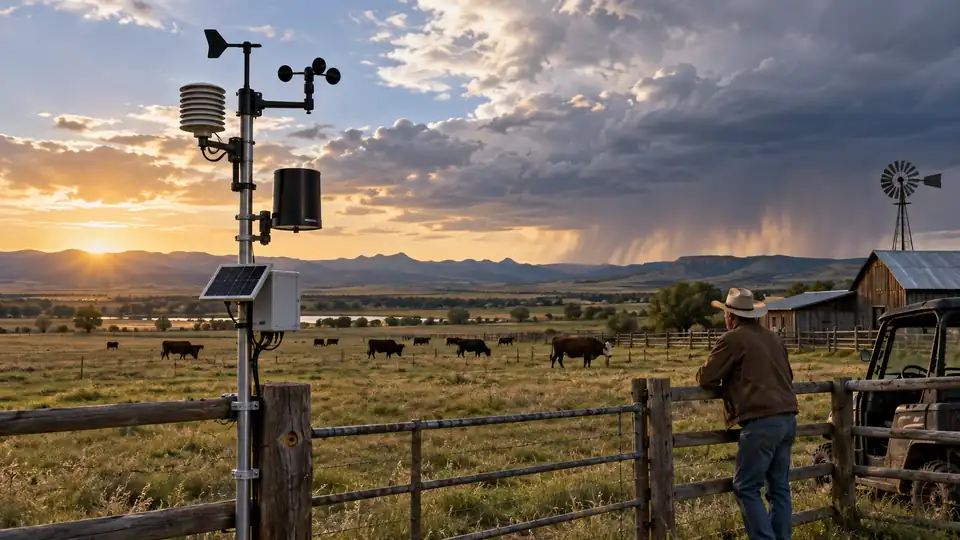
A ranch weather station has to do more than show the temperature beside the kitchen door. Rainfall totals can shape watering decisions, wind direction can affect livestock areas and spray planning, and humidity, pressure, and heat readings add useful context before a fast-moving front arrives. The strongest choices here combine a capable outdoor sensor array with a display that is easy to read, a wireless link suited to the property, and, in some cases, Wi-Fi for checking conditions from town.
Wireless and Wi-Fi are separate features, a distinction that matters on a large property. A station may send readings from an outdoor sensor to a nearby console without offering remote access at all. Sensor placement matters too. A long advertised transmission range can help, but trees, metal buildings, walls, and terrain may reduce the practical distance. Rain gauges also need suitable exposure and leveling, while wind sensors need open airflow rather than a sheltered corner beside a barn.
This comparison gives the most weight to rainfall, wind, temperature, humidity, property coverage, data access, display usability, and installation demands. The Ambient Weather WS-2902 takes the top position because it combines a broad set of outdoor measurements with Wi-Fi, remote access, smart-home connections, and a local color display. Other picks make more sense for a large screen, lightning awareness, simple local monitoring, or a lower-cost setup.
Quick Answer
- Best Overall: Ambient Weather WS-2902 Wi-Fi Smart Weather Station for ranches that need broad measurements plus remote and smart-home access.
- Best Premium: Tempest Weather Station for a low-maintenance sensor with app access, fast updates, lightning detection, and a listed wireless range of more than 1,000 feet.
- Best Large-Display Option: Sainlogic 12-in-1 Weather Station for reading rainfall, wind, temperature, and pressure from a prominent 8-inch console without Wi-Fi.
- Best for Storm Awareness: AcuRite Iris 01024M for onboard lightning detection alongside the core weather measurements.
Best Weather Stations for Ranches Comparison Table
| Product | Measurements | Connectivity | Sensor Design | Best For |
|---|---|---|---|---|
| Ambient Weather WS-2902 | Temperature, humidity, rain, wind, UV, solar radiation | Wireless, Wi-Fi, smart-home support | Osprey sensor array | Connected property monitoring |
| Sainlogic 12-in-1 Large Display | Temperature, humidity, rain, wind, pressure, dew point, heat index | Wireless, no Wi-Fi | Solar-assisted outdoor sensor with backup battery | Large-property local viewing |
| AcuRite Iris 01512MCB | Temperature, humidity, rain, wind, pressure, historical data | Wireless | Integrated outdoor sensor | Broad local records |
| AcuRite Iris 01540M | Temperature, humidity, rain, wind, pressure, dew point | Wireless, Wi-Fi, Weather Underground | 5-in-1 sensor array | Weather network uploads |
| Sainlogic 12-in-1 Black | Temperature, humidity, rain, wind, pressure, dew point | Wireless, listed range up to 443 feet | Integrated outdoor sensor | Rain records and value |
| Tempest Weather Station | Temperature, humidity, rain, wind, UV, solar, lightning | Wireless, app, Alexa, smart-home platforms | Solar-powered sensor with no moving parts | Premium remote monitoring |
| AcuRite 02077M | Temperature, humidity, pressure trends, forecast | Wireless | Separate outdoor temperature sensor | Simple secondary location |
| Sainlogic Wireless Weather Station | Temperature, humidity, rain, wind, pressure, dew point | Wireless, no Wi-Fi | Outdoor sensor with mounting bracket | Readable ranch console |
| AcuRite Iris 01024M | Temperature, humidity, rain, wind, pressure, lightning | Wireless | 5-in-1 sensor with lightning sensor | Storm and lightning awareness |
The detailed reviews below explain where each system earns its place, what it leaves out, and which type of property benefits most from its design.
1. Ambient Weather WS-2902 Wi-Fi Smart Weather Station – Best Overall
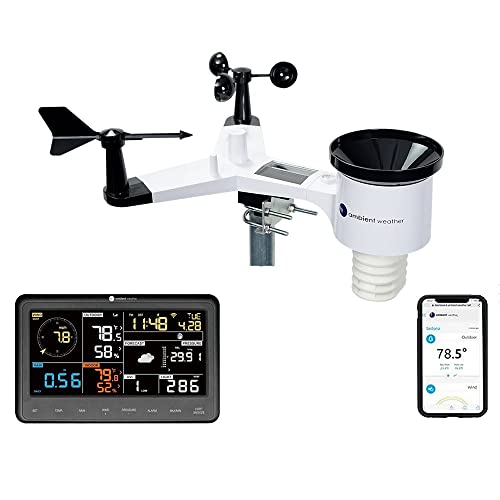
The WS-2902 fits a ranch particularly well because its Osprey sensor array covers the measurements that matter across open ground: temperature, humidity, rainfall, wind speed, wind direction, UV intensity, and solar radiation. The included color LCD gives the person at home a quick local view, while Wi-Fi opens a second path for checking conditions away from the console. That split is useful when a ranch office, house, and working area do not all share the same routine.
Its connected features are the biggest reason it ranks first. The listing identifies remote access, alerts, Ambient Weather Network sharing, IFTTT, Google Home, and Alexa support. Those connections can make weather observations more useful for irrigation or property routines, though the exact automation setup depends on the service and configuration. The sensor array still needs thoughtful outdoor placement, since a sheltered wind sensor or sun-heated temperature sensor can affect the usefulness of local readings.
Pros
- Measures wind speed and direction, temperature, humidity, rainfall, UV intensity, and solar radiation.
- Combines an outdoor sensor array with an included color LCD console.
- Supports Wi-Fi access, alerts, and remote viewing.
- Lists IFTTT, Google Home, and Alexa compatibility.
- Can share data through the Ambient Weather Network.
Cons
- Wi-Fi features add setup and connectivity dependencies that local-only stations avoid.
- The listing does not clearly specify the exact outdoor transmission range or update interval.
This is the strongest fit for a property where the weather station should remain useful after someone leaves the ranch. It offers more connected capability than the local-only Sainlogic and AcuRite systems, while its UV and solar-radiation readings add context for exposed acreage. Choose another model if a simple console is all you need or if you prefer to avoid network accounts and smart-home setup.
To buy this product, click here.
2. Sainlogic 12-in-1 Weather Station – Best Large-Display Option

An 8-inch screen changes the feel of local monitoring. Someone walking through a mudroom or ranch office can glance at large, high-contrast figures instead of leaning toward a compact display. This Sainlogic shows temperature, humidity, pressure, wind speed, wind direction, rainfall, dew point, and heat index, so the console can act as a useful daily dashboard for a property that does not need cloud access.
The outdoor sensor is described as solar powered with backup battery support, and the listing gives outdoor temperature coverage from -40 to 60 degrees Fahrenheit. Batteries are sold separately, so the power arrangement deserves attention before installation. Rainfall readings can be manually calibrated, with listed error figures that vary between light and heavy rain. Those are product-listing claims rather than independent verification, but the calibration option is useful when local rainfall totals matter.
Pros
- Large 8-inch display uses bold, high-contrast information.
- Tracks rainfall, wind speed, wind direction, pressure, dew point, and heat index.
- Offers manual rainfall calibration.
- Lists an outdoor temperature range from -40 to 60 degrees Fahrenheit.
- Outdoor sensor is described as solar powered with backup battery support.
Cons
- No Wi-Fi or remote monitoring is listed.
- Backup batteries are sold separately.
This station makes sense for a ranch office, kitchen, or workshop where local visibility matters more than checking readings from off-site. The large screen and broad measurement set are practical, but the absence of Wi-Fi means someone must be near the console to see the data. Its listed farm and ranch installation options make it a straightforward local monitor, provided the sensor is mounted where buildings and trees do not distort wind or rain readings.
To buy this product, click here.
3. AcuRite Iris 01512MCB – Best for Broad Local Records
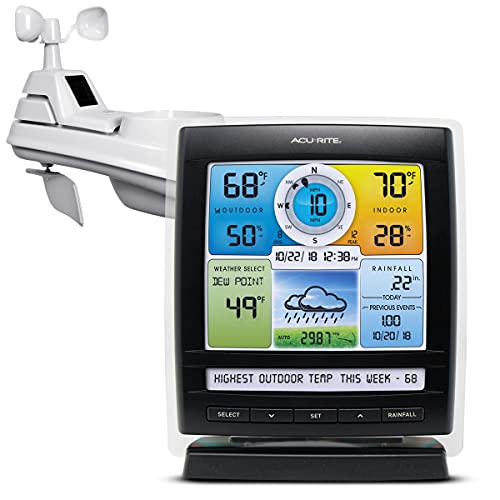
The appeal of the Iris 01512MCB is its emphasis on information at the console. The product information lists more than 55 data points, including historical records, heat index, dew point, feels-like temperature, and pressure trends. For someone watching how a property changes across a season, those records can be more useful than a single current temperature figure on a bright screen.
The wireless outdoor sensor reports temperature, humidity, rainfall, wind speed, wind direction, and pressure to a color display. Setup is described as a battery installation followed by mounting the sensor to a pole or post with the included bracket. That keeps the system relatively self-contained, though it does not offer the Wi-Fi or remote access found on the Ambient Weather and Tempest systems.
Pros
- Lists more than 55 weather data points.
- Includes historical information, pressure trends, and calculated heat and cold indicators.
- Measures rainfall, wind speed, wind direction, temperature, humidity, and pressure.
- Includes a color LCD with adjustable dimmer.
- Includes a mounting bracket for pole or post installation.
Cons
- Remote monitoring and Wi-Fi are not listed.
- The many displayed data points may require more time to interpret than a simpler console.
This is a sensible choice for someone who likes studying local conditions from the house or office and wants more historical context than a basic thermometer provides. It gives up connected access, so it is less suitable for checking a distant pasture while away. Compared with the Sainlogic large-display station, its strength is the breadth of listed records rather than screen size.
To buy this product, click here.
4. AcuRite Iris 01540M – Best for Weather Network Uploads
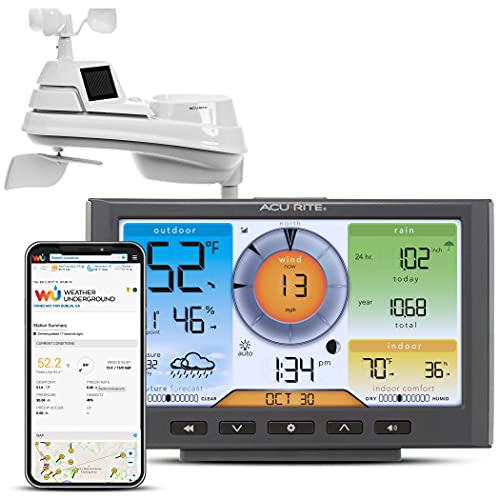
The 01540M brings a useful distinction to this roundup: it combines a familiar local weather console with Wi-Fi access to Weather Underground. That can suit a ranch owner who wants to view or share local observations through a weather network rather than relying solely on the display in the house. The listing identifies more than 25 data points, including enhanced rainfall history, heat index, dew point, and wind chill.
Its 5-in-1 outdoor arrangement measures temperature, humidity, wind speed, wind direction, and rainfall, while the system also lists barometric pressure through the console. The built-in anemometer, wind vane, rain gauge, hygrometer, and thermometer keep the setup consolidated. As with any integrated array, the mounting location affects several measurements at once, so a cramped spot beside a structure is a poor compromise.
Pros
- Provides Wi-Fi access to Weather Underground.
- Measures rainfall, wind speed, wind direction, temperature, and humidity.
- Lists more than 25 data points and enhanced rainfall history.
- Includes a color display with adjustable dimming.
- Combines several weather instruments in one outdoor array.
Cons
- The listing identifies Weather Underground support but does not detail every remote-access function.
- It does not list UV or solar-radiation measurements.
This is a strong middle path for someone who wants network sharing without moving to the more connected Ambient Weather or Tempest ecosystems. It has enough rainfall and wind information for routine property monitoring, although buyers focused on solar radiation or broader smart-home connections should look higher in the rankings. Confirm the current Weather Underground setup requirements before ordering.
To buy this product, click here.
5. Sainlogic 12-in-1 Wireless Weather Station – Best for Rain Records
Rainfall history is the headline strength here. The listing describes hourly, daily, weekly, monthly, and cumulative records, giving a property owner more ways to review wet and dry periods than a console that displays only the current total. The station also covers temperature, humidity, pressure, wind speed, wind direction, dew point, and feels-like temperature on a 6.5-inch color display.
Sainlogic lists temperature accuracy of plus or minus 0.2 degrees Celsius and humidity accuracy of plus or minus 1.8 percent relative humidity for its Swiss sensor. Those are advertised specifications for this model, not independent measurements. The published wireless transmission distance reaches up to 443 feet in open, unobstructed conditions, which may help with a spread-out layout, although buildings, metal structures, and terrain can reduce that figure.
Pros
- Records rainfall by hour, day, week, month, and cumulative total.
- Lists temperature and humidity accuracy specifications.
- Includes a 6.5-inch HD color display with adjustable backlight.
- Monitors wind speed, wind direction, pressure, dew point, and feels-like temperature.
- Lists wireless transmission up to 443 feet in open conditions.
Cons
- No Wi-Fi or remote access is listed.
- The published transmission distance is a favorable open-area maximum, not a guarantee through buildings.
This model is a good fit for local rainfall tracking across a ranch home, garden, or outbuilding. It offers more rain-history detail than some basic stations while keeping the display and installation fairly approachable. The trade-off is clear: it cannot send those readings to a phone over the internet according to the supplied information, so it suits a property with someone regularly near the console.
To buy this product, click here.
6. Tempest Weather Station – Best Premium Connected Option
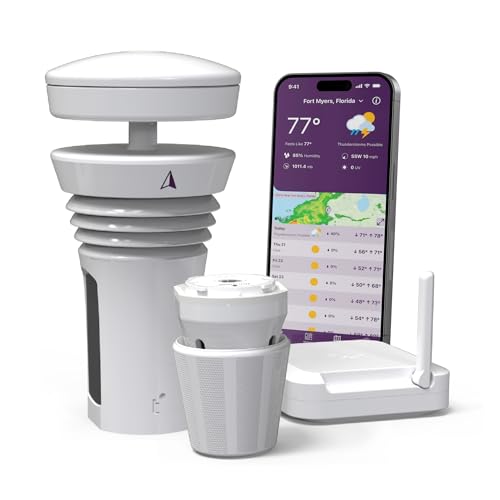
Tempest takes a different physical approach from the cup-and-vane arrays elsewhere in this list. The product information describes a solar-powered outdoor sensor with no moving parts, real-time updates every three seconds, and a listed wireless range of more than 1,000 feet. That architecture can be appealing on a large property where reducing mechanical components and repeated outdoor maintenance matters, though the available information does not establish a service life or guarantee performance in every environment.
The measurement list is broad: temperature, humidity, pressure, wind speed, wind direction, dew point, solar radiation, UV index, lightning strikes, and rainfall. App access and Alexa, Rachio, IFTTT, and other smart-home platform connections are also listed. The exact functions available through each service may differ, so buyers should verify the current configuration before treating a specific automation as guaranteed.
Pros
- Lists temperature, humidity, pressure, rain, wind, UV, solar radiation, and lightning measurements.
- Uses a solar-powered outdoor sensor with no moving parts according to the listing.
- Provides app access and smart-home platform connections.
- Lists wireless transmission of more than 1,000 feet.
- Reports real-time updates every three seconds in the product information.
Cons
- It is a premium-priced system compared with the local console models.
- The listing does not explain every app, platform, or automation requirement.
Tempest is the best alternative for a ranch where remote access, fast updates, lightning information, and reduced mechanical complexity carry more weight than a traditional console. Its connected design is more suitable for checking a distant property than local-only stations. Pick the Ambient Weather model instead if a color LCD and explicit IFTTT, Google Home, and Alexa references are more important to your setup.
To buy this product, click here.
7. AcuRite 02077M Wireless Home Weather Station – Best for Simple Secondary Monitoring
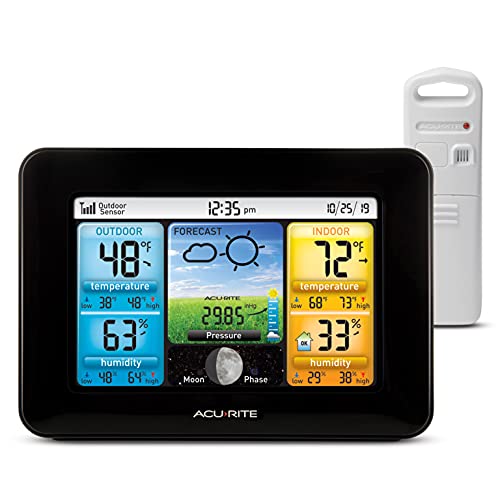
The 02077M is a simpler choice for a ranch that needs another temperature and humidity point rather than a full rain-and-wind array. Its outdoor sensor sends temperature, humidity, and pressure trends to a color display that also shows high and low records, forecast icons, moon phase, and more than 15 data points. That can be useful in a bunkhouse, office, or residence where a straightforward glance at local conditions is the goal.
Setup is described as placing two AA batteries in the outdoor sensor and hanging it from a post or tree branch. The batteries are not included. Because the outdoor unit is a temperature sensor rather than the broad integrated array used by the higher-ranked systems, it does not provide ranch-scale rainfall or wind monitoring. Its compact approach is the reason to choose it, not a replacement for a complete property weather station.
Pros
- Simple wireless indoor and outdoor temperature monitoring.
- Displays humidity and pressure trends alongside temperature.
- Includes high and low records, forecast icons, and moon phase information.
- Uses an adjustable-dimmer color display.
- Outdoor sensor can hang from a post or tree branch.
Cons
- It does not list rainfall, wind speed, or wind direction measurements.
- Outdoor sensor batteries are not included.
This model belongs lower in the ranking because ranch weather decisions often benefit from rain and wind data. Still, it can be a sensible secondary monitor for a separate occupied building or a location where only temperature and humidity matter. Choose a complete station if one console needs to cover irrigation, storm preparation, and outdoor work planning.
To buy this product, click here.
8. Sainlogic Wireless Weather Station – Best for Readable Local Monitoring
This Sainlogic focuses on clear local information through a 6.5-inch color display with oversized fonts and adjustable backlighting. The screen presents temperature, humidity, pressure, wind speed, wind direction, rainfall, dew point, feels-like temperature, and moon phase. For an office where people pass by throughout the day, that at-a-glance layout can be more useful than a small console that demands close attention.
The listing gives temperature ranges from 0 to 60 degrees Celsius indoors and -40 to 60 degrees Celsius outdoors, along with a humidity range from 10 to 99 percent. Its rainfall information includes hourly, daily, weekly, monthly, and total records, and the stated rainfall figures vary by the amount being measured. The outdoor sensor mounts to a fence, roof, or pillar with the supplied bracket, so location planning remains part of getting useful readings.
Pros
- Uses a 6.5-inch color display with oversized fonts.
- Tracks rainfall across hourly, daily, weekly, monthly, and total periods.
- Measures wind speed, wind direction, temperature, humidity, and pressure.
- Lists outdoor temperature coverage from -40 to 60 degrees Celsius.
- Includes a mounting bracket for several outdoor installation locations.
Cons
- No Wi-Fi or remote monitoring is listed.
- The listing does not identify a specific transmission distance.
This is a practical local station for someone who values readable figures and a broad measurement set without connected features. It resembles the other Sainlogic choices in its no-Wi-Fi approach, so the selection comes down to display layout and the exact rainfall-recording information provided. A ranch owner who often checks weather away from the property should move up to Ambient Weather or Tempest.
To buy this product, click here.
9. AcuRite Iris 01024M – Best for Lightning Awareness

The 01024M earns its place through a feature that most of the other stations here do not list: lightning detection. The product information describes distance-to-storm estimates, strike tracking within a 25-mile radius, and daily, weekly, and monthly strike counts. That information can add useful awareness before outdoor work, although lightning detection should never replace an appropriate safety plan or official warnings.
The core station remains capable for ordinary property monitoring. It reports temperature, humidity, wind speed, wind direction, rainfall, and pressure, while the high-definition TFT display switches among outdoor conditions, indoor readings, and daily records. The listed wireless range is up to 330 feet, and the outdoor readings update every 18 to 36 seconds. Those figures can help with planning, but the stated range is still an open-condition maximum rather than a promise through ranch buildings.
Pros
- Includes a lightning sensor with listed distance-to-storm estimates.
- Tracks lightning strikes within a listed 25-mile radius.
- Measures temperature, humidity, rain, wind speed, wind direction, and pressure.
- Uses a high-definition, auto-dimming TFT display.
- Lists wireless transmission up to 330 feet and updates every 18 to 36 seconds.
Cons
- Remote Wi-Fi access is not listed.
- The lightning feature adds specialized information that may matter less than remote access for some properties.
This is the right kind of specialized choice for a ranch where storm awareness is a central concern and a local console is acceptable. It gives up the connected access of the top two models, but it adds onboard lightning information alongside the main weather readings. Choose it over the AcuRite 01512MCB if strike tracking matters more than the larger list of general data points.
To buy this product, click here.
Buying Guide
Rainfall and Wind Usually Matter More Than a Long Feature List
A ranch station should usually begin with rainfall, wind speed, wind direction, temperature, and humidity. Rain totals can help explain field conditions, while wind information adds context for outdoor work and changing fronts. UV and solar radiation are useful additions for some properties, but a station with seven listed variables is not automatically better than one with five if the extra readings will never influence a decision.
Wireless Sensor Links Are Different From Wi-Fi
Every product in this comparison uses some form of wireless communication between the outdoor sensor and the console or receiving system. Only some list Wi-Fi, app access, weather-network uploads, or smart-home connections. A local-only station can still work well across a property, but it generally requires someone to be near the display. Ambient Weather and Tempest are stronger choices for checking conditions away from the ranch.
Use Transmission Range as a Starting Point
Listed distances are usually favorable conditions. The Sainlogic model gives a maximum of 443 feet in open, unobstructed conditions, while AcuRite lists up to 330 feet for the 01024M and Tempest lists more than 1,000 feet. A metal barn, thick wall, slope, trees, or other structures can affect communication. Plan the sensor and console locations before assuming the longest number will solve every placement problem.
Integrated Arrays Simplify Setup, but Placement Still Matters
An integrated outdoor array puts several instruments in one installation, which keeps the setup tidy. It also means one mounting location influences wind, temperature, humidity, and rain readings at the same time. Keep the array away from nearby heat sources and obstructions as far as the installation allows. A rain gauge needs clear exposure, while anemometers need moving air, so a convenient spot beside a building may be a poor measurement spot.
Accuracy, Resolution, and Range Are Separate Terms
A display that shows tenths of a degree has fine resolution, but that does not prove the sensor is accurate to a tenth of a degree. Measurement range describes the values a sensor reports, while operating range describes the conditions in which the system is intended to function. The Sainlogic listing gives accuracy figures for one model, but those remain published product claims rather than independent verification.
Check Which Power Sources Apply to Each Component
Solar language usually refers to the outdoor sensor rather than the complete system. The large Sainlogic station is described as solar powered with backup battery support, while Tempest lists a solar-powered outdoor sensor. Consoles may still need their own power arrangement, and some batteries are sold separately. Confirm the requirements for the outdoor array, console, and any gateway before mounting equipment far from a building.
More Sensors Can Matter on a Large Property
A single integrated array gives a useful central reading, but conditions can vary between a residence, pasture, orchard, and low-lying area. The products selected here do not all list extra sensor support, so do not assume a second location can be added later. If multiple locations are essential, confirm sensor expansion and compatibility before purchasing rather than relying on the station’s general feature count.
Best Weather Stations for Ranches FAQ
What Is the Best Weather Station for a Ranch?
The Ambient Weather WS-2902 is the strongest overall choice in this comparison because it measures temperature, humidity, rainfall, wind, UV, and solar radiation while adding Wi-Fi, remote access, alerts, and smart-home connections. A local-only station may be a better fit if all readings will be checked from a nearby console.
Do Ranch Weather Stations Need Wi-Fi?
No. Wi-Fi is useful for remote viewing, alerts, network sharing, and some automation, but a wireless sensor can send readings to a local display without internet access. The Sainlogic and several AcuRite models provide local monitoring without listing Wi-Fi.
What Measurements Matter Most on a Ranch?
Rainfall, wind speed, wind direction, outdoor temperature, and humidity are usually the most broadly useful measurements. Pressure, dew point, heat index, UV, solar radiation, and lightning information can add context, but their importance depends on the property and the work being done.
Does a Longer Wireless Range Guarantee Better Coverage?
No. A listed maximum range normally describes favorable open conditions. Buildings, metal structures, terrain, trees, and interference can reduce the practical distance. Place the console and outdoor sensor with the actual property layout in mind, rather than comparing range numbers alone.
Are the Weather Station Measurements Directly Measured?
Temperature, humidity, rainfall, wind, pressure, UV, and solar radiation can be direct sensor measurements when the product includes the appropriate instruments. Dew point, heat index, wind chill, feels-like temperature, and forecast icons are generally calculated or derived from other readings. The product listing should be checked for the exact sensor arrangement.
Does Solar Power Mean the Whole Weather Station Is Battery-Free?
No. Solar power may apply to the outdoor sensor while the console uses another power source. The Sainlogic large-display model lists solar power with backup battery support, and Tempest lists a solar-powered outdoor sensor. Check the power requirements for every component before installation.
Can a Weather Station Replace Official Storm Warnings?
No. Local readings and lightning information can improve awareness of conditions at the property, but they do not replace official alerts, forecasts, or a clear severe-weather safety plan. The AcuRite 01024M lists lightning detection, but that feature should be treated as supplementary information.
What Is the Difference Between a Rainfall Total and Rainfall Accuracy?
A rainfall total is the amount recorded over a selected period. Accuracy describes how closely that recorded amount may represent the actual rainfall, while resolution describes the smallest displayed increment. Proper placement and leveling also affect rain measurements, so a detailed total does not by itself prove high accuracy.
Final Verdict
The Ambient Weather WS-2902 is the strongest overall choice for a ranch that needs broad local weather information and the ability to check conditions away from the console. Its combination of rainfall, wind, temperature, humidity, UV, solar radiation, Wi-Fi, alerts, and smart-home support gives it a wider practical role than the local-only models. The Tempest is the premium alternative for app-centered monitoring, frequent updates, lightning information, and a solar-powered outdoor sensor described as having no moving parts.
For a large, easy-to-read local display, the Sainlogic 12-in-1 model is the better match, while the AcuRite Iris 01024M earns attention where lightning awareness matters most. Before ordering, map the sensor location, check the communication path to the console or network, and decide whether remote access is genuinely necessary. A well-placed simpler station will usually serve a property better than a feature-heavy system mounted beside a wall, roof, or metal building.