
A cabin weather station has a tougher job than a bedside thermometer. It may need to show freezing temperatures before sunrise, record rainfall while the property is empty, track wind around an exposed roofline, and send useful observations to a phone several miles away. For that reason, the best weather stations for cabins usually combine a capable outdoor sensor array with dependable local communication, practical power requirements, and some form of remote data access.
The biggest distinction is between a wireless station and a connected station. Wireless sensor transmission usually carries readings from the outdoor array to an indoor console. Wi-Fi can take the next step by moving those observations onto an app, cloud service, or weather network. A cabin without dependable Internet may be better served by a large local display, while a remote property with broadband will benefit from alerts and away-from-home access. Sensor placement matters just as much. A shaded temperature sensor, level rain gauge, and unobstructed wind sensor will generally provide more useful information than an expensive system installed beside a wall or under a roof overhang.
This guide weighs measurements, connectivity, installation, power, display design, data access, and cabin practicality. The Ambient Weather WS-2902 takes the top overall position because it combines a full sensor array, Wi-Fi access, rainfall and wind data, smart-home support, and a dedicated color console. The Tempest is a strong premium alternative, while the Sainlogic Wi-Fi model stands out for cabin owners who want app alerts and long-term data storage without moving into the highest price tier.
Quick Answer
Best overall: The Ambient Weather WS-2902 offers the most balanced setup for a connected cabin. Its outdoor array measures temperature, humidity, wind speed and direction, rainfall, UV, and solar radiation, while Wi-Fi enables remote access and smart-home functions.
Best premium option: The Tempest Weather Station adds lightning detection, solar-assisted outdoor operation, three-second updates, and integrations with Alexa, Rachio, and IFTTT.
Best for cabin data logging: The Sainlogic Wi-Fi Smart Weather Station supports app alerts, Weather Underground synchronization, Excel export, and up to two years of local data storage according to its listing.
Best local-display choice: The AIRAIN TECH Wireless Weather Station supplies two displays and a broad set of outdoor measurements without requiring Wi-Fi.
Best Weather Stations for Cabins Comparison Table
| Product | Measurements | Connectivity | Cabin Advantage |
|---|---|---|---|
| Ambient Weather WS-2902 | Temperature, humidity, rain, wind, UV, solar radiation | Wireless sensor array, Wi-Fi | Best overall connected setup |
| Tempest Weather Station | Temperature, humidity, rain, wind, UV, solar radiation, lightning | Wireless, app, smart-home integrations | Premium remote monitoring |
| Sainlogic Wi-Fi Smart Weather Station | Temperature, humidity, rain, wind, pressure, dew point | 2.4/5 GHz Wi-Fi, Bluetooth pairing, app | Data storage and alerts |
| AcuRite Iris 01540M | Temperature, humidity, rain, wind, pressure, calculated values | Wireless, Wi-Fi, Weather Underground | Weather network uploads |
| Ambient Weather WS-2000 | Temperature, humidity, rain, wind, UV, solar radiation | Wireless sensor array, Wi-Fi | Advanced console and calibration |
| AIRAIN TECH Wireless Weather Station | Temperature, humidity, rain, wind, pressure, UV, dew point | Wireless, no Wi-Fi | Two displays and broad local monitoring |
| AcuRite Iris 01512MCB | Temperature, humidity, rain, wind, pressure, historical data | Wireless local console | Simple setup with many data points |
| Sainlogic 12-in-1 Wireless Station | Temperature, humidity, rain, wind, pressure, dew point | Wireless console, no Wi-Fi | Large-property local monitoring |
| Newentor Wireless Weather Station | Temperature, humidity, pressure, forecast data | Wireless sensors, up to three channels | Budget indoor and outdoor monitoring |
The detailed reviews below focus on the practical differences that matter at a cabin, from away-from-property access to console power and sensor placement.
1. Ambient Weather WS-2902 Wi-Fi Smart Weather Station — Best Overall
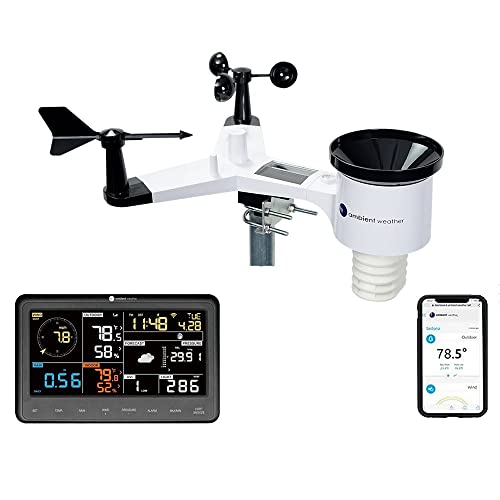
A cabin weather station needs to cover more than temperature, and the WS-2902 does that with an integrated Osprey sensor array. The listed measurements include outdoor temperature, humidity, wind speed, wind direction, rainfall, UV intensity, and solar radiation. That combination gives a property owner a useful snapshot of conditions around the cabin, whether the question is “Did it rain overnight?” or “How strong was the wind across the clearing?”
The Wi-Fi connection is the reason this model ranks first. A local console remains useful when someone is inside the cabin, while Wi-Fi can provide remote access, alerts, and connections with services such as IFTTT, Google Home, and Alexa according to the product information. The outdoor array still communicates wirelessly with the console, so buyers should distinguish the sensor link from the cabin’s Internet connection. A remote cabin will need both a suitable installation and working network access for away-from-home features.
Pros
- Measures temperature, humidity, rainfall, wind speed, wind direction, UV, and solar radiation.
- Combines a wireless outdoor sensor array with Wi-Fi connectivity.
- Supports remote access and listed smart-home connections with IFTTT, Google Home, and Alexa.
- Includes a color LCD console for local readings inside the cabin.
- Can optionally transmit data to the Ambient Weather Network.
Cons
- The remote features depend on a working Wi-Fi and Internet connection at the property.
- The outdoor sensor array requires careful placement so nearby structures do not interfere with wind and rain readings.
The WS-2902 is the strongest fit for someone who wants a complete picture of cabin weather without assembling separate instruments. It makes the most sense where Internet access is available and remote alerts matter. A cabin without reliable broadband may get more practical value from a local-only station, while buyers focused on lightning detection should look at the Tempest instead. For a connected, all-around installation, this is the most balanced choice in the group.
To buy this product, click here.
2. Tempest Weather Station — Best Premium Remote Monitoring
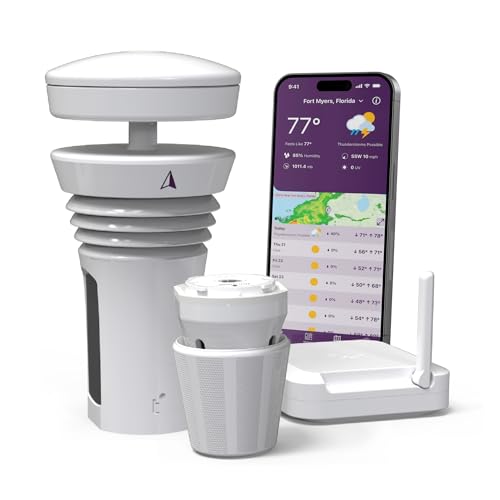
The Tempest takes a different approach from stations that rely on a conventional cup anemometer and separate rain gauge. Its listed sensor package monitors temperature, humidity, barometric pressure, wind speed and direction, dew point, solar radiation, UV index, lightning strikes, rainfall, and other conditions from a single outdoor unit. Lightning detection gives it a meaningful edge for a cabin where changing conditions may matter before anyone arrives.
Remote-property owners will also notice the power and update design. The outdoor sensor is listed as solar powered, transmits wirelessly more than 1,000 feet, and provides updates every three seconds. Those are useful characteristics for a spread-out property, although the published transmission distance should be treated as a favorable-condition figure rather than a guarantee through walls, trees, or metal structures. The listing also names Alexa, Rachio, and IFTTT integrations, which may appeal to owners automating irrigation or other cabin systems.
Pros
- Lists lightning strikes among its monitored weather conditions.
- Measures wind, rain, temperature, humidity, pressure, UV, and solar radiation.
- Solar-powered outdoor sensor reduces the need to manage ordinary sensor batteries.
- Provides listed wireless transmission beyond 1,000 feet and updates every three seconds.
- Supports Alexa, Rachio, IFTTT, and other listed smart-home connections.
Cons
- The strongest remote and integration features require the station’s connected service architecture and Internet access.
- Its premium feature set may be unnecessary for a cabin owner who only needs local temperature and rainfall readings.
Choose the Tempest when remote awareness, lightning information, and minimal outdoor moving parts matter more than keeping the system simple. It is especially appealing for a cabin that sits far from the main residence and benefits from fast updates. Someone who wants a conventional indoor console with straightforward local operation may prefer the WS-2902 or AIRAIN station, but the Tempest offers the broadest connected monitoring package here.
To buy this product, click here.
3. Sainlogic 5G/2.4G Wi-Fi Smart Weather Station — Best for Data Logging

For a cabin owner who wants a record of conditions rather than a quick glance at a screen, the Sainlogic Wi-Fi model brings useful data features into the conversation. Its product information lists indoor and outdoor temperature and humidity, barometric pressure, rainfall, wind speed and direction, dew point, feels-like temperature, and moon information. The app records hourly, daily, monthly, and yearly rainfall totals, which can help reveal how wet a property has been between visits.
The data-storage claim is this model’s clearest distinction. The listing describes two years of local storage and Excel export, with each export covering up to 30 days. That could be useful for reviewing temperature swings, rainfall patterns, or unusual events after returning from town. It also lists dual-band 2.4 GHz and 5 GHz Wi-Fi, Bluetooth fast pairing, app alerts, and Weather Underground synchronization. Buyers should still confirm the current app and service details before purchase, since connected features depend on network setup and service availability.
Pros
- Lists support for both 2.4 GHz and 5 GHz Wi-Fi.
- Provides app alerts and Weather Underground synchronization according to the listing.
- Stores up to two years of local weather data according to the product information.
- Supports Excel export for reviewing recorded conditions.
- Lists rainfall accuracy of ±1 mm below 15 mm and ±7% above 15 mm.
Cons
- The app, alerts, and remote features depend on Wi-Fi access at the cabin.
- The listing does not establish that every connected feature works without Internet access.
This station suits a property owner who wants historical records, rainfall totals, and app-based awareness without choosing the most expensive system. It is a better data tool than a basic console-only station, but it also introduces more setup and network dependencies. If the cabin has unreliable Internet, the WS-2000 or a local-only Sainlogic model may be less frustrating for routine visits.
To buy this product, click here.
4. AcuRite Iris 01540M 5-in-1 Weather Station — Best for Weather Underground
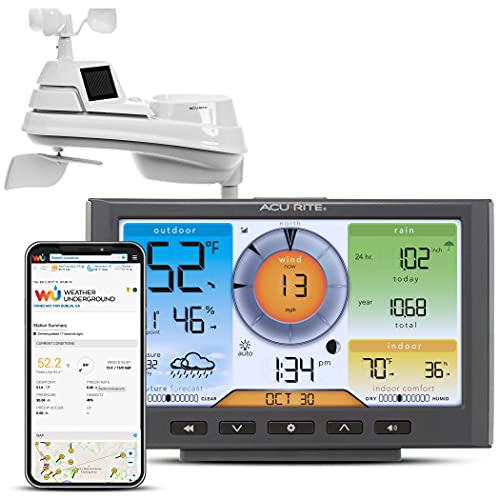
The AcuRite Iris 01540M is a sensible match for a cabin owner who wants a familiar set of outdoor measurements and a route for sharing them online. Its sensor system measures temperature, humidity, wind speed, wind direction, and rainfall, while the station also reports barometric pressure. The console lists more than 25 data points, including heat index, dew point, wind chill, rainfall history, and threshold alarms. Some of these are calculated values, so they should not be confused with separate physical sensors.
Wi-Fi access to Weather Underground is the major reason to choose this model. The listing specifically identifies remote monitoring through that service, which is more useful than assuming every Wi-Fi station supports every weather platform. For a cabin owner who wants to compare local observations with a broader personal-station network, that distinction matters. The adjustable color display remains useful inside the cabin, while the outdoor array still needs sensible exposure for reliable wind and rain observations.
Pros
- Includes temperature, humidity, wind speed, wind direction, and rainfall sensors.
- Lists Wi-Fi connection to Weather Underground for remote monitoring.
- Provides a color console with adjustable dimming.
- Tracks historical rainfall, heat index, dew point, wind chill, and pressure information.
- Includes threshold alarm support for selected weather conditions.
Cons
- Remote Weather Underground access requires a working Wi-Fi connection.
- The 5-in-1 label should not be compared directly with other brands without checking which functions each brand counts.
The 01540M is a good choice for readers who specifically want Weather Underground support and a conventional multi-sensor station. It gives up the lightning detection of the Tempest and the longer data-storage description of the Sainlogic Wi-Fi model. Still, its platform support is clearly stated, which makes it easier to evaluate than a generic connected station with vague cloud language.
To buy this product, click here.
5. Ambient Weather WS-2000 Smart Weather Station — Best Advanced Console
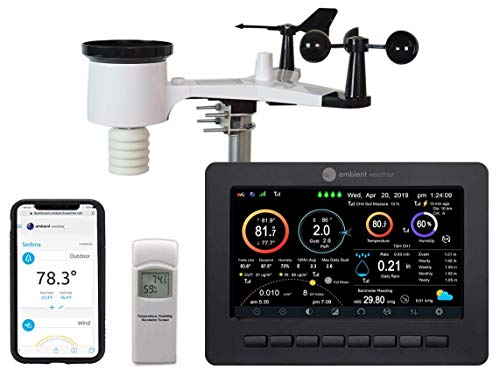
The WS-2000 shares the core sensor coverage that makes the WS-2902 attractive. Its integrated outdoor array measures temperature, humidity, rainfall, wind speed, wind direction, UV, and solar radiation, while a TFT color display presents conditions indoors. That is a strong mix for a cabin where someone wants broad local information without checking separate instruments scattered around the property.
Its listing also identifies calibration support and imperial or metric units, details that matter to people who want to adjust how information is displayed or recorded. Wi-Fi connectivity can send data to the Ambient Weather Network, creating a path toward remote observation when the cabin has Internet service. The outdoor array requires three AAA batteries, and the console uses the included 5-volt DC adapter, so this is not a fully off-grid system.
Pros
- Measures wind, rainfall, temperature, humidity, UV, and solar radiation.
- Includes a TFT color display for local cabin monitoring.
- Supports imperial and metric units.
- Lists calibration capability for its measurements.
- Provides optional Wi-Fi connection to the Ambient Weather Network.
Cons
- The sensor array requires three AAA batteries, which adds a maintenance task at an unattended cabin.
- The console requires a 5-volt DC adapter and therefore needs a suitable indoor power source.
The WS-2000 makes sense for buyers who value the console and calibration options as much as remote connectivity. It is a more advanced-feeling choice than a basic indoor/outdoor thermometer, yet it keeps the sensor arrangement straightforward. The WS-2902 is the better overall balance for many cabins, while this model may appeal to someone who prefers its TFT display and more adjustment-oriented feature set.
To buy this product, click here.
6. AIRAIN TECH Wireless Weather Station — Best for Two Local Displays
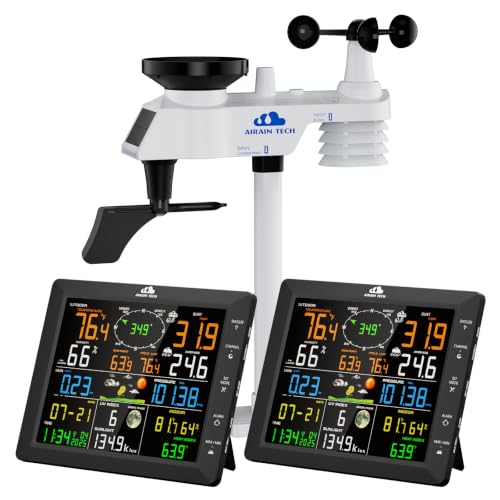
The AIRAIN TECH station is built for a cabin where local visibility matters more than Internet access. Its package includes two main display units and one outdoor sensor, allowing readings to be viewed in separate rooms according to the listing. The sensor reports temperature, humidity, rainfall, wind speed, wind direction, UV, barometric pressure, dew point, and wind chill, so it covers much more than a basic thermometer.
The 8.5-inch color screen should make a full weather overview easier to read from across a room, while adjustable brightness helps in a dim cabin at night. The product information lists a transmission range up to 328 feet in open conditions and includes a mounting pole, bracket, nuts, bolts, and screws. There is no Wi-Fi, so this system cannot provide the same away-from-property access as the WS-2902 or Tempest. Its strength is the straightforward local setup.
Pros
- Includes two display units and one outdoor sensor.
- Lists rainfall, wind speed, wind direction, UV, pressure, dew point, and wind chill.
- Uses a large 8.5-inch adjustable-brightness color display.
- Includes mounting hardware and a mounting pole.
- Lists wireless transmission up to 328 feet in open conditions.
Cons
- No Wi-Fi means no listed app-based remote monitoring or cloud access.
- The published temperature and humidity accuracy figures are broader than the claims listed for some connected competitors.
Choose AIRAIN when the cabin has limited or no Internet service and the people using the property want weather information in more than one room. It also reduces the need to buy separate mounting hardware because the package lists a pole and fasteners. Someone who needs alerts while away should skip this local-only design and choose a connected station instead.
To buy this product, click here.
7. AcuRite Iris 01512MCB Wireless Weather Station — Best for Simple Setup
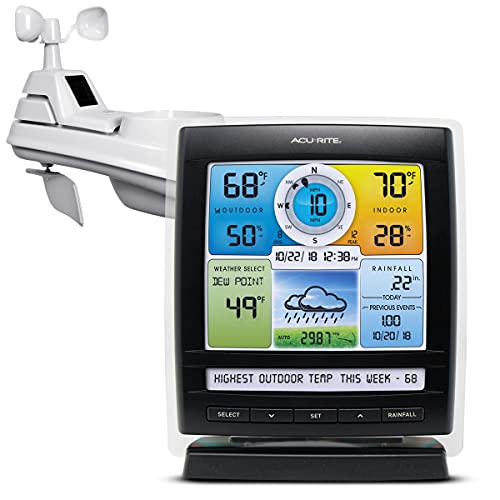
The AcuRite Iris 01512MCB focuses on a conventional local weather-station experience. Its outdoor sensor measures temperature, humidity, wind speed, wind direction, barometric pressure, and rainfall, while the color console displays current conditions and historical information. The listing describes more than 55 data points, including heat index, dew point, feels-like temperature, pressure trends, and other readings. Those derived values can help interpret changing conditions, but the station’s core value comes from its physical temperature, humidity, pressure, wind, and rain measurements.
Setup is described as a battery installation followed by mounting the outdoor sensor to a pole or post with the included bracket. That simplicity can be useful at a cabin where the owner does not want to configure Wi-Fi or an app during a short visit. The personalized forecast uses elevation and barometric pressure information, but forecast icons should be treated as station-generated guidance rather than a replacement for a broader weather service.
Pros
- Measures the core temperature, humidity, pressure, wind, and rainfall variables.
- Lists more than 55 data points and historical weather information.
- Includes a color display with adjustable dimming.
- Includes an outdoor mounting bracket for pole or post installation.
- Provides a pressure-based local forecast using elevation information.
Cons
- The available product information does not identify Wi-Fi or remote monitoring for this model.
- Local readings depend on someone being near the console at the cabin.
This model is a sensible pick for a cabin that receives regular visits and has no need for cloud access. It provides more weather context than a simple indoor/outdoor thermometer while keeping the installation relatively direct. The WS-2902 or AcuRite 01540M is a better fit for unattended monitoring, but the 01512MCB avoids network complexity and still covers the measurements most properties need.
To buy this product, click here.
8. Sainlogic 12-in-1 Wireless Weather Station — Best for a Large Local Display
A 6.5-inch high-contrast display gives this Sainlogic station a clear cabin-friendly purpose. The console lists indoor and outdoor temperature and humidity, barometric pressure, wind speed and direction, rainfall, dew point, feels-like temperature, moon phase, calendar, and alarm functions. For someone walking through the cabin and wanting to read the conditions quickly, the larger display may matter more than app access.
Rainfall reporting is another useful feature. The listing describes hourly, daily, weekly, monthly, and cumulative rainfall records, along with a stated 0 to 9,999 mm range and ±7% accuracy claim. Its wireless transmission is listed up to 443 feet in open conditions, though walls, terrain, and building materials can reduce that distance. This model has no Wi-Fi, so it belongs in a cabin where local monitoring is the priority.
Pros
- Displays a broad set of weather variables on a 6.5-inch color screen.
- Records hourly, daily, weekly, monthly, and cumulative rainfall.
- Lists temperature accuracy of ±0.2°C and humidity accuracy of ±1.8% RH.
- Includes mounting hardware and automatic sensor synchronization.
- Lists wireless transmission up to 443 feet in open conditions.
Cons
- No Wi-Fi means the station cannot provide listed remote app monitoring.
- The advertised transmission distance is an open-area maximum, not a guaranteed distance through a cabin and surrounding structures.
The local Sainlogic is a practical option for a larger property where the sensor may sit some distance from the cabin and the console needs to remain easy to read. It is also a better rainfall-recording choice than simpler thermometer stations. Choose a connected model if the cabin is frequently empty and remote alerts matter, but pick this one for a clear local dashboard without network configuration.
To buy this product, click here.
9. Newentor Wireless Indoor Outdoor Weather Station — Best Budget Option

The Newentor is aimed at cabin owners who mainly need indoor and outdoor temperature and humidity at a modest cost. Its color display also shows daily high and low records, pressure, forecast information, moon phase, time, date, and customizable alerts. One outdoor sensor is included, and the system supports up to three remote sensors, which could help monitor a detached room or another location if compatible additional sensors are obtained separately.
Power behavior is worth understanding before using it at an unattended property. With the included DC adapter, the display can remain continuously lit. On battery power alone, the listing says the screen lights for a short glance before entering an energy-saving mode, and batteries are not included. That makes it useful as a bedside or living-room console, but less suitable for someone seeking rainfall and wind observations across a larger property.
Pros
- Provides indoor and outdoor temperature and humidity readings.
- Supports up to three remote sensor channels according to the listing.
- Includes pressure, daily high and low records, forecast icons, and alerts.
- Offers a color display with adjustable backlight.
- Includes atomic time and dual alarm functions.
Cons
- Its listed measurement set does not include outdoor rainfall, wind speed, or wind direction.
- Batteries are not included, and battery-only operation dims the display after a short period.
The Newentor is best for a small cabin where temperature and humidity are the main questions, such as checking indoor comfort or watching conditions near an exterior wall. It is not the right tool for measuring wind or rainfall around a larger property. Buyers who need a complete outdoor weather picture should step up to the AcuRite 01512MCB, Sainlogic 12-in-1, or another station with a full outdoor array.
To buy this product, click here.
Buying Guide
Wireless and Wi-Fi Solve Different Problems
A wireless outdoor array can send readings to a console without giving the station Internet access. That is enough for someone inside the cabin, but it does not automatically provide phone access from town. The WS-2902, Tempest, Sainlogic Wi-Fi station, and AcuRite 01540M add connected features, while the AIRAIN and local Sainlogic models are intended for console-based monitoring. Choose based on whether the cabin is occupied often or monitored remotely between visits.
Decide Which Measurements Matter at the Property
Temperature and humidity cover basic comfort checks, but rainfall and wind become much more useful for an exposed cabin, a long driveway, a garden, or a property with trees and outbuildings. UV and solar radiation add context for outdoor exposure, while lightning detection is a specialized advantage offered by the Tempest in this group. A station with more measurements is not automatically better if those variables will never affect a decision.
Remote Monitoring Requires Internet Access
Remote monitoring depends on more than a wireless sensor. The console or gateway must connect to a network, and the station must support an app, cloud service, or specified weather platform. Weather Underground support is explicitly listed for the AcuRite 01540M. Ambient models list Ambient Weather Network access, while the Tempest lists several smart-home connections. A local-only station cannot send a cabin owner an alert while they are away.
Advertised Range Needs Cabin-Specific Context
Transmission distances are usually stated for open conditions. A sensor placed across a clearing may communicate differently from one separated from the console by thick timber walls, metal siding, a basement floor, or dense terrain. The 443-foot Sainlogic figure and the 328-foot AIRAIN figure should help with initial planning, but they are not guarantees inside every building.
Separate Accuracy, Resolution, and Measurement Range
A display that shows small increments does not automatically have matching accuracy. Likewise, a sensor’s measurement range is different from its operating range, and a fast update rate does not prove better accuracy. The Sainlogic listings provide specific temperature, humidity, and rainfall claims, while some other products provide less detail. Treat supplied values as listing specifications rather than independent verification.
Plan Sensor Placement Before Installation
The outdoor array needs an appropriate location. Roof surfaces, pavement, walls, direct sunlight, trees, and nearby heat sources can influence readings. Wind sensors need exposure to moving air, and rain gauges need a level, unobstructed position. A capable station installed in a poor location can produce less useful cabin information than a simpler station placed thoughtfully.
Check Power at an Unattended Cabin
Many consoles use an adapter, while outdoor arrays may use batteries or solar assistance. The WS-2000 listing specifies a 5-volt console adapter and three AAA batteries for its sensor array. The Tempest listing describes a solar-powered outdoor sensor, while the Newentor changes its display behavior when running on batteries alone. Match the power arrangement to visits, winter access, and the availability of reliable electricity.
Best Weather Stations for Cabins FAQ
What Is the Best Weather Station for a Remote Cabin?
The Ambient Weather WS-2902 is the strongest overall choice here for a connected remote cabin because it combines a full outdoor array, Wi-Fi, local display, remote access, and listed smart-home support. The Tempest is a stronger premium alternative if lightning detection, rapid updates, and solar-assisted outdoor operation matter.
Do Wireless Weather Stations Require Wi-Fi?
No. Wireless usually describes the link between the outdoor sensor and indoor console. The AIRAIN, Sainlogic 12-in-1, and AcuRite 01512MCB can provide local readings without the Wi-Fi features listed for connected models. Wi-Fi is required for the remote and cloud functions identified for stations such as the WS-2902 and AcuRite 01540M.
Can These Weather Stations Be Checked While Away From the Cabin?
The WS-2902, Tempest, Sainlogic Wi-Fi model, and AcuRite 01540M list connected or remote-monitoring features. Those functions require the appropriate network and service setup at the property. Local-only stations show readings on a console but do not provide the same away-from-home access.
Which Station Is Best for Rainfall Tracking?
The Sainlogic Wi-Fi station lists hourly, daily, monthly, and yearly rainfall records with app access and data export. The Sainlogic 12-in-1 also lists several rainfall-history periods on its local console. A rain gauge must be level and positioned away from obstructions for useful readings, regardless of the station selected.
Does a Weather Station Measure Dew Point Directly?
Dew point is commonly calculated from temperature and humidity readings. The products in this guide list dew point as a displayed weather value, but the available information does not identify a separate dew-point sensor in these systems. It is best understood as a derived measurement unless a product specifically states otherwise.
Is the Tempest Completely Battery Free?
The listing describes the Tempest outdoor sensor as solar powered, but that does not establish that every component of the complete system operates without another power source. Confirm the current power requirements for the console, hub, and any included components before installing it at a cabin without regular electrical service.
Should a Cabin Weather Station Have a Large Display?
A large display helps when the station will be checked from across a room or by several people. The AIRAIN has an 8.5-inch display, while the Sainlogic 12-in-1 lists a 6.5-inch display. If the station will mainly be checked through an app, display size matters less than connectivity, power, and data access.
Final Verdict
The Ambient Weather WS-2902 is the strongest overall choice for most connected cabins. Its integrated sensor array covers temperature, humidity, rainfall, wind, UV, and solar radiation, and its Wi-Fi features create a practical path to remote access and smart-home use. It still includes a local color console, so someone inside the cabin does not need a phone for every quick check. The main requirement is dependable Internet access if the owner wants away-from-property alerts or cloud features.
The Tempest is the premium alternative for lightning information, rapid updates, solar-assisted outdoor operation, and broader smart-home integration. The Sainlogic Wi-Fi station is compelling for rainfall history, Excel export, and longer-term data records. For a cabin without reliable Internet, the AIRAIN offers an unusually useful local setup with two displays and a broad measurement list, while the Sainlogic 12-in-1 emphasizes a large console and rainfall history. Match the station to the property’s power, network, sensor-placement, and monitoring needs before choosing the longest feature list.