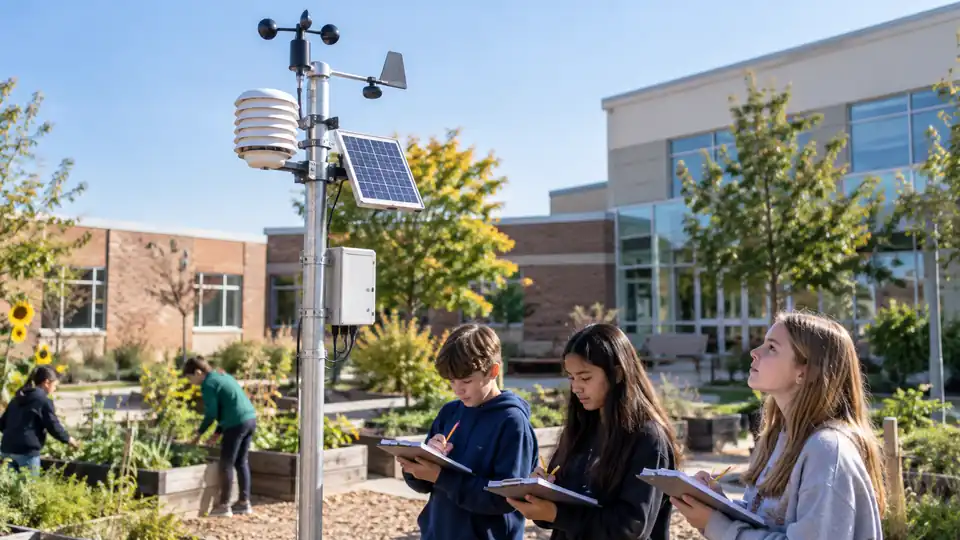
A school weather station can turn a forecast into something students can measure, question, and revisit. A sensor array mounted outside the building can provide local temperature, humidity, rainfall, wind, and pressure readings that feel far more tangible than a number on a weather app. The best choice depends on whether the station will support a single classroom display, a science lab, outdoor education, a campus garden, or longer-term data projects.
Schools often buy too much station for a simple display, or too little for meaningful observation. Wireless sensor transmission is useful for placing an outdoor array away from the console, but it is different from Wi-Fi and does not automatically provide remote access. Measurements also need context. A rain gauge must be level and unobstructed, wind sensors need suitable exposure, and a display showing extra decimal places does not prove higher accuracy. For most campuses, the Ambient Weather WS-2902 offers the strongest overall balance because it combines a broad measurement set with Wi-Fi access, alerts, and a clear color console.
The products below range from classroom-friendly local stations to connected systems that can support data collection away from campus. The comparison weighs direct measurements, display design, sensor arrangement, data access, installation, and the practical trade-offs that matter in a school environment.
Quick Answer
- Best Overall: Ambient Weather WS-2902 Wi-Fi Smart Weather Station combines temperature, humidity, wind, rainfall, UV, and solar radiation measurements with Wi-Fi access and smart-home compatibility.
- Best for School-Wide Remote Access: AcuRite Iris 01540M connects to Weather Underground, giving schools a way to view and share station data beyond the local console.
- Best for Data Projects: Sainlogic Wi-Fi Smart Weather Station lists two years of local storage and Excel export, which can be useful for charting weather trends.
- Best for a Large Classroom Display: Sainlogic SA68 has an 8-inch display with bold fonts and adjustable backlighting, while still showing wind, rainfall, pressure, temperature, and humidity.
Best Weather Stations for Schools Comparison Table
| Product | Measurements | Connectivity and Data | Display or Sensor Highlight | Best For |
|---|---|---|---|---|
| Ambient Weather WS-2902 | Temperature, humidity, wind, rainfall, UV, solar radiation | Wi-Fi, remote access, IFTTT, Alexa, Google Home | Color LCD and integrated sensor array | Connected school weather programs |
| AcuRite Iris 01540M | Temperature, humidity, wind, pressure, rainfall | Wi-Fi and Weather Underground | Color display, threshold alarms | Sharing observations online |
| Sainlogic Wi-Fi Smart Weather Station | Temperature, humidity, wind, rainfall, pressure | 2.4/5 GHz Wi-Fi, app, Weather Underground, Excel export | Up to 443-foot listed wireless range | Historical data projects |
| Sainlogic SA68 | Temperature, humidity, wind, rainfall, pressure | Wireless local display, no Wi-Fi | 8-inch display and solar-assisted sensor | Large shared displays |
| Sainlogic 12-in-1 Wireless Station | Temperature, humidity, wind, rainfall, pressure, dew point | Wireless local display, no Wi-Fi | 6.5-inch display and rainfall history | Broad measurements on a moderate budget |
| AcuRite Iris 01535M | Temperature, humidity, wind, rainfall, pressure | Wireless local display | HD display, alerts, optional lightning sensor support | Detailed local monitoring |
| AcuRite Iris 01512MCB | Temperature, humidity, wind, rainfall, pressure | Wireless local display | Over 55 listed data points | Exploring derived weather data |
| AcuRite 02077M | Temperature, humidity, pressure trends | Wireless local display | Color screen and forecast icons | Simple classroom observation |
| AcuRite What-to-Wear Station | Outdoor temperature and trends | Wireless local display | Clothing recommendations and freeze indicator | Elementary weather lessons |
The detailed reviews explain which stations fit a classroom lesson, a campus-wide display, or a longer-term data collection project.
1. Ambient Weather WS-2902 — Best Overall
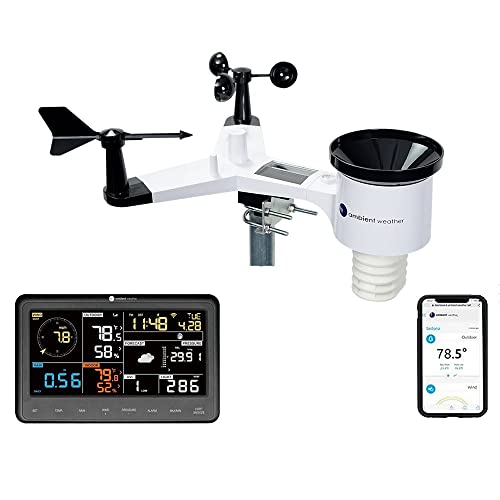
The WS-2902 is the most complete fit for a school that wants local measurements and a route to online data. Its Osprey sensor array measures temperature, humidity, wind speed, wind direction, rainfall, UV intensity, and solar radiation. That mix gives students several useful lines of inquiry, from comparing sunny and cloudy conditions to tracking rainfall against soil or garden observations. The color LCD keeps the information visible in a classroom, office, or science lab.
Its Wi-Fi connection changes the teaching possibilities. The listing describes remote data access, alerts, IFTTT support, Google Home and Alexa compatibility, and optional transmission to the Ambient Weather Network. Wi-Fi is doing more here than connecting the outdoor sensor to the screen. It can help a teacher check conditions away from the console or bring current observations into a broader school project. The sensor array is integrated, so installation is simpler than placing every instrument separately, although one outdoor location cannot represent every part of a large campus.
Pros
- Measures temperature, humidity, wind speed, wind direction, rainfall, UV intensity, and solar radiation.
- Includes a color LCD display for local observation.
- Supports Wi-Fi-based remote access and alerts according to the listing.
- Lists IFTTT, Google Home, and Alexa compatibility.
- Can optionally share data with the Ambient Weather Network.
Cons
- The integrated sensor array limits the ability to place each measurement in a separate location.
- Accurate campus comparisons still depend on sensible outdoor placement and exposure.
This is the strongest choice for a school that wants one station to serve a classroom display, an outdoor learning area, and connected data activities. It has more measurement breadth than the simpler AcuRite models and clearer connectivity than the local-only stations. A school that only needs temperature and humidity may find its extra capabilities unnecessary, but science departments, environmental clubs, and garden programs can make better use of the wider sensor set.
To buy this product, click here.
2. AcuRite Iris 01540M — Best for Weather Network Uploads
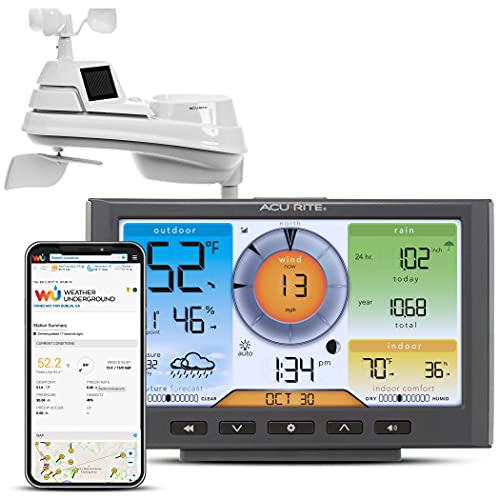
A school that wants students to see how local observations become shared weather data should look closely at the Iris 01540M. The listing identifies Wi-Fi connectivity to Weather Underground, along with temperature, humidity, wind speed, wind direction, barometric pressure, and rainfall measurements. That combination gives a class plenty to read from the console while also creating an online sharing path for a campus station.
The display reports more than 25 data points and supports threshold alarms, historical information, heat index, dew point, wind chill, and rainfall history. Several of these are calculated values rather than separate sensors, which makes the station useful for teaching the difference between a direct observation and a derived weather value. The included outdoor system has a built-in anemometer, wind vane, barometer, hygrometer, rain gauge, and thermometer. A teacher should still plan the mounting position carefully, because a single combined array must serve all of those instruments.
Pros
- Provides Wi-Fi connection to Weather Underground.
- Measures temperature, humidity, pressure, wind, and rainfall.
- Displays more than 25 listed data points.
- Offers threshold alarms and historical rainfall information.
- Includes a color display with adjustable dimming.
Cons
- The listing does not identify broader smart-home compatibility or spreadsheet export.
- A school must use the integrated outdoor sensor location for several different measurements.
The 01540M makes sense for a school where sharing observations beyond the room is a central goal. It is a better fit than a local-only console for a website, weather club, or cross-class project that needs a network destination. The Ambient Weather station offers a broader measurement set, while this AcuRite keeps its focus on familiar weather variables and Weather Underground access.
To buy this product, click here.
3. Sainlogic Wi-Fi Smart Weather Station — Best for Data Logging

Long-term school projects need more than a number that disappears when the display changes. The Sainlogic Wi-Fi Smart Weather Station stands out because its listing describes two years of local data storage and Excel export. Each export covers up to 30 days, so a class can work with manageable chunks of temperature, humidity, rainfall, and other observations rather than relying on a screenshot from a console.
The station supports 2.4 GHz and 5 GHz Wi-Fi, Bluetooth fast pairing, app access, real-time alerts, and Weather Underground synchronization according to the product information. It also lists a Swiss SHT40 temperature and humidity sensor, rainfall records, wind measurements, pressure, dew point, and feels-like temperature. The published accuracy claims are ±0.2°C for temperature and ±1.8% RH for humidity. Those are listing specifications, not independent verification, but they give buyers useful information for comparison. The sensor’s listed wireless distance reaches 443 feet in open conditions, though walls, metal, and campus buildings can reduce that figure.
Pros
- Lists two years of local data storage.
- Supports Excel export for data analysis.
- Works with 2.4 GHz and 5 GHz Wi-Fi according to the listing.
- Provides app alerts and Weather Underground synchronization.
- Records rainfall by hourly, daily, monthly, and yearly periods.
Cons
- Each export covers up to 30 days, so longer projects require multiple exports.
- The listed 443-foot transmission distance applies to open, unobstructed conditions.
This station is especially useful for students learning to build tables, graphs, and comparisons from real observations. It gives up some of the broader environmental measurements found on the Ambient Weather model, including listed UV and solar radiation, but it offers a more explicit data-storage and export story. Choose it for a school that expects weather observations to become a spreadsheet project rather than remain a display on the wall.
To buy this product, click here.
4. Sainlogic SA68 — Best for a Large Display

A weather station in a busy hallway has a different job from one on a teacher’s desk. The SA68 uses an 8-inch display with bold fonts, high contrast, and three backlight levels, so several students can read the main observations without crowding around a small console. It shows indoor and outdoor temperature, humidity, barometric pressure, wind speed and direction, rainfall, dew point, and perceived temperature.
The SA68 is a local wireless system rather than a Wi-Fi station. That distinction matters in a school. Students can watch current conditions on the display, but the product information does not identify app access, cloud history, or remote viewing. Its outdoor sensor is described as solar powered with battery backup, while the batteries are not included. The listing also gives outdoor temperature coverage from -40°F to 60°F, indoor temperature from 32°F to 140°F, humidity from 10% to 99%, and pressure from 300 to 1100 hPa. These are stated measurement ranges, not guarantees of equal accuracy across every point.
Pros
- Uses an 8-inch display with bold, high-contrast information.
- Shows temperature, humidity, wind, rainfall, pressure, dew point, and perceived temperature.
- Offers three adjustable backlight levels.
- Lists solar power with battery backup for the outdoor sensor.
- Includes manual rainfall calibration according to the product information.
Cons
- No Wi-Fi is listed, so remote access and cloud sharing are not identified.
- Batteries are not included.
The SA68 is a strong choice for a classroom wall, front office, or library display where immediate visibility matters more than online access. It gives students a broad set of local observations without requiring a network account. A school planning a multi-month digital data project should choose one of the Wi-Fi models instead, but this station offers a straightforward way to make outdoor conditions part of the daily school environment.
To buy this product, click here.
5. Sainlogic 12-in-1 Wireless Weather Station — Best Broad-Measurement Local Option
The 12-in-1 label is useful here only because the listing identifies what the station displays. Students can follow indoor and outdoor temperature and humidity, barometric pressure, wind speed and direction, rainfall, dew point, feels-like temperature, moon phase, calendar information, and the clock. That gives a class enough material for basic weather logs, comparisons between days, and conversations about which values come from sensors and which are calculated.
A 6.5-inch color screen with three backlight levels keeps the main information reasonably accessible, while the outdoor sensor sends data to the display wirelessly. The listing states a transmission distance of up to 443 feet in open, unobstructed conditions. It also gives rainfall tracking from 0 to 9,999 mm and lists hourly, daily, weekly, monthly, and cumulative records. The product does not have Wi-Fi, so its records remain tied to the local station rather than a remote school dashboard or online classroom.
Pros
- Combines temperature, humidity, pressure, wind, rainfall, dew point, and feels-like readings.
- Provides hourly, daily, weekly, monthly, and cumulative rainfall records.
- Uses a 6.5-inch color display with adjustable backlighting.
- Includes mounting hardware according to the listing.
- Offers a wireless sensor link for flexible console placement.
Cons
- No Wi-Fi or remote data access is listed.
- The advertised wireless range is stated for open, unobstructed conditions.
This is a sensible middle ground for a school that wants more than a thermometer but does not need cloud connectivity. It gives students a wider measurement vocabulary than the simpler AcuRite 02077M while avoiding the setup and account questions associated with Wi-Fi. Select it for local lessons, school gardens, and hallway observation. Choose the Sainlogic Wi-Fi model if exporting records is central to the curriculum.
To buy this product, click here.
6. AcuRite Iris 01535M — Best for Local Alerts
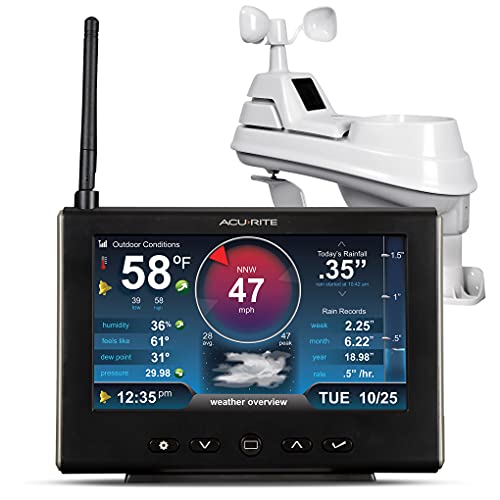
The Iris 01535M focuses on a detailed local console and configurable alerts. It measures indoor and outdoor temperature and humidity, wind speed and direction, pressure, and rainfall. The display also reports heat index, frost point, or dew point, along with rainfall history and high and low records. That makes it useful for lessons where students compare a measured temperature with a calculated comfort or moisture-related value.
The listing identifies customizable alarms for temperature, humidity, wind speed, and rainfall, plus a storm alarm activated by falling barometric pressure. A school could use those alerts as prompts for observation, although pressure-based warnings should be treated as station-generated indications rather than a substitute for official severe-weather communication. The station can also be expanded with an AcuRite lightning sensor sold separately. That sensor is optional, so lightning detection is not included in the package described here.
Pros
- Measures temperature, humidity, pressure, wind speed, wind direction, and rainfall.
- Offers customizable alerts for several weather conditions.
- Includes a storm alarm based on falling barometric pressure.
- Displays rainfall history, heat index, frost point, and dew point.
- Supports an optional AcuRite lightning sensor sold separately.
Cons
- The optional lightning sensor is not included.
- The available product information does not identify Wi-Fi or remote access for this model.
This station suits a science room where the console itself is the main teaching tool. It presents more weather context than a basic temperature station, and its alert functions can encourage students to record what happens before and after a pressure change or rainfall event. A school that needs online sharing should move up to a Wi-Fi model, while a school focused on local observation can save complexity with this AcuRite.
To buy this product, click here.
7. AcuRite Iris 01512MCB — Best for Exploring Weather Data
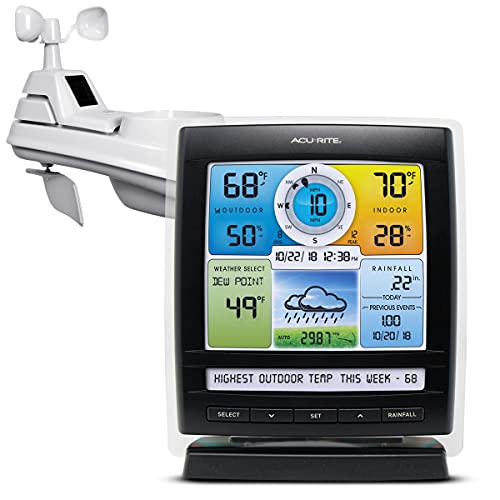
The 01512MCB gives a classroom a broad set of readings without requiring a network connection. Its listing describes more than 55 data points, including indoor and outdoor temperature and humidity, wind speed and direction, barometric pressure, rainfall, heat index, dew point, feels-like temperature, pressure trends, and historical data. That large count includes calculated and historical values, so it should not be read as 55 separate outdoor sensors. Still, it can give students plenty to examine on a single color screen.
Setup is described as straightforward: install batteries, attach the outdoor sensor to a pole or post with the included mounting bracket, and pair it with the display. The console includes an adjustable dimmer and clock functions. Its personalized forecast uses elevation data and pressure readings to generate a 12-hour forecast from current conditions. That is useful for teaching how pressure trends relate to forecast indicators, while leaving room to explain that a station-generated forecast is different from a full professional forecast.
Pros
- Lists more than 55 available data points.
- Includes temperature, humidity, wind, pressure, rainfall, and derived readings.
- Provides historical data and pressure trends.
- Includes a color display with adjustable dimming.
- Mounting hardware is included according to the listing.
Cons
- No Wi-Fi or online sharing is identified for this model.
- The large data-point count includes calculated and historical information, not 55 separate sensors.
This is a good fit for teachers who want to move beyond a simple current-conditions display and discuss weather interpretation. It offers a richer local console than the 02077M, but it lacks the connected data path provided by the Ambient Weather and Wi-Fi AcuRite stations. The choice comes down to whether students will analyze information at the console or retrieve it from a network.
To buy this product, click here.
8. AcuRite 02077M Wireless Home Weather Station — Best for Simple Setup
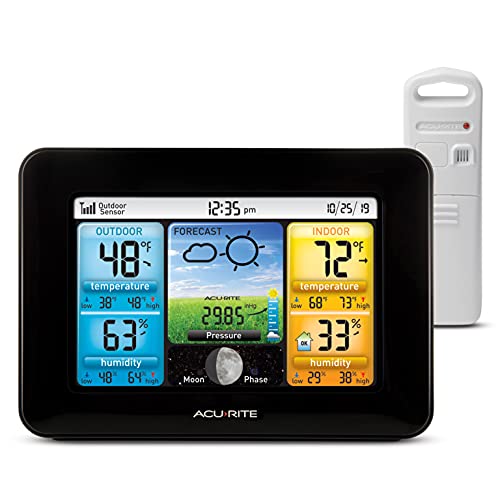
Not every classroom needs rainfall totals, wind direction, or a cloud dashboard. The AcuRite 02077M keeps the focus on indoor and outdoor temperature, humidity, pressure trends, high and low records, forecast icons, and moon phase information. Its outdoor sensor hangs from an integrated hanger, and the listing describes a simple battery-powered setup with a color LCD display.
That narrower measurement set can be an advantage for younger students or a teacher introducing the difference between indoor and outdoor conditions. The display includes signal strength, date, and more than 15 listed data points, while an adjustable dimmer helps with placement in a room. It does not provide the rainfall and wind instrumentation found in the higher-ranked models, so it is better for a basic observation station than a complete campus weather project.
Pros
- Provides indoor and outdoor temperature and humidity readings.
- Shows pressure trends, forecast icons, and moon phase information.
- Uses a color LCD display with an adjustable dimmer.
- Outdoor sensor can hang from a post or tree branch.
- Offers a simpler measurement set for introductory lessons.
Cons
- Does not list rainfall, wind speed, or wind direction measurements.
- Two AA batteries for the outdoor sensor are not included.
The 02077M is a practical starting point for a classroom that needs clear temperature and humidity observations without the installation demands of a full sensor array. It is less suitable for advanced earth science, agriculture, or environmental monitoring because wind and rainfall are absent. Choose it when simplicity matters more than breadth, then move to the Sainlogic or AcuRite Iris systems if students need a fuller picture of outdoor conditions.
To buy this product, click here.
9. AcuRite What-to-Wear Weather Station — Best for Elementary Weather Lessons

The What-to-Wear station takes a different educational approach. Instead of presenting a long list of measurements, it connects the outdoor temperature and forecast with more than 40 clothing recommendations. The display can show an outfit suggestion, a freeze indicator, the temperature trend, a comparison with the previous day, and a forecast generated from the outdoor sensor. For an elementary classroom, that can turn a morning weather check into a quick discussion about observation and decision-making.
The display also includes an alarm clock, date, daylight-saving adjustment, and a 10-minute snooze function. Its battery-powered display and outdoor sensor can continue providing readings during a power outage, according to the listing. This is a focused teaching tool rather than a complete meteorological station. It does not list rainfall, wind, humidity, or pressure measurement, so it should not be selected for a school garden or formal weather-data project.
Pros
- Shows more than 40 clothing recommendations tied to the forecast.
- Displays outdoor temperature, trend information, and a freeze indicator.
- Compares the current condition with the previous day.
- Includes a battery-powered display and outdoor sensor.
- Uses a simple format suited to introductory weather discussions.
Cons
- Does not list rainfall, wind, humidity, or barometric pressure measurements.
- Its clothing recommendations are less useful for advanced data analysis.
This station belongs in a younger classroom, a school entrance, or a morning routine where the goal is to make weather understandable and observable. It ranks below the complete stations because its measurements are limited, but it offers a clear connection between outdoor conditions and daily choices. For experiments, charts, and campus monitoring, choose a station with rainfall, wind, humidity, or data access instead.
To buy this product, click here.
Buying Guide
Choose the Measurements That Match the Lesson
A school science project may need temperature and rainfall, while an elementary morning display may need only outdoor temperature and a readable forecast. Wind speed and direction add useful material for geography, local climate, and engineering lessons. UV and solar radiation broaden the curriculum further, but they matter most when students will use those measurements in a specific project. A longer specification list does not automatically make a station more useful.
Wireless Sensor Links and Wi-Fi Do Different Jobs
Every station in this roundup uses some form of wireless communication between the outdoor sensor and the indoor display, but only some list Wi-Fi. A local wireless link helps place the console inside a classroom. Wi-Fi can add app access, network uploads, alerts, or remote viewing, depending on the product. The Ambient Weather WS-2902 and Sainlogic Wi-Fi model offer the clearest connected options, while the SA68 and local AcuRite stations are intended primarily for nearby viewing.
Remote Data Access Needs Explicit Support
A school that wants families, administrators, or students in another classroom to view observations should verify the actual access method. Weather Underground support, app access, remote station viewing, and smart-home compatibility are separate claims. The product information identifies Weather Underground access for the AcuRite 01540M and Sainlogic Wi-Fi model. The Ambient Weather WS-2902 lists remote access and several smart-home services. A wireless-only station should not be assumed to provide any of those functions.
Data Logging Helps Turn Readings Into Projects
Historical records are useful for graphing temperature changes, comparing rainfall by week, and examining pressure trends. The Sainlogic Wi-Fi station is the clearest fit for this work because its listing describes two years of local storage and Excel export, with each export covering up to 30 days. Other stations list historical information on their consoles, but the available product information does not establish the same export process.
Install the Sensor Where Its Measurements Make Sense
An integrated array simplifies setup because one outdoor assembly contains several instruments. It also means that temperature, wind, and rainfall all share the same general location. Keep the sensor away from obvious heat sources and obstructions, and follow the product’s mounting instructions. A rain gauge should be level, while a wind sensor needs open exposure to moving air. The best console cannot correct for a poor outdoor location.
Read Accuracy, Resolution, and Range Separately
The Sainlogic models list temperature and humidity accuracy claims, and the rainfall systems list rainfall error figures. These are different from the displayed resolution or the sensor’s measurement range. A display that shows small increments does not prove that the measurement is equally close to a reference. Likewise, a listed wireless distance describes communication conditions, not sensor accuracy. Treat listing specifications as useful comparison information rather than independent testing.
Check Power Requirements Before Installation
Power arrangements vary across the nine choices. Some consoles use an adapter with battery backup, some outdoor sensors require batteries, and the SA68 listing describes solar power with battery backup for the outdoor system. Batteries are not included with several products. Check which component needs which power source before mounting a sensor on a roof, pole, or distant part of campus.
Best Weather Stations for Schools FAQ
What Is the Best Weather Station for Most Schools?
The Ambient Weather WS-2902 is the strongest overall choice because it combines a color display with temperature, humidity, wind, rainfall, UV, and solar radiation measurements. Its listed Wi-Fi, remote access, alerts, and smart-home support also give a school more ways to use the data than a local-only console.
Do Schools Need a Wi-Fi Weather Station?
No. A local wireless station can be enough for a classroom display or daily observation routine. Wi-Fi becomes more useful when students need remote access, online sharing, alerts, app viewing, or exported records. The product information should identify those functions for the exact model rather than relying on the word wireless.
Which Station Is Best for Student Data Analysis?
The Sainlogic Wi-Fi Smart Weather Station is the clearest fit because its listing describes two years of local storage and Excel export. Students can work with temperature, humidity, rainfall, wind, and pressure records over time. Each export covers up to 30 days, so longer projects may require multiple exports.
Are the Weather Stations Suitable for a School Garden?
Stations that measure rainfall, temperature, humidity, and wind are the most useful starting points for a garden. The Ambient Weather, AcuRite Iris, and Sainlogic multi-measurement models provide those observations. None of the supplied product information establishes direct soil moisture or plant measurements, so do not assume that a general weather station monitors soil conditions.
Can a Wireless Weather Station Be Read From Another Building?
It depends on the listed transmission range and the building layout. The Sainlogic models list up to 443 feet in open, unobstructed conditions, but walls, metal, floors, and interference can reduce communication distance. A wireless sensor link is also different from Wi-Fi. For access away from the local console, choose a model with explicitly listed app, cloud, or remote-monitoring support.
Do More Data Points Mean a Better School Weather Station?
Not automatically. A station may count calculated values, historical records, and direct measurements together. A product listing that mentions more than 55 data points does not mean it has 55 outdoor sensors. Compare the actual measurements and data functions with the lessons the school plans to teach.
Is a Forecast Icon the Same as a Weather Measurement?
No. Temperature, humidity, pressure, rainfall, wind, UV, and solar radiation can be direct sensor measurements when the station includes those instruments. Dew point, heat index, feels-like temperature, and forecast icons may be calculated from other readings. Students can learn from both, but they represent different kinds of information.
Which Station Has the Easiest Display for a Shared Space?
The Sainlogic SA68 has the largest listed display in this group at 8 inches, with bold fonts, high contrast, and adjustable backlighting. The Sainlogic 12-in-1 uses a 6.5-inch display, while several AcuRite models offer color screens with adjustable dimming. Placement and viewing distance still matter, especially in a busy hallway.
Final Verdict
The Ambient Weather WS-2902 is the strongest overall choice for a school that wants a complete local station with a path to connected weather projects. Its listed measurements cover temperature, humidity, wind, rainfall, UV, and solar radiation, while Wi-Fi adds remote access, alerts, network sharing, and smart-home compatibility. The AcuRite Iris 01540M is a strong alternative for a campus that specifically wants Weather Underground access, and the Sainlogic Wi-Fi model is better suited to classes that plan to export and analyze longer-term records.
For a large shared display without Wi-Fi, the Sainlogic SA68 offers a readable 8-inch screen and a broad set of local observations. The simpler AcuRite 02077M works better for introductory temperature and humidity lessons, while the What-to-Wear model gives younger students an approachable connection between forecasts and daily clothing choices. Match the station to the school’s actual teaching plan, available mounting location, power access, and need for online data. A smaller station used consistently can teach more than an advanced system that no class has time to monitor.