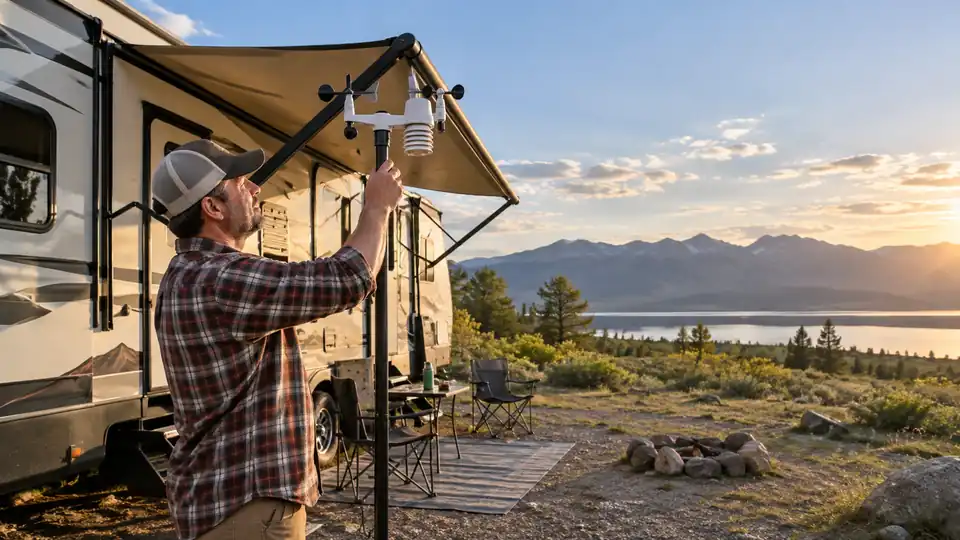
An RV weather station needs to do more than decorate a countertop with colorful icons. The useful system is the one that gives you dependable local temperature and humidity readings, shows changing pressure, tracks rain or wind when those conditions matter, and fits the way you actually camp. A compact local display may be perfect for a weekend stop, while a Wi-Fi station can be far more useful for checking a parked RV from home.
RVs create a few practical wrinkles. Space is limited, campsite layouts vary, and a sensor that needs a permanent roof or pole installation may be awkward for temporary travel. Wireless sensor-to-console communication is also different from Wi-Fi. A station can send readings across a campsite without offering app access or remote monitoring. For connected weather data, the Tempest Weather Station stands out because its outdoor sensor combines broad measurements, solar assistance, app access, and smart-home support in a relatively self-contained design.
The selections below favor stations that can serve an RV, campsite, seasonal site, or compact property without pretending every model is equally portable. Local-only stations lead the simpler choices, while Wi-Fi models earn attention for remote access and stored data. Sensor placement, power, display size, and the difference between a calculated forecast and a direct measurement all matter before you pack one into the next trip.
Quick Answer
- Best Overall: Tempest Weather Station for broad measurements, app access, solar-assisted outdoor operation, and smart-home compatibility.
- Best Connected Value: Ambient Weather WS-2902 for Wi-Fi data, rainfall, wind, UV, solar radiation, and remote alerts.
- Best for Local RV Monitoring: AIRAIN TECH Wireless Weather Station for two displays, a broad measurement set, and no dependence on Wi-Fi.
- Best Simple Budget Choice: AcuRite 02077M for straightforward indoor/outdoor readings, forecast icons, and compact local use.
Best Weather Stations for RVs Comparison Table
| Product | Measurements | Connectivity | Sensor And Display Setup | Best For |
|---|---|---|---|---|
| Tempest Weather Station | Temperature, humidity, pressure, wind, rain, UV, solar radiation, lightning | Wireless, app, Alexa, IFTTT, smart-home platforms | Solar-powered outdoor sensor, app-based access | Connected RV sites and broad monitoring |
| Ambient Weather WS-2902 | Temperature, humidity, pressure, wind, rain, UV, solar radiation | Wireless, Wi-Fi, Ambient Weather Network, IFTTT, Google Home, Alexa | Osprey sensor array and color console | Remote monitoring and smart alerts |
| Sainlogic 5G/2.4G Wi-Fi Smart Weather Station | Temperature, humidity, pressure, wind, rain, dew point, feels-like | Wi-Fi, Bluetooth pairing, app, Weather Underground sync | Outdoor sensor, app, data storage | App access and rainfall records |
| AcuRite Iris 5-in-1 01540M | Temperature, humidity, pressure, wind, rain, derived values | Wireless, Wi-Fi, Weather Underground | Integrated sensor array and color display | Weather network uploads |
| AIRAIN TECH Wireless Weather Station | Temperature, humidity, pressure, wind, rain, UV, dew point, wind chill | Wireless, no Wi-Fi | Outdoor sensor and two color displays | Local monitoring in and around an RV |
| Sainlogic 12-in-1 Wireless Weather Station | Temperature, humidity, pressure, wind, rain, dew point, feels-like | Wireless, no Wi-Fi | Outdoor sensor and 6.5-inch display | Large local display and rainfall history |
| AcuRite Iris 01512MCB | Temperature, humidity, pressure, wind, rain, historical and derived data | Wireless local console | Outdoor sensor and color display | Detailed local weather information |
| Newentor Wireless Weather Station | Temperature, humidity, pressure, forecast, moon phase | Wireless sensor link, up to three sensor channels | One included sensor and color display | Compact temperature and humidity monitoring |
| AcuRite Wireless Home Weather Station 02077M | Temperature, humidity, pressure trends, forecast | Wireless local console | Outdoor sensor and color display | Simple RV weather checks |
The detailed reviews explain how each station handles campsite setup, local readings, remote access, sensor placement, and the trade-offs behind its ranking.
1. Tempest Weather Station – Best Overall
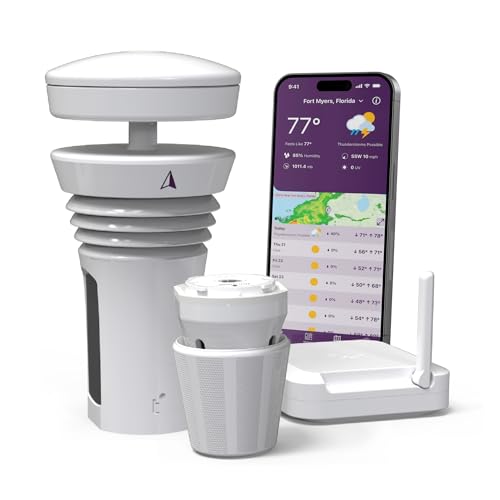
Tempest earns the top spot because it addresses the two sides of RV weather monitoring: local outdoor conditions and access to that information through connected services. The listing identifies measurements for temperature, humidity, barometric pressure, wind speed and direction, dew point, solar radiation, UV index, lightning strikes, and rainfall. That is a substantial range for someone who wants more than an indoor/outdoor thermometer while staying away from a traditional multi-part console setup.
The outdoor sensor is solar powered and sends data wirelessly more than 1,000 feet according to the listing, with updates every three seconds. That published distance is a best-case figure, so trees, metal siding, buildings, and campsite obstacles can affect the result. The system also supports Alexa, Rachio, IFTTT, and other smart-home platforms, which gives it a clear advantage for a permanently parked RV or seasonal site where remote alerts and automation matter.
Pros
- Measures temperature, humidity, pressure, wind, rainfall, UV, solar radiation, and lightning.
- Solar-powered outdoor sensor reduces the need to manage ordinary sensor batteries.
- Listing states wireless transmission beyond 1,000 feet in favorable conditions.
- Provides app access and supports Alexa, Rachio, IFTTT, and other smart-home platforms.
- Outdoor sensor has no moving parts according to the product information.
Cons
- The listing does not describe a traditional standalone indoor console as part of the system.
- Connected features depend on the station’s app and network setup rather than local sensor communication alone.
This is the strongest choice for an RV that stays at a seasonal site, a connected campsite, or a property where checking conditions from elsewhere matters. It is less appealing for a traveler who wants a simple battery-powered display that can be tossed into a storage compartment and used without app setup. The broad measurement list is useful, but the value comes from matching those sensors and connected features to your routine rather than collecting every possible weather metric.
To buy this product, click here.
2. Ambient Weather WS-2902 – Best for Remote Monitoring
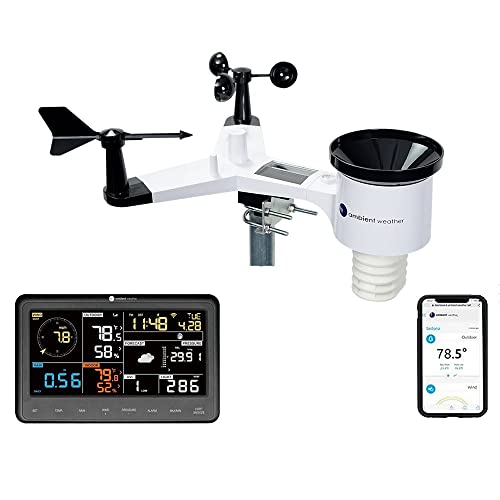
A campsite with changing wind and sudden rain benefits from more than a temperature number. The WS-2902 uses an Osprey sensor array with a rain cup and reports wind speed, wind direction, temperature, humidity, rainfall, UV intensity, and solar radiation. Its color display gives you a local reference inside the RV, while Wi-Fi opens a separate path to alerts, remote access, and the Ambient Weather Network.
The smart-home support is unusually relevant for a stationary RV setup. The listing names IFTTT, Google Home, and Alexa, so the station can participate in routines or alerts where the required services are configured. It is a more involved system than a basic wireless thermometer, and the outdoor array needs a sensible exposed location. The advertised capabilities are strongest for a long-term installation rather than a quick overnight stop beside a trailhead.
Pros
- Measures wind, rainfall, UV intensity, solar radiation, temperature, and humidity.
- Includes a color console for local viewing.
- Wi-Fi enables remote access and alerts through the listed connected services.
- Supports Ambient Weather Network sharing.
- Works with IFTTT, Google Home, and Alexa according to the listing.
Cons
- The integrated outdoor sensor array requires more deliberate placement than a small temperature sensor.
- Wi-Fi and smart-home functions add setup requirements that local-only users may not need.
Choose this model if the RV is part of a more permanent weather-monitoring arrangement and you want wind and rain information available away from the console. It ranks below Tempest because the sensor array and network setup may be less convenient for frequent relocation. For someone who wants a dashboard inside the RV plus connected data for a parked site, however, it is a capable middle ground.
To buy this product, click here.
3. Sainlogic 5G/2.4G Wi-Fi Smart Weather Station – Best for App Data

The Sainlogic smart station is aimed at readers who want current weather readings and a record of what happened after a rainy or windy day. Its product information lists indoor and outdoor temperature and humidity, barometric pressure, wind speed and direction, rainfall, dew point, and feels-like temperature. The app displays real-time data, while the listing also identifies Weather Underground synchronization and alerts.
Its data-storage feature is a meaningful distinction for a seasonal RV. The station stores up to two years of local data, with Excel exports covering up to 30 days at a time. That makes it more useful for reviewing rainfall or temperature patterns than a console that only shows current readings and high-low values. The outdoor link is listed at up to 443 feet in open areas, and Bluetooth fast pairing is used during setup. Wi-Fi is the route to the app and connected records, not the same thing as the sensor’s wireless link.
Pros
- Supports both 5 GHz and 2.4 GHz Wi-Fi according to the listing.
- App provides real-time indoor and outdoor weather information.
- Listing identifies Weather Underground synchronization and alerts.
- Stores up to two years of local data and supports Excel export.
- Includes rainfall records and a stated open-area transmission distance of up to 443 feet.
Cons
- The advertised wireless distance can be reduced by RV walls, metal structures, trees, and other obstructions.
- The product information does not describe a solar-powered sensor system.
This is a strong fit for a parked RV, garden trailer, or seasonal site where historical records matter. It may be more system than needed for a few nights of camping, especially if you only want to glance at temperature before stepping outside. Buyers should also separate the app’s usefulness from the sensor’s placement. A Wi-Fi connection cannot correct a rain gauge tucked under an awning or a temperature sensor sitting against a sun-heated wall.
To buy this product, click here.
4. AcuRite Iris 5-in-1 01540M – Best for Weather Underground
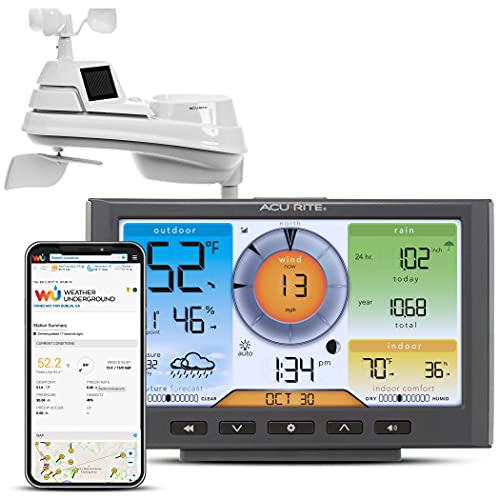
AcuRite’s Iris 01540M makes a useful choice for an RV owner who wants a familiar console and a defined weather-network destination. The listing identifies Wi-Fi connectivity to Weather Underground, along with indoor and outdoor temperature and humidity, barometric pressure, rainfall, wind speed, and wind direction. It also lists more than 25 data points, including heat index, dew point, wind chill, rainfall history, and threshold alarms.
The 5-in-1 label should not be treated as a universal industry standard. Here, the meaningful details are the actual instruments named in the listing: anemometer, wind vane, barometer, hygrometer, rain gauge, and thermometer. The color display includes an adjustable dimmer, which can be handy in a dim RV cabin at night. Wi-Fi makes remote sharing possible through Weather Underground, while the outdoor sensor still needs suitable placement away from structures that can distort wind or rain readings.
Pros
- Explicitly supports Wi-Fi connection to Weather Underground.
- Measures wind speed, wind direction, rainfall, pressure, temperature, and humidity.
- Color display includes an adjustable dimmer.
- Provides historical rainfall and calculated values such as dew point and wind chill.
- Includes threshold alarm capability according to the product information.
Cons
- The listing does not identify solar assistance for the outdoor sensor.
- The integrated sensor arrangement may be less convenient to relocate frequently than a small temperature-only sensor.
This station suits a long-term RV pad or home base where Weather Underground sharing is part of the plan. It is less compelling for someone who wants a quick, low-maintenance campsite instrument without an account or network setup. Compared with the Sainlogic Wi-Fi model, its clearest distinction is the specifically named Weather Underground connection and the AcuRite console experience, while the available information does not identify comparable local Excel export.
To buy this product, click here.
5. AIRAIN TECH Wireless Weather Station – Best for Two Local Displays
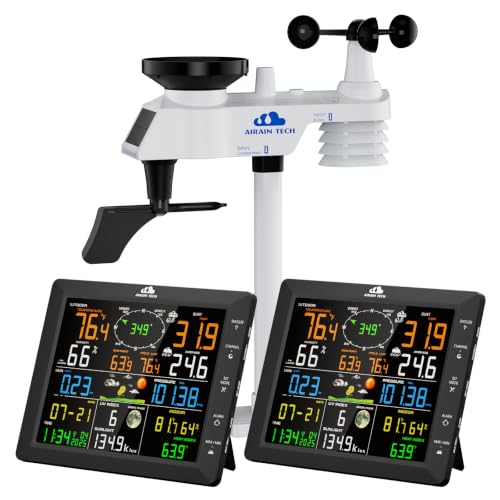
Two displays can be surprisingly handy in an RV. One can stay near the bed or dinette while another sits where the main living area is visible, saving you from wandering through the cabin to check a pressure trend before heading outside. AIRAIN TECH includes two main display units and an outdoor sensor, with readings for indoor and outdoor temperature and humidity, pressure, wind speed and direction, rainfall, UV index, dew point, wind chill, and moon phase.
This is a local wireless station, not a Wi-Fi or app system. That limitation is also its appeal for a campsite with weak service or no router. The listing gives the outdoor transmission distance as up to 328 feet and includes a mounting pole, adjustable-angle bracket, hardware, and power adapter. Its stated temperature range runs from -40°F to 140°F, while listed temperature and humidity accuracy figures are ±2°F/1°C and ±5 percent respectively. Those are product-listing claims, not independent verification.
Pros
- Includes two main display units.
- Measures rainfall, wind speed and direction, UV, pressure, temperature, and humidity.
- Includes a mounting pole, bracket, and installation hardware.
- Provides dew point and wind chill calculations.
- Does not require Wi-Fi for local weather viewing.
Cons
- No Wi-Fi or app-based remote monitoring is identified in the product information.
- Listed humidity accuracy is less specific than the temperature figure and should not be treated as independent testing.
AIRAIN TECH is a sensible pick for a large RV interior, a campsite with unreliable Internet, or a user who wants one display inside and another nearby. It gives up remote access, stored app data, and smart-home functions, so it should not be chosen for checking an unattended RV from hundreds of miles away. The included mounting hardware also helps, but the sensor still needs an open, level location for useful wind and rain readings.
To buy this product, click here.
6. Sainlogic 12-in-1 Wireless Weather Station – Best Large Local Display
The 6.5-inch color display is the headline feature here, but the measurement set gives this station its place in the list. It shows indoor and outdoor temperature and humidity, pressure, wind speed and direction, rainfall, dew point, feels-like temperature, moon phase, calendar information, and alarm functions. For an RV with limited interior space, large high-contrast readings can be easier to check from across the cabin than a small console packed with tiny labels.
The station is wireless but has no Wi-Fi, so its role is local monitoring. The listing gives rainfall records from hourly through cumulative totals and identifies a stated rainfall accuracy of ±7 percent. It also lists temperature accuracy of ±0.2°C and humidity accuracy of ±1.8 percent relative humidity. These are supplied listing specifications. The outdoor link is advertised up to 443 feet in open, unobstructed conditions, and included mounting hardware simplifies setup, although a temporary campsite may still require a stable mounting solution.
Pros
- Large 6.5-inch display with adjustable backlight.
- Tracks hourly, daily, weekly, monthly, and cumulative rainfall.
- Includes wind speed, wind direction, pressure, dew point, and feels-like readings.
- Listing gives temperature and humidity accuracy figures for the sensor.
- Includes mounting hardware and supports a listed open-area range of up to 443 feet.
Cons
- No Wi-Fi or remote app access is identified.
- Its integrated outdoor setup may be less convenient for short, frequently changing campsite stops.
Pick this one if your priority is a readable console and detailed local rain history rather than remote monitoring. It is a better match for a seasonal RV location than a constantly moving travel setup, since the rain and wind instruments need deliberate placement. Compared with AIRAIN TECH, it offers one listed display instead of two, but the Sainlogic display is still generously sized and the rainfall history is clearly described.
To buy this product, click here.
7. AcuRite Iris 01512MCB – Best for Detailed Local Data
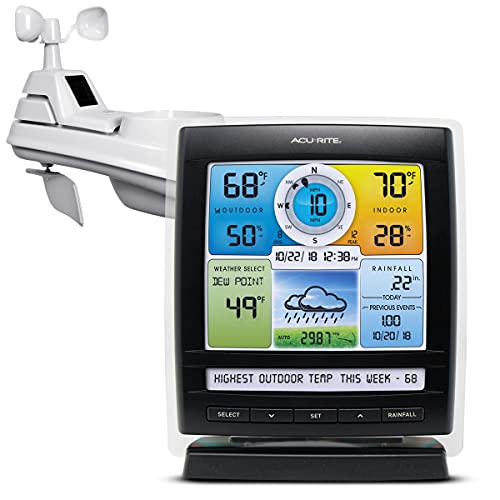
The Iris 01512MCB focuses on a detailed console experience without identifying Wi-Fi or app access. The listing says it provides more than 55 data points, including indoor and outdoor temperature and humidity, wind speed and direction, rainfall, pressure trends, heat index, dew point, feels-like temperature, and historical information. That combination gives a local observer plenty to follow while sitting inside the RV, especially during changing weather.
Setup is described as installing batteries, attaching the outdoor sensor to a pole or post with the included mounting bracket, and pairing it with the color display. The station also uses elevation information with pressure data to create a personalized 12-hour forecast. That forecast is a derived estimate, not a direct measurement of future conditions, and it should be read as a planning aid. The adjustable display dimmer is useful in a sleeping area, while the lack of identified remote access limits unattended-site monitoring.
Pros
- Listing identifies more than 55 data points.
- Measures temperature, humidity, pressure, wind, and rainfall.
- Includes historical information and pressure trend data.
- Outdoor sensor attaches with the included mounting bracket.
- Color display has an adjustable dimmer.
Cons
- Wi-Fi, app access, and remote monitoring are not identified in the supplied product information.
- The forecast is derived from station data and should not be treated as a guaranteed weather prediction.
This model makes sense for someone who enjoys reading a full local weather dashboard and does not need a phone notification. It is less suitable for a remote RV that may sit unattended for weeks. Compared with the AcuRite 5-in-1, it offers a more detailed local data presentation in the available information, while the 5-in-1 model has the clearer advantage for Weather Underground connectivity.
To buy this product, click here.
8. Newentor Wireless Weather Station – Best for Multiple Temperature Locations

Newentor keeps the focus on temperature and humidity, which can be exactly right for an RV. The color display shows indoor and outdoor readings, daily high and low records, pressure, forecast information, moon phase, time, date, alerts, and alarm functions. One outdoor sensor is included, while the station supports up to three remote sensor channels. That can help monitor the cabin, a storage area, or another nearby location if additional compatible sensors are added.
The two power modes are relevant in a small mobile space. With the included DC adapter, the display can remain lit. On battery power, the screen turns on for a short glance and then enters an energy-saving mode. Batteries are not included. The station predicts conditions for the next 12 to 24 hours after a stated calibration period of seven to ten days, but it does not provide the wind and rainfall instruments found on the higher-ranked complete arrays.
Pros
- Supports up to three remote sensor channels.
- Displays indoor and outdoor temperature and humidity with daily high-low records.
- Includes adjustable alerts, pressure, forecast information, and moon phase.
- Offers a continuously lit adapter-powered mode.
- Includes atomic time and dual alarm functions.
Cons
- One remote sensor is included, and additional sensors are not identified as included.
- The supplied information does not identify rainfall, wind speed, or wind direction measurement.
Choose Newentor for temperature and humidity checks rather than full outdoor weather instrumentation. It is convenient for a compact RV where a small sensor can reveal whether the cabin or storage area is getting too warm or damp. Those who need rain totals, wind direction, or remote app access should step up to a connected station instead of expecting a forecast icon and pressure trend to replace dedicated sensors.
To buy this product, click here.
9. AcuRite Wireless Home Weather Station 02077M – Best Simple RV Option
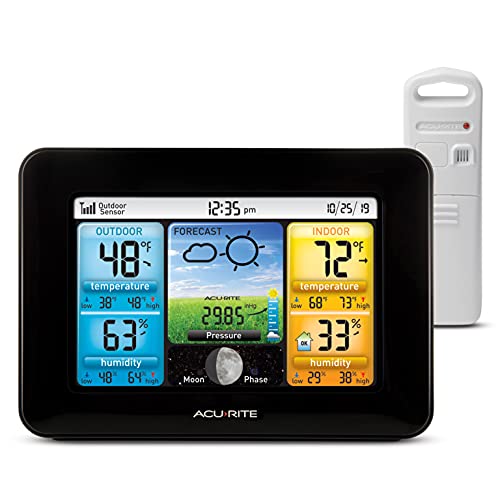
The AcuRite 02077M is a straightforward choice for checking conditions without taking over the RV dashboard. It monitors indoor and outdoor temperature, humidity, and pressure trends, then uses the outdoor reading to provide a personalized 12-hour forecast. The color display adds high-low records, signal information, forecast icons, trend arrows, date, and moon phase, so the experience feels more complete than a basic two-number thermometer.
The outdoor sensor uses two AA batteries, which are not included, and can hang from a post or tree branch using its integrated hanger. That arrangement may be easier to deploy at a campsite than a larger array with multiple exposed instruments. It still needs sensible placement, since a sensor against a hot RV wall or in direct sun may not represent surrounding air conditions well. The system is local and wireless, with no Wi-Fi or remote access identified in the listing.
Pros
- Simple indoor and outdoor temperature and humidity monitoring.
- Displays pressure trends, forecast icons, high-low records, and moon phase.
- Outdoor sensor has an integrated hanger for flexible placement.
- Color display includes an adjustable dimmer.
- Provides more than 15 listed data points according to the product information.
Cons
- Outdoor sensor batteries are not included.
- Wind, rainfall, UV, and Wi-Fi functions are not identified for this model.
This is the sensible low-complexity pick for a traveler who wants a quick look at local conditions and does not need a rain gauge or app. It is easier to justify in a frequently moving RV than a full sensor array, but its measurement set is limited. If pressure trends and temperature are enough, the simple design is an advantage. If you want actual wind or rain records, the Sainlogic or AcuRite Iris models are better equipped.
To buy this product, click here.
Buying Guide
Wireless Does Not Always Mean Wi-Fi
A wireless outdoor sensor may communicate with a nearby console through a radio link while the station remains completely offline. That is useful at a campsite where you want local readings without a router. Wi-Fi adds a separate network connection, which can enable an app, cloud history, alerts, or weather-network uploads. Ambient Weather, Sainlogic Wi-Fi, AcuRite 01540M, and Tempest offer the strongest connected paths in this selection, while Newentor and AcuRite 02077M are local wireless systems.
Choose Measurements That Match Your Travel Style
Temperature and humidity are enough for many RV trips, especially if your main concern is cabin comfort or storage conditions. Wind direction and rainfall become more valuable at exposed campsites, during storm planning, or at a seasonal site. UV, solar radiation, and lightning detection add further context but also point toward more advanced systems such as Tempest. A longer feature list is useful only when you will actually use those readings.
Portable Setup Is Different From Permanent Installation
An integrated outdoor array can measure several conditions from one coordinated unit, but it may need a stable mounting point and clear exposure. A small temperature sensor can be easier to move between campsites. Rain gauges need open exposure and level placement, while wind sensors need unobstructed moving air. An RV roof, awning, metal wall, or nearby tree can affect readings, so a station’s advertised range does not solve every placement problem.
Remote Access Requires More Than a Sensor Link
If the RV is parked while you are away, choose a product with explicit Internet, app, or cloud functionality. A wireless console in an empty RV cannot send an alert unless the system has a supported connected path. Tempest, Ambient Weather, Sainlogic Wi-Fi, and AcuRite 01540M identify different forms of connected access. The local-only models are better for trips where someone is physically near the display.
Accuracy, Resolution, And Range Describe Different Things
A display showing decimal places does not automatically prove greater accuracy. Accuracy describes closeness to a reference, while resolution describes the size of the displayed increments. Measurement range is the span a sensor can report, and transmission range is the distance between devices under stated conditions. Walls, metal framing, terrain, interference, and sensor placement can reduce a listed open-air wireless range.
Check Power Component By Component
The console, outdoor sensor, gateway, and app connection may each have different power requirements. Tempest lists a solar-powered outdoor sensor, while Newentor and DreamSky-style local consoles use adapter power with battery behavior that may dim the display. The station being wireless does not mean every component is battery powered. Check whether batteries are included before leaving for a trip, particularly with models such as the AcuRite 02077M.
Best Weather Stations for RVs FAQ
What type of weather station is best for an RV?
The best type depends on whether the RV moves frequently or stays at a seasonal site. A compact local station suits short trips and simple temperature checks. A full sensor array with Wi-Fi is more useful for a permanent site where wind, rain, app access, and historical information matter.
Are wireless weather stations the same as Wi-Fi weather stations?
No. Wireless usually describes the connection between an outdoor sensor and a console. Wi-Fi connects a station or gateway to a local network and may enable app access or remote services. A wireless station can work without Wi-Fi.
Can a weather station monitor an unattended RV?
Only a model with an explicitly supported connected service can provide meaningful remote access. Tempest, Ambient Weather WS-2902, Sainlogic Wi-Fi, and AcuRite 01540M identify connected functions. Local-only stations require someone near the console to read the information.
Do RV weather stations need to be mounted?
Complete stations with wind and rain sensors benefit from stable, open placement, and some include mounting hardware or a pole. Smaller temperature and humidity sensors may be easier to hang or place temporarily. Follow the product instructions and avoid assuming that an RV ladder, roof, or awning is automatically a suitable mounting point.
Does a forecast icon replace a rain gauge?
No. A forecast icon is generally calculated from station information such as pressure trends. A rain gauge directly measures precipitation collected at the sensor. If rainfall totals matter, choose a model that explicitly includes a rain gauge, such as Tempest, Ambient Weather WS-2902, or the AcuRite Iris stations.
Is a longer wireless range always better?
A longer listed range can provide more placement flexibility in open conditions, but it is not a guarantee through an RV or campground. Metal walls, other vehicles, trees, buildings, and interference can reduce the practical distance. Treat the advertised range as a favorable-condition specification.
Do solar-powered weather stations eliminate batteries?
Not necessarily. Solar power may apply to the outdoor sensor while the console still uses an adapter or batteries. Tempest’s product information identifies a solar-powered outdoor sensor, but the complete power arrangement should still be checked before installation.
Final Verdict
The Tempest Weather Station is the strongest overall choice for an RV that stays connected, especially at a seasonal site where remote checks, app data, broad measurements, and smart-home functions are useful. Its combination of temperature, humidity, pressure, wind, rain, UV, solar radiation, and lightning information gives it a clear lead over simpler local consoles. Ambient Weather’s WS-2902 is a strong alternative for a traditional display plus Wi-Fi, weather-network access, and smart-home support.
For local operation without Wi-Fi, AIRAIN TECH offers an appealing two-display arrangement and a broad measurement set, while the AcuRite 02077M keeps things compact and uncomplicated. Match the station to your travel pattern before focusing on sensor count. A moving RV may benefit from a small local system, while a parked RV can make better use of connected data, rainfall history, and remote alerts. Whatever you choose, place outdoor sensors away from heat, obstructions, and poor rain exposure so the readings reflect the surrounding conditions as fairly as possible.