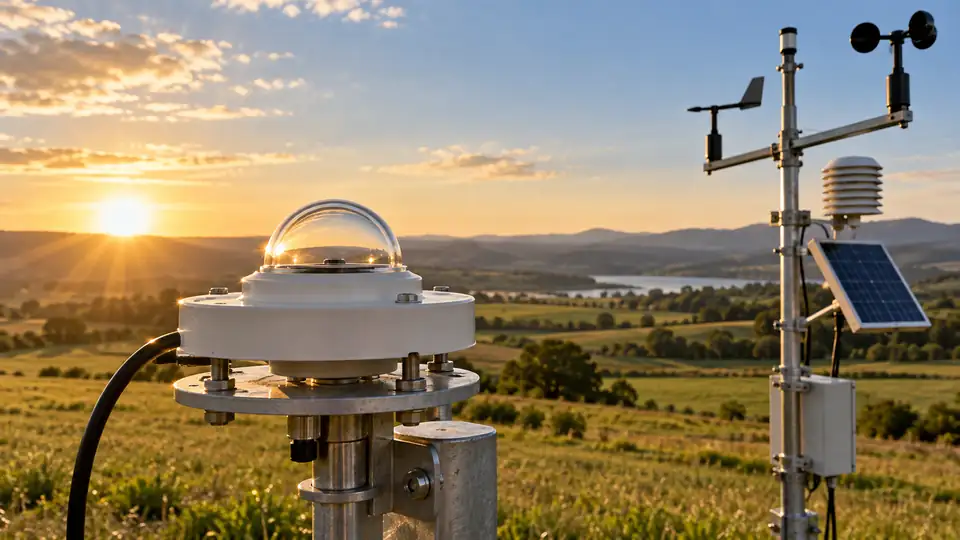
Solar radiation is one of those weather-station measurements that can quietly change how useful your data feels. A station may report temperature, humidity, wind, and rain, yet sunlight heating the outdoor sensor can still skew daytime temperature readings. The strongest options in this roundup combine a genuine solar-radiation reading with practical measurements such as UV, rainfall, wind speed, and wind direction.
The product descriptions also reveal an important split. Some stations explicitly list solar radiation, while others list UV or light without confirming a solar-radiation sensor. Those measurements are related, but they are not interchangeable. Connectivity matters too. A wireless sensor link sends data to a console, while Wi-Fi can add app access, cloud history, alerts, or weather-network uploads. Installation, sensor placement, power requirements, and the need for a separate gateway can matter more than a colorful display.
The Ambient Weather WS-2902 is the strongest all-around choice because its listed sensor array includes solar radiation, UV, rainfall, wind, temperature, and humidity, while its Wi-Fi connection supports remote access and smart-home features. The comparison below also includes several capable stations whose supplied descriptions do not clearly confirm solar-radiation measurement, so the distinction is easy to see before you buy.
Quick Answer
- Ambient Weather WS-2902: Best Overall for a complete station with listed solar-radiation measurement, Wi-Fi, remote access, and smart-home compatibility.
- Ambient Weather WS-2000 with AWN+: Best for a more capable display and expanded Ambient Weather Network features, including advanced graphing and alerts.
- Ecowitt WS90: Best for a modular setup with a listed solar-radiation sensor, solar-assisted outdoor hardware, and broad Ecowitt gateway compatibility.
- VEVOR 7-in-1 Wi-Fi Weather Station: A lower-cost alternative with Wi-Fi, a solar-assisted sensor, and light measurement, though the listing does not clearly identify solar radiation.
Best Weather Stations With Solar Radiation Sensor Comparison Table
| Product | Solar-Radiation Fit | Connectivity | Sensor Design | Best For |
|---|---|---|---|---|
| Ambient Weather WS-2902 | Explicitly listed | Wireless sensor array and Wi-Fi | Integrated array with rain cup | Best overall connected setup |
| Ambient Weather WS-2000 with AWN+ | Explicitly listed | Wireless sensor array and Wi-Fi | Integrated array | Advanced network features |
| Ecowitt WS90 | Explicitly listed | 915 MHz sensor link, gateway required | Integrated sensor with haptic rain detection | Modular Ecowitt systems |
| Ambient Weather WS-2000 | Explicitly listed | Wireless sensor array and Wi-Fi | Integrated array | Color-console monitoring |
| VEVOR 7-in-1 Wi-Fi Weather Station | Light listed, solar radiation unclear | Wi-Fi and wireless sensor link | Solar-assisted integrated sensor | Lower-cost connected monitoring |
| Sainlogic Smart Weather Station | Solar radiation not listed | Dual-band Wi-Fi and Bluetooth pairing | Integrated outdoor sensor | Data logging and export |
| AcuRite Optimus | Solar radiation not listed | Wireless sensor, app, and smart-home support | Compact solar-powered sensor | Compact installations |
| AcuRite Iris | Solar radiation not listed | Wireless sensor and local console | Outdoor sensor with included bracket | Simple local monitoring |
| AIRAIN TECH Wireless Weather Station | Solar radiation not listed | Wireless sensor link, no Wi-Fi | Outdoor sensor with dual displays | Local viewing in two rooms |
The detailed reviews explain which stations genuinely list solar radiation and which ones are better treated as alternatives for broader weather monitoring.
1. Ambient Weather WS-2902 — Best Overall
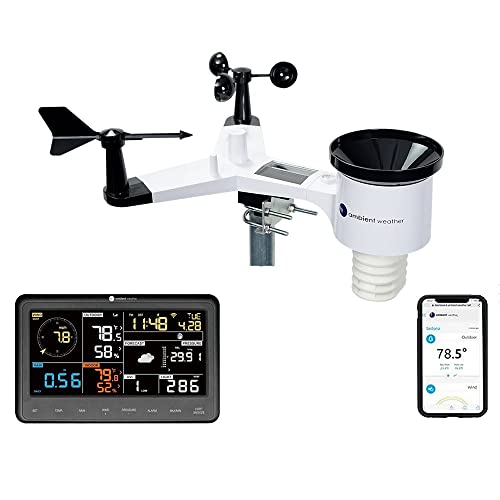
The WS-2902 earns the top position because the product information directly lists solar radiation alongside UV intensity, temperature, humidity, rainfall, wind speed, and wind direction. That gives it a much closer match to the search intent than stations whose listings mention sunlight or light without identifying solar-radiation measurement. Its Osprey sensor array combines the outdoor instruments with a rain cup, while the included color display keeps local readings visible without reaching for a phone.
Wi-Fi gives this station a second layer of usefulness. The listing describes remote data access, alerts, smart-home connections through IFTTT, Google Home, and Alexa, plus optional uploads to the Ambient Weather Network. A backyard gardener can check conditions away from the console, while someone automating a weather-dependent device can use the supported smart-home links. The sensor still needs thoughtful placement, since direct exposure, nearby surfaces, and obstructions can affect readings.
Pros
- Solar radiation is explicitly listed among the measured variables.
- Measures temperature, humidity, rainfall, wind, and UV intensity.
- Includes an outdoor Osprey sensor array and color display.
- Supports Wi-Fi access, alerts, and remote data viewing.
- Lists IFTTT, Google Home, and Alexa compatibility.
Cons
- The supplied information does not specify a solar-radiation accuracy figure.
- The wireless outdoor sensor uses batteries that are not detailed in the product information.
This is the clearest choice for a household that wants a complete station and a confirmed solar-radiation measurement without assembling a separate gateway system. It is less compelling for someone who wants a highly modular sensor network or a station built around a specialized data-export workflow. For general backyard monitoring, though, it balances local visibility, connected access, and relevant measurements unusually well.
To buy this product, click here.
2. Ambient Weather WS-2000 With AWN+ — Best for Network Features
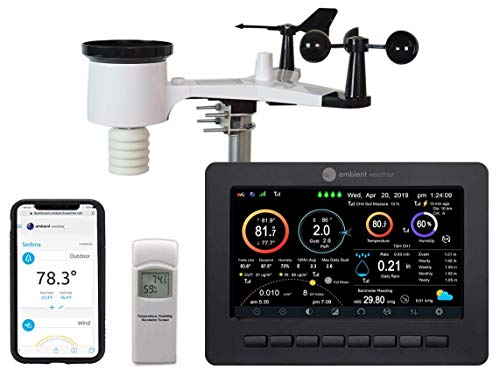
This WS-2000 bundle is aimed at readers who want the station itself plus a richer online dashboard experience. The listing identifies solar radiation, UV, rainfall, temperature, humidity, wind speed, and wind direction, matching the core measurement need closely. Its TFT color display gives the console a more information-heavy feel, useful for a kitchen counter, office, or weather room where local readings are checked throughout the day.
The included year of AWN+ access is the meaningful difference here. The listing describes advanced graphing, degree-day tiles, SMS alerts, premium map layers, and layout customization. Those tools may appeal to someone tracking heat accumulation or reviewing weather patterns over time. The subscription timing is defined by the listing, so buyers should check how renewal works before treating the bundle as a permanent service.
Pros
- Solar radiation is explicitly listed in the sensor measurements.
- Includes a TFT color display and integrated outdoor sensor array.
- Measures rainfall, wind, UV, temperature, and humidity.
- Includes one year of AWN+ features such as graphing and SMS alerts.
- Supports Wi-Fi uploads to the Ambient Weather Network.
Cons
- Advanced AWN+ features are described as a one-year inclusion.
- The listing does not provide a solar-radiation accuracy specification.
Choose this version over the standard WS-2000 if online visualization and alerts matter more than keeping the system as simple as possible. The sensor coverage is similar to the other Ambient Weather option, so the extra appeal comes from the included network features rather than a different solar sensor. It suits data-minded users who will actually use graphs, tiles, and alerts.
To buy this product, click here.
3. Ecowitt WS90 — Best for a Modular System
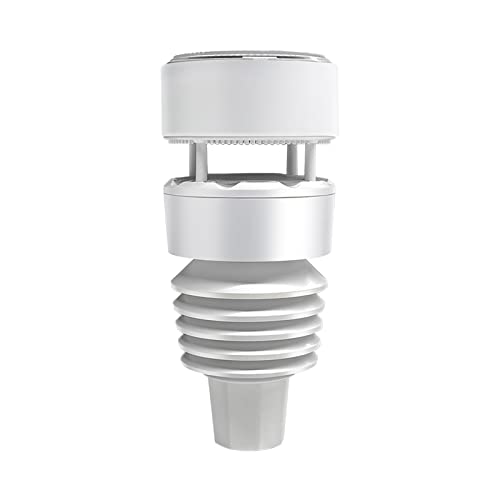
The WS90 has a strong measurement match, with the listing naming solar radiation, UV, light, temperature, humidity, wind speed, wind direction, and rainfall. Its haptic rain sensor replaces a traditional rain cup design, and the outdoor unit includes a solar panel with backup batteries. The product information lists a transmission distance of up to 500 feet with obstacles and up to 1,000 feet in open space, though walls, metal, terrain, and interference can change the result.
This is a sensor module rather than a complete standalone weather station. A compatible Ecowitt gateway, hub, or console is required before the readings can reach an app or online service. That architecture is useful for someone building a broader Ecowitt setup, but it changes the total purchase and installation plan. The listing also cautions that rainfall deviation can be larger in certain conditions and suggests a separate WH40 for readers with demanding rain-data requirements.
Pros
- Solar radiation and UV are explicitly listed among the measurements.
- Combines wind, temperature, humidity, light, and rainfall sensing.
- Uses a haptic rainfall sensor and includes a solar panel with backup batteries.
- Supports several Ecowitt gateways, hubs, and consoles.
- Can upload data to Ecowitt, Weather Underground, WeatherCloud, and WOW after configuration.
Cons
- A gateway, hub, or console is required and sold separately.
- The listing acknowledges that rainfall deviation can increase in some conditions.
The WS90 makes sense for a modular installation where the owner wants to choose the console and build outward over time. It is a poor fit for someone expecting a ready-to-use station with a display in the box. Check the exact Ecowitt components and mounting tube requirements before ordering, since the one-inch tube and base are not included.
To buy this product, click here.
4. Ambient Weather WS-2000 — Best for a Color Console
The standard WS-2000 remains a direct match for the target measurement because its product information lists solar radiation, UV, rainfall, temperature, humidity, wind speed, and wind direction. The all-in-one sensor array keeps the outdoor installation relatively compact, while the TFT display provides a local view of the readings. Units can be shown in imperial or metric formats, and calibration is listed as supported.
Wi-Fi connectability adds a path to Ambient Weather Network uploads, but the supplied description does not spell out every remote feature available through the service. That makes this version easier to recommend for local console use than for a highly specific cloud workflow. The console uses an included 5V adapter, while the outdoor array requires three AAA batteries that are not included, a small detail worth catching before installation day.
Pros
- Explicitly lists solar radiation and UV measurement.
- Includes a TFT color display for local monitoring.
- Measures wind, rain, temperature, and humidity in one array.
- Supports imperial and metric units with calibration capability.
- Provides Wi-Fi connectivity for Ambient Weather Network uploads.
Cons
- Three AAA batteries for the sensor array are not included.
- The supplied information does not detail solar-radiation accuracy or data-retention limits.
This is a sound pick for someone who wants confirmed solar-radiation measurement and a capable color console without the AWN+ bundle. The AWN+ version ranks higher for readers who want advanced online features included. For local monitoring, the regular WS-2000 keeps the choice more straightforward.
To buy this product, click here.
5. VEVOR 7-in-1 Wi-Fi Weather Station — Best Solar-Assisted Alternative

The VEVOR station brings together a solar-assisted outdoor sensor, a seven-inch TFT display, Wi-Fi access, and support for Weather Underground and WeatherCloud. Its listed measurements include wind speed, wind direction, temperature, humidity, rainfall, and light. The outdoor unit also reports derived information such as dew point and wind chill. Light is relevant to sunlight monitoring, but the listing does not clearly identify it as a solar-radiation sensor, so it should not be treated as equivalent to the Ambient Weather or Ecowitt models above.
Its solar panel charges rechargeable Ni-MH batteries in the outdoor sensor, while the indoor display remains a separate component with its own power needs. The listed 328-foot transmission distance is a best-case figure, not a guarantee through walls or metal structures. A large display and smartphone access make the system attractive for general home or property monitoring, especially where reduced battery replacement is useful.
Pros
- Solar-assisted outdoor sensor uses rechargeable Ni-MH batteries.
- Includes a seven-inch TFT color display.
- Supports Wi-Fi access plus Weather Underground and WeatherCloud connections.
- Measures rainfall, wind, temperature, humidity, and light.
- Lists IPX6 protection for the outdoor sensor.
Cons
- The listing identifies light measurement but does not clearly confirm solar radiation.
- The advertised 328-foot transmission distance can vary with buildings and interference.
This station deserves attention as a connected, solar-assisted alternative, not as a confirmed replacement for a solar-radiation sensor. It is a better match for general weather monitoring than for research or solar-aware temperature analysis. If the radiation measurement is the deciding factor, choose one of the higher-ranked models instead.
To buy this product, click here.
6. Sainlogic Smart Weather Station — Best for Data Export

Sainlogic takes a data-focused approach. Its listing describes dual-band Wi-Fi, Bluetooth pairing, app alerts, rainfall records, wind monitoring, and two years of local storage. The station also lists Excel export, with each export covering up to 30 days of data. That can be useful for garden records, weather comparisons, or reviewing temperature and humidity changes over longer periods.
The supplied information gives specific temperature, humidity, and rainfall claims, including listed accuracy figures for those measurements. It does not identify a solar-radiation sensor, however, so the station ranks below products with confirmed radiation measurement. The published open-area wireless range is 135 meters, and a built-in bubble level supports horizontal placement of the rain sensor. Those details matter for installation, although real properties can reduce transmission distance.
Pros
- Supports both 2.4 GHz and 5 GHz Wi-Fi according to the listing.
- Bluetooth fast pairing is described for initial setup.
- Stores up to two years of local data and supports Excel export.
- Records hourly, daily, monthly, and yearly rainfall totals.
- Lists app alerts and a 135-meter open-area wireless range.
Cons
- Solar radiation is not listed among the supplied measurements.
- Each stated Excel export covers up to 30 days of data.
Pick this station for records, exports, and connected rainfall tracking rather than for solar-radiation measurement. It could suit a garden or small property where spreadsheet history matters more than UV or radiation data. Buyers focused on the keyword should verify the exact sensor list before choosing it.
To buy this product, click here.
7. AcuRite Optimus — Best Compact Option

The Optimus is built around a compact outdoor sensor and a high-definition display. Its six listed measurements include temperature, humidity, rainfall, wind speed, wind direction, and lightning detection. The sensor is described as solar powered, and the product information positions its compact design for apartments, decks, and locations where a bulky array may be unwelcome.
The AcuRite NOW app adds current readings, alerts, and historical data, while the listing also identifies Google Home, Alexa, and smart-thermostat connections. An internal aspirating fan is described for temperature and humidity readings, and wind direction is listed as precise to within one degree. Those are specific claims from the product information, not independent test results. Solar radiation is not listed, so the Optimus should be viewed as a compact connected weather station rather than a confirmed radiation-monitoring choice.
Pros
- Compact solar-powered outdoor sensor suits space-conscious installations.
- Measures temperature, humidity, rainfall, wind, and lightning.
- Includes a high-definition display.
- Supports AcuRite NOW app access, alerts, and historical data.
- Lists Google Home, Alexa, and smart-thermostat integration.
Cons
- Solar radiation is not listed among the six primary measurements.
- The supplied information does not explain the full power arrangement for every station component.
The Optimus is appealing where appearance, compact placement, and app access matter more than a broad radiation sensor list. It can work well as a general home weather monitor, but it should not replace the WS-2902 or WS-2000 for a confirmed solar-radiation requirement. Its strongest advantage is the smaller outdoor footprint.
To buy this product, click here.
8. AcuRite Iris — Best for Straightforward Local Monitoring
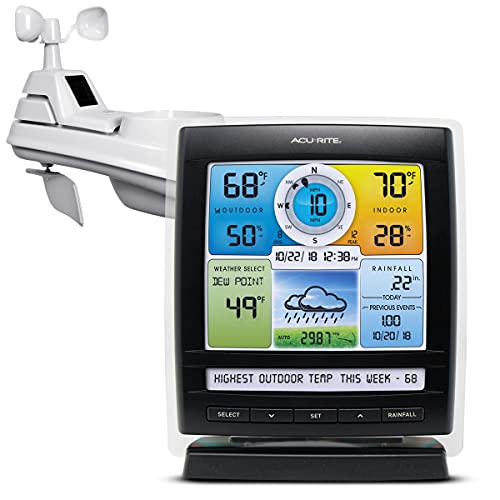
The Iris focuses on the classic local weather-station experience. Its outdoor sensor sends temperature, humidity, wind speed, wind direction, barometric pressure, and rainfall to a color LCD console. The listing describes more than 55 data points, including heat index, dew point, feels-like temperature, pressure trends, historical data, and a twelve-hour forecast based on station information.
That broad set of calculated and measured values makes the Iris useful for everyday observation, but the supplied product details do not list solar radiation or UV measurement. The included mounting bracket simplifies the basic installation, and the adjustable display dimmer helps in a bedroom, kitchen, or office. There is no supplied indication of Wi-Fi or remote app access, so this is primarily a console-centered option.
Pros
- Measures outdoor temperature, humidity, rainfall, wind, and pressure.
- Reports derived values such as dew point and heat index.
- Includes a color LCD display with adjustable dimming.
- Includes an outdoor sensor mounting bracket.
- Provides historical data and pressure-trend information.
Cons
- Solar radiation is not listed among the measurements.
- The supplied information does not identify Wi-Fi, app, or remote-monitoring support.
The Iris fits someone who wants a substantial local display and familiar weather information without building a connected system. It does not satisfy the central solar-radiation requirement based on the supplied description, so it belongs lower in this comparison. Choose it for console-based household monitoring, not solar-aware environmental records.
To buy this product, click here.
9. AIRAIN TECH Wireless Weather Station — Best for Two Local Displays

AIRAIN TECH is a local wireless station with two displays, an outdoor sensor, a rain gauge, wind speed and direction, indoor and outdoor temperature and humidity, and barometric pressure. The listing gives a 328-foot maximum wireless transmission distance and a sixteen-second refresh interval. Two displays can be handy when one console stays in a living area and another sits in a bedroom, office, or workshop.
The product is explicitly described as having no Wi-Fi. That keeps setup focused on sensor-to-display communication, but it removes app access and remote monitoring. The supplied temperature and humidity ranges and accuracy claims provide more detail than many budget listings, although they should be treated as published product information rather than independent verification. Solar radiation is not listed, and the station therefore serves as a basic local-weather alternative.
Pros
- Includes two displays for viewing conditions in separate rooms.
- Measures temperature, humidity, rainfall, wind, and barometric pressure.
- Lists a sixteen-second data refresh interval.
- Includes an outdoor mounting pole, bracket, and hardware.
- Provides a wireless sensor link without requiring home Wi-Fi.
Cons
- The product is explicitly described as having no Wi-Fi.
- Solar radiation is not listed among the measurements.
This is the simplest choice in the group for readers who want local readings in more than one room and have no interest in online access. Its two-display layout is more relevant than its weather forecast icons for everyday use. For solar-radiation monitoring, however, the higher-ranked Ambient Weather and Ecowitt products are the safer selections.
To buy this product, click here.
Buying Guide
Confirm That Solar Radiation Is Actually Measured
Solar radiation, UV intensity, and light are separate measurements. The WS-2902, both listed WS-2000 versions, and the Ecowitt WS90 explicitly identify solar radiation. The VEVOR station lists light, while several other models list neither solar radiation nor UV. A display showing sunlight-related information does not establish that the station has a dedicated solar-radiation sensor.
Wireless Sensor Links Are Different From Wi-Fi
A wireless outdoor array can send readings to a console without touching your home network. Wi-Fi connects a console or gateway to the network and may support apps, cloud history, alerts, or uploads. The AIRAIN station is wireless but has no Wi-Fi, while the WS-2902 combines both types of communication. Keep those functions separate during comparison.
Check Whether a Gateway Is Required
The Ecowitt WS90 is a sensor module, not a complete standalone station. It requires an Ecowitt gateway, hub, or console before its readings can reach an app or online platform. A complete kit with a display may be easier to install, while the modular approach can make sense if you already use compatible Ecowitt equipment.
Sensor Placement Affects Daytime Temperature
A solar-radiation sensor can provide useful environmental information, but placement still matters for temperature and humidity readings. Roofs, pavement, walls, direct sun, and nearby equipment can create local heat. Wind sensors need exposure to moving air, and rain gauges need a reasonably open, level position. The station cannot correct every placement problem through software.
Do Not Confuse Accuracy With Resolution
A display that shows small increments is reporting resolution, not necessarily accuracy. Published accuracy claims should be matched to the exact model and measurement. The Sainlogic listing gives specific temperature, humidity, and rainfall claims, while the Ambient Weather listings identify the measured variables without giving a solar-radiation accuracy figure. Missing specifications should remain missing rather than being filled with assumptions.
Separate Solar Assistance From Whole-System Power
The Ecowitt WS90 and VEVOR outdoor sensors use solar assistance, but that does not mean every component is solar powered. Consoles and gateways can have separate power requirements, and backup batteries may still be part of the outdoor sensor design. Check which component receives solar power before planning a completely off-grid installation.
Best Weather Stations With Solar Radiation Sensor FAQ
What Is The Best Weather Station With A Solar Radiation Sensor?
The Ambient Weather WS-2902 is the strongest overall choice in this comparison. Its listed measurements include solar radiation, UV intensity, rainfall, wind speed, wind direction, temperature, and humidity. It also includes a display and supports Wi-Fi, remote access, alerts, and listed smart-home connections.
Is UV Measurement The Same As Solar Radiation?
No. UV measurement focuses on ultraviolet intensity or index, while solar radiation describes broader radiant energy from the sun. A product listing that names UV or light does not automatically confirm a solar-radiation sensor. Check the exact measurement list before ordering.
Does A Weather Station Need Wi-Fi To Measure Solar Radiation?
No. Solar radiation is measured by the outdoor sensor, while Wi-Fi controls how data travels beyond the local sensor and console arrangement. Wi-Fi becomes useful for app access, remote monitoring, alerts, cloud history, or online weather-network uploads where the product supports those functions.
Is The Ecowitt WS90 A Complete Weather Station?
The supplied listing describes the WS90 as a sensor that cannot be used alone. It requires a compatible Ecowitt gateway, hub, or console. Its sensor list includes solar radiation, UV, light, rainfall, wind, temperature, and humidity, but the additional data-access hardware must be planned separately.
Are Solar-Powered Weather Stations Battery-Free?
No. Solar assistance usually applies to the outdoor sensor rather than the entire system. The WS90 includes a solar panel and backup batteries, and the VEVOR listing describes a solar panel charging rechargeable Ni-MH batteries. Consoles and gateways can still need their own power sources.
Can I Use A Solar-Radiation Weather Station In A Greenhouse?
You can use one for broader outdoor conditions, but greenhouse placement requires care. Direct sunlight, glass, ventilation, and nearby surfaces can affect readings. A station with additional temperature or humidity sensors may be more useful for monitoring separate greenhouse zones, provided those sensors are genuinely supported and available.
Does A Longer Wireless Range Guarantee Better Performance?
No. Published range figures generally describe favorable open-air conditions. Walls, floors, metal structures, terrain, and interference can reduce communication distance. Treat a listed range as a maximum reference, then plan the console and outdoor sensor locations with the actual property in mind.
Final Verdict
The Ambient Weather WS-2902 is the strongest overall choice for a complete connected station with a clearly listed solar-radiation measurement. It covers the core weather variables, includes a local color display, and adds Wi-Fi access, alerts, remote viewing, and listed smart-home compatibility. The Ambient Weather WS-2000 versions are strong alternatives for readers who prefer the TFT console, with the AWN+ bundle adding a year of advanced network features.
The Ecowitt WS90 is the better route for a modular installation, provided you budget for a compatible gateway or console and understand its rainfall limitations. The VEVOR, Sainlogic, AcuRite, and AIRAIN models can serve broader weather-monitoring needs, but their supplied descriptions do not confirm solar-radiation measurement. Before ordering, match the exact sensor list to your purpose, separate Wi-Fi from ordinary wireless communication, and plan the outdoor placement carefully.