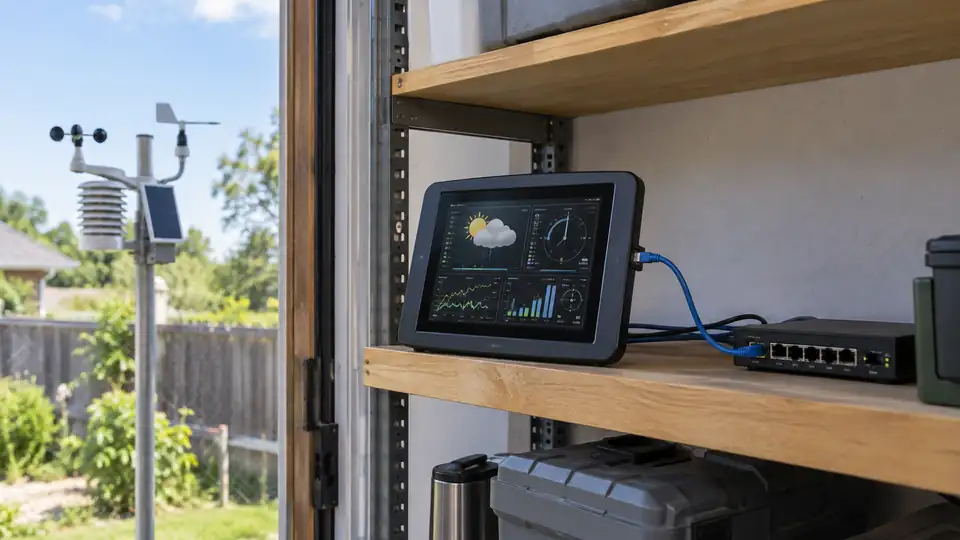
Ethernet changes the buying decision more than a product title may suggest. A weather station can send readings wirelessly from an outdoor sensor to a console, yet still lack a wired network connection. For a station with Ethernet, look for a gateway or hub with a physical network port, then check what that connection actually enables, such as remote access, weather-network uploads, local storage, or steadier network communication.
The sensor package matters just as much. Rainfall, wind, temperature, humidity, pressure, UV, solar radiation, and lightning each serve different purposes, while a fast refresh rate does not automatically mean better accuracy. Installation also affects the readings. A rain cup needs sensible exposure and leveling, and an outdoor sensor array can be affected by nearby walls, roofs, pavement, and trees. The Ambient Weather WS-1553-IP is the strongest overall fit here because its WeatherHub supports direct Ethernet alongside Wi-Fi and remote monitoring.
The comparison below gives priority to genuine wired-network capability, then separates complete stations from Wi-Fi alternatives and expandable systems. That distinction matters if you need a cable-connected station for a home network, a remote dashboard, or a property where Wi-Fi stability is a concern.
Quick Answer
- Best Overall: Ambient Weather WS-1553-IP combines an outdoor sensor array, WeatherHub, remote monitoring, alerts, and direct Ethernet connectivity.
- Best for Expandability: Ecowitt GW3000 provides Ethernet, Wi-Fi, an SD card port, and support for a broad range of optional Ecowitt sensors.
- Best Advanced Alternative: Ambient Weather WS-5000-IP3 uses an ultrasonic sensor array with five-second updates, though the supplied information describes enhanced Wi-Fi rather than explicitly confirming Ethernet.
- Best for Weather Underground: AcuRite Iris 5-in-1 connects to Weather Underground for remote monitoring, but its listing does not identify direct Ethernet.
Best Weather Stations With Ethernet Comparison Table
| Product | Measurements | Network Connection | Sensor Design | Best For |
|---|---|---|---|---|
| Ambient Weather WS-1553-IP | Temperature, humidity, wind, rainfall, plus station data | Direct Ethernet or Wi-Fi | Wireless all-in-one array | Best overall wired setup |
| Ecowitt GW3000 | Indoor temperature, humidity, pressure, optional sensor data | Ethernet or Wi-Fi | Gateway with built-in indoor sensors | Expandable installations |
| Ambient Weather WS-5000-IP3 | Temperature, humidity, pressure, wind, rain, UV, solar radiation | Enhanced Wi-Fi listed | Ultrasonic array, no moving parts | Fast advanced monitoring |
| Ambient Weather WS-2902 | Temperature, humidity, wind, rain, UV, solar radiation | Wi-Fi | Wireless Osprey array | Connected home weather data |
| Tempest Weather Station | Temperature, humidity, pressure, wind, rain, UV, solar radiation, lightning | Wireless app and smart-home access | Solar-powered sensor with no moving parts | Low-maintenance advanced monitoring |
| Sainlogic Wi-Fi Smart Weather Station | Temperature, humidity, pressure, wind, rain | 2.4G/5G Wi-Fi and Bluetooth pairing | Wireless outdoor sensor | App alerts and data export |
| AcuRite Iris 5-in-1 | Temperature, humidity, pressure, wind, rainfall | Wi-Fi with Weather Underground | Wireless 5-in-1 array | Weather Underground users |
| Ambient Weather WS-2000 | Temperature, humidity, wind, rain, UV, solar radiation | Enhanced Wi-Fi listed | Wireless integrated array | Color-console monitoring |
| Sainlogic 12-in-1 Wireless Weather Station | Temperature, humidity, pressure, wind, rain, dew point, feels-like data | Wireless console link, no Wi-Fi | Wireless outdoor sensor | Local display and rainfall history |
The detailed reviews explain which systems genuinely provide wired networking, which rely on Wi-Fi, and where each station gives up capability for simplicity or expandability.
1. Ambient Weather WS-1553-IP: Best Overall

The WS-1553-IP is the cleanest match for a buyer who specifically wants Ethernet rather than a weather station that merely happens to use wireless outdoor sensors. Its package includes an outdoor sensor array and a WeatherHub, and the product information explicitly lists direct Ethernet alongside Wi-Fi. That gives the hub a wired route to the network while the outdoor measurements still travel wirelessly from the array.
Its sensor array sends real-time weather updates every 16 seconds, and the system supports remote access, alerts, IFTTT, Google Home, Alexa, and the Ambient Weather Network. A homeowner could place the hub near a router with a network cable while checking conditions away from home through the supported services. The listing does not provide a complete measurement-by-measurement accuracy table, so the strong case here is connectivity architecture and practical monitoring rather than a claim of superior sensor accuracy.
Pros
- Direct Ethernet connection is explicitly supported.
- Includes both the outdoor sensor array and WeatherHub.
- Provides remote monitoring and weather alerts.
- Supports IFTTT, Google Home, and Alexa integrations.
- Updates weather conditions every 16 seconds according to the listing.
Cons
- The outdoor sensor array still communicates wirelessly with the hub.
- The supplied information does not identify detailed accuracy specifications for each measurement.
This is the best starting point for a connected home, cabin, or small property where a wired hub matters. It is also easier to evaluate than a modular gateway because the core outdoor station is included. Buyers seeking an ultrasonic array, lightning detection, or extensive optional-sensor support may prefer another system, but the WS-1553-IP has the clearest Ethernet fit in this group.
To buy this product, click here.
2. Ecowitt GW3000: Best for Expandability

The GW3000 takes a different path from a conventional all-in-one weather station. It is a gateway with built-in indoor temperature, humidity, and atmospheric-pressure sensors, plus a wired network port and an SD card slot. Outdoor monitoring depends on pairing it with compatible Ecowitt sensors, which are sold separately. That modular design can suit a property where one sensor array is not enough.
The product information lists support for several Ecowitt outdoor arrays and multiple categories of optional sensors. It can accept up to eight listed multi-channel sensors, up to 16 soil or related sensors, and other specialized sensor types according to the listing. Ethernet can avoid relying on Wi-Fi for the gateway’s network connection, while the SD card provides a local route for data transfer. The trade-off is clear: the gateway itself is affordable and flexible, but the complete monitoring system requires additional hardware.
Pros
- Includes a WLAN port for Ethernet network connection.
- Includes an SD card port for local data storage and transfer.
- Built-in indoor temperature, humidity, and pressure sensors are included.
- Supports a broad range of optional Ecowitt sensor types.
- Can be configured through Ethernet or Wi-Fi.
Cons
- Outdoor weather sensors are sold separately.
- It is a gateway-based system rather than a complete outdoor station in the box.
Choose this model if you want to build around a wired gateway and expect your monitoring needs to grow. It makes particular sense for several rooms, soil locations, or other sensor points. A buyer wanting one purchase with outdoor wind and rainfall measurements should choose the WS-1553-IP instead, while someone planning a broader Ecowitt installation may value the GW3000’s expansion path more.
To buy this product, click here.
3. Ambient Weather WS-5000-IP3: Best Advanced Alternative

For rapid updates and a sensor array without moving parts, the WS-5000-IP3 is the most advanced complete station in this selection. Its package includes an ultrasonic sensor array, an extra-large rain cup, an indoor/outdoor thermo-hygrometer-barometer, and a Weather Hub. The listing gives a five-second update interval, which can make changing wind conditions easier to follow than a slower-refreshing station.
The system measures temperature, humidity, pressure, wind, rainfall, UV, and solar radiation through its listed components, while Wi-Fi enables access to the Ambient Weather Network and smart-home features such as IFTTT, Google Home, and Alexa. The product title includes “IP3,” but the supplied feature information describes enhanced Wi-Fi and does not explicitly confirm a direct Ethernet port. That makes this a strong connected alternative, not a fully verified wired-network match.
Pros
- Ultrasonic sensor array has no moving parts.
- Lists real-time updates every five seconds.
- Includes an indoor/outdoor thermo-hygrometer-barometer.
- Measures wind, rainfall, UV, and solar radiation.
- Supports remote alerts and listed smart-home integrations.
Cons
- Direct Ethernet is not explicitly identified in the supplied information.
- It is a premium-priced system compared with simpler connected stations.
This station suits readers who value fast updates and ultrasonic wind sensing more than a confirmed cable connection. It is a stronger technical alternative to the WS-2902, but the WS-1553-IP remains the safer choice for a strict Ethernet requirement. Before ordering, verify the exact hub connection options if a physical network cable is essential.
To buy this product, click here.
4. Ambient Weather WS-2902: Best Connected Home Alternative
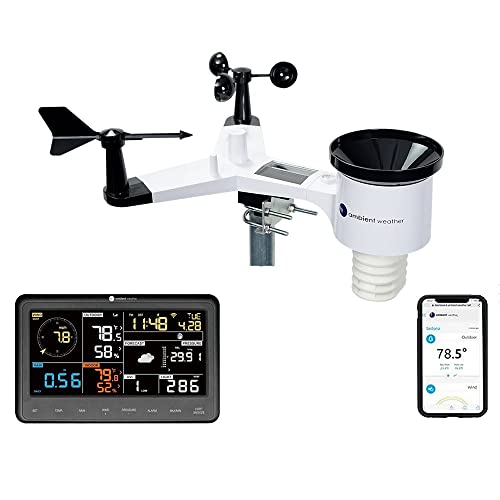
The WS-2902 pairs a wireless Osprey sensor array with a color LCD console, giving the room a local display while Wi-Fi carries data to the connected services. Its listed measurements include wind speed and direction, temperature, humidity, rainfall, UV intensity, and solar radiation. That broad set makes it useful for a backyard where rain and sun exposure matter as much as basic temperature.
The console gives a quick glance at current conditions, while the Wi-Fi features support remote access, alerts, smart-home programming, and Ambient Weather Network sharing. The supplied information does not identify direct Ethernet, so this station should be treated as a Wi-Fi choice rather than a confirmed wired model. That distinction is easy to miss because wireless sensor communication and Wi-Fi network access solve different problems.
Pros
- Includes an Osprey outdoor sensor array and color LCD display.
- Measures wind, temperature, humidity, rainfall, UV, and solar radiation.
- Supports remote access and weather alerts through Wi-Fi services.
- Works with listed IFTTT, Google Home, and Alexa features.
- Provides both local console viewing and connected data access.
Cons
- Direct Ethernet is not listed in the supplied product information.
- The wireless outdoor array still needs thoughtful placement for useful readings.
This is a sensible alternative for someone who wants a recognizable console and connected backyard data without building a modular system. It should move down your list if a wired network connection is mandatory. For ordinary Wi-Fi monitoring, its measurement mix is more useful than a basic temperature-only display.
To buy this product, click here.
5. Tempest Weather Station: Best for Low-Maintenance Monitoring
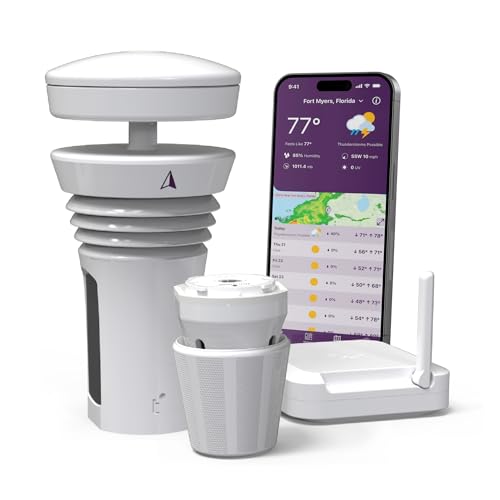
Tempest stands apart through its single solar-powered outdoor sensor and no-moving-parts design. The listing says it measures temperature, humidity, pressure, wind speed and direction, dew point, solar radiation, UV index, lightning strikes, and rainfall. Updates arrive every three seconds, so the system is aimed at readers who want a dense stream of backyard observations rather than a simple indoor display.
Its wireless sensor transmits up to 1,000 feet or more according to the product information, and the station works with Alexa, Rachio, IFTTT, and other listed smart-home platforms. Solar power applies to the outdoor sensor, not automatically to every component in the installation. The supplied information also does not explicitly identify Ethernet, so Tempest is better viewed as an advanced wireless and app-connected alternative.
Pros
- Lists a three-second real-time update interval.
- Measures lightning strikes in addition to common weather variables.
- Outdoor sensor is solar powered according to the listing.
- No-moving-parts design may simplify the outdoor sensor architecture.
- Supports Alexa, Rachio, IFTTT, and listed smart-home platforms.
Cons
- Direct Ethernet is not identified in the supplied information.
- The product information does not describe a conventional indoor color console.
Tempest is a compelling choice for a property where rapid updates, lightning information, and fewer moving sensor components matter. It is less suitable for someone who specifically wants a wired hub or a traditional wall-mounted display. Check the required app and network arrangement before buying, especially if the station will be installed somewhere that needs independent local viewing.
To buy this product, click here.
6. Sainlogic 5G/2.4G Wi-Fi Smart Weather Station: Best for Data Export

This Sainlogic station focuses on accessible app monitoring and longer-term records. Its product information lists dual-band 5G/2.4G Wi-Fi, Bluetooth fast pairing, app alerts, Weather Underground synchronization, and two years of local data storage. It also supports Excel export, with each export covering up to 30 days of data. That combination is useful for a greenhouse, garden, or property where trends matter more than a single glance at the current temperature.
The outdoor sensor reports temperature, humidity, pressure, wind, and rainfall. The listing gives temperature accuracy of ±0.2°C, humidity accuracy of ±1.8% RH, and rainfall accuracy of ±1 mm below 15 mm or ±7% above that amount. Those are listing claims, not independent verification. The station supports a published wireless range of 443 feet in open conditions, while the supplied information does not identify Ethernet.
Pros
- Supports both 2.4G and 5G Wi-Fi according to the listing.
- Includes Bluetooth fast pairing and app alerts.
- Lists Weather Underground synchronization.
- Stores up to two years of local data and supports Excel export.
- Includes a built-in bubble level for rainfall-sensor placement.
Cons
- Direct Ethernet is not listed.
- Export coverage is limited to 30 days per file according to the product information.
This is the strongest alternative for someone whose priority is recorded history rather than a wired gateway. The export feature gives the station a practical edge for comparing rainfall or temperature changes over time. A buyer who needs Ethernet should step back to the WS-1553-IP or GW3000, while someone who wants app-based records may find this system more useful than a station with a larger console.
To buy this product, click here.
7. AcuRite Iris 5-in-1: Best for Weather Underground
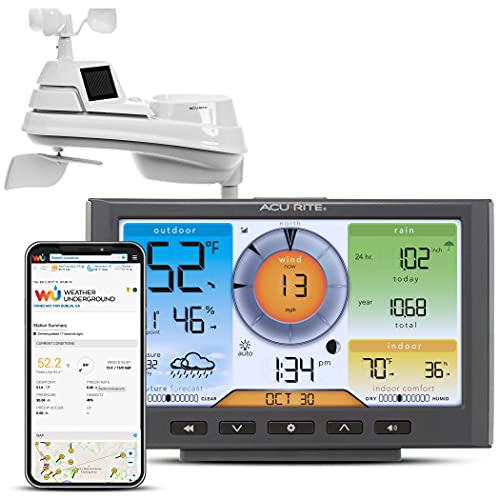
The AcuRite Iris 5-in-1 is a complete home station with a color LCD display and a wireless outdoor array. It measures indoor and outdoor temperature and humidity, wind speed and direction, pressure, and rainfall. The listing also describes historical information, threshold alarms, heat index, dew point, wind chill, and enhanced rainfall history, giving the console more context than a basic thermometer.
Its strongest connectivity distinction is Weather Underground access for remote monitoring and data sharing. That is useful for readers already using that platform, but the supplied information does not identify direct Ethernet. The product title and listing describe a Wi-Fi connection, so it should not be treated as a cable-connected station simply because it supports Internet-based monitoring.
Pros
- Includes a color LCD console and wireless 5-in-1 outdoor array.
- Measures temperature, humidity, pressure, wind, and rainfall.
- Supports Weather Underground remote monitoring.
- Provides threshold alarms and historical weather information.
- Displays derived values such as dew point, wind chill, and heat index.
Cons
- Direct Ethernet is not listed in the supplied information.
- The 5-in-1 label does not include the UV and solar-radiation measurements listed for some competing stations.
Pick the Iris when Weather Underground is central to your setup and you want a familiar indoor display. It is a more focused station than the Tempest or WS-5000-IP3, with fewer listed measurements but a straightforward home-monitoring layout. For a strict Ethernet installation, its Wi-Fi connection is the deciding limitation.
To buy this product, click here.
8. Ambient Weather WS-2000: Best for a Color Console
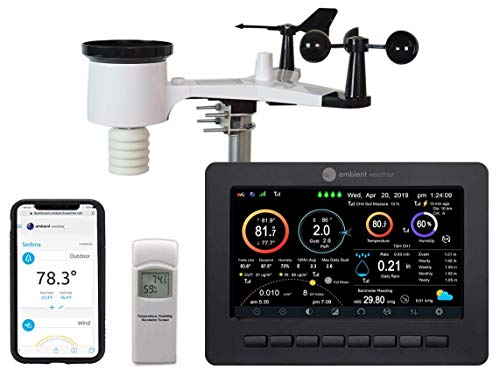
The WS-2000 is built around a TFT color display and an integrated wireless sensor array. Its listed measurements include temperature, humidity, wind speed and direction, rainfall, UV, and solar radiation. A console like this is handy for a kitchen, office, or workshop where current conditions should be visible without opening an app.
The station supports imperial and metric units and allows calibration, while enhanced Wi-Fi provides a route to the Ambient Weather Network. The console uses an included 5V DC adapter, and the outdoor sensor array requires three AAA batteries that are not included. Direct Ethernet is not explicitly listed, so the WS-2000 belongs among connected Wi-Fi alternatives rather than confirmed Ethernet systems.
Pros
- Includes a TFT color display for local monitoring.
- Measures wind, temperature, humidity, rainfall, UV, and solar radiation.
- Supports imperial and metric units.
- Provides calibration capability according to the listing.
- Supports enhanced Wi-Fi connectivity to the Ambient Weather Network.
Cons
- Direct Ethernet is not identified.
- Three AAA batteries for the outdoor sensor are not included.
This model suits a reader who values a dedicated color console and broad outdoor measurements. It is less compelling than the WS-2902 for a buyer focused on a specific remote-monitoring workflow, and it does not satisfy a confirmed Ethernet requirement from the supplied information. Still, the combination of calibration, color display, and UV or solar-radiation data gives it a clear role.
To buy this product, click here.
9. Sainlogic 12-in-1 Wireless Weather Station: Best for Local Display Value
The 12-in-1 Sainlogic is a local wireless station rather than a networked Ethernet system. Its 6.5-inch color display shows indoor and outdoor temperature and humidity, pressure, wind speed and direction, rainfall, dew point, feels-like temperature, moon phase, calendar, and alarm-clock information. The large screen and adjustable backlight are practical for a living room, workshop, or farm office where several readings need to be visible at once.
The listing gives rainfall records by hour, day, week, month, and cumulative total. It also states temperature accuracy of ±0.2°C, humidity accuracy of ±1.8% RH, and a wireless transmission distance of up to 443 feet in open conditions. Those figures come from the product information, while actual communication can vary with walls, metal, terrain, and other obstructions. There is no Wi-Fi or Ethernet, so the station cannot provide remote network access.
Pros
- Includes a 6.5-inch color display with adjustable backlight.
- Shows a broad set of direct and calculated weather information.
- Records rainfall by hour, day, week, month, and cumulative total.
- Lists temperature and humidity accuracy specifications.
- Includes mounting hardware and automatic sensor synchronization.
Cons
- No Wi-Fi or Ethernet connectivity is listed.
- Remote monitoring and app access are not provided in the supplied information.
This station makes sense only when local viewing is enough. It can be a practical lower-cost choice for someone who wants a large screen and rainfall history without configuring a network, but it does not answer the Ethernet part of the search. Choose it for a self-contained display, not for away-from-home alerts or cloud records.
To buy this product, click here.
Buying Guide
Ethernet and Wireless Sensor Communication Solve Different Problems
A weather station may use a wireless radio between the outdoor sensor and its hub while using Ethernet between the hub and your router. The WS-1553-IP follows that pattern. The outdoor array does not need a cable running back to the house, while the WeatherHub can use a direct network connection. That arrangement can be useful when the router is near the console but wireless network access is less desirable.
Do not treat a wireless console link as Ethernet. A station can work perfectly well indoors without Wi-Fi or a network cable, yet still be unable to send observations beyond the property.
Confirm What the Wired Connection Actually Does
Ethernet may provide network access for remote monitoring, weather-network uploads, app data, or gateway configuration. The supplied information explicitly connects direct Ethernet with the WS-1553-IP and GW3000, while several other stations list Wi-Fi only. Check whether the connection belongs to an included hub, whether the outdoor sensors are included, and whether any service or app is required for the functions you want.
Choose a Complete Station or a Modular Gateway
The WS-1553-IP includes an outdoor array and WeatherHub, so it can serve as a complete starting system. The Ecowitt GW3000 is different. It includes built-in indoor sensors and the wired gateway, but outdoor arrays and other sensors are sold separately. Modular hardware can grow across a property, though its final cost and setup depend on the sensors you add.
Separate Direct Measurements From Calculated Information
Temperature, humidity, pressure, wind, rainfall, UV, solar radiation, and lightning can be direct sensor measurements when the appropriate hardware is present. Dew point, wind chill, heat index, feels-like temperature, and forecast icons are calculated or derived values. They can still be useful, but they should not be treated as separate physical sensors or guaranteed forecasts.
Do Not Read Accuracy Into Display Resolution
A screen showing tenths of a degree is reporting more increments, not proving that the sensor is accurate to a tenth of a degree. The Sainlogic products list accuracy claims for temperature, humidity, and rainfall, while several other stations provide less detail in the supplied information. Treat listing values as published claims rather than independent testing results.
Account for Placement and Transmission Conditions
A sensor array mounted beside a hot wall or beneath an obstruction may produce less useful observations than the same hardware placed with better exposure. Rainfall measurement also depends on leveling and avoiding obvious obstructions. Published wireless distances are generally best-case figures. Walls, floors, metal structures, terrain, and interference can reduce the actual distance between an outdoor array and its console or gateway.
Check Power at the Component Level
The WS-2000 console uses an included 5V adapter, while its outdoor array requires three AAA batteries that are not included. Tempest’s solar claim applies to its outdoor sensor. A gateway, console, sensor array, and optional sensors may each use different power arrangements, so inspect the complete system rather than assuming that “solar” or “wireless” describes every component.
Best Weather Stations With Ethernet FAQ
What is the best weather station with Ethernet?
The Ambient Weather WS-1553-IP is the strongest overall fit because its package includes an outdoor sensor array and WeatherHub, and the supplied information explicitly lists direct Ethernet or Wi-Fi. It also supports remote monitoring, alerts, and listed smart-home integrations.
Does a wireless weather station automatically have Ethernet?
No. Wireless usually describes communication between the outdoor sensor and a console or gateway. Ethernet is a wired network connection. The WS-1553-IP lists both types of connectivity, while the Sainlogic 12-in-1 station lists a wireless sensor connection without Wi-Fi or Ethernet.
Is the Ecowitt GW3000 a complete weather station?
The GW3000 is a gateway with built-in indoor temperature, humidity, and pressure sensors. It supports optional Ecowitt outdoor and specialty sensors, but those sensors are sold separately according to the supplied information. It is best viewed as the wired core of a modular system.
Can I use Ethernet for the outdoor sensor itself?
The supplied products describe Ethernet at the hub or gateway level, not a cable running directly to the outdoor sensor array. The outdoor sensors communicate wirelessly with the hub or console. This keeps the outdoor installation cable-free while allowing the indoor network connection to use Ethernet.
Which stations support remote monitoring?
The WS-1553-IP lists remote access and alerts. The WS-2902 lists remote access through Wi-Fi services, the AcuRite Iris 5-in-1 lists Weather Underground remote monitoring, and the Sainlogic Wi-Fi Smart model lists app alerts and Weather Underground synchronization. The local-only Sainlogic 12-in-1 does not list remote access.
Does Wi-Fi provide the same benefit as Ethernet?
Both can connect a hub or console to a network, but they are different connection methods. The supplied information does not establish that every Wi-Fi model also has a physical Ethernet port. If a cable connection is central to your installation, choose a product that explicitly lists Ethernet rather than assuming it from Wi-Fi support.
Are extra sensors included with the Ecowitt GW3000?
No. The product information identifies compatible Ecowitt sensors, including outdoor arrays and multi-channel sensors, as sold separately. The GW3000 includes its gateway and built-in indoor temperature, humidity, and pressure sensing.
Does a faster update interval mean better accuracy?
No. Update interval describes how often new readings are transmitted or refreshed. Accuracy describes how close a measurement is expected to be to the relevant reference. The Tempest lists three-second updates and the WS-5000-IP3 lists five-second updates, but those refresh figures do not independently prove higher accuracy.
Final Verdict
The Ambient Weather WS-1553-IP is the strongest overall recommendation for this category because it combines a complete outdoor station with a WeatherHub that explicitly supports direct Ethernet or Wi-Fi. Its 16-second update interval, remote monitoring, alerts, and smart-home connections cover the practical needs of a connected home without requiring a separate outdoor sensor purchase.
The Ecowitt GW3000 is the better route for a modular installation where optional sensors and local SD-card storage matter, though its outdoor sensors are separate purchases. The WS-5000-IP3 and Tempest offer more advanced sensor approaches, yet the supplied information does not confirm direct Ethernet for either one. Before ordering, verify the exact connection method for the hub, confirm which sensors are included, and decide whether you need local display access, remote alerts, data export, or a genuinely cable-connected network path.