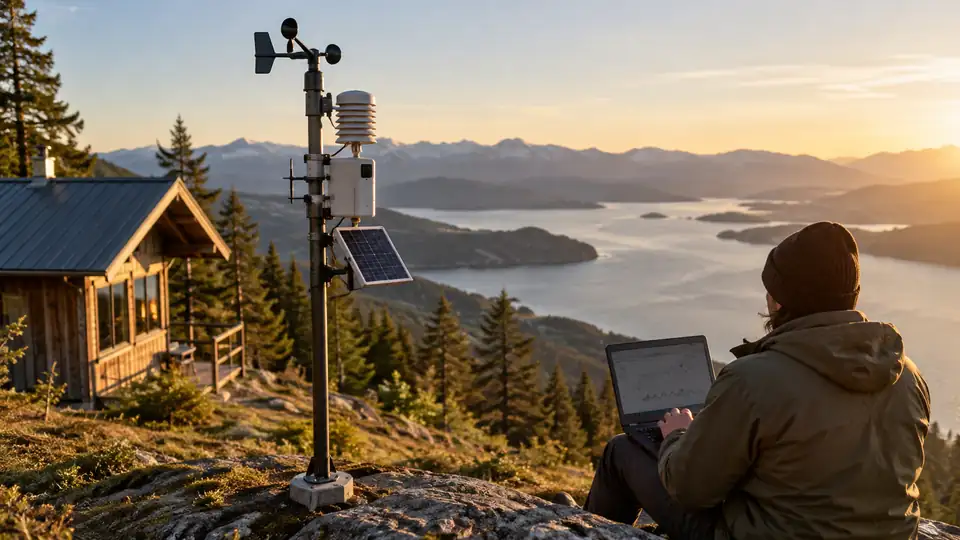
A weather station with an app should do more than display a temperature beside the kitchen window. The useful systems in this roundup combine outdoor sensing with a phone-based view of conditions, historical records, alerts, or smart-home functions. The important split is between a station that sends sensor data to a local console and one that also connects the console or gateway to Wi-Fi for access away from home.
Sensor coverage matters just as much. A compact temperature-and-humidity unit may suit a nursery or basement, while a larger property benefits from rainfall, wind speed, wind direction, pressure, UV, and solar-radiation readings. App access also varies widely. Some products offer live readings and history, while others add spreadsheet export, weather-network uploads, automation, or alerts. The Tempest Weather Station stands out for its broad measurement set, app access, smart-home support, and solar-powered outdoor sensor.
The rankings below weigh the supplied measurements, connectivity, data features, sensor design, display, power requirements, and installation trade-offs. A lower-priced station can be a better fit for simple monitoring, while a farm, greenhouse, or remote property may benefit from deeper records and broader platform support.
Quick Answer
- Tempest Weather Station: Best overall for broad measurements, app access, smart-home integration, and minimal outdoor moving parts.
- Ambient Weather WS-2902: A strong choice for a full sensor array with rainfall, wind, UV, solar radiation, remote access, and automation support.
- Sainlogic 5G/2.4G WiFi Smart Weather Station: Best for dual-band Wi-Fi, rainfall records, Excel export, and long-term local storage.
- Smart WiFi Weather Station with App Control: A simpler budget-oriented option for temperature, humidity, alerts, and app-based household monitoring.
Best Weather Stations With App Comparison Table
| Product | Measurements | App And Connectivity | Sensor And Power Details | Best For |
|---|---|---|---|---|
| Tempest Weather Station | Temperature, humidity, pressure, wind, rain, UV, solar radiation, lightning | App, Alexa, Rachio, IFTTT | Solar outdoor sensor, 1,000+ ft listed wireless range | Best overall connected monitoring |
| Ambient Weather WS-2902 | Temperature, humidity, wind, rain, UV, solar radiation | Wi-Fi, remote access, IFTTT, Google Home, Alexa | Osprey integrated sensor array and color display | Smart-home users and full weather coverage |
| Sainlogic 5G/2.4G WiFi Smart Weather Station | Temperature, humidity, rain, wind, pressure-related data | Dual-band Wi-Fi, Bluetooth pairing, app, Weather Underground | 135 m listed wireless range, 2-year storage | Data logging and broader router compatibility |
| AcuRite Iris 5-in-1 | Temperature, humidity, pressure, wind, rainfall | Wi-Fi connection to Weather Underground | Integrated outdoor instruments and color display | Weather Underground monitoring |
| VEVOR YT60234 7-in-1 | Temperature, humidity, rain, wind, light, pressure, derived readings | Wi-Fi, Weather Underground, WeatherCloud | Solar sensor, rechargeable Ni-MH cells, 150 m listed range | Weather-network access and solar-assisted operation |
| Sainlogic 10-in-1 Weather Station | Temperature, humidity, pressure, rain, wind | Weatherseed app, alerts, 2.4 GHz Wi-Fi | 2-year storage, Excel export, integrated outdoor sensor | Alerts and downloadable records |
| Grillum Smart WiFi Weather Station | Temperature, humidity, pressure, rain, wind, UV | 2.4 GHz Wi-Fi and smartphone app | Solar panel or batteries, 328 ft listed transmission range | Large display and detailed app history |
| VEVOR 7-in-1 Wi-Fi Weather Station | Temperature, humidity, rain, wind, sunlight, dew point | Smart Life app, 2.4 GHz Wi-Fi | Solar-assisted sensor and 150 m listed range | Large display and straightforward setup |
| Smart WiFi Weather Station With App Control | Temperature and humidity | Tuya app, 2.4 GHz Wi-Fi | One sensor included, up to 3 channels, battery or adapter | Simple indoor and outdoor monitoring |
The detailed reviews explain what each system actually measures, how its app connection works, and which compromises matter after installation.
1. Tempest Weather Station : Best Overall
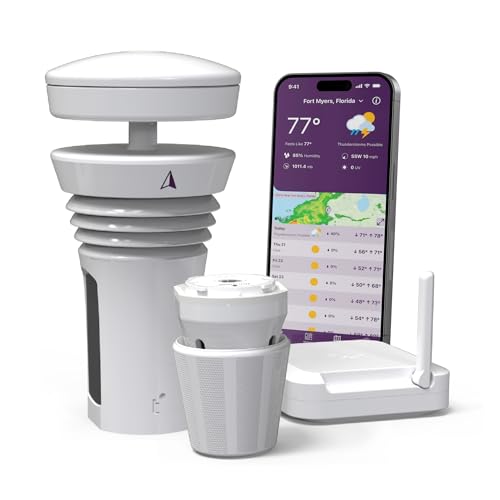
Tempest earns the top position because its connected feature set reaches well beyond basic temperature and humidity. The supplied product information lists barometric pressure, wind speed and direction, rainfall, dew point, solar radiation, UV index, and lightning strikes. That gives a homeowner, gardener, or property manager a much fuller local picture than a station that stops at indoor and outdoor temperature.
The outdoor sensor uses solar power and transmits wirelessly more than 1,000 feet according to the listing, while updates are described as arriving every three seconds. Its no-moving-parts construction may simplify the outdoor sensor arrangement compared with systems that use spinning cups or a separate rain mechanism, although the product information does not establish a universal maintenance schedule. App access pairs with Alexa, Rachio, IFTTT, and other smart-home platforms, opening paths for weather-based routines such as irrigation decisions.
Pros
- Measures a broad set of weather variables, including wind, rain, UV, solar radiation, and lightning.
- App and smart-home support includes Alexa, Rachio, and IFTTT.
- Solar-powered outdoor sensor reduces dependence on routine battery replacement for that component.
- Listed wireless transmission distance exceeds 1,000 feet.
- Three-second update claim suits users who want frequently refreshed conditions.
Cons
- Its premium positioning may be excessive for buyers who need only temperature and humidity.
- The supplied information does not detail every power requirement or installation accessory.
Tempest is the strongest fit for someone who wants app-based weather monitoring to become part of a broader home routine. The extensive measurement list and platform support give it a wider role than a console that simply sits on a shelf. Buyers who prefer a large local screen or detailed spreadsheet export may find another model more suitable, so the app-first design is the key trade-off.
To buy this product, click here.
2. Ambient Weather WS-2902 : Best For Smart-Home Integration
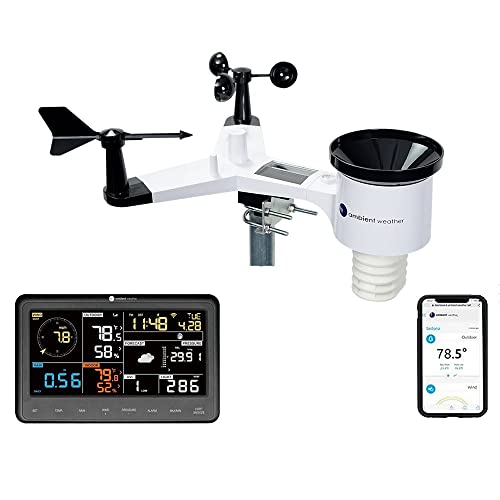
The WS-2902 takes a traditional personal weather station layout and adds genuine Wi-Fi functionality. Its included Osprey sensor array measures temperature, humidity, wind speed, wind direction, rainfall, UV intensity, and solar radiation. A color LCD console provides local visibility, while the connected features allow users to check conditions away from the display.
Its strongest distinction is the range of connected options listed for the model. The product information names IFTTT, Google Home, Alexa, and the Ambient Weather Network, with support for alerts and remote data access. That creates a useful bridge between backyard observations and household automation. Someone watching rainfall before running irrigation gets a more practical tool than someone relying on a forecast icon alone.
Pros
- Includes an integrated sensor array with wind, rainfall, UV, and solar-radiation measurements.
- Provides a color LCD display for local monitoring.
- Supports remote access and alerts through its connected system.
- Lists IFTTT, Google Home, and Alexa compatibility.
- Can transmit data to the Ambient Weather Network.
Cons
- The supplied information does not list a specific wireless transmission distance.
- Its broader sensor array requires more deliberate outdoor placement than a simple temperature sensor.
The WS-2902 is a compelling option for a connected home that values both a physical console and app-based access. It gives up the Tempest’s listed lightning measurement and unusually long transmission claim, but it offers a familiar all-in-one array with a clearly described set of smart-home connections. Check the required Wi-Fi location and outdoor mounting position before ordering.
To buy this product, click here.
3. Sainlogic 5G/2.4G WiFi Smart Weather Station : Best For Data Logging

For buyers who want more than a live reading on a phone, this Sainlogic model brings unusually clear data-handling features to the comparison. The product information lists two years of local storage and Excel export, with each export covering up to 30 days. That arrangement suits someone tracking seasonal temperature changes, rainfall totals, or greenhouse conditions without relying solely on a rolling app graph.
It also stands apart through dual-band Wi-Fi and Bluetooth pairing. The listing gives a 443-foot open-area wireless range and identifies a Swiss SHT40 temperature and humidity sensor, along with stated accuracy figures for those measurements. Rainfall records can be viewed by hour, day, month, and year, and the station includes a bubble level to help with horizontal placement of the rain sensor. Range and accuracy claims remain product-listing specifications rather than independent test results, but they provide useful comparison points.
Pros
- Supports both 5 GHz and 2.4 GHz Wi-Fi according to the listing.
- Stores up to two years of data and supports Excel export.
- Records rainfall across hourly, daily, monthly, and yearly periods.
- Includes Bluetooth fast pairing and app alerts.
- Lists a 135 m open-area wireless transmission distance.
Cons
- Each Excel export is limited to a stated 30-day period.
- The outdoor array needs careful leveling and placement for useful rainfall and wind readings.
This station makes sense for a garden, greenhouse, cellar, or property where records matter as much as today’s conditions. It is more data-focused than the simpler app stations, while its dual-band connection may reduce router setup friction. Choose another model if smart-home platform integration is your priority, since the supplied information identifies Weather Underground but does not list Alexa, Google Home, or IFTTT support.
To buy this product, click here.
4. AcuRite Iris 5-in-1 Home Weather Station : Best For Weather Underground
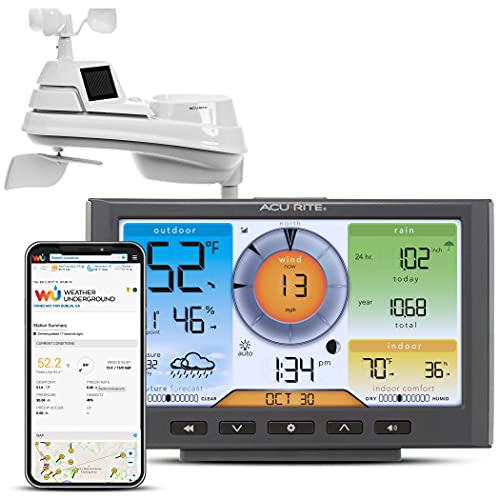
AcuRite Iris focuses on the measurements most homes use first: indoor and outdoor temperature, humidity, wind speed, wind direction, barometric pressure, and rainfall. The supplied information also lists a large color display with dimming, threshold alarms, historical data, heat index, dew point, wind chill, and enhanced rainfall history. That mix gives the console more context than a basic thermometer while keeping the product centered on home monitoring.
Its app-related strength is the Wi-Fi connection to Weather Underground. Users who want to view their station remotely or share data through that platform have a clearly identified path rather than a vague promise of Internet connectivity. The five-in-one sensor array combines several outdoor instruments, so installation is more compact than placing separate wind and rain sensors, but placement still affects exposure and readings.
Pros
- Measures temperature, humidity, pressure, wind speed, wind direction, and rainfall.
- Connects to Weather Underground for remote monitoring.
- Large color display includes adjustable dimming.
- Provides threshold alarms and historical weather information.
- Calculates useful values such as dew point, wind chill, and heat index.
Cons
- The supplied information does not list support for Alexa, Google Home, or IFTTT.
- Its five-in-one design offers less measurement coverage than stations with UV or solar-radiation sensors.
AcuRite Iris is a sensible choice for a household that wants a recognizable core measurement set and Weather Underground access. It sits below the more expansive systems because its platform support and sensor coverage are narrower. Buyers who want UV, solar radiation, or broader automation should look higher in the ranking.
To buy this product, click here.
5. VEVOR YT60234 7-in-1 WiFi Weather Station : Best For Weather-Network Access

The YT60234 combines a seven-in-one outdoor sensor with a 7.5-inch display and app-based access. Its listed measurements include wind speed, wind direction, temperature, humidity, rainfall, and light, with pressure, dew point, wind chill, and moon phase shown as additional information. The distinction matters because some of those readings are calculated or displayed values rather than separate outdoor sensors.
Its connectivity is unusually clear for a lower-cost station. The product information names both Weather Underground and WeatherCloud, while the app provides smartphone access to outdoor conditions. The outdoor sensor uses solar assistance, rechargeable Ni-MH batteries, and a listed 150-meter transmission distance. The console must remain connected to its adapter for Wi-Fi synchronization, so the solar feature applies to the outdoor sensor rather than the complete system.
Pros
- Lists support for both Weather Underground and WeatherCloud.
- Includes wind, rain, temperature, humidity, and light measurements.
- Uses a 7.5-inch display with four brightness levels.
- Outdoor sensor combines solar assistance with rechargeable Ni-MH cells.
- Lists a 150-meter transmission distance.
Cons
- The adapter must remain connected for Wi-Fi and date synchronization.
- The supplied information does not detail app history or export functions.
This VEVOR model suits someone who wants weather-network connectivity and a large local screen without moving into the most expensive tier. It gives up the deeper data-export description found on the Sainlogic 5G station, yet its Weather Underground and WeatherCloud support may matter more to a platform-focused buyer. Keep the console near dependable power and place the outdoor sensor away from likely interference sources.
To buy this product, click here.
6. Sainlogic 10-in-1 Weather Station : Best For Alerts And Export

Sainlogic’s 10-in-1 model is aimed at readers who want phone alerts and a readable console without giving up historical records. The Weatherseed app is described as providing alerts for temperature, humidity, and barometric pressure, while the station records rainfall by hour, day, week, month, and year. A bold, high-contrast display can be useful across a kitchen or office where quick glances matter more than a dense dashboard.
The listing also describes two-year data storage with Excel download, although exports are limited to selected 30-day periods. The sensor array includes rainfall and wind monitoring, and the product information gives rainfall accuracy claims for different rainfall amounts. Those figures should be treated as listing specifications, while installation remains important because the same listing warns that sensor positioning affects wind direction and temperature readings.
Pros
- Weatherseed app provides alerts for temperature, humidity, and pressure changes.
- Supports up to two years of storage and Excel downloads.
- Offers rainfall history across several time periods.
- Uses enlarged display text for quick reading.
- Includes a bracket-based outdoor sensor installation system.
Cons
- Wi-Fi support is limited to 2.4 GHz according to the listing.
- Excel downloads are limited to a stated 30-day selection at a time.
This station is a good middle ground for a user who wants records and alerts but does not need the broader smart-home ecosystem of the top two picks. It is less flexible for modern routers that strongly favor 5 GHz, and the supplied information does not identify Weather Underground or WeatherCloud support. For rainfall history and phone notifications, its focus is clear.
To buy this product, click here.
7. Grillum Smart WiFi Weather Station : Best For A Feature-Rich Display
Grillum puts a lot of information on its 7.5-inch VA display. The listed screen data includes temperature, humidity, wind speed, rainfall, pressure, UV index, feels-like temperature, and a 12-hour forecast. The app adds current readings, history, alarms, unit changes, and remote viewing, making this one of the more display-centered choices for a living room, workshop, or home office.
The outdoor sensor combines a wind vane, wind cups, rain funnel, temperature and humidity sensing, light sensing, UV sensing, and a solar panel. It supports up to three additional standard sensors, but those extras are not included. The station’s 328-foot maximum transmission range is a published figure, and the app connection requires the display to remain plugged in. Battery operation keeps the system available in a limited mode, with the display waking briefly when touched.
Pros
- 7.5-inch display presents a broad set of readings at once.
- App provides current conditions, historical data, alarms, and remote access.
- Outdoor array includes wind, rain, UV, light, temperature, and humidity functions.
- Supports up to three additional standard sensors.
- Solar panel can assist the outdoor sensor power system.
Cons
- Additional sensors are not included.
- Wi-Fi works only on 2.4 GHz and requires adapter power for connection.
Grillum is attractive for someone who wants a busy, information-rich screen and the ability to revisit past readings in an app. It ranks below the data-export models because the supplied information does not specify spreadsheet downloads or third-party weather-network support. Router setup may also require separate 2.4 GHz configuration in some homes.
To buy this product, click here.
8. VEVOR 7-in-1 Wi-Fi Weather Station : Best For A Large Display And Solar-Assisted Sensor

This VEVOR station combines a 7.5-inch display with a solar-assisted outdoor sensor that monitors temperature, humidity, rainfall, wind speed, wind direction, and sunlight. The system also displays dew point, moon phases, and six-to-12-hour forecasts. That blend works well for a household that wants a quick glance at the console before checking the Smart Life app for current data.
The listing gives a 150-meter outdoor transmission distance and includes an aluminum alloy rod fixed bracket. It supports NiMH battery charging, while the console needs to remain plugged in for Wi-Fi and synchronization. The product information says the station supports Smart Life without weather-site registration, which may appeal to someone who prefers a direct app experience rather than a public weather network.
Pros
- 7.5-inch display offers four brightness levels.
- Outdoor sensor measures temperature, humidity, rainfall, wind, direction, and sunlight.
- Solar panel works with battery backup for the outdoor sensor.
- Lists a 150-meter transmission distance.
- Includes an aluminum alloy rod fixed bracket.
Cons
- Wi-Fi is limited to 2.4 GHz and requires the adapter to remain plugged in.
- The supplied information does not identify data export or third-party platform support.
This model is a reasonable choice for a buyer who values a large screen, Smart Life access, and solar assistance more than long-term export tools. Its connected features are narrower than those of the Ambient Weather and Tempest systems, but the display and included bracket give it a practical household focus. Avoid placing the sensor near listed sources of interference such as power lines or signal towers.
To buy this product, click here.
9. Smart WiFi Weather Station With App Control : Best For Simple Monitoring

Some households do not need a wind cup, rain funnel, or UV sensor sitting outside. This compact station focuses on indoor and outdoor temperature and humidity, then sends those readings to a phone through the Tuya app. The app provides historical trends, high and low alerts, unit switching, and a five-day forecast display, creating a simpler path into app-based monitoring.
The system supports up to three sensors, although one sensor is included. Battery operation provides basic weather data, while the adapter is required for Wi-Fi and app functions. That distinction is easy to overlook during setup. The large LCD has four brightness levels and also works as an alarm clock, making it a natural fit for a bedroom, nursery, office, or small home where a full outdoor array would feel excessive.
Pros
- Tuya app provides live readings, history, and high and low alerts.
- Supports up to three temperature and humidity sensor channels.
- Large LCD includes four brightness settings.
- Offers battery operation for basic local data.
- Includes a five-day forecast display with weather icons.
Cons
- It does not list rainfall, wind, UV, or solar-radiation measurements.
- Wi-Fi and app functions require adapter power and a 2.4 GHz network.
This is the sensible lower-complexity pick for temperature and humidity monitoring. It ranks ninth because the keyword often leads shoppers toward a complete personal weather station, and this model does not provide wind or rainfall data. Choose it for rooms, storage areas, or a few temperature-sensitive locations, not for detailed backyard weather records.
To buy this product, click here.
Buying Guide
Wi-Fi And The Outdoor Sensor Link Solve Different Problems
A station can use a wireless radio link between the outdoor array and its console, then use Wi-Fi to send that console’s data to an app. Those are separate connections. The advertised wireless distance describes communication between system components, while Wi-Fi depends on the home router and the station’s power arrangement. Check both before assuming that a long sensor range guarantees remote phone access.
Decide Which Measurements Matter
Temperature and humidity may be enough for a nursery, cellar, or greenhouse corner. A garden or larger property may benefit from rainfall, wind speed, and wind direction. UV and solar radiation matter for a more complete outdoor record, while lightning detection is a specialized feature. A higher “in-one” number does not automatically make a station more useful if the added readings do not fit your routine.
App Access Is Not Identical Across Models
Some apps show current readings and history. Others add alerts, Excel export, public weather-network uploads, or smart-home automation. The Tempest and Ambient Weather models have the clearest supplied smart-home connections in this group, while the Sainlogic stations place more emphasis on alerts and stored records. Read the stated app functions rather than assuming every Wi-Fi product offers the same remote experience.
Check The Power Arrangement
Several stations require the console or display to remain plugged in for Wi-Fi synchronization. Solar assistance generally applies to the outdoor sensor, not the entire system. Battery operation may disable app access or turn off the display to conserve energy. A remote property with limited power has different requirements from a kitchen console beside an outlet.
Treat Transmission Range As A Published Maximum
Open-area range figures can help compare products, but walls, floors, metal structures, terrain, and interference can reduce the distance in an actual installation. The VEVOR and Sainlogic stations list long distances, yet their product information also warns about interference or specifies open-area conditions. Place the outdoor array where it can measure exposed air while keeping the console or gateway within a practical communication path.
Plan The Outdoor Sensor Placement
Rain gauges need level placement and unobstructed exposure. Wind sensors need moving air rather than a sheltered corner beside a wall. Temperature and humidity sensors can be affected by direct sun or nearby heat sources. A sophisticated app cannot correct every installation problem, so the mounting location deserves as much attention as the product label.
Best Weather Stations With App FAQ
What Is The Best Weather Station With An App?
The Tempest Weather Station is the strongest overall choice in this comparison because it combines a broad measurement set with app access, smart-home support, solar-powered outdoor sensing, and a listed wireless range of more than 1,000 feet. Its premium feature set may be unnecessary for simple temperature monitoring.
Does Wi-Fi Mean A Weather Station Can Be Checked From Anywhere?
No. Wi-Fi connects a station to a home network, but remote access depends on the product’s app or cloud service. The supplied information specifically identifies remote access for several models, while other stations mention Wi-Fi without describing every remote function.
What Is The Difference Between Wireless And Wi-Fi Weather Stations?
Wireless commonly describes the sensor-to-console connection. Wi-Fi describes the network connection that can send data through a router. A station may use wireless outdoor sensors without offering Wi-Fi or app access.
Do These Weather Stations Measure Rainfall Directly?
The models with listed rain gauges use outdoor rainfall-sensing hardware. Rainfall totals still depend on appropriate placement and leveling. Forecast icons and app weather information should not be confused with direct rainfall measurement from the local sensor.
Which Model Is Best For Downloading Weather Records?
The Sainlogic 5G/2.4G model and the Sainlogic 10-in-1 model both list two-year storage and Excel export. The product information says exports cover up to 30 days at a time, so users handling long records should plan for multiple export periods.
Are The Solar-Powered Models Completely Off-Grid?
No. Solar assistance applies to the outdoor sensor on the VEVOR models and Tempest. Several consoles still require adapter power for Wi-Fi, synchronization, or continuous display operation. Check each component’s power needs before choosing a station for a cabin or remote site.
Do All Nine Stations Support The Same Smart-Home Platforms?
No. The Ambient Weather WS-2902 lists IFTTT, Google Home, and Alexa support, while Tempest lists Alexa, Rachio, IFTTT, and other smart-home platforms. The other products use named apps or weather networks, but the supplied information does not establish the same platform compatibility.
Final Verdict
The Tempest Weather Station is the strongest overall option for app-based weather monitoring because it covers temperature, humidity, pressure, wind, rain, UV, solar radiation, and lightning while also connecting with Alexa, Rachio, IFTTT, and other smart-home platforms. Its solar outdoor sensor and listed long-range wireless transmission add practical flexibility, although the premium feature set is more than a simple indoor-outdoor thermometer user needs.
The Ambient Weather WS-2902 is the better alternative for a full sensor array with a local color display and clearly listed smart-home connections. The Sainlogic 5G/2.4G model deserves a close look if Excel export and long-term records matter most. For straightforward temperature and humidity checks, the Smart WiFi Weather Station keeps the setup simpler. Match the station to the measurements, app functions, power arrangement, and mounting location you can actually use.