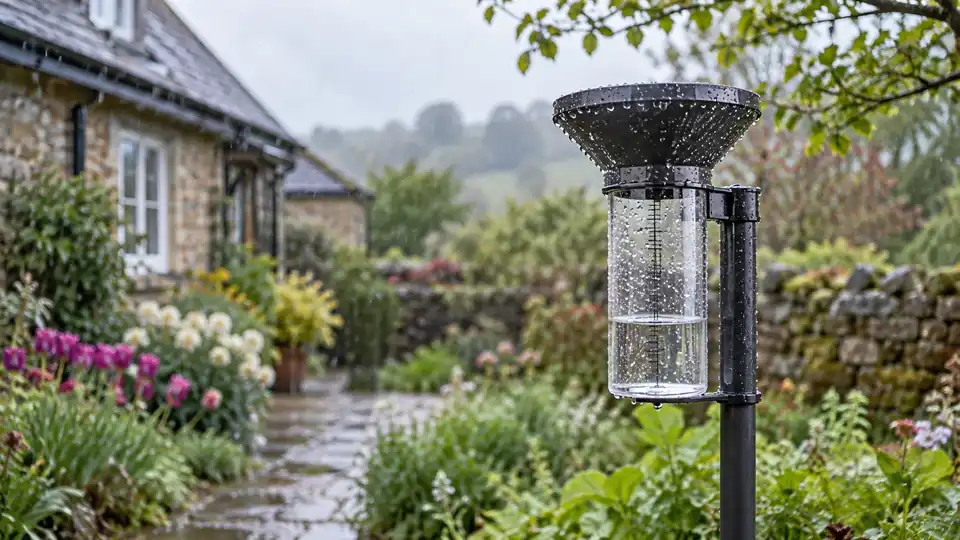
A rain gauge changes the buying decision. A station that merely shows temperature and a forecast icon is not enough if you want to know how much rain actually reached the garden, driveway, greenhouse, or larger property. The strongest options here combine rainfall tracking with useful local measurements such as wind speed, wind direction, outdoor temperature, humidity, and barometric pressure. The main differences appear in how the rain is recorded, how readings reach you, and whether the system offers a local console, app access, historical records, or smart-home connections.
Wireless sensor transmission and Wi-Fi solve different problems. A local wireless station can send outdoor readings to an indoor display without joining your home network, while a Wi-Fi model may let you check conditions away from the console. Advertised transmission distance also needs context because walls, metal structures, trees, and terrain can affect communication. Rain-gauge placement matters as well. A level, unobstructed installation gives the precipitation sensor a better chance of producing useful totals, while the best display or app cannot correct a poor sensor location.
This comparison gives the strongest emphasis to genuine rainfall measurement, then weighs connectivity, data history, wind monitoring, display quality, sensor design, and installation. The Ambient Weather WS-2902 leads for connected home monitoring, while Tempest is the more advanced choice for smart-home integration and frequent updates. Several simpler wireless stations remain appealing for readers who want local rainfall information without an app or cloud service.
Quick Answer
- Best Overall: Ambient Weather WS-2902 Wi-Fi Smart Weather Station combines rainfall, wind, temperature, humidity, UV, solar radiation, Wi-Fi, remote access, and smart-home support.
- Best Premium: Tempest Weather Station offers a solar-powered outdoor sensor, lightning detection, frequent updates, and broad integration support.
- Best for Data Logging: Sainlogic 5G/2.4G WiFi Smart Weather Station records rainfall and other readings, stores up to two years of local data, and supports Excel export.
- Best Simple Setup: AcuRite Iris keeps the focus on a local display, rainfall history, wind information, alerts, and straightforward wireless installation.
Best Weather Stations With Rain Gauge Comparison Table
| Product | Rainfall And Measurements | Connectivity | Sensor Or Data Feature | Best For |
|---|---|---|---|---|
| Ambient Weather WS-2902 | Rain, wind, temperature, humidity, UV, solar radiation | Wireless and Wi-Fi | Remote access and smart-home support | Connected home monitoring |
| Tempest Weather Station | Rain, wind, temperature, humidity, pressure, UV, solar radiation, lightning | Wireless, app, smart-home | Solar-powered sensor, updates every 3 seconds | Advanced connected monitoring |
| Sainlogic 5G/2.4G WiFi Smart Weather Station | Rain, wind, temperature, humidity, pressure | 2.4GHz and 5GHz Wi-Fi, Bluetooth pairing | Two-year local storage and Excel export | Rainfall records and data analysis |
| Grillum Smart WiFi Weather Station | Rain, wind, temperature, humidity, pressure, UV | 2.4GHz Wi-Fi and app | 7.5-inch display and historical app data | Large display with remote access |
| AcuRite Iris | Rain, wind, temperature, humidity, pressure | Wireless local console | Alerts, rainfall history, optional lightning sensor | Local monitoring and alerts |
| Sainlogic 12-in-1 Wireless Weather Station | Rain, wind, temperature, humidity, pressure | Wireless, no Wi-Fi | 443-foot listed open-area transmission range | Large properties without app needs |
| AIRAIN TECH Wireless Weather Station | Rain, wind, temperature, humidity, pressure | Wireless, no Wi-Fi | 328-foot listed transmission range and included mounting hardware | Simple installation |
| Sainlogic Wireless Weather Station With Rain Gauge | Rain, wind, temperature, humidity, pressure | Wireless, no Wi-Fi | Hourly, daily, weekly, monthly, and total rainfall records | Readable local rainfall tracking |
| Digital Wireless Rain Gauge Weather Station | Rain, temperature, humidity, pressure | Wireless local console | Self-emptying gauge and three sensor channels | Budget rainfall monitoring |
The detailed reviews explain how each station handles rainfall, data access, sensor placement, and everyday monitoring.
1. Ambient Weather WS-2902 Wi-Fi Smart Weather Station, Best Overall
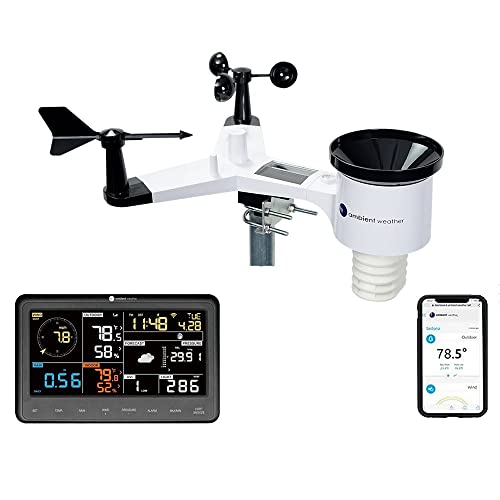
The WS-2902 earns the top position because it covers the measurements most people expect from a complete personal weather station while adding meaningful online access. Its outdoor sensor array measures rainfall, wind speed, wind direction, temperature, humidity, UV intensity, and solar radiation. That broader measurement set gives a gardener more context than rainfall alone. A shower total tells you what fell, while wind and solar readings help explain how quickly soil or container plants may dry.
Wi-Fi is the important distinction here. The station also uses a wireless sensor connection, but the listing separately identifies Wi-Fi access, remote monitoring, alerts, smart-home use, and connection with the Ambient Weather Network. It also identifies Alexa, Google Home, and IFTTT support. Those features make the WS-2902 a stronger choice for someone who wants to check backyard conditions away from the console or use weather readings in home routines. The trade-off is a more connected setup than a basic display-only station, so buyers should be comfortable with network configuration and online services.
Pros
- Measures rainfall, wind speed, wind direction, temperature, humidity, UV intensity, and solar radiation.
- Provides Wi-Fi access for remote observations and alerts.
- Supports Alexa, Google Home, and IFTTT according to the listing.
- Includes an Osprey sensor array and color LCD display.
- Can connect with the Ambient Weather Network for online weather data sharing.
Cons
- Wi-Fi and smart-home features add setup dependencies that a local-only station avoids.
- The listing does not provide detailed rainfall accuracy or resolution figures.
This is the strongest fit for a connected household, garden, or property where rainfall history and remote access matter together. A reader who only wants a clock-like console may prefer AcuRite Iris or one of the simpler Sainlogic stations. The WS-2902 makes more sense when the data needs to travel beyond the room where the display sits.
To buy this product, click here.
2. Tempest Weather Station, Best Premium
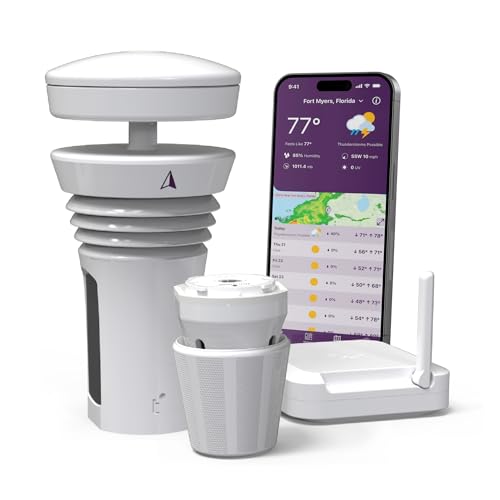
Tempest takes a broader approach to rainfall monitoring by combining precipitation with lightning, solar radiation, UV, wind, temperature, humidity, barometric pressure, and calculated values such as dew point. The supplied information describes a single outdoor sensor with no moving parts and a solar-powered design. That architecture may appeal to someone who wants fewer mechanical components in the sensor array, although the listing does not provide a detailed rain-measurement method or rainfall accuracy figure.
The connectivity package is its strongest reason for ranking high. The station supports an app, Alexa, Rachio, IFTTT, and other smart-home platforms according to the product information. Its listed wireless transmission distance exceeds 1,000 feet, and the listing gives a three-second update interval. Those numbers are useful context for a large property or automation setup, but actual communication still depends on placement and surrounding obstructions. This is a premium system for readers who want a connected observation point rather than a simple indoor rainfall display.
Pros
- Measures rainfall, wind, temperature, humidity, pressure, UV, solar radiation, and lightning.
- Uses a solar-powered outdoor sensor with no moving parts, according to the listing.
- Lists updates every three seconds for frequently refreshed observations.
- Supports Alexa, Rachio, IFTTT, and other smart-home platforms.
- Lists wireless transmission beyond 1,000 feet.
Cons
- The supplied information does not specify rainfall accuracy or resolution.
- Its advanced connected feature set may be unnecessary for local console-only monitoring.
Tempest suits a reader who wants rainfall as part of a larger smart-home and environmental monitoring system. It is harder to justify for someone who simply wants weekly garden totals on a bedside display. The solar-powered sensor and broad integration support separate it from ordinary wireless consoles, but the available product information leaves some rain-gauge specifications unstated.
To buy this product, click here.
3. Sainlogic 5G/2.4G WiFi Smart Weather Station, Best for Data Logging

Rainfall records become far more useful once you can compare them across weeks, months, or seasons. This Sainlogic model lists hourly, daily, monthly, and yearly rainfall totals, along with two years of local data storage. It also supports Excel export, with each export covering up to 30 days. That gives a gardener, greenhouse operator, or property manager a way to move beyond glancing at today’s total and examine changing conditions over time.
The station supports both 2.4GHz and 5GHz Wi-Fi, and Bluetooth fast pairing is listed for setup. Its temperature and humidity information includes published accuracy claims for the Swiss SHT40 sensor chip, while the rain information lists ±1 mm below 15 mm and ±7% above that level. Those are listing specifications, not independent verification, but they are more detailed than the rain information supplied for several alternatives. The outdoor link is listed at up to 443 feet in open conditions, which should be treated as a best-case figure rather than a guarantee through walls.
Pros
- Supports both 2.4GHz and 5GHz Wi-Fi.
- Lists hourly, daily, monthly, and yearly rainfall records.
- Stores up to two years of local data and supports Excel export.
- Lists rainfall accuracy of ±1 mm below 15 mm and ±7% above that amount.
- Includes Bluetooth fast pairing and a listed 443-foot open-area wireless range.
Cons
- Excel exports cover up to 30 days at a time despite the longer storage period.
- Actual transmission performance can vary with walls, metal, terrain, and interference.
This is the most compelling choice for someone who treats rainfall as a record rather than a momentary reading. It has more data-focused usefulness than a basic console, while its dual-band Wi-Fi support may fit homes with newer routers. Skip it if you have no interest in data history or app-based access and would rather avoid network setup.
To buy this product, click here.
4. Grillum Smart WiFi Weather Station, Best for a Large Display

The Grillum pairs a 7.5-inch display with Wi-Fi access and a rainfall-capable outdoor sensor. Its screen presents rainfall, wind speed, temperature, humidity, barometric pressure, UV index, feels-like temperature, and a 12-hour forecast. A large console can be useful in a kitchen, workshop, or common room where readings need to be visible from several feet away. Adjustable brightness also gives the display more flexibility between a sunlit daytime room and a darker evening setting.
The app is the real dividing line between this model and local-only stations. The listing says it provides current conditions and historical data remotely, including temperature, humidity, pressure, wind, and rainfall. The Wi-Fi details require a 2.4GHz network, and the display must be plugged in for Wi-Fi operation. On battery power, the screen stays off until activated briefly. The sensor combines wind, rain, temperature, humidity, light, UV, and solar-panel components, while up to three additional standard sensors are supported but not included.
Pros
- Uses a 7.5-inch display with adjustable brightness.
- Provides app access to current conditions and historical rainfall data.
- Measures rainfall, wind, temperature, humidity, pressure, and UV.
- Supports up to three additional standard sensors, which are sold separately.
- Lists a 328-foot maximum transmission range.
Cons
- Wi-Fi supports 2.4GHz networks only.
- Wi-Fi operation requires the display to remain plugged in, and batteries are not included for the outdoor sensor.
Grillum is a sensible middle ground for someone who wants a prominent local screen plus app history. It may frustrate buyers whose router uses a combined band arrangement or anyone expecting the display to remain active on battery power. Check your network and planned console location before choosing it for a remote outbuilding.
To buy this product, click here.
5. AcuRite Iris Weather Station, Best for Local Alerts
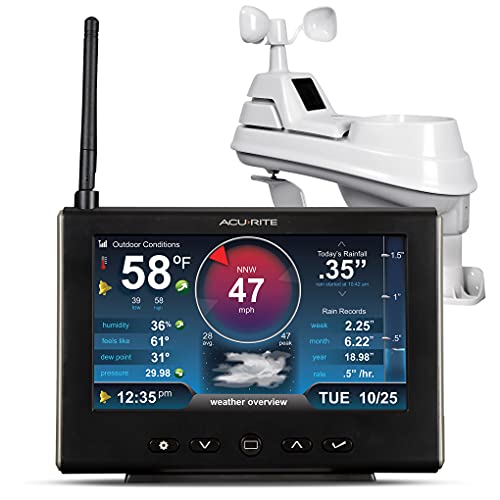
AcuRite Iris focuses on the information that matters at home without requiring Wi-Fi or an app. The wireless outdoor sensor sends rainfall, temperature, humidity, wind speed, wind direction, and pressure readings to the HD display. The product information also lists rainfall history, weekly, monthly, and all-time highs and lows. That arrangement feels practical for a kitchen counter or bedside table where a quick glance is more important than remote access.
Custom alerts give this station a useful edge. The listing identifies thresholds for temperature, humidity, wind speed, and rainfall, along with a storm alert triggered by falling barometric pressure. The display also shows calculated information such as feels-like temperature, heat index, frost point, or dew point. An optional AcuRite lightning sensor is listed as an upgrade, but it is sold separately, so the base package should not be treated as a lightning-detection station.
Pros
- Displays rainfall, wind, temperature, humidity, and pressure from the wireless outdoor sensor.
- Includes rainfall history and high-low records.
- Offers customizable temperature, humidity, wind, and rainfall alerts.
- Lists a storm alert based on falling barometric pressure.
- Includes mounting hardware for attaching the outdoor sensor to a pole or post.
Cons
- Wi-Fi and remote app access are not identified for this model.
- The optional lightning sensor is sold separately and is not included.
AcuRite Iris is a strong fit for readers who want a clear local weather console with useful alerts and rainfall history. It is less suitable for remote-property monitoring because the supplied information does not identify internet access. Someone wanting smart-home routines or online records should move up to Ambient Weather, Tempest, or a Wi-Fi Sainlogic model.
To buy this product, click here.
6. Sainlogic 12-in-1 Wireless Weather Station, Best for a Large Property Without Wi-Fi
This Sainlogic station is built around a broad local measurement set rather than online access. It reports indoor and outdoor temperature and humidity, barometric pressure, wind speed, wind direction, rainfall, dew point, feels-like temperature, moon phase, calendar information, and alarm functions. The 6.5-inch color display uses adjustable backlighting, giving the console enough visual flexibility for a bright room or a dim corner near a desk.
The listing gives more specific sensor information than many lower-cost stations. It identifies temperature accuracy of ±0.2°C and humidity accuracy of ±1.8% RH for the included Swiss sensor, while rainfall is listed at ±7% across a 0 to 9,999 mm range. The wireless transmission distance is listed up to 443 feet in open, unobstructed conditions. Those figures help with comparison, but a property with trees, walls, or metal buildings should treat the distance as a favorable maximum.
Pros
- Provides a 12-in-1 local weather display with rainfall and wind information.
- Lists temperature accuracy of ±0.2°C and humidity accuracy of ±1.8% RH.
- Records hourly, daily, weekly, monthly, and cumulative rainfall.
- Includes mounting hardware and a 6.5-inch adjustable-backlight display.
- Lists wireless transmission up to 443 feet in open conditions.
Cons
- Wi-Fi, app access, and remote internet monitoring are not identified.
- The advertised transmission distance may be reduced by buildings and other obstructions.
This is a good match for an orchard, garden, or spread-out home property where the console can remain local and a long open-area sensor link is useful. It gives up online records and smart-home functions, so it should not be confused with a Wi-Fi system. Buyers who value straightforward local information may find that trade-off refreshing.
To buy this product, click here.
7. AIRAIN TECH Wireless Weather Station, Best for Included Installation Hardware

AIRAIN TECH takes a practical local-console approach and includes a broad set of mounting pieces in the listed package. The product information identifies a display, outdoor sensor, power adapter, base, backplate bracket, mounting pole, nuts, bolts, and mounting screws. That can simplify the first setup for someone who does not already have compatible hardware, although the final mounting location still needs suitable exposure and a secure installation method.
The station monitors rainfall, wind speed, wind direction, indoor and outdoor temperature and humidity, pressure, moon phase, and forecast information. Its listed outdoor transmission distance is up to 328 feet or 100 meters. The temperature range is given as -40°F to 140°F, with listed temperature accuracy of ±2°F or 1°C and humidity accuracy of ±5%. These published figures provide useful context, but the listing does not identify Wi-Fi, app access, or online data storage.
Pros
- Includes a mounting pole, brackets, hardware, and power adapter according to the listing.
- Measures rainfall, wind speed, wind direction, temperature, humidity, and pressure.
- Lists a temperature range from -40°F to 140°F.
- Provides a 6.5-inch color display with adjustable brightness.
- Lists a two-year warranty and technical support from a Florida service center.
Cons
- Wi-Fi and app-based remote access are not identified.
- The listed humidity accuracy is ±5%, which is less detailed than the stronger humidity claim supplied for some Sainlogic models.
AIRAIN TECH suits a buyer who wants a complete local station and would rather receive mounting pieces in the box than source them separately. The supplied information does not establish smart-home or remote-monitoring functions, so it belongs on a fence, post, or similar location where the console can be checked locally. Its included hardware is the main practical distinction.
To buy this product, click here.
8. Sainlogic Wireless Weather Station With Rain Gauge, Best for Readable Rainfall Records
The large 6.5-inch color display makes this Sainlogic model especially focused on at-a-glance reading. Oversized information and adjustable backlighting can be useful when the console sits in a living room, workshop, or room used by someone who prefers larger text. Rainfall records are available by hour, day, week, month, and total, so the station can answer both “Is it raining now?” and “How much has fallen recently?” without requiring a phone.
Its outdoor readings include temperature, humidity, pressure, wind speed, wind direction, rainfall, dew point, and feels-like temperature. The listed outdoor temperature range is -40°C to 60°C, while the rain information gives ±1 mm accuracy below 15 mm and ±7% across the wider 15 to 9,999 mm range. This is a no-Wi-Fi station, so the outdoor sensor communicates with the display rather than a home network. That keeps the system simple but limits access to the room where the console is located.
Pros
- Uses a 6.5-inch color display with oversized fonts and adjustable backlighting.
- Records rainfall hourly, daily, weekly, monthly, and cumulatively.
- Displays wind speed, wind direction, temperature, humidity, and pressure.
- Lists rainfall accuracy of ±1 mm below 15 mm and ±7% across the broader range.
- Uses wireless transmission without requiring Wi-Fi.
Cons
- Remote app access and online data storage are not identified.
- The listed product information does not specify an exact transmission distance.
This station is a sensible choice for a household that values a large, information-rich console and detailed local rainfall totals. It is less useful for someone who needs to check precipitation while away from home. Compared with the similarly feature-rich Sainlogic 12-in-1, the main attraction here is the rainfall-focused display and stated precipitation detail rather than Wi-Fi or data export.
To buy this product, click here.
9. Digital Wireless Rain Gauge Weather Station, Best Budget-Oriented Option

This compact system puts rainfall monitoring at the center of a wider home weather display. The listing identifies a self-emptying wireless rain gauge, indoor and outdoor temperature and humidity, pressure history, moon phase, forecast information, and trend tracking. A self-emptying design means the gauge is intended to clear collected water after measurement rather than requiring the user to empty a container manually, though the supplied information does not give a rainfall accuracy or resolution figure.
The console also includes an atomic clock function, dual alarms, a snooze feature, and a full-color display with adjustable backlighting. It supports up to three sensors, but only one sensor is included. That distinction matters for a greenhouse, storage room, nursery, or cellar because extra monitoring locations would require additional compatible sensors. The station is wireless, but Wi-Fi and remote internet access are not identified, so its main role is local observation from the indoor display.
Pros
- Includes a self-emptying wireless rain gauge.
- Displays rainfall, temperature, humidity, pressure history, and forecast trends.
- Supports up to three sensor channels.
- Uses a color display with four adjustable backlight levels when connected to the adapter.
- Includes WWVB time calibration, automatic daylight-saving adjustment, and dual alarms.
Cons
- Only one sensor is included despite support for three sensor channels.
- The supplied information does not specify rainfall accuracy, resolution, or Wi-Fi access.
This is a reasonable lower-cost route into automatic rainfall monitoring for a home or garden. Its self-emptying gauge and multiple-channel support give it more practical range than a basic indoor rain display, while the missing accuracy details call for modest expectations. Choose it for local rainfall awareness, not for detailed online records or advanced property-wide analysis.
To buy this product, click here.
Buying Guide
Rainfall Measurement Deserves More Attention Than a “12-in-1” Label
Sensor-count labels vary from one manufacturer to another. A station advertised as 12-in-1 may count calculated values, clock functions, or display information alongside sensor readings. Look at the actual rainfall details instead. The useful questions are whether the station records totals, reports historical periods, identifies a measurement range, or supplies an accuracy claim. A wide list of measurements does not automatically mean better precipitation monitoring.
Wireless Does Not Always Mean Wi-Fi
Most stations in this roundup use a wireless link between the outdoor sensor and the indoor console. That connection lets you avoid a cable running through the house, but it does not provide internet access. Wi-Fi models such as the Ambient Weather WS-2902, Grillum, and Sainlogic smart station connect to a home network and add app or online functions. A local-only station may be easier to operate, while a Wi-Fi model is more useful for checking rainfall from another location.
Remote Monitoring Requires a Supported Internet Path
A sensor can transmit hundreds of feet to a display without allowing you to see the data from work or while traveling. Look for explicit references to Wi-Fi, apps, cloud access, remote data, or supported online networks. Ambient Weather and Tempest list broader connected functions. AcuRite Iris and the no-Wi-Fi Sainlogic models are primarily local-console systems according to the supplied information.
Accuracy, Resolution, and Range Are Different
A display that shows small increments is not automatically more accurate. Accuracy describes how close a reading may be to a reference, while resolution describes the smallest displayed step. Measurement range describes the values the sensor can report. Transmission range describes communication distance, not measurement quality. The Sainlogic smart station gives rainfall accuracy claims and data-storage details, while several other products identify rainfall monitoring without supplying comparable accuracy information.
Place the Rain Gauge for Useful Readings
Rainfall measurements can be affected by nearby walls, roofs, trees, and other obstructions. The gauge should be level and positioned where falling rain can reach it without obvious blockage. Wind sensors also need open exposure, while temperature and humidity readings can be influenced by direct sun and nearby heat sources. A sophisticated station cannot compensate for poor placement.
Check What Is Included Versus Supported
Grillum supports up to three additional standard sensors, but those sensors are not included. The budget Digital Wireless Rain Gauge Weather Station also supports three channels while including one sensor. AcuRite lists an optional lightning sensor that is sold separately. These differences affect the real cost and installation plan, especially if you want to monitor a greenhouse, cellar, nursery, or several parts of a larger property.
Power Requirements Can Affect Connected Use
Grillum’s listing states that Wi-Fi works only while the display is plugged in, and its screen stays off on battery power until activated briefly. Tempest identifies a solar-powered outdoor sensor, but that does not mean every component of the system is solar powered. Check which part uses batteries, an adapter, solar assistance, or another power source before choosing a station for a remote location.
Best Weather Stations With Rain Gauge FAQ
What Is the Best Weather Station With a Rain Gauge?
The Ambient Weather WS-2902 is the strongest overall option in this comparison because it combines rainfall, wind, temperature, humidity, UV, solar radiation, Wi-Fi, remote access, and smart-home support. It suits readers who want local measurements available beyond the indoor console. A simpler station may be a better fit if you prefer to avoid network setup.
What Is the Difference Between a Wireless Weather Station and a Wi-Fi Weather Station?
A wireless weather station usually sends readings from its outdoor sensor to a local console. A Wi-Fi weather station adds a network connection that may support apps, online history, remote access, alerts, or integrations. Wireless sensor communication alone does not mean the station can be checked from outside the home.
Do These Stations Measure Rainfall Directly?
The products identify outdoor rain-gauge or rainfall-monitoring hardware. Other displayed values, such as dew point, feels-like temperature, and forecast information, may be calculated from sensor readings rather than directly measured. The supplied listings do not describe every product’s exact rainfall mechanism, so compare the stated accuracy, resolution, history, and gauge design carefully.
Can I Use a Weather Station to Monitor Rainfall Away From Home?
Choose a model with explicit Wi-Fi, app, cloud, or remote-access support. Ambient Weather, Tempest, Grillum, and the Sainlogic smart station list connected functions. Local wireless stations with indoor consoles are useful in the house but do not automatically provide remote access.
Are Extra Sensors Included?
Not always. Grillum supports up to three additional standard sensors, but the listing says one multifunction sensor is included. The Digital Wireless Rain Gauge Weather Station supports three sensors while including one. AcuRite’s lightning sensor is an optional accessory. Treat “supports” or “expandable” as different from “included.”
Does a Longer Wireless Range Guarantee Better Performance?
No. A listed distance usually describes favorable open-area conditions. Walls, floors, metal buildings, trees, terrain, and interference can reduce communication distance. The Sainlogic 12-in-1 station lists up to 443 feet in open, unobstructed conditions, while AIRAIN TECH lists up to 328 feet. Those figures help compare the products, but they are not guarantees for a particular property.
Can These Weather Stations Measure Snow Accurately?
The supplied information focuses on rainfall and does not establish frozen-precipitation performance for these models. A standard rain gauge should not be assumed to measure snow or ice accurately unless the product information specifically addresses that use.
Should I Choose a Large Display or an App?
A large display is useful when several people need to read conditions indoors at a glance. An app is more useful when you want access away from the console or historical information on a phone. Grillum emphasizes a 7.5-inch display and app history, while local models such as AcuRite Iris focus on console alerts and rainfall records.
Final Verdict
The Ambient Weather WS-2902 is the strongest overall choice for a connected home or garden because it combines genuine rainfall monitoring with wind, temperature, humidity, UV, solar radiation, Wi-Fi, remote access, and smart-home support. It gives rainfall a useful place inside a broader local weather picture. Tempest is the premium alternative for readers who want lightning information, a solar-powered outdoor sensor, frequent updates, and a wider integration focus.
For detailed rainfall records, the Sainlogic 5G/2.4G WiFi Smart Weather Station stands out with listed rainfall accuracy figures, two years of local storage, and Excel export. AcuRite Iris is the better direction for a straightforward local console with alerts and history, while the lower-cost digital rain-gauge station keeps the basic monitoring task accessible. Match the station to the way you will actually use the data. A local display may be all you need, but a Wi-Fi model earns its place if rainfall records, remote access, or automation matter.