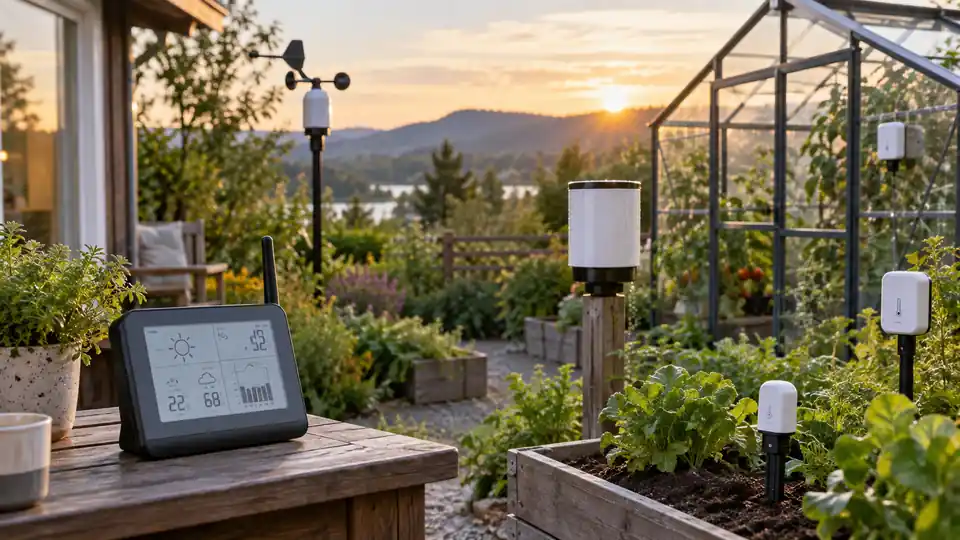
A multi-sensor weather station earns its space when one temperature reading is not enough. A nursery, garage, greenhouse, basement, garden, RV, and backyard can all develop different conditions, and a console that shows several locations at once saves you from walking around with a thermometer in hand. For this category, the useful details are sensor count, simultaneous channel display, wireless range, humidity monitoring, alerts, and whether the console remains readable where you plan to place it.
Wireless sensor transmission should not be confused with Wi-Fi. The stations below send readings from remote sensors to a local display, but the supplied product information does not identify app access, cloud monitoring, or internet connectivity for these models. Range claims are also best-case open-area figures, so walls, floors, metal structures, and placement can affect communication. Sensor position matters too. A temperature sensor exposed to direct sun, pavement, or a warm wall can report conditions that do not represent the surrounding air.
The strongest choices combine three remote sensors with a readable console, useful alerts, and practical power options. Some prioritize a large color display, while others favor battery operation, a longer listed transmission distance, simpler controls, or a more established multi-room design. The Weather Stations Wireless Indoor Outdoor Thermometer with Multiple Sensors takes the top spot because it brings three sensors, four-location viewing, pressure-based forecasting, alerts, and a broad set of everyday functions into one straightforward console.
Quick Answer
- Best Overall: Weather Stations Wireless Indoor Outdoor Thermometer with Multiple Sensors, for a balanced three-sensor setup with a large display, alerts, forecasts, and four-location monitoring.
- Best for Long Listed Range: OBET Weather Station Wireless Indoor Outdoor Thermometer, which lists a 500-foot open-area transmission range and supports three remote sensors.
- Best for Battery Operation: Newentor Weather Station with 3-Sensor, with a console designed for AA battery operation and an always-readable display.
- Best for a Large Color Touchscreen: LFF Weather Station with 3 Sensors, which pairs a 7.5-inch full-color touchscreen with multi-location monitoring.
Best Weather Stations with Multiple Sensors Comparison Table
| Product | Best For | Sensor Setup | Display and Range |
|---|---|---|---|
| Weather Stations Wireless Indoor Outdoor Thermometer | Best overall balance | Three remote sensors, four locations | 7.5-inch VA color display, up to 200 feet open area |
| OBET Weather Station 500 Feet | Long listed transmission range | Three remote sensors | 7.68-inch color display, up to 500 feet open area |
| Newentor Weather Station with 3-Sensor | Battery-powered monitoring | Three remote sensors, four zones | High-contrast display, 200-foot theoretical range |
| Weather Station with 3 Sensors and Large Display | Large, readable household console | Up to three remote sensors | 7.5-inch HD display, up to 328 feet listed |
| Weather Stations Wireless Indoor Outdoor with Multiple Sensors | Four-location viewing | Three sensors, four areas | 7.9-inch class console, up to 200 feet open area |
| LFF Weather Station with 3 Sensors | Color touchscreen controls | Three outdoor sensors plus indoor reading | 7.5-inch touchscreen, up to 330 feet open area |
| AcuRite Multi-Room Weather Station | Established multi-room format | Readings from up to four locations | Illuminated color display, 12-hour forecast |
| PENTASPI Weather Station | Lower-cost multi-zone monitoring | Three wireless sensors, three displayed zones | Color display, USB backlight |
| Newentor Three-Sensors Monitor | Wide viewing angle | Three remote sensors | 7.5-inch VA display, up to 328 feet listed |
The detailed reviews below focus on what each station actually measures, how its sensors and console work together, and where each design makes the most sense.
1. Weather Stations Wireless Indoor Outdoor Thermometer with Multiple Sensors — Best Overall

The appeal here is breadth without requiring a separate display for every room. Three remote sensors report temperature and humidity from three locations, while the console adds its own indoor readings for four displayed areas. That arrangement suits a home where the garage feels chilly, the nursery needs closer humidity attention, and the backyard has its own outdoor conditions. The console also records maximum and minimum values, displays pressure trends, and offers temperature, humidity, and frost alerts.
A 7.5-inch VA color display keeps the information visible from across a room, and the included DC adapter allows the backlight to remain on with four brightness levels. Battery operation changes the experience, since the screen lights for roughly 15 seconds after a touch rather than staying illuminated. The station lists a wireless range of up to 200 feet in open space, so placement still deserves care inside a house with walls and floors. Atomic timekeeping, sunrise and sunset information, moon phase, tide indicators, dual alarms, and comfort icons add useful household functions, though the forecast remains a pressure-based 12-hour indication rather than a substitute for a full local forecast.
Pros
- Includes three remote sensors for four-location temperature and humidity monitoring.
- Displays pressure trends, forecast icons, alerts, historical highs and lows, and frost information.
- Large 7.5-inch VA color display has four adjustable brightness levels when adapter powered.
- Supports both included DC power and battery operation.
- Lists temperature tolerance of ±1.8°F and humidity tolerance of ±5%.
Cons
- Listed wireless range is up to 200 feet in open space, not a guaranteed indoor distance.
- Batteries are not included, and battery mode turns the display off after a short viewing period.
This is the most complete choice for someone who wants a local console that can keep several parts of a property visible at once. It is especially practical beside a kitchen counter or family-room table where alerts and four-location readings can be checked quickly. Buyers seeking Wi-Fi, app access, or online records should look elsewhere, since those capabilities are not identified in the available product information. For multi-sensor household monitoring without that extra connectivity layer, this station has the clearest balance.
To buy this product, click here.
2. OBET Weather Station Wireless Indoor Outdoor Thermometer — Best for Long Listed Range

OBET puts its biggest number on the wireless connection. The listing gives a transmission distance of up to 500 feet in open space, which can be useful for a detached garage, garden, RV, or outbuilding where a shorter listed range may feel restrictive. Three remote sensors can monitor separate places, and the color console shows indoor and outdoor temperature, humidity, maximum and minimum records, pressure, trends, alerts, and forecast icons.
The 7.68-inch screen is slightly larger than several competing consoles here, and its USB power mode keeps the backlight available at adjustable brightness levels. Battery operation is more conservative, with the screen turning off after about 10 seconds. The product information lists temperature accuracy as ±1.8°F and humidity accuracy as ±5%, while also advising that sensors be placed vertically away from direct sun, rain, and the ground. That placement guidance matters more than a headline range figure if a sensor is tucked beside a hot wall or exposed to afternoon sunlight.
Pros
- Supports three remote sensors for multi-location monitoring.
- Lists a 500-foot open-area wireless transmission distance.
- Large 7.68-inch color display shows readings, trends, alerts, and forecast icons.
- Lists temperature accuracy of ±1.8°F and humidity accuracy of ±5%.
- USB power provides adjustable continuous backlighting.
Cons
- USB power is supported, but the listing says the USB plug is not included.
- Battery mode turns the display off after approximately 10 seconds.
This is a sensible pick for a spread-out property where the console and sensors may be separated by more than a typical room or two. The 500-foot figure is an open-area claim, so metal buildings, concrete, and multiple floors can change the result. It also lacks the broader household extras found on the top pick, such as atomic timekeeping and sunrise or moon information, but its straightforward three-sensor layout and larger display keep the focus on location monitoring.
To buy this product, click here.
3. Newentor Weather Station with 3-Sensor — Best for Battery Operation
A console that can run on AA batteries gives this Newentor model a different kind of flexibility. A bedroom, basement, cabin, or room without a convenient outlet can still have a permanent display, and the product information describes battery operation lasting up to 12 to 24 months. The console shows readings from four locations simultaneously, so there is no need to tap through channels to see what is happening in the nursery, basement, and yard.
The high-contrast display is intended to remain readable without a constantly lit backlight, which is useful on a bedside table or in a hallway where a bright screen would be distracting. The station also includes an atomic clock, maximum and minimum records, alerts, barometric trends, and a forecast function. Its listed transmission range is 200 feet in theory. That is adequate for many homes, but the product information does not promise a particular performance through walls, so sensor placement should still begin with a close connection test.
Pros
- Displays temperature and humidity from four locations at the same time.
- Console is listed for AA battery operation lasting up to 12 to 24 months.
- High-contrast display is intended to remain readable without constant backlighting.
- Includes atomic timekeeping, alerts, maximum and minimum records, and pressure trends.
- Supports up to three remote sensor channels.
Cons
- Listed wireless range is 200 feet in theory, with indoor performance affected by building materials.
- The product information does not identify Wi-Fi, app, or cloud access.
This is the better fit for someone who wants multi-room readings without making the console dependent on a wall outlet. It gives up the larger range claims and elaborate display lighting of some rivals, but the always-readable design and battery emphasis are meaningful in a cabin, basement, or room where a power cord becomes a nuisance. It is less suitable for anyone expecting remote internet monitoring or a rain and wind instrument, since its supplied sensor arrangement focuses on temperature and humidity.
To buy this product, click here.
4. Weather Station Wireless Indoor Outdoor with 3 Sensors — Best for a Large Household Display

For a kitchen wall or family-room shelf, screen layout can matter as much as the sensor count. This model uses a 7.5-inch HD display with high-contrast sections for temperature, humidity, forecast, time, and date. Three remote sensors can be connected, letting one console cover several rooms or outdoor locations. The listed transmission distance reaches up to 328 feet, although that figure applies to the stated maximum and should not be treated as a promise through a finished building.
The station uses barometric pressure trends to generate a forecast for an area described as roughly 8 to 12 miles around the home. The listing says pressure calibration requires seven to 10 days for the forecast to become accurate for the location, a useful reminder that forecast icons need a settling period. A power adapter keeps the display lit, while batteries provide backup and trigger a short 15-second viewing period when the screen is touched. Atomic time synchronization, moon phase, pressure, and dual power modes round out the household feature set.
Pros
- Large 7.5-inch HD display organizes readings for quick viewing.
- Supports up to three remote sensors for multi-location monitoring.
- Lists a transmission distance of up to 328 feet.
- Offers both adapter power and battery backup for the console.
- Includes atomic clock functions, moon phase, pressure trends, and forecast icons.
Cons
- Forecast calibration is listed as taking seven to 10 days.
- Battery mode does not keep the screen continuously illuminated.
This option suits a household that wants a substantial, easy-to-read console and does not mind using the adapter for normal operation. The forecast needs patience after setup, and the station does not replace a rain gauge, wind sensor, or internet-connected monitoring system. Its advantage is the mix of a large display, three-sensor support, and backup power, especially for someone who wants readings visible from a chair rather than on a small bedside screen.
To buy this product, click here.
5. Weather Stations Wireless Indoor Outdoor with Multiple Sensors — Best for Four-Location Viewing

This station keeps the central use case uncomplicated: three sensors, four monitored areas, and a screen that shows the readings together. That can translate into a bedroom, baby room, kitchen, and yard, or a living area, garage, greenhouse, and patio. The product information lists a sensor range of up to 200 feet in open space and says the readings may take several hours to stabilize after setup.
The console combines temperature and humidity readings with six forecast icons, pressure information, maximum and minimum records, a radio clock, and two alarms. It can remain lit through the included AC adapter, with four brightness settings, or switch to a short viewing period under battery power. Sensor pairing may take up to three minutes, and the listing recommends placing the console and sensors together before moving the remote units. That initial step is easy to overlook, yet it can prevent a cold morning of wondering why one channel is blank.
Pros
- Three included sensors provide simultaneous readings from up to four areas.
- Displays six forecast icons based on temperature, humidity, and pressure information.
- Includes a radio clock, two alarms, maximum and minimum records, and low-battery information.
- Offers four brightness levels when powered by the included adapter.
- Listing provides a clear initial pairing and stabilization procedure.
Cons
- Listed wireless range is up to 200 feet in open space.
- AA batteries are not included, and battery mode switches the display off after about 10 seconds.
This is a practical middle-ground choice for a house that needs several temperature and humidity points without chasing specialized weather instruments. The setup instructions are more explicit than many listings, which helps when three sensors need to be assigned and connected. It is less appealing for remote internet monitoring or a large rural property, but for four-location local viewing, the package has a clear purpose and a manageable installation routine.
To buy this product, click here.
6. LFF Weather Station with 3 Sensors — Best for a Color Touchscreen

The LFF model leans into the display experience with a 7.5-inch full-color touchscreen and touch controls for its functions. Three wireless sensors can monitor temperature and humidity indoors and in three other locations, with the product information listing up to 330 feet, or 100 meters, in an open area. Channel assignment matters here. The sensors need to be set to channels 1, 2, and 3 so the console can connect to all of them.
Its feature list includes atomic time, seven time zones, dual alarms, comfort indicators, pressure, maximum and minimum records, and a six-icon forecast for roughly the next six to 12 hours. The console stays lit on its AC adapter and turns off after about 10 seconds on batteries. Touch controls can feel more immediate than a row of tiny buttons, though they also mean the screen and control layout are central to the ownership experience. The supplied information does not identify Wi-Fi or app functions, so this remains a local display system rather than a remote-monitoring station.
Pros
- Includes three wireless sensors for indoor and multi-location monitoring.
- 7.5-inch full-color touchscreen presents readings and forecast icons prominently.
- Lists an open-area transmission range of up to 330 feet.
- Provides atomic time, seven time zones, two alarms, and comfort indicators.
- Includes three adjustable backlight levels and two power modes.
Cons
- Correct channel assignment is required for all three sensors to connect.
- AAA batteries are not included, and battery mode turns the display off after about 10 seconds.
Choose this model if a large touch interface sounds more appealing than a button-heavy console. It gives a detached garage or garden more reach on paper than the 200-foot models, while still keeping temperature and humidity from four places visible locally. It is not the right direction for a buyer who needs rainfall, wind, app alerts, or cloud history, since those functions are not identified. Its strength is the clear, touch-oriented presentation of multiple indoor and outdoor zones.
To buy this product, click here.
7. AcuRite Multi-Room Weather Station 02082M — Best for a Multi-Room Format
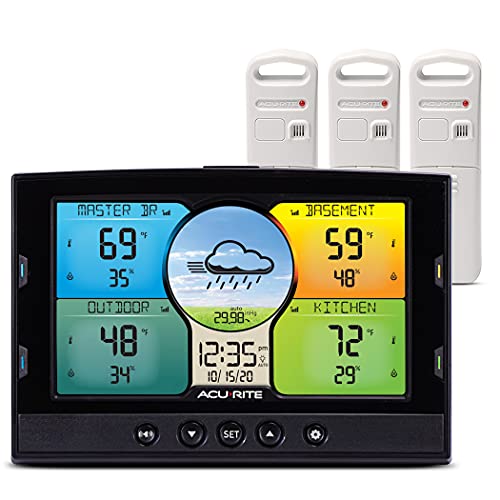
AcuRite takes a slightly different route from the three-remote-sensor packages above. Its product information describes environmental conditions from up to four locations, with a color display showing temperature and humidity readings together. The console also has built-in temperature, humidity, and barometric pressure sensors, while an outdoor thermometer sensor supplies the conditions used for its 12-hour personalized forecast.
That structure makes the station attractive for someone who wants a familiar multi-room snapshot rather than a long list of household clock functions. Programmable alarms can signal when conditions move beyond selected limits, which is useful for a nursery, storage room, or area where temperature and humidity deserve attention. The supplied information does not identify the exact number of included remote sensors in the same three-sensor terms used by several alternatives, nor does it identify Wi-Fi or app access. That makes the configuration worth confirming before purchase if the number of included transmitters is central to your plan.
Pros
- Monitors environmental conditions in up to four locations.
- Color display shows temperature and humidity readings from the monitored areas.
- Console includes temperature, humidity, and barometric pressure sensors.
- Uses outdoor sensor information for a 12-hour personalized forecast.
- Programmable alarms can respond to selected environmental limits.
Cons
- The supplied information does not clearly detail the included sensor count as a three-sensor package.
- Wi-Fi, app, and cloud monitoring are not identified.
This is the right alternative for a reader who prefers AcuRite’s multi-room presentation and needs temperature and humidity visibility more than extra moon, tide, or alarm functions. It ranks below the clearer three-sensor packages because the included sensor arrangement is less explicit in the available information. Check the current listing carefully before ordering if you need three separate remote locations specifically, but the four-location format and programmable alarms give it a legitimate place here.
To buy this product, click here.
8. PENTASPI Weather Station with 3 Sensors — Best for Lower-Cost Multi-Zone Monitoring

PENTASPI focuses on a compact information hub for three monitored zones. The supplied description mentions indoor, outdoor, and refrigerator readings on one screen, with three color-coded wireless sensor transmitters intended to make the channels easier to distinguish. That setup could be handy in a home where a freezer or refrigerator needs a separate temperature check, although the product information does not describe a dedicated food-storage certification or specialized probe.
The display also records maximum and minimum temperature and humidity, shows pressure graphs, provides high and low alerts, and presents seven forecast symbols. Its listed outdoor temperature guard spans -4°F to 158°F, while the humidity range is given as 20% to 95% for the stated sensor information. USB power keeps the adjustable backlight available, and battery mode dims the screen after about 10 seconds. A USB cable is included, but the plug and batteries are not. The console is a useful local monitor, yet Wi-Fi and app access are not identified.
Pros
- Includes three color-coded wireless sensor transmitters.
- Supports simultaneous monitoring of three zones, including a refrigerator location.
- Lists high and low alerts, maximum and minimum records, and pressure graphs.
- Provides seven forecast symbols instead of a smaller five-icon set.
- Includes a USB cable and adjustable backlight settings.
Cons
- USB plug and batteries are not included.
- The supplied information does not identify a wireless transmission distance or app access.
This model works for a reader who values zone labeling and a refrigerator channel more than a long stated outdoor range. The color-coded sensors could reduce the little mental scramble that happens when several nearly identical readings appear on a screen. It is less compelling for a detached outbuilding or large garden because the listing does not give a transmission-distance figure. For compact local monitoring with alerts and a broad outdoor temperature range, it remains a focused alternative.
To buy this product, click here.
9. Newentor Weather Stations Wireless Indoor Outdoor with 3-Sensors Monitor — Best for Wide Viewing Angles

The newer Newentor monitor emphasizes visibility and sensor placement. Its 7.5-inch VA display is described as having a 170-degree viewing angle, which may help when the console sits on a kitchen counter and people approach from different directions. Three remote sensors extend monitoring across a home, garden, or patio, and the listed transmission distance reaches up to 328 feet. As with every range figure here, the number describes the advertised open-area capability rather than a guaranteed result through walls.
The outdoor sensors are described with a larger number of ventilation holes intended to support temperature and humidity response, while the console uses AC power or three AA batteries. The adapter is included, but batteries are not, and each outdoor sensor requires two AA batteries. Atomic clock synchronization through WWVB or RCC keeps time and date updated automatically. This product information says little about pressure-based forecasting, alerts, or historical records compared with the more feature-heavy stations above, so its appeal is centered on readable multi-sensor monitoring and setup simplicity.
Pros
- Includes three remote sensors for coverage across home, garden, or patio areas.
- 7.5-inch VA display is listed with a 170-degree viewing angle.
- Lists an open-area transmission distance of up to 328 feet.
- Includes an AC adapter and supports console battery backup.
- Provides WWVB or RCC atomic clock synchronization.
Cons
- AA batteries for the console and outdoor sensors are not included.
- The supplied information does not clearly identify Wi-Fi, app access, or cloud records.
This is a good fit for a shared household display where readability from the side matters. It offers the same core multi-sensor idea as several higher-ranked products, but its wider-view display and stated sensor ventilation design give it a distinct angle. Buyers who want forecast history, extensive alarms, or richer console functions may prefer the first few choices. Buyers who mainly need a clear snapshot from several locations can keep this simpler design in contention.
To buy this product, click here.
Buying Guide
Wireless Sensor Links Are Not Wi-Fi
All of the products in this roundup are built around wireless communication between remote sensors and a local console. That is useful for avoiding cables across a yard or between rooms, but it does not mean the readings can be viewed from a phone while you are away. The supplied information does not identify Wi-Fi, app access, cloud storage, Weather Underground uploads, or Home Assistant compatibility for these models. If checking conditions from work or while traveling matters, confirm that capability separately before ordering.
Count the Included Sensors, Not the Supported Channels
A console may support three channels, but the package may include one, two, or three remote sensors. Those are different things. The top choices here clearly describe three included sensors, while the AcuRite listing describes monitoring up to four locations without presenting the included arrangement in the same detail. Read the package contents carefully if you need a garage, greenhouse, basement, and outdoor location visible at the same time.
Range Figures Describe Favorable Conditions
Listings commonly describe wireless range in open space. A 500-foot claim may sound ideal for a large property, but walls, floors, metal siding, concrete, terrain, and interference can reduce the usable distance. Place the console and sensors together during initial pairing when the instructions recommend it, then move each sensor gradually. A shorter listed range can still work better than a longer one if the building layout is simple.
Temperature and Humidity Placement Matter
Remote sensors should represent the air you want to monitor. Direct sunlight, a dark wall, pavement, a roof, or a heat source can distort a temperature reading. OBET specifically advises placing its sensors vertically away from sun, rain, and the ground. That is useful guidance for any of these systems. A multi-sensor station can reveal differences between rooms, but poor placement can create differences that belong to the installation rather than the weather.
Accuracy Is Different From Resolution
A display showing one decimal place does not automatically measure to that precision. Accuracy describes how close a reading is expected to be to a reference, while resolution describes the increments shown on the screen. The supplied listings for several products give temperature or humidity accuracy claims, but those remain listing specifications rather than independent verification. Compare like with like, and do not treat a larger display or extra digits as proof of better sensor performance.
Decide Whether a Constantly Lit Display Matters
Most of these consoles use two power modes. An adapter can keep the display illuminated, while batteries usually activate the screen briefly after a button press or touch. That difference matters if the station will sit in a dark hallway, on a nightstand, or across a room where you want to glance over without touching it. Battery operation adds placement freedom, but it usually trades away continuous backlighting.
Forecast Icons Are Local Estimates, Not Full Weather Reports
Several stations use barometric pressure trends, temperature, and humidity information to generate icons for conditions such as sunny, cloudy, rain, or snow. These icons can help with a quick household glance, but they are derived forecasts rather than direct measurements of future weather. Some listings also state that the pressure system needs several days to calibrate. Treat the display as a convenient local trend indicator, not as a replacement for a detailed forecast.
Best Weather Stations with Multiple Sensors FAQ
What does a multi-sensor weather station measure?
These models primarily measure temperature and relative humidity at several locations. Their consoles may also display barometric pressure, pressure trends, maximum and minimum records, comfort indicators, alerts, and forecast icons. The products reviewed here do not present a consistent built-in rain gauge, anemometer, UV sensor, or lightning detector, so check the sensor list before expecting those measurements.
Are these weather stations Wi-Fi enabled?
The supplied product information describes wireless sensor-to-console communication, but it does not identify Wi-Fi connectivity for the reviewed models. Wireless means the outdoor or remote sensors transmit to the included display. It does not automatically mean the station connects to your router, supports an app, or provides remote internet access.
Can one console show several sensor locations at once?
Yes. Several models here display readings from three remote sensors plus the console location, creating four visible areas. The OBET, Newentor, LFF, and other three-sensor systems are intended for locations such as bedrooms, garages, gardens, patios, basements, and outdoor areas. Confirm the channel layout and included sensor count before purchase.
Is the advertised wireless range guaranteed inside a house?
No. Listed distances generally describe open-area conditions. Walls, floors, concrete, metal structures, interference, and sensor placement can reduce communication distance. A station advertising 500 feet may have more range potential than one listing 200 feet, but neither figure guarantees a particular indoor installation.
Do these stations measure rain and wind?
The supplied information for these nine products centers on temperature, humidity, pressure, and forecast functions. It does not clearly identify a rain gauge or wind-speed and wind-direction sensor for the reviewed configurations. Choose a complete weather station with those dedicated sensors if precipitation or wind data is required.
Should the outdoor sensors be placed in direct sunlight?
Direct sunlight can heat a sensor and affect the temperature it reports. The OBET listing specifically advises placing sensors away from direct sun, rain, and the ground. For all models, follow the product instructions and choose a ventilated location that represents the air conditions you want to monitor.
Do these stations keep the screen on when running on batteries?
Usually, no. The reviewed models generally use a short temporary display period in battery mode to conserve power. Adapter operation typically allows continuous backlighting, with brightness controls on many models. Check the individual listing if constant visibility is important.
Which type is best for a greenhouse or basement?
A three-sensor model is useful when the console can show the greenhouse, basement, and indoor reference location together. The Newentor three-sensor model is particularly suited to battery-powered placement, while the top Weather Stations Wireless Indoor Outdoor Thermometer offers alerts, pressure trends, and four-location viewing. None of the supplied information identifies dedicated soil sensors or greenhouse-specific controls.
Final Verdict
The Weather Stations Wireless Indoor Outdoor Thermometer with Multiple Sensors is the strongest overall choice because it combines three remote sensors with four-location viewing, a 7.5-inch color console, adjustable backlighting, alerts, pressure trends, forecast icons, and useful household functions. Its 200-foot open-area range is more modest than OBET’s 500-foot listing, but the broader feature balance makes it easier to recommend for an ordinary home with several rooms or nearby outdoor areas.
Choose the OBET if a longer listed transmission distance is the priority, or the Newentor three-sensor station if battery operation and an always-readable display matter more than a long feature list. The LFF is a good alternative for a large touchscreen, while the PENTASPI makes sense for compact three-zone monitoring that includes a refrigerator location. Whichever model you choose, verify the included sensor count, plan the sensor locations before mounting them, and treat wireless range and forecast icons as practical aids rather than guarantees.