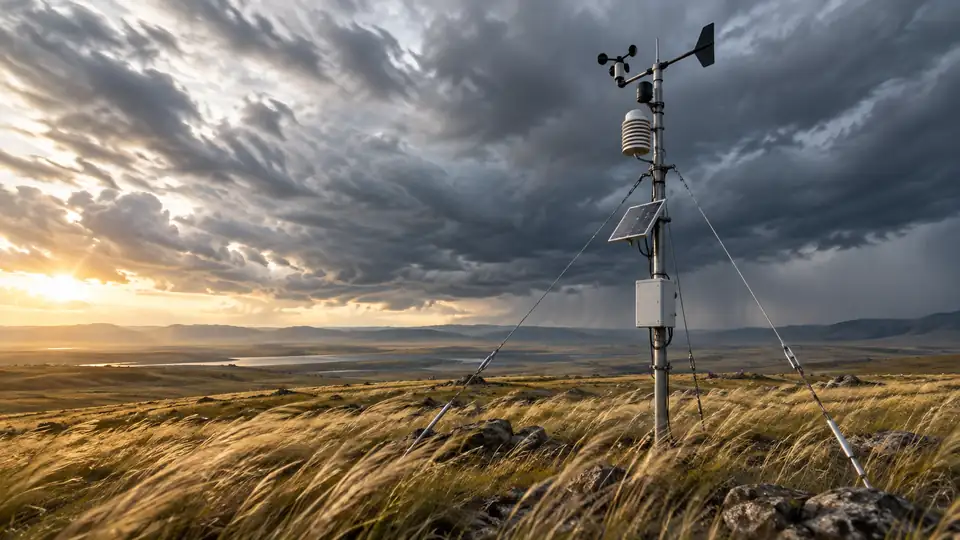
High wind makes a weather station work harder as a monitoring tool. You need dependable wind speed and direction readings, a sensor arrangement that can be mounted with clear exposure, and a console or app that lets you see changing conditions without standing outside in the gusts. Rainfall, barometric pressure, temperature, and humidity add useful context, but a long wireless range or a broad measurement list does not prove that an outdoor assembly can withstand severe wind. Structural stability still depends on the mounting location, hardware, and installation.
The biggest shopping trap is treating every wireless station as a Wi-Fi station. A wireless sensor may communicate only with its indoor display, while Wi-Fi can send data to an app, weather network, or smart-home service. Advertised transmission distance also deserves a careful reading. A listed maximum may apply to open conditions, while walls, metal buildings, trees, and terrain can reduce the usable connection. For exposed properties, the Tempest Weather Station stands out because its listing combines wind monitoring, app access, a stated 1,000-plus-foot wireless range, and a sensor with no moving parts.
The comparison below gives extra weight to wind and direction monitoring, remote access, sensor placement, data history, display usefulness, and installation trade-offs. Some stations are better for a connected property, while others make more sense for a large easy-to-read local display or a lower-cost setup.
Quick Answer
- Best Overall: Tempest Weather Station for its wind monitoring, app access, smart-home compatibility, three-second updates, solar-powered outdoor sensor, and stated 1,000-plus-foot wireless range.
- Best Connected Home Alternative: Ambient Weather WS-2902 Wi-Fi Smart Weather Station for wind, rain, UV, solar radiation, remote access, alerts, and smart-home features.
- Best for Data Logging: Sainlogic 10-in-1 WiFi Weather Station for app alerts and up to two years of stored data with Excel export.
- Best for Weather Underground: AcuRite Iris 5-in-1 Home Weather Station for its stated Wi-Fi connection to Weather Underground and broad local weather readings.
Best Weather Stations for High Winds Comparison Table
| Product | Wind And Weather Data | Connectivity | Sensor And Installation Notes | Best For |
|---|---|---|---|---|
| Tempest Weather Station | Wind speed/direction, rain, temperature, humidity, pressure, UV, solar radiation, lightning | App, Alexa, Rachio, IFTTT, smart-home platforms | Solar-powered sensor, no moving parts, listed 1,000-plus-foot range | Connected high-wind monitoring |
| Ambient Weather WS-2902 | Wind speed/direction, rain, temperature, humidity, UV, solar radiation | Wi-Fi, Ambient Weather Network, Alexa, Google Home, IFTTT | Integrated Osprey sensor array with rain cup | Remote home monitoring |
| Sainlogic 10-in-1 WiFi | Wind, rain, temperature, humidity, pressure, dew point | 2.4GHz Wi-Fi, Weatherseed app, alerts | Outdoor sensor with bracket, up to two years of data storage | App alerts and data history |
| AcuRite Iris 5-in-1 01540M | Wind speed/direction, rain, temperature, humidity, pressure | Wi-Fi connection to Weather Underground | Integrated wireless sensor and color display | Weather network uploads |
| Sainlogic 5G/2.4G WiFi Smart Station | Wind, rain, temperature, humidity, pressure | Dual-band Wi-Fi, Bluetooth pairing, app, Weather Underground sync | Listed 443-foot open-area wireless range and bubble level | Modern router compatibility |
| Grillum Smart WiFi Weather Station | Wind, rain, temperature, humidity, pressure, UV | 2.4GHz Wi-Fi and smartphone app | Listed 328-foot range, solar panel or three AA batteries for sensor | Lower-cost connected monitoring |
| Ambient Weather WS-2000 | Wind speed/direction, rain, temperature, humidity, UV, solar radiation | Wi-Fi option and personal weather network support | Integrated sensor array, display uses a 5V adapter | Large-property weather dashboards |
| AcuRite Iris 01535M | Wind, rain, temperature, humidity, pressure, dew point | Local wireless console | Mounting bracket included, optional lightning sensor support | Local alerts and simple setup |
| AIRAIN TECH Wireless Weather Station | Wind, rain, temperature, humidity, pressure, UV, dew point | Local wireless connection, no Wi-Fi | Two displays, listed 328-foot range, mounting pole included | Large local displays |
The detailed reviews explain how each station handles wind-focused monitoring, data access, sensor placement, and the limitations that matter in an exposed installation.
1. Tempest Weather Station — Best Overall
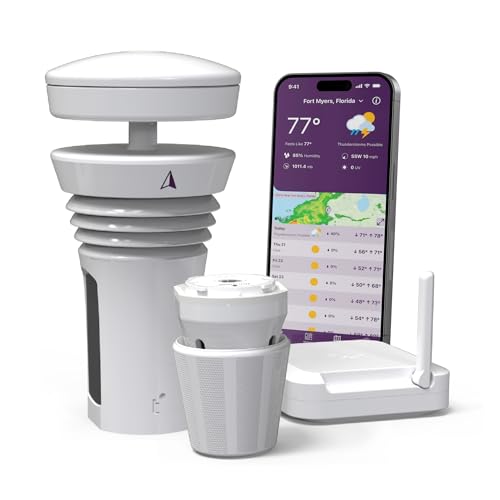
Wind monitoring is the reason this station takes the top position. The listing identifies wind speed and direction among its measurements, with temperature, humidity, barometric pressure, rain, dew point, solar radiation, UV index, and lightning strikes also included in the data set. That broad coverage is useful when a gusty afternoon turns into a fast-moving storm, since the console or app can show more than a single wind number. It gives the surrounding conditions some context.
The outdoor sensor is solar powered, transmits wirelessly up to a listed 1,000-plus feet, and provides updates every three seconds according to the product information. Its no-moving-parts design is a meaningful distinction for a property where a traditional rotating wind assembly may be difficult to reach for maintenance. App access and integrations with Alexa, Rachio, IFTTT, and popular smart-home platforms make this the strongest option for checking conditions away from the display or using weather data in automations. The listing does not provide a structural wind-survival rating, so a careful mount remains part of the system.
Pros
- Measures wind speed and direction along with rain, pressure, temperature, humidity, UV, solar radiation, and lightning.
- Outdoor sensor uses a no-moving-parts design.
- Listed wireless transmission distance exceeds 1,000 feet.
- Updates are listed at three-second intervals.
- Supports app access, Alexa, Rachio, IFTTT, and other smart-home platforms.
Cons
- The listing does not specify a structural wind-resistance or survival rating.
- The outdoor sensor still needs a suitable location with clear exposure and secure mounting.
This is the most complete choice for a connected property where wind changes need to be visible quickly and remotely. It suits a homeowner managing irrigation or smart-home routines as well as someone who wants local observations while away from the station. A buyer seeking a simple, display-only system may find its connected features unnecessary, and the stated wireless range should be treated as a favorable maximum rather than a guarantee through buildings.
To buy this product, click here.
2. Ambient Weather WS-2902 Wi-Fi Smart Weather Station — Best Connected Home Alternative
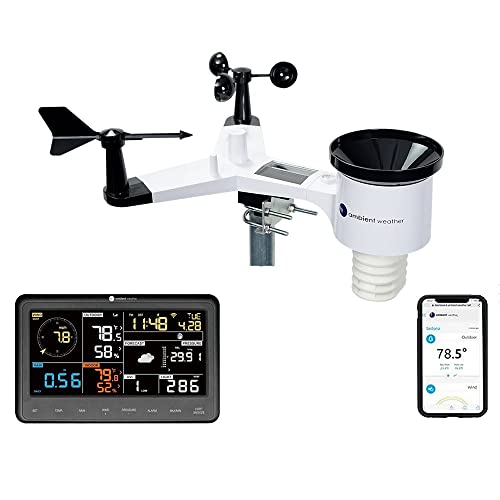
The WS-2902 brings the important wind readings into a broader home weather system. Its Osprey sensor array measures wind speed and direction, temperature, humidity, rainfall, UV intensity, and solar radiation, while the included color display keeps local readings visible without opening a phone. That combination works well beside a house, workshop, or garden where someone wants to glance at changing conditions while also keeping a longer record online.
Wi-Fi is the major advantage over a local-only station. The listing says users can set alerts, access data remotely, and connect with IFTTT, Google Home, Alexa, and the Ambient Weather Network. Those features give high-wind monitoring a practical remote dimension, although the product information does not state a wind measurement range or a structural rating for severe gust exposure. The integrated sensor array simplifies the installation compared with a system built from separate instruments, but placement still matters. A roof edge, wall, tree line, or nearby heat source can affect the readings.
Pros
- Measures wind speed and direction, rainfall, temperature, humidity, UV, and solar radiation.
- Includes an Osprey sensor array and color LCD display.
- Supports remote data access and alerts through Wi-Fi features.
- Lists IFTTT, Google Home, and Alexa compatibility.
- Can transmit data to the Ambient Weather Network as an optional setting.
Cons
- The product information does not provide a wind measurement range or structural wind rating.
- The integrated array limits the freedom to place each sensor separately.
The WS-2902 is a strong fit for someone who wants a full set of outdoor observations without stepping into a more specialized system. It ranks behind Tempest because the supplied information gives less detail about update speed and sensor construction, yet its Wi-Fi and smart-home support remain compelling. Choose it for connected home monitoring, especially if the color display and Ambient Weather ecosystem appeal to you.
To buy this product, click here.
3. Sainlogic 10-in-1 WiFi Weather Station — Best for Data Logging

For a property where wind observations need to become a record rather than a passing glance, this Sainlogic model offers a useful data feature. The Weatherseed app can record information for up to two years and export selected periods to Excel, with each export covering up to 30 days. The station measures wind speed, wind direction, rainfall, temperature, humidity, and barometric pressure, while dew point and other displayed values provide additional context for changing conditions.
The station uses 2.4GHz Wi-Fi and sends alerts for changes in temperature, humidity, and pressure. Its enlarged display is useful in a kitchen, office, or workshop where a quick read matters more than a dense dashboard. The listing gives rainfall claims of ±1 mm below 15 mm and ±7 percent from 15 to 9,999 mm. Those are product-listing specifications for rainfall, not independent verification, and they do not describe wind accuracy. The outdoor sensor should be mounted according to its instructions, especially because wind direction can be affected by poor orientation or nearby obstructions.
Pros
- Measures wind speed and direction, rainfall, temperature, humidity, and pressure.
- Weatherseed app supports alerts for selected weather changes.
- Stores up to two years of data according to the listing.
- Supports Excel export, with exports covering up to 30 days at a time.
- Uses an enlarged, high-contrast display.
Cons
- Wi-Fi support is limited to 2.4GHz networks.
- The supplied information does not state a wind measurement range or structural rating.
This station makes sense for garden records, property monitoring, and seasonal comparisons where a spreadsheet is more useful than a simple current reading. It is less attractive for someone who wants broad smart-home integration or a stated long-distance wireless specification. The two-year storage feature is the reason to choose it over a simpler console, while the 2.4GHz requirement is the main setup detail to check first.
To buy this product, click here.
4. AcuRite Iris 5-in-1 Home Weather Station 01540M — Best for Weather Underground
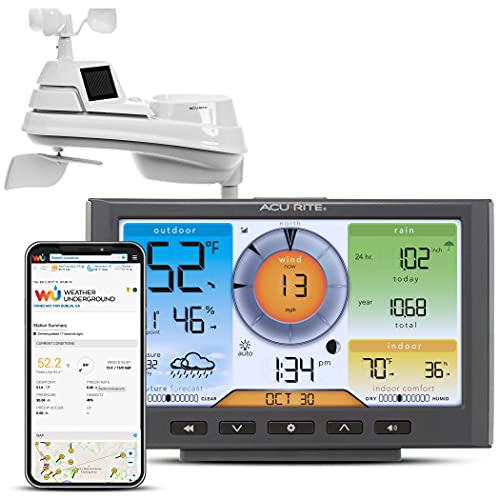
The 01540M is a sensible choice for readers who specifically want to share local observations through Weather Underground. Its wireless outdoor station measures wind speed and direction, rainfall, temperature, humidity, and barometric pressure, while the color display shows the readings indoors. The listing also identifies a built-in anemometer, wind vane, rain gauge, barometer, hygrometer, and thermometer, making the system relevant to high-wind monitoring without requiring a collection of separate instruments.
Wi-Fi connects the display to Weather Underground for remote monitoring and data sharing. That is a more specific platform claim than generic “smart” language, which helps this model stand out. The station also tracks historical information, heat index, dew point, wind chill, and rainfall history. Those derived values can help interpret a blustery day, but they should not be mistaken for separate direct wind measurements. No wind range or outdoor structural rating is supplied, so exposed mounting needs careful attention.
Pros
- Explicitly supports a Wi-Fi connection to Weather Underground.
- Measures wind speed and direction, rainfall, temperature, humidity, and pressure.
- Includes a color display with adjustable dimming.
- Tracks historical data and rainfall history.
- Displays derived values such as wind chill, dew point, and heat index.
Cons
- The supplied information does not identify a wind measurement range or structural wind rating.
- Its platform support is more specific to Weather Underground than to a broad list of smart-home services.
Pick this AcuRite when Weather Underground is central to the purchase and you still want a conventional indoor display. It is a better match than a local-only station for someone who wants to view or share observations away from home. Buyers who prefer an app-first system or detailed long-term export tools may find the Sainlogic or Tempest options more suitable.
To buy this product, click here.
5. Sainlogic 5G/2.4G WiFi Smart Weather Station — Best for Dual-Band Wi-Fi

A modern router can complicate the setup of a weather station that accepts only 2.4GHz Wi-Fi. This Sainlogic model addresses that part of the experience by listing support for both 5GHz and 2.4GHz networks, along with Bluetooth fast pairing. Its sensor reports wind speed and direction, rainfall, temperature, humidity, and barometric pressure, while the app provides current readings, alerts, rainfall totals, and stored weather information.
The product information lists an open-area wireless transmission distance of up to 443 feet and a bubble level in the sensor assembly to help with horizontal placement. That range may be useful across a spacious property, but it is still a listed maximum rather than a promise through walls, metal outbuildings, or uneven terrain. The station also stores up to two years of data and supports Excel export, with each export covering up to 30 days. Temperature and humidity accuracy claims are supplied for the exact listing, while comparable wind accuracy is not given.
Pros
- Supports both 5GHz and 2.4GHz Wi-Fi according to the listing.
- Includes Bluetooth fast pairing.
- Lists wind, rain, temperature, humidity, and pressure monitoring.
- Provides app alerts, Weather Underground synchronization, and data history.
- Lists up to 443 feet of open-area wireless transmission and includes a bubble level.
Cons
- The stated 443-foot range may be reduced by walls, terrain, and other obstructions.
- The supplied information does not give a wind measurement range or structural wind-resistance rating.
This is a practical choice for someone who wants current router compatibility, app alerts, and long-term records in one package. It ranks below the leading connected stations because the supplied information provides less detail about smart-home control and sensor construction. It can be especially useful across a detached garage, garden, or larger residential property, provided the wireless path is favorable.
To buy this product, click here.
6. Grillum Smart WiFi Weather Station — Best for Lower-Cost Connected Monitoring

Grillum takes a compact, connected approach to wind monitoring. Its combined outdoor sensor includes a wind vane, wind cups, rain funnel, temperature and humidity sensor, light sensor, UV sensor, and solar panel. The station reports wind speed, rainfall, pressure, temperature, humidity, UV index, feels-like temperature, and a 12-hour forecast on a 7.5-inch display. For a backyard or small property, that is a substantial local information panel without moving into a more elaborate system.
The app provides current and historical conditions remotely, including wind and rainfall history. The sensor has a listed transmission range of up to 328 feet and can support up to three additional standard sensors, although those extra sensors are not included. A key limitation is the power arrangement: Wi-Fi works only while the display is plugged in, and the display stays off on battery power except for a brief wake-up after a touch. The outdoor sensor uses solar power or three AA batteries, which does not mean the full station is solar powered.
Pros
- App provides remote current readings and historical weather data.
- Outdoor assembly includes wind, rain, temperature, humidity, light, UV, and solar functions.
- 7.5-inch display shows wind and several other readings together.
- Lists support for up to three additional standard sensors.
- Outdoor sensor uses solar power or three AA batteries.
Cons
- Wi-Fi operation requires the display to be plugged in.
- The station supports only 2.4GHz Wi-Fi, and additional sensors are not included.
Grillum suits a connected backyard setup where app access and a broad local display matter more than advanced platform integration. It is a weaker fit for a property relying on battery-only operation at the console, since remote Wi-Fi functions are unavailable in that state. Check the router setup and plan the sensor location before ordering, especially if the outdoor assembly will sit beyond the main house.
To buy this product, click here.
7. Ambient Weather WS-2000 Smart Weather Station — Best for a Full Sensor Dashboard
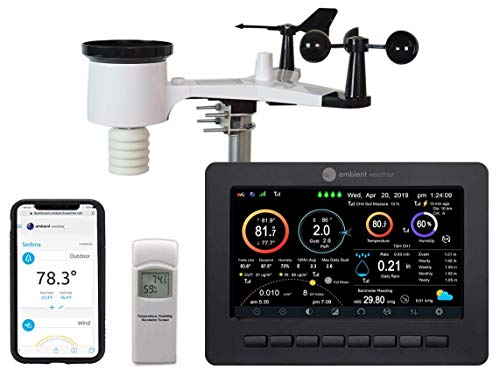
The WS-2000 focuses on a color TFT display and a complete integrated outdoor sensor array. Wind speed and direction sit alongside temperature, humidity, rainfall, UV, and solar radiation, giving a high-wind location several useful observations in one dashboard. The station supports imperial and metric units and allows calibration according to the supplied product information, which gives experienced users more control over how readings are displayed and adjusted.
Its Wi-Fi connectivity option allows the station to send data to a personal weather network. The listing does not provide the same detailed app, alert, or smart-home information described for some other connected models, so it is better viewed as a dashboard-oriented system than an all-purpose automation platform. The console uses a 5V DC adapter, while the outdoor sensor array requires three AAA batteries. That split matters in a shed, cabin, or detached workspace where power access may be limited.
Pros
- Integrated array measures wind speed and direction, rain, temperature, humidity, UV, and solar radiation.
- Includes a TFT color display.
- Supports imperial and metric units.
- Calibration is listed as available.
- Wi-Fi can transmit data to a personal weather network.
Cons
- The supplied information does not detail app alerts, smart-home control, or remote access beyond network transmission.
- The console requires a 5V DC adapter and the sensor array requires three AAA batteries.
This station is a good fit for someone who values a clear local dashboard and a broad set of outdoor measurements. It gives up some of the explicit remote-control detail found on Tempest and the WS-2902, but it remains relevant for exposed properties that need wind and solar observations together. Verify the intended Wi-Fi and network functions before buying if away-from-home access is a primary requirement.
To buy this product, click here.
8. AcuRite Iris Weather Station 01535M — Best for Local Wind Alerts
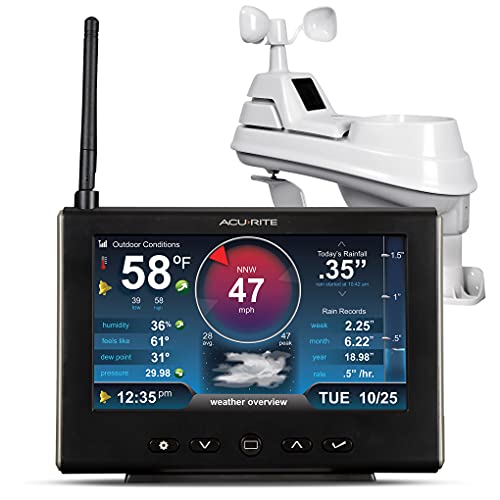
The 01535M is built around direct indoor viewing and configurable local alerts. It reports wind speed and direction, rainfall, indoor and outdoor temperature, humidity, and barometric pressure, then uses the display to show more than 25 data points. Wind, rainfall, temperature, humidity, and pressure alarms can help someone notice changing conditions while working indoors. A storm alarm based on falling pressure adds another signal, although pressure trends should be treated as context rather than a guarantee of severe weather.
Installation is straightforward in concept. The listing says to install batteries, attach the outdoor sensor to a pole or post with the included mounting bracket, and place the display inside. An optional AcuRite lightning sensor can expand the system, but that sensor is sold separately and is not part of the included weather station. The local wireless design avoids router setup, yet it also means the supplied information does not establish app-based remote access or cloud monitoring.
Pros
- Measures wind speed and direction, rain, temperature, humidity, and pressure.
- Offers customizable alarms for wind, rainfall, temperature, and humidity.
- Includes an HD display with weather history and derived readings.
- Outdoor sensor mounting bracket is included.
- Supports an optional lightning sensor sold separately.
Cons
- The supplied model information does not identify Wi-Fi or remote monitoring.
- The optional lightning sensor is not included.
Choose this AcuRite when the priority is a local screen and practical alerts rather than phone access. It can work well in a home office, kitchen, or workshop where wind changes need to be noticed quickly. Readers who need observations while away from the property should move up to a Wi-Fi model, while readers who want the simplest possible system may appreciate the lack of network setup.
To buy this product, click here.
9. AIRAIN TECH Wireless Weather Station — Best for Two Local Displays
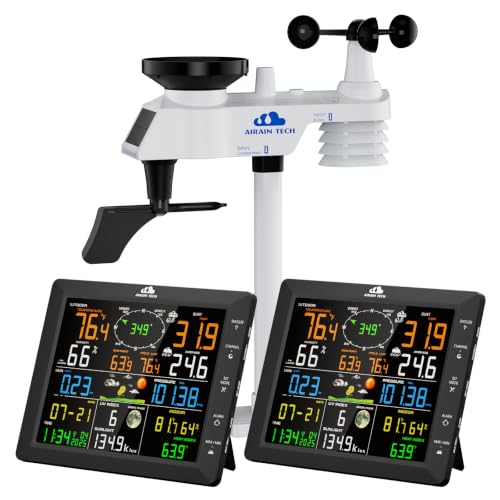
AIRAIN TECH takes a local-monitoring approach with two main displays, an outdoor sensor, and an included mounting pole. The system reports wind speed and direction, rainfall, indoor and outdoor temperature and humidity, barometric pressure, UV index, moon phase, dew point, and wind chill. The 8.5-inch color display is intended to place a broad set of readings in one view, which can be handy when a large number on a desk or wall is easier to follow than a phone screen.
The listing gives the outdoor sensor a wireless range of up to 328 feet and identifies automatic pairing after startup. Temperature accuracy is listed as ±2°F or 1°C, while humidity accuracy is listed as ±5 percent. Those are product information claims for the named sensors, not independent test results, and comparable wind accuracy is not supplied. The station does not use Wi-Fi, so it cannot be treated as a remote-monitoring system. Its included pole and mounting hardware may simplify setup, although the exact suitability of any mount depends on the location and installation.
Pros
- Includes two main displays.
- Measures wind speed and direction, rainfall, temperature, humidity, pressure, and UV.
- Lists a 328-foot wireless transmission range.
- Includes an outdoor sensor, mounting pole, brackets, nuts, bolts, and screws.
- Lists temperature and humidity accuracy specifications.
Cons
- No Wi-Fi or app-based remote access is identified in the product information.
- The supplied information does not provide a wind measurement range or structural wind rating.
This is a reasonable local-display option for a house, workshop, or property where two viewing locations are useful. It is less suitable for someone who needs historical cloud data or alerts while away. The included pole gives the package a practical advantage over console-only bundles, but high-wind placement still calls for attention to mounting stability, exposure, and the limits of the supplied hardware.
To buy this product, click here.
Buying Guide For Weather Stations In High-Wind Locations
Wind Measurement Is Different From Wind Survival
A station may report wind speed and direction without carrying a structural rating for severe gusts. The product information supplied for these models does not establish that any of them is hurricane-proof, storm-proof, or suitable for every exposed roof or mast. Mounting stability, clear exposure, nearby structures, and the strength of the installation all matter. Treat a wind measurement specification as information about the sensor, not proof that the assembly will survive the same wind indefinitely.
Choose Wi-Fi When You Need Data Away From the Display
A wireless outdoor sensor can send readings to a local console without using a home network. That arrangement works for a house where someone can look at the screen, but it does not automatically provide remote monitoring. Tempest, the Ambient Weather WS-2902, Sainlogic models, Grillum, and the AcuRite 01540M offer different forms of connected access. Check the exact service each one names. Wi-Fi, app access, Weather Underground uploads, and smart-home control are separate capabilities.
Give Transmission Range Some Context
Several listings publish a maximum distance, including 328 feet, 443 feet, and more than 1,000 feet. These figures can help compare the intended communication reach, but they should not be read as guaranteed performance through walls, floors, metal buildings, or dense vegetation. A sensor across an open yard may communicate differently from one mounted behind a detached garage. Plan the display or gateway location around the actual building layout.
Integrated Arrays Simplify Setup, But Placement Still Matters
An integrated outdoor assembly puts the anemometer, wind vane, rain gauge, and temperature or humidity sensors into one package. That reduces the number of outdoor components to mount, as seen with Tempest, Ambient Weather, Grillum, and the AcuRite stations. It also means the entire array must occupy a location that works for several measurements at once. Trees, walls, roofs, pavement, and other obstructions can influence readings, especially wind direction and rainfall.
Separate Direct Measurements From Derived Values
Wind speed, wind direction, rainfall, temperature, humidity, pressure, UV, and solar radiation can be direct sensor readings when the product includes the appropriate instruments. Dew point, wind chill, heat index, feels-like temperature, and forecast icons are calculated or interpreted values. They can add useful context during a windy weather change, but they do not replace direct wind or pressure measurements.
Check What Solar Power Actually Runs
Solar assistance usually applies to the outdoor sensor, not the entire weather-station system. Tempest identifies a solar-powered outdoor sensor, while Grillum lists solar power or three AA batteries for its outdoor sensor. The console may still require an adapter, and a connected display may need continuous power for Wi-Fi functions. Read the power details component by component before planning a cabin, shed, or remote-property installation.
Review Data Storage And Platform Support Separately
Long-term records can matter if you want to compare windy seasons, rainfall, or pressure changes. Sainlogic lists up to two years of storage and Excel export, while the AcuRite 01540M specifically identifies Weather Underground support. Ambient Weather models list network and smart-home features, and Tempest lists several integrations. A station that displays historical information is not automatically a raw-data export system, so confirm the exact function that matters to you.
Best Weather Stations for High Winds FAQ
What Is The Best Weather Station For High Winds?
The Tempest Weather Station is the strongest overall choice in this selection because its listing combines wind speed and direction monitoring with app access, a stated 1,000-plus-foot wireless range, three-second updates, a solar-powered outdoor sensor, and a no-moving-parts design. It does not have a supplied structural wind-survival rating, so proper mounting remains necessary.
Does A Wireless Weather Station Have Wi-Fi?
No. Wireless may refer only to the radio link between the outdoor sensor and the indoor display. Wi-Fi connects a station or console to a home network and may support app access, weather-network uploads, or smart-home features. The AIRAIN TECH and AcuRite 01535M listings describe local wireless operation, while Tempest and several other models explicitly list connected services.
Can These Stations Be Used For Remote Monitoring?
Some can. Tempest lists app and smart-home integrations, Ambient Weather WS-2902 lists remote access and alerts, Sainlogic lists app alerts and data storage, Grillum lists remote app access, and the AcuRite 01540M lists Weather Underground remote monitoring. Local-only models such as AIRAIN TECH should not be treated as remote-monitoring systems simply because their outdoor sensor communicates wirelessly.
Does A Long Wireless Range Mean The Station Will Work Anywhere?
No. A listed range is generally a maximum under favorable conditions. Walls, floors, metal structures, terrain, trees, and interference can reduce communication distance. The 328-foot, 443-foot, and 1,000-plus-foot figures in the listings are useful comparison points, but they are not guarantees for a particular property.
Are These Weather Stations Rated To Survive Severe Wind?
The supplied product information does not provide a structural wind-survival rating for the reviewed stations. Wind measurement capability and structural resistance are different specifications. Use an appropriate mounting location, follow the product instructions, and avoid assuming that a sensor able to report a high wind speed is rated to remain secure indefinitely in that wind.
Which Station Is Best For Weather Data History?
The Sainlogic 10-in-1 WiFi and Sainlogic 5G/2.4G models list up to two years of storage and Excel export, with each export covering up to 30 days. Those features make them the clearest choices here for retaining and reviewing weather records. The exact app workflow and export process should be checked before purchase.
Do More Sensors Automatically Make A Weather Station Better?
No. More measurements can be useful if you need UV, solar radiation, lightning, or detailed rainfall history, but they can also add setup and placement demands. A station with the measurements you actually use may be more practical than one with a longer feature list. Wind exposure, data access, and mounting often matter more than the number in an “in-1” label.
Final Verdict
The Tempest Weather Station is the strongest overall option for high-wind monitoring because it combines wind speed and direction readings with rapid listed updates, app access, smart-home integrations, a solar-powered outdoor sensor, and a no-moving-parts design. Its stated wireless reach is also the longest in this comparison. The Ambient Weather WS-2902 is a strong alternative for a connected home that wants a color display, Wi-Fi alerts, weather-network access, and UV and solar-radiation readings.
Choose the Sainlogic 10-in-1 if data history and Excel export are central to the purchase, or the AcuRite 01540M if Weather Underground is the platform you already prefer. For local monitoring, the AcuRite 01535M and AIRAIN TECH keep setup more focused on an indoor display, while Grillum offers connected features with important power and 2.4GHz limitations. Whichever station you select, match the sensor arrangement to the property, treat advertised range as a maximum, and remember that careful mounting is as important as the electronics in an exposed location.