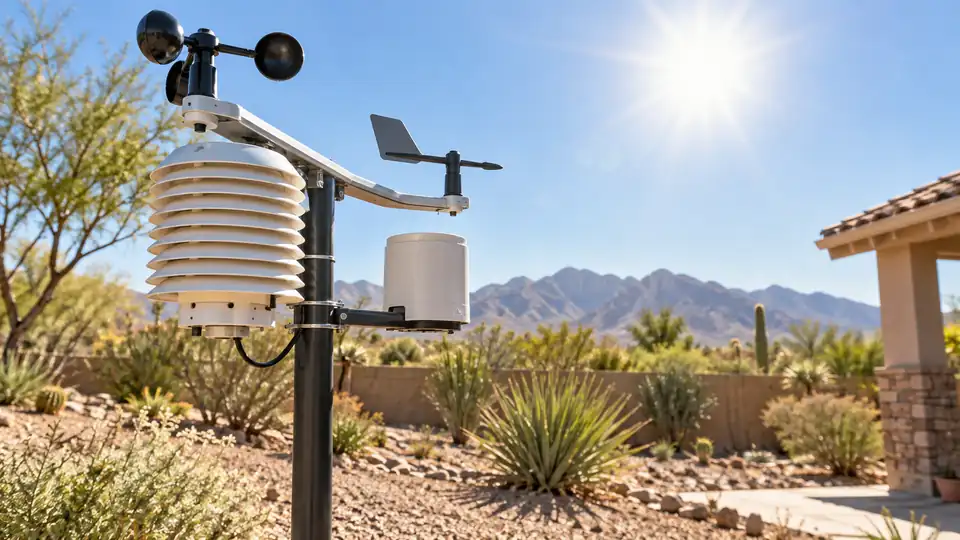
Hot weather puts unusual pressure on a home weather station. Outdoor temperature and humidity matter, but heat index, dew point, rainfall, wind, solar radiation, and UV readings can make the difference between a basic indoor/outdoor thermometer and a useful local monitoring system. Sensor placement matters just as much. A temperature sensor mounted against a wall, above dark pavement, or in direct afternoon sun can report conditions that do not represent the surrounding air.
The biggest choice is between a simple local display and a connected station that records conditions away from home. Wireless sensor communication sends readings to a console, while Wi-Fi can enable app access, weather-network uploads, alerts, or smart-home routines. Those capabilities are separate, and a long transmission range does not prove that a station supports remote monitoring. For a connected hot-weather setup, the Ambient Weather WS-2902 offers the strongest combination of heat-relevant measurements, Wi-Fi access, and smart-home support.
The selections below range from straightforward temperature and humidity monitors to full sensor arrays with rain, wind, UV, solar radiation, or lightning data. I weigh the measurements that matter in hot conditions, the difference between local and remote access, sensor architecture, power requirements, and practical installation trade-offs.
Quick Answer
Best Overall: The Ambient Weather WS-2902 Wi-Fi Smart Weather Station is the most balanced choice for hot-weather monitoring because it measures temperature, humidity, rainfall, wind, UV intensity, and solar radiation, while also supporting remote access and smart-home connections.
Best Premium: The Tempest Weather Station covers a broad set of heat-related measurements, including lightning strikes, UV index, solar radiation, dew point, wind, and rainfall. Its solar-powered outdoor sensor and app connectivity suit buyers who want a low-maintenance connected system.
Best for Weather Underground: The AcuRite Iris 5-in-1 Home Weather Station combines local readings with Wi-Fi access to Weather Underground, making it useful for checking conditions away from the console.
Best Simple Local Station: The Sainlogic 12-in-1 Wireless Weather Station provides temperature, humidity, wind, rainfall, pressure, dew point, and related readings on a large display, but it does not offer Wi-Fi.
Best Weather Stations for Hot Weather Comparison Table
| Product | Measurements | Connectivity | Sensor Design | Best For |
|---|---|---|---|---|
| Ambient Weather WS-2902 | Temperature, humidity, wind, rain, UV, solar radiation | Wi-Fi, smart-home support | Integrated Osprey array | Connected hot-weather monitoring |
| Tempest Weather Station | Temperature, humidity, wind, rain, UV, solar radiation, lightning | App, Alexa, Rachio, IFTTT | Solar-powered sensor with no moving parts | Premium remote monitoring |
| AcuRite Iris 5-in-1 | Temperature, humidity, wind, rain, pressure | Wi-Fi, Weather Underground | Integrated 5-in-1 array | Weather-network uploads |
| Ambient Weather WS-2000 | Temperature, humidity, wind, rain, UV, solar radiation | Wi-Fi connectivity option | Integrated sensor array | Advanced local display |
| AcuRite Iris 01512MCB | Temperature, humidity, wind, rain, pressure, derived heat data | Wireless console | Outdoor sensor array | Detailed local readings |
| Sainlogic 12-in-1 | Temperature, humidity, wind, rain, pressure, dew point | Wireless, no Wi-Fi | Outdoor sensor assembly | Local rain and wind monitoring |
| DreamSky Weather Station | Temperature, humidity, pressure-based forecast | Wireless console | One included sensor, three supported channels | Simple household monitoring |
| Fokey Weather Station | Temperature, humidity, pressure trends | Wireless console | Remote sensor with display | Multiple indoor locations |
| Newentor Weather Station | Temperature, humidity, pressure, forecast | Wireless console | One included sensor, three supported channels | Large color display and alerts |
The detailed reviews explain how each station handles heat-related measurements, connectivity, installation, and everyday monitoring.
1. Ambient Weather WS-2902 Wi-Fi Smart Weather Station – Best Overall
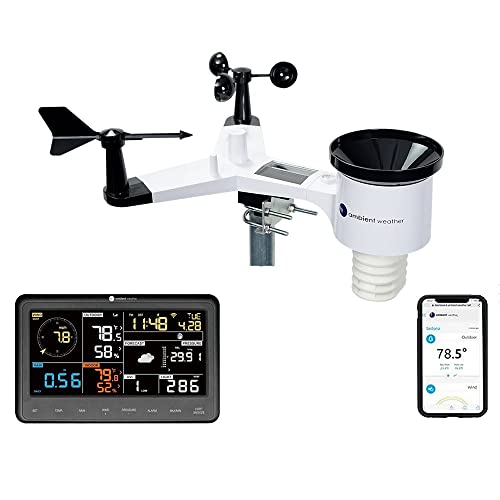
Hot-weather monitoring becomes far more useful once temperature and humidity are viewed alongside sunlight, wind, and rainfall. The WS-2902 brings those measurements together through an Osprey sensor array, which reports outdoor temperature, humidity, wind speed, wind direction, rainfall, UV intensity, and solar radiation. That combination can help explain why a patio feels harsher than the official forecast or why a garden dries quickly after a hot, breezy afternoon.
The Wi-Fi connection gives this station a clear advantage over local-only consoles. The product information describes remote data access, alerts, smart-home connections through IFTTT, Google Home, and Alexa, plus optional transmission to the Ambient Weather Network. The integrated array keeps installation relatively straightforward, although placement still matters for accurate exposure. A roof, wall, tree, or reflective surface can influence readings, so the station’s broad measurement set works best when the sensor has a sensible outdoor location.
Pros
- Measures temperature, humidity, wind speed, wind direction, rainfall, UV intensity, and solar radiation.
- Genuine Wi-Fi connectivity supports remote access and weather-data sharing.
- Supports alerts and listed integrations with IFTTT, Google Home, and Alexa.
- Includes an outdoor Osprey sensor array and color LCD display.
- Provides more direct heat and sunlight context than a temperature-only station.
Cons
- The integrated sensor array gives less flexibility than a system built from separately placed instruments.
- The supplied information does not identify a specific operating temperature range or measurement accuracy for each sensor.
This is the strongest fit for a home, garden, or larger property where heat monitoring means more than checking the thermometer. It offers the measurements needed to track hot, sunny conditions and the connectivity needed to check them away from the console. Buyers who want only indoor and outdoor temperature may find its broader system unnecessary, while readers seeking connected local weather data get a more complete setup.
To buy this product, click here.
2. Tempest Weather Station – Best Premium
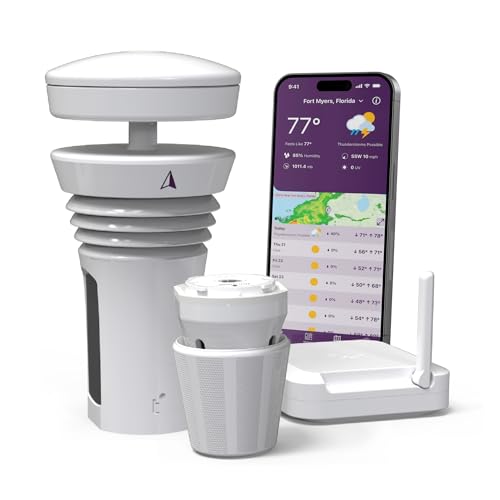
The Tempest takes a different approach from console-centered stations. Its outdoor unit combines temperature, humidity, barometric pressure, wind speed, wind direction, dew point, solar radiation, UV index, lightning strikes, and rainfall in one system. For a hot-weather property, that is a valuable spread. Dew point adds context to sticky air, UV and solar-radiation readings describe sun exposure, and lightning information adds another layer to summer-storm awareness.
The listing describes a solar-powered outdoor sensor with wireless transmission beyond 1,000 feet and updates every three seconds. It also identifies a no-moving-parts design, app access, and integrations with Alexa, Rachio, IFTTT, and other smart-home platforms. Those details make the Tempest appealing for a connected home or irrigation setup. The trade-off is cost and dependence on a connected ecosystem, so it makes more sense for someone who will use remote data and automation than for a reader who simply wants a large indoor display.
Pros
- Measures temperature, humidity, pressure, wind, rainfall, dew point, UV, solar radiation, and lightning strikes.
- Solar-powered outdoor sensor reduces the need for routine battery replacement at the outdoor unit.
- Listed wireless transmission range exceeds 1,000 feet.
- Reports updates every three seconds according to the product information.
- Supports app access and listed integrations with Alexa, Rachio, and IFTTT.
Cons
- It is a premium-priced system for readers who need only basic temperature and humidity readings.
- The available information does not specify every power requirement or the exact details of its app data retention.
The Tempest is a strong choice for hot, sunny conditions where UV, solar radiation, lightning, and dew point are useful rather than decorative numbers. Its no-moving-parts design may simplify outdoor maintenance, but the listing does not provide a weather-resistance rating or a guarantee for harsh exposure. Choose it for connected monitoring and broad measurements, not simply because it reports many data points.
To buy this product, click here.
3. AcuRite Iris 5-in-1 Home Weather Station – Best for Weather Network Uploads
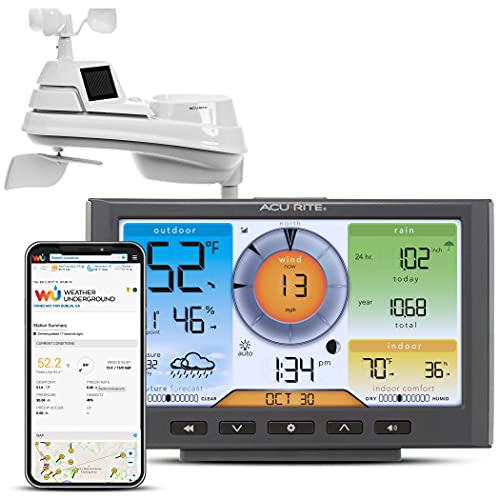
The AcuRite Iris 5-in-1 focuses on the core outdoor variables that make hot-weather monitoring useful: temperature, humidity, wind speed, wind direction, and rainfall. It also includes barometric pressure through the station, plus derived information such as heat index, dew point, and wind chill. Those calculated values are useful for interpreting a hot afternoon, but they should not be confused with separate sensors measuring each one directly.
Its distinguishing feature is Wi-Fi access to Weather Underground. That gives the system a clear purpose for anyone who wants to see local observations away from the indoor console or share them through a weather platform. The color display adds a convenient local view, while the built-in anemometer, wind vane, rain gauge, barometer, hygrometer, and thermometer create a complete integrated array. UV and solar radiation are absent from the listed measurements, so this model is less suited to tracking direct sun exposure than the Ambient and Tempest options.
Pros
- Measures outdoor temperature, humidity, wind speed, wind direction, pressure, and rainfall.
- Provides Wi-Fi access to Weather Underground for remote monitoring and data sharing.
- Reports heat index, dew point, wind chill, and rainfall history as additional information.
- Includes a color display with adjustable dimming.
- Combines the main weather instruments in one outdoor array.
Cons
- It does not list UV or solar-radiation measurement.
- The supplied information does not specify the exact Wi-Fi setup requirements or data-export options.
This station fits a reader who wants local weather observations available through a recognized weather platform, especially for checking rainfall and heat conditions away from home. It gives up the solar and UV data found on higher-end systems, but its core measurements are more relevant than a basic thermometer for a garden, yard, or small property. Place the rain gauge and wind instruments where nearby structures will not distort their readings.
To buy this product, click here.
4. Ambient Weather WS-2000 Smart Weather Station – Best for a Detailed Local Display
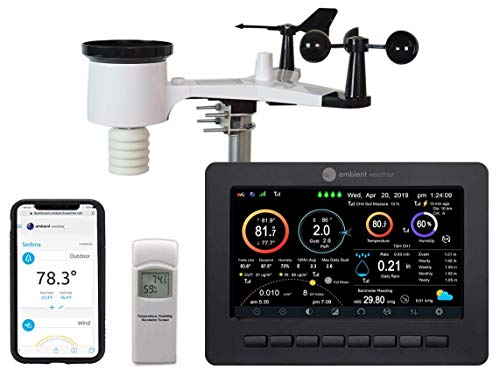
The WS-2000 is built around an integrated sensor array and a TFT color display. Its outdoor measurements include temperature, humidity, wind speed, wind direction, rainfall, UV, and solar radiation, giving it the same broad hot-weather relevance as the WS-2902. A homeowner watching a sun-baked yard can see more than the air temperature, while a gardener can pair rainfall and humidity information with irrigation decisions.
The product information identifies Wi-Fi connectivity as an option for transmitting data to the Ambient Weather Network. That is useful, but the supplied details do not describe every remote-access feature or smart-home integration for this exact model. The console requires a 5V DC adapter, and the outdoor sensor array uses three AAA batteries. This makes the power arrangement straightforward, although the outdoor unit will require attention when its batteries need replacement.
Pros
- Measures temperature, humidity, wind, rainfall, UV, and solar radiation.
- Uses an integrated outdoor sensor array for a consolidated installation.
- Includes a TFT color display for local monitoring.
- Supports imperial and metric units.
- Offers Wi-Fi connectivity to the Ambient Weather Network.
Cons
- The console requires a 5V DC adapter, and the outdoor array requires three AAA batteries.
- The available information does not clearly detail smart-home integrations or the full scope of remote access.
The WS-2000 makes sense for readers who value a richer local display and broad solar, UV, rain, wind, and humidity data. It sits below the WS-2902 because the supplied information is less specific about connected features, while the sensor measurements remain highly relevant to hot conditions. Buyers should verify the current Wi-Fi and network functions before ordering if remote access is central to the purchase.
To buy this product, click here.
5. AcuRite Iris 01512MCB Indoor/Outdoor Weather Station – Best for Detailed Local Readings
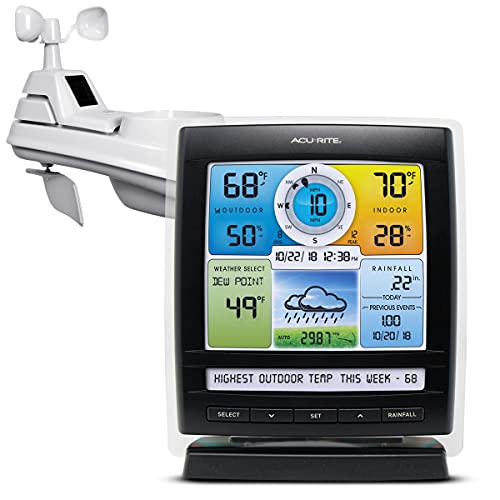
A heat wave can feel different from one side of a property to another, especially where shade, pavement, and airflow change. The AcuRite Iris 01512MCB provides a detailed local console with more than 55 listed data points, including indoor and outdoor temperature and humidity, wind speed and direction, rainfall, pressure trends, heat index, dew point, and feels-like temperature. These values give a fuller picture of outdoor comfort than a single thermometer reading.
The outdoor sensor mounts to a pole or post using the included mounting bracket, and the station sends readings wirelessly to the color display. This is a local monitoring system rather than a listed Wi-Fi or app platform, so it works best where someone can regularly view the console. The sensor arrangement is useful for a yard, workshop, or home weather corner, but it lacks the UV and solar-radiation measurements that make the top connected selections stronger for direct sun analysis.
Pros
- Lists more than 55 data points, including heat index, dew point, and feels-like temperature.
- Measures temperature, humidity, wind speed, wind direction, pressure, and rainfall.
- Includes a color LCD display with adjustable dimming.
- Comes with a mounting bracket for attaching the outdoor sensor to a pole or post.
- Provides historical weather information through the local display.
Cons
- The supplied information does not identify Wi-Fi, app, or remote-monitoring support.
- It does not list UV or solar-radiation measurement.
This model is a good fit for a reader who wants a dense local information screen and useful heat-related calculated values without moving into a connected platform. It may be a poor match for a vacant property or anyone who needs alerts while away. The heat index and dew point can add practical context during humid weather, while the lack of UV data keeps it below the connected stations for sun-exposure monitoring.
To buy this product, click here.
6. Sainlogic 12-in-1 Wireless Weather Station – Best Local Rain and Wind Monitor
The Sainlogic 12-in-1 is aimed at readers who want a broad set of readings without paying for Wi-Fi or app functions. It lists indoor and outdoor temperature and humidity, barometric pressure, wind speed and direction, rainfall, dew point, feels-like temperature, moon phase, calendar, and alarm functions. Its rainfall display can track hourly, daily, weekly, monthly, and cumulative totals, which is useful during hot weather when irrigation and storm patterns become important.
The 6.5-inch color display uses adjustable backlighting, and the outdoor unit has listed wireless transmission up to 443 feet in open conditions. That number is a maximum-style specification, not a guarantee through walls, floors, metal structures, or dense landscaping. The listing also gives temperature, humidity, and rainfall accuracy claims, but those remain product-information claims rather than independent verification. With no Wi-Fi, this station is for local observation rather than checking conditions from another location.
Pros
- Combines temperature, humidity, pressure, wind, rainfall, dew point, and feels-like readings.
- Records rainfall across hourly, daily, weekly, monthly, and cumulative periods.
- Includes a 6.5-inch color display with three backlight levels.
- Lists wireless transmission up to 443 feet in open conditions.
- Includes mounting hardware according to the product information.
Cons
- It does not provide Wi-Fi, app access, or remote monitoring.
- The advertised transmission distance can be affected by walls, metal, terrain, and other obstructions.
This is a sensible choice for a garden, backyard, or property where the console will be checked locally. Its rainfall history is more useful for hot-weather watering decisions than a station that reports temperature alone. Select something higher in the ranking if you need sunlight data, smart-home routines, or access from away from home.
To buy this product, click here.
7. DreamSky Weather Station Indoor Outdoor Thermometer – Best Simple Display

The DreamSky keeps the focus on readings that most households check first: indoor temperature, outdoor temperature, humidity, time, date, and forecast information. Its large colorful display is easy to read from across a room, and high and low temperature alerts can draw attention to changing outdoor conditions. That makes it practical beside a kitchen door, in a home office, or near a bedroom where a complicated weather console would feel excessive.
The station supports up to three outdoor sensors, although one sensor is included. That creates a path for monitoring another room, basement, greenhouse area, or shaded location, but additional sensors should not be mistaken for included accessories. The forecast uses local pressure information and requires calibration, while the product information describes a 12 to 24-hour forecast window. It has no listed Wi-Fi, wind, rainfall, UV, or solar-radiation measurement.
Pros
- Large colorful display shows indoor and outdoor temperature and humidity clearly.
- Supports up to three outdoor sensors with one included.
- Provides high and low temperature alerts.
- Offers five backlight brightness settings.
- Includes atomic time synchronization and automatic daylight-saving adjustment.
Cons
- It does not list wind, rainfall, UV, or solar-radiation measurements.
- The display stays illuminated continuously only with adapter power, while battery operation enters a power-saving mode.
Choose the DreamSky for straightforward indoor/outdoor temperature and humidity monitoring, especially where clear numbers matter more than full weather instrumentation. It can help identify a hot room or follow outdoor humidity, but it cannot explain wind, rainfall, or solar load. A connected or rain-capable station will serve better for garden management or remote property checks.
To buy this product, click here.
8. Fokey Weather Station Wireless Indoor Outdoor – Best for Multiple Local Sensors

Fokey adds a useful twist to the basic indoor/outdoor format: its remote sensor includes a 2-inch digital screen. Someone checking a shed, porch, or secondary indoor space can read that sensor directly rather than walking back to the main console. The main 7.6-inch VA display shows temperature, humidity, pressure trends, time, and forecast information, while support for up to three remote sensors opens the door to monitoring separate areas.
The product information lists a maximum wireless pairing range of 328 feet and adjustable absolute or relative pressure modes. Those pressure settings can help users interpret local trends, although pressure-based forecast indicators remain estimates rather than direct future-weather measurements. The listing also gives a temperature error-margin claim, but it should be treated as a stated product claim rather than a result independently verified here. There is no listed Wi-Fi, rainfall, wind, UV, or solar-radiation sensor.
Pros
- Includes a remote sensor with its own 2-inch digital display.
- Uses a 7.6-inch VA display with high-contrast color information.
- Supports up to three remote sensors.
- Shows pressure trends with adjustable absolute and relative pressure modes.
- Lists a wireless pairing range up to 328 feet.
Cons
- It does not list rainfall, wind, UV, solar-radiation, Wi-Fi, or app functions.
- Only one remote sensor is identified as included, so expanded monitoring may require additional purchases.
The Fokey is most useful where temperature and humidity need to be checked in several nearby locations. Its separate sensor display is more practical than a standard sensor when someone regularly works outdoors or moves between rooms. It is less suitable for analyzing sun exposure, storm rainfall, or conditions at a property that cannot be visited, since the supplied information describes local wireless monitoring rather than Internet access.
To buy this product, click here.
9. Newentor Weather Station Wireless Indoor Outdoor Thermometer – Best for Alerts and a Household Console

The Newentor combines indoor and outdoor temperature and humidity readings with daily high and low records, customizable alerts, barometric pressure, moon phase, time, and forecast information. Its color LCD is suited to a living room, bedside table, or office, where the display can stay on continuously with the included adapter. For a household watching a heat wave, high and low records provide a quick sense of how conditions changed while nobody was watching.
Like the DreamSky and Fokey, this station supports up to three remote sensors, with one included. Battery power activates an energy-saving display mode that lights for a short glance before dimming, while full-time viewing requires the adapter. The forecast is based on local pressure information and needs a calibration period, so it should be treated as a personal trend indicator rather than a replacement for an official forecast. Wind, rain, UV, and solar-radiation measurements are not listed.
Pros
- Displays indoor and outdoor temperature and humidity with daily high and low records.
- Includes customizable alerts, an alarm, snooze, and atomic time functions.
- Supports up to three remote sensors with one included.
- Offers a color LCD display with continuous adapter-powered operation.
- Shows barometric pressure, moon phase, and forecast information.
Cons
- It does not list rainfall, wind, UV, solar-radiation, Wi-Fi, or app support.
- Batteries are not included, and battery-only operation dims the screen after a brief viewing period.
The Newentor suits a home that wants a readable console, temperature alerts, and additional indoor monitoring without a connected weather platform. Its lower position reflects the narrow measurement set rather than a flaw in its household role. For hot-weather gardening, storm tracking, or remote checks, choose a station above it with rain, wind, sunlight, or Wi-Fi capabilities.
To buy this product, click here.
Buying Guide
Decide Whether You Need Sunlight Measurements
Temperature alone does not describe the full heat load around a property. UV intensity and solar radiation can add useful context on bright afternoons, while humidity and dew point help explain why a moderate temperature can still feel oppressive. The Ambient Weather WS-2902, Ambient WS-2000, and Tempest include listed UV or solar-related measurements. Simpler stations such as the DreamSky and Newentor focus on temperature and humidity, which may be enough for room monitoring but provide less information about outdoor exposure.
Wireless Sensor Links Are Not Wi-Fi
Every station with a remote outdoor sensor needs some form of wireless communication with its display. That does not mean the station connects to the Internet. The Sainlogic, AcuRite Iris 01512MCB, DreamSky, Fokey, and Newentor use local wireless arrangements according to the supplied information. The WS-2902, AcuRite Iris 5-in-1, and connected Ambient and Tempest systems add Internet-related functionality. Pick Wi-Fi only when remote viewing, data sharing, alerts, or automation matters.
Rain and Wind Need Correct Placement
A rain gauge needs open exposure and a stable, level location, while a wind sensor needs access to moving air rather than a sheltered corner beside a wall. Nearby roofs, trees, fences, and buildings can affect the observations. An integrated array simplifies the number of components to install, but it also places several measurements together. Before buying, identify whether your property has a suitable outdoor location rather than assuming the most expensive station will correct poor exposure.
Check What Is Included and What Is Optional
Several household stations support up to three sensors but include only one. That distinction matters if you plan to monitor a bedroom, greenhouse, basement, or shaded porch. The DreamSky, Fokey, and Newentor all describe multi-sensor support, but the available information identifies one included sensor for each. Extra channels are useful only after the compatible additional sensors are purchased and positioned.
Accuracy, Resolution, and Range Describe Different Things
A display showing small temperature increments does not automatically mean the sensor is equally accurate. Similarly, a wireless range quoted for open conditions can shrink through walls, floors, metal structures, and terrain. The Sainlogic listing provides specific accuracy claims, while Fokey provides a stated error-margin claim, but these are listing claims rather than independent measurements. Treat them as specifications to compare cautiously, not as proof of field performance.
Think About Power at Both Ends of the System
A console may need an adapter for a continuously illuminated screen while the outdoor sensor uses batteries or solar assistance. The Tempest listing identifies a solar-powered outdoor sensor, while the Ambient WS-2000 requires a powered console and three AAA batteries in its sensor array. The DreamSky and Newentor can use batteries for backup or basic operation, but their displays enter power-saving modes without adapter power. Check each component rather than labeling the entire system battery-powered or solar-powered.
Best Weather Stations for Hot Weather FAQ
What measurements matter most in hot weather?
Outdoor temperature and relative humidity are the basic starting points. Dew point or heat index can add comfort context, while rainfall helps with irrigation and storm tracking. Wind, UV, and solar radiation are useful when you want to understand drying, sun exposure, or the difference between shaded and exposed areas. The right mix depends on whether you are monitoring a room, yard, garden, or larger property.
Which station is best for remote monitoring?
The Ambient Weather WS-2902 is the strongest overall choice in this group because the product information identifies Wi-Fi, remote access, alerts, and listed smart-home connections. The Tempest also supports app access and several integrations. Local wireless stations such as the Sainlogic and AcuRite Iris 01512MCB require someone to view the console, so they do not serve the same remote-monitoring role.
Does a wireless weather station have Wi-Fi?
No. Wireless commonly describes the short-range link between an outdoor sensor and its indoor console. Wi-Fi connects a device to a local network and may enable Internet or app functions. A station can have wireless outdoor sensors without offering Wi-Fi, as seen with the Sainlogic, DreamSky, Fokey, and Newentor models.
Are forecast icons the same as measured weather?
No. Temperature, humidity, pressure, rainfall, and wind can be direct sensor measurements when the station includes those instruments. Forecast icons are generated from pressure trends or other station information, while an app may also show Internet-derived weather data. A forecast display should be treated as an estimate, not as a direct measurement of future conditions.
Do more sensors always make a weather station better?
No. More measurements help only when they answer a real monitoring need. UV and solar radiation are valuable for sun-exposed areas, while rainfall and wind matter for gardens and larger properties. A simple temperature and humidity station may be easier to install and easier to read if those are the only variables you need.
Can I place the outdoor temperature sensor in direct sunlight?
Direct sunlight can influence a temperature reading, especially when the sensor is near a wall, roof, pavement, or other heat-absorbing surface. The supplied product information does not establish that any of these stations can ignore placement effects. Use an appropriately exposed location and follow the product’s installation guidance rather than treating the console’s temperature as independent of its surroundings.
Which stations include rainfall measurement?
The Ambient Weather WS-2902, Tempest, AcuRite Iris 5-in-1, Ambient WS-2000, AcuRite Iris 01512MCB, and Sainlogic 12-in-1 list rainfall measurement. The DreamSky, Fokey, and Newentor descriptions do not list rain gauges. A rainfall-capable station still needs suitable placement, and its rainfall total should not be confused with rainfall accuracy or resolution.
Final Verdict
The Ambient Weather WS-2902 is the strongest overall choice for hot-weather monitoring because it combines the measurements that explain outdoor heat with genuine Wi-Fi functionality. Temperature, humidity, rainfall, wind, UV, and solar radiation create a more useful picture than a basic thermometer, while remote access and listed smart-home support give the station a practical role beyond the room where its display sits.
The Tempest is the premium alternative for readers who want lightning, dew point, UV, solar radiation, app access, and a solar-powered outdoor sensor. The AcuRite Iris 5-in-1 is a sensible connected choice for Weather Underground users, while the Sainlogic is better suited to local rain and wind tracking without Wi-Fi. Match the station to the conditions you actually need to observe, and give sensor placement, power, and connectivity as much attention as the headline measurement count.