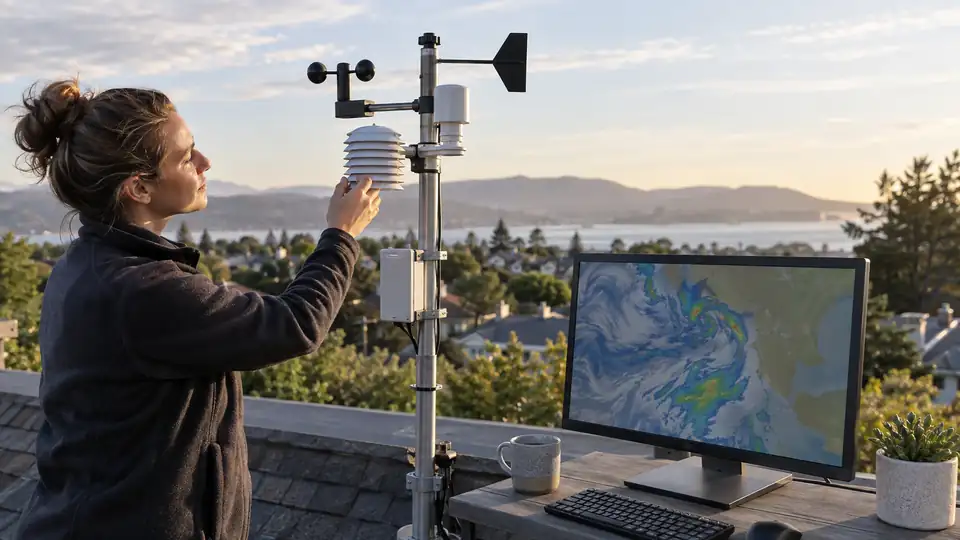
A station that measures rain in the backyard is useful. A station that also sends those observations to Weather Underground becomes much more useful when you are away from home, comparing conditions with nearby stations, or tracking a property over time. The strongest choices here combine a complete outdoor sensor array with Wi-Fi access, clear local readings, and explicit Weather Underground support. Temperature, humidity, rainfall, wind speed, wind direction, and barometric pressure form the core, while UV, solar radiation, lightning, app alerts, and data export separate the more capable systems.
Wireless sensor communication and Wi-Fi are different jobs. The outdoor array may use a private wireless link to reach its console, while Wi-Fi connects the console or gateway to your network and the Internet. That distinction matters because a long advertised sensor range does not automatically provide remote access, and an app does not automatically confirm Weather Underground compatibility. Sensor placement matters, too. Trees, walls, roofs, pavement, direct sun, and an unlevel rain gauge can affect readings regardless of the station’s feature list.
This comparison gives the most weight to explicit Weather Underground support, useful local measurements, remote data access, data history, installation practicality, and meaningful differences between sensor systems. The Ambient Weather WS-2902 takes the top position for its broad measurements, smart-home features, Wi-Fi access, and direct fit for connected home monitoring. Several alternatives make more sense if you prioritize data export, a large display, lightning detection, dual-band Wi-Fi, or a lower-cost setup.
Quick Answer
- Best Overall: Ambient Weather WS-2902 combines temperature, humidity, rain, wind, UV, and solar radiation with Wi-Fi, remote access, Weather Underground network support, and smart-home compatibility.
- Best for Data Logging: Sainlogic SA68plus offers dual-band Wi-Fi, a touchscreen console, two years of historical storage, and spreadsheet export.
- Best for a Large Display: VEVOR 7-in-1 Wi-Fi Weather Station pairs a 7-inch display with solar-assisted outdoor power and stated Weather Underground support.
- Best for Lightning Detection: AcuRite Atlas adds lightning detection, UV and light measurements, a high-definition display, and Weather Underground connectivity.
Best Weather Stations for Weather Underground Comparison Table
| Product | Measurements | Connectivity and Data | Best For |
|---|---|---|---|
| Ambient Weather WS-2902 | Temperature, humidity, rain, wind, UV, solar radiation | Wi-Fi, remote access, Weather Underground, smart-home features | Best overall connected setup |
| AcuRite Iris 01540M | Temperature, humidity, pressure, rain, wind | Wi-Fi and Weather Underground | Simple home monitoring |
| Sainlogic SA68plus | Temperature, humidity, pressure, rain, wind | Dual-band Wi-Fi, app, two-year storage, export | Historical data and flexible Wi-Fi |
| Sainlogic 5G WiFi Weather Station | Temperature, humidity, rain, wind | Dual-band Wi-Fi, Bluetooth setup, app, Weather Underground | Gardens and environmental monitoring |
| AcuRite Atlas | Temperature, humidity, pressure, rain, wind, UV, light, lightning | Wi-Fi and Weather Underground | Broader weather observations |
| Weatherseed Wireless Weather Station | Temperature, humidity, rain, wind direction and speed | 2.4 GHz Wi-Fi, app, cloud history, Weather Underground | Lower-cost app access |
| AcuRite Iris 01544M | Temperature, humidity, pressure trend, rain, wind | Direct-to-Wi-Fi display and Weather Underground | Remote monitoring with a local display |
| VEVOR 7-in-1 Wi-Fi Weather Station | Temperature, humidity, rain, wind, light, pressure-related data | Wi-Fi, Weather Underground, WeatherCloud, 100 m listed range | Large display and solar-assisted sensor power |
| Sainlogic Smart AI Weather Station | Temperature, humidity, rain, wind, UV, extra sensor support | Dual-band Wi-Fi, app alerts, Weather Underground, export | Extra sensors and app alerts |
The detailed reviews below explain how each station handles local measurements, Wi-Fi, Weather Underground access, data history, and outdoor installation.
1. Ambient Weather WS-2902 – Best Overall
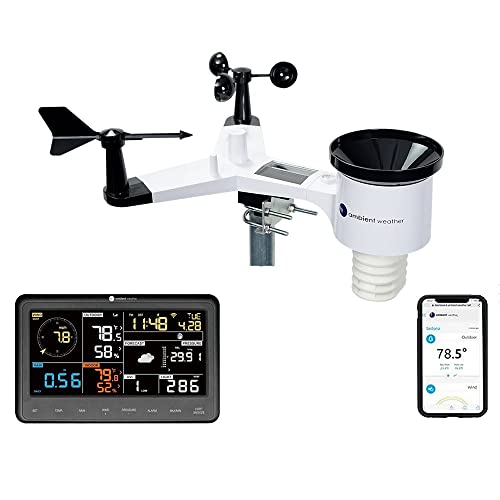
The WS-2902 fits the central purpose of a Weather Underground station unusually well because it brings a broad group of outdoor measurements into one connected system. Its Osprey sensor array reports temperature, humidity, rainfall, wind speed, wind direction, UV intensity, and solar radiation, while the indoor color display keeps local readings visible without reaching for a phone. That combination suits a backyard where you want to glance at current conditions before leaving, then review the same station remotely later.
Wi-Fi gives this model more reach than a wireless console alone. The product information identifies remote access, Weather Underground network transmission, and smart-home support through IFTTT, Google Home, and Alexa. Those integrations can make weather data useful for alerts and home routines, although the station still depends on sensible outdoor placement. A rain cup needs open exposure, and wind readings can be affected by nearby structures, so the connected features cannot compensate for a sheltered or poorly positioned array.
Pros
- Measures temperature, humidity, rainfall, wind speed, wind direction, UV intensity, and solar radiation.
- Supports Wi-Fi access and Weather Underground network transmission.
- Offers remote access and alerts through its connected platform.
- Lists IFTTT, Google Home, and Alexa support for smart-home use.
- Includes an outdoor Osprey sensor array and color LCD display.
Cons
- The integrated sensor array limits how independently each outdoor measurement can be positioned.
- The supplied information does not identify a data-export format or storage period.
This is the strongest starting point for a reader who wants a complete connected station rather than a basic indoor display. It has more environmental measurements than the simpler AcuRite Iris models and a clearer smart-home angle than several alternatives. Someone focused mainly on spreadsheet analysis may prefer the Sainlogic models with stated export features, while a buyer who wants lightning detection should look at the AcuRite Atlas instead.
To buy this product, click here.
2. AcuRite Iris 01540M – Best Simple Weather Underground Setup
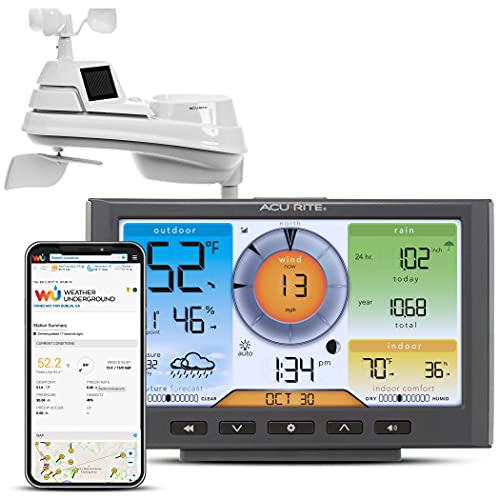
The AcuRite Iris 01540M takes a familiar home-weather approach and adds the connectivity needed for Weather Underground. Its wireless outdoor sensor reports temperature, humidity, wind speed, wind direction, barometric pressure, and rainfall to a color LCD console. For someone who wants to see conditions in the kitchen while also sharing data online, that division is practical and easy to understand.
The station’s product information also lists more than 25 data points, threshold alarms, historical data, heat index, dew point, wind chill, and rainfall history. Some of those are calculated values rather than separate outdoor measurements, which is useful context when comparing it with stations that include UV or solar-radiation sensors. The adjustable display dimmer is a small but worthwhile touch for a console that may sit in a living room or office through the night.
Pros
- Explicitly supports a Wi-Fi connection to Weather Underground.
- Measures indoor and outdoor temperature and humidity, wind, pressure, and rainfall.
- Includes a color LCD display with an adjustable dimmer.
- Provides threshold alarms and historical weather information.
- Reports calculated values such as heat index, dew point, and wind chill.
Cons
- It does not list UV, solar radiation, or lightning detection among its measurements.
- The available information does not clearly specify a spreadsheet export function.
This model makes sense for a household that wants the essential measurements and explicit Weather Underground access without moving into a more specialized data-logging system. A gardener who mainly watches rain, temperature, and humidity gets the useful basics, while a solar-monitoring enthusiast or storm watcher will find the WS-2902 or Atlas more informative. Keep the outdoor array away from heat sources and obstructions so the local data has a fair chance of representing the surrounding conditions.
To buy this product, click here.
3. Sainlogic SA68plus – Best for Data Logging

Historical weather records are the reason to look closely at the Sainlogic SA68plus. The listing states that it can save and download up to two years of weather history to spreadsheets, giving a reader more to work with than a current-conditions dashboard. That can be useful for comparing rainfall from season to season, examining temperature patterns around a garden, or keeping a personal weather archive instead of relying only on a forecast icon.
The station includes a 6.5-inch touchscreen showing temperature, humidity, wind speed and direction, rainfall, barometric pressure, forecast icons, and moon phase. It also supports both 5 GHz and 2.4 GHz Wi-Fi, along with a listed wireless transmission distance of up to 443 feet in open conditions. The range figure is a best-case listing value, not a promise through walls, metal buildings, or multiple floors, but the dual-band network support may simplify connection with a modern home router.
Pros
- Lists Weather Underground compatibility and app-based remote monitoring.
- Supports both 5 GHz and 2.4 GHz Wi-Fi bands.
- Stores and exports up to two years of historical weather data.
- Includes a 6.5-inch touchscreen console with adjustable backlight levels.
- Lists rainfall accuracy figures and hourly-to-yearly rainfall records.
Cons
- The advertised 443-foot sensor range is stated for open conditions and may be reduced by obstructions.
- The console and app focus on core weather measurements rather than UV, solar radiation, or lightning detection.
Choose this station if the record itself matters as much as the live observation. It is a stronger fit than the AcuRite 01540M for someone who wants to download data, while the WS-2902 offers a broader measurement set for UV and solar information. The Sainlogic’s touchscreen is also more interactive, but buyers who prefer a simpler, traditional console may find the AcuRite layout more familiar.
To buy this product, click here.
4. Sainlogic 5G WiFi Weather Station – Best for Temperature and Humidity Tracking

The Sainlogic 5G WiFi Weather Station places extra emphasis on temperature and humidity data. Its listing gives temperature accuracy as plus or minus 0.36 degrees Fahrenheit, or plus or minus 0.2 degrees Celsius, and humidity precision as plus or minus 1.8% RH. Those are product-listing claims rather than independent verification, but they make the model particularly interesting for a greenhouse, nursery, wine cellar, or other space where humidity trends deserve close attention.
It also covers the outdoor basics with wind, rain, temperature, and humidity sensors, then sends information through a dual-band Wi-Fi connection and app. Bluetooth quick pairing is identified as part of setup, while the outdoor signal is listed at up to 443 feet in open air. The rain gauge includes a bubble level and records hourly, daily, monthly, and annual totals, which makes installation important. A gauge that is not level can undermine the benefit of a detailed rainfall history.
Pros
- Lists specific temperature and humidity performance figures for the sensor system.
- Supports 5 GHz and 2.4 GHz Wi-Fi with Bluetooth quick pairing.
- Provides Weather Underground support and app-based remote monitoring.
- Stores up to two years of records and supports Excel export.
- Includes a rain gauge with a built-in bubble level.
Cons
- The product information does not identify UV, solar-radiation, or lightning measurements.
- Each export supports up to 30 days of data at a time, according to the listing.
This is a sensible choice for tracking temperature and humidity across a home or growing space, especially if exportable records will be useful later. The SA68plus has a more prominent touchscreen and similar data-history emphasis, while this model’s stated humidity and temperature figures give it a more focused monitoring angle. Choose the WS-2902 instead if solar and UV readings are central to your routine.
To buy this product, click here.
5. AcuRite Atlas – Best for Lightning Detection

The AcuRite Atlas broadens the observation set beyond the usual temperature, humidity, wind, pressure, and rain package. Its product information lists UV, light intensity, and lightning detection, with lightning strikes identified from up to 25 miles away. That feature can add useful context before an outdoor gathering or during a storm, although an alert should never replace sensible lightning safety decisions.
Weather Underground connectivity gives the Atlas a clear place in this roundup, while the high-definition display provides a detailed local view. The console has battery-backup support, and the outdoor station uses a mounting bracket and hardware for installation. Its forecast feature combines elevation and atmospheric pressure to produce a short-term station-based forecast, but that forecast should be understood as a derived estimate rather than a direct measurement of future weather.
Pros
- Lists explicit Wi-Fi connectivity to Weather Underground.
- Includes lightning detection with a stated detection distance of up to 25 miles.
- Measures UV, light intensity, temperature, humidity, wind, pressure, and rain.
- Provides a high-definition display with optional battery backup support.
- Includes mounting hardware and tabletop or wall-mount display options.
Cons
- The broader sensor package may be more than needed for basic rain and temperature monitoring.
- The listing does not identify spreadsheet export details as clearly as the Sainlogic data-focused models.
The Atlas is the better match for readers who want storm-related information and a richer console rather than a minimal Weather Underground uploader. The WS-2902 remains more compelling for smart-home integrations, while the Atlas adds a specific lightning function that the other leading options lack. A buyer should still verify the preferred mounting location and power arrangement before installation, particularly if the sensor will be placed far from the display.
To buy this product, click here.
6. Weatherseed Wireless Weather Station – Best Lower-Cost App Option

The Weatherseed station keeps its sensor arrangement straightforward with a 5-in-1 outdoor array covering temperature, humidity, rainfall, wind speed, and wind direction. Its 2.4 GHz Wi-Fi connection sends data to the Weatherseed app, where the listing says users can view current conditions, receive temperature and humidity alerts, and track barometric changes. It also explicitly identifies Weather Underground integration, which is the key reason it belongs in this comparison rather than being treated as a generic app-connected station.
The app provides two years of data history and allows exports of up to 30 days at a time in Excel format. Weatherseed also offers forecast information for the next 24 hours and seven days through the app, generated from the station’s readings. That forecast is separate from the locally measured variables. The outdoor array includes a solar panel for daytime auxiliary power and still requires three AA batteries, so the system should be viewed as solar-assisted rather than fully battery-free.
Pros
- Explicitly supports Weather Underground through the Weatherseed app.
- Includes temperature, humidity, rainfall, wind speed, and wind direction sensors.
- Provides two years of app history and Excel export in available data blocks.
- Offers alerts for temperature, humidity, and barometric changes.
- Includes the mounting bracket, pole, and installation hardware.
Cons
- It uses 2.4 GHz Wi-Fi rather than listing dual-band network support.
- The outdoor sensor still requires three AA batteries despite its solar-assisted design.
This model suits someone who wants app access and Weather Underground sharing without paying for a larger measurement package. The VEVOR station offers a bigger display and solar-rechargeable sensor design, while the Weatherseed model makes its app history and alerts central to the experience. Its 5-in-1 label should not be compared as though it were automatically equivalent to every other manufacturer’s 5-in-1 system. The actual measurements are what matter.
To buy this product, click here.
7. AcuRite Iris 01544M – Best Direct-to-Wi-Fi Display
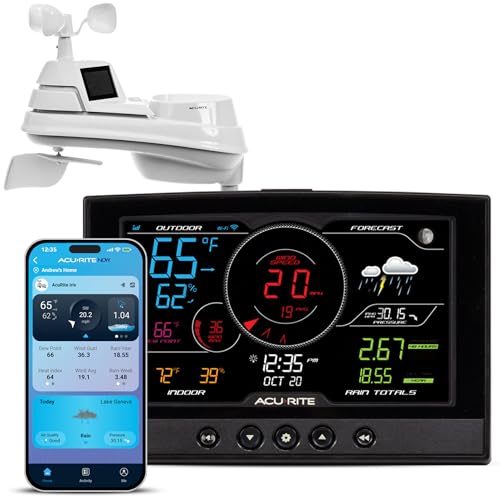
The AcuRite Iris 01544M is aimed at readers who want a direct Wi-Fi connection built around a local wireless display. It reports indoor and outdoor temperature and humidity, wind speed and direction, barometric pressure trends, and rainfall totals. The console can therefore serve as the household glance point, while the Wi-Fi connection extends the data to Weather Underground for remote monitoring.
Its pressure trend, heat index, dew point, and feels-like readings add interpretation without claiming that each value comes from a separate sensor. The station also uses an outdoor barometer and elevation information for a personalized 12-hour forecast. Compared with the 01540M, this model’s direct-to-Wi-Fi presentation makes it attractive for a buyer who places extra weight on remote access, though the available product information does not describe the same broad UV, solar, or lightning measurements found on higher-ranked stations.
Pros
- Provides explicit direct-to-Wi-Fi connectivity and Weather Underground support.
- Measures temperature, humidity, wind, pressure trends, and rainfall.
- Offers remote monitoring through the connected weather platform.
- Displays heat index, dew point, and feels-like temperature.
- Includes a station-based 12-hour forecast feature.
Cons
- The listed measurement set does not include UV, solar radiation, or lightning detection.
- The available information does not clearly specify long-term data export.
This is a good fit for a home where the display and remote Weather Underground access need to work together without an expansive sensor package. The 01540M is the simpler alternative, while the WS-2902 and Atlas offer more direct environmental measurements. Make sure the outdoor sensor has suitable exposure and that the display’s network connection fits the intended location before treating it as a remote-monitoring solution.
To buy this product, click here.
8. VEVOR 7-in-1 Wi-Fi Solar Weather Station – Best for a Large Display

The VEVOR station stands out at a glance because its indoor unit uses a 7-inch TFT color display. The outdoor system reports wind speed, wind direction, temperature, humidity, rainfall, and light, while the console also shows pressure, dew point, wind chill, calendar, and moon phase information. The distinction matters: some displayed values are calculated or supporting information rather than separate measurements, so the 7-in-1 label should be read alongside the actual sensor list.
Wi-Fi access includes explicit Weather Underground and WeatherCloud support, and the listing gives a transmission distance of up to 100 meters. The sensor uses solar assistance with rechargeable Ni-MH batteries, while the console remains a separate indoor component. The listed IPX6 rating applies to the stated product protection claim, but it should not be expanded into a general promise of resistance to every installation condition. The included mounting hardware and aluminum rod simplify the basic setup.
Pros
- Includes a large 7-inch TFT color display.
- Supports Weather Underground and WeatherCloud connections.
- Uses a solar panel to assist the outdoor sensor’s rechargeable batteries.
- Lists a 100-meter transmission distance for flexible sensor placement.
- Includes mounting hardware and displays wind, rain, temperature, humidity, and light data.
Cons
- The solar feature applies to the outdoor sensor system, not automatically to the entire station.
- The available information does not identify the same multi-year spreadsheet history as several Sainlogic models.
Choose the VEVOR if a readable wall or tabletop display matters more than a highly expandable data archive. The large screen can be useful in a kitchen, workshop, or office where several people need to read conditions quickly. The Weatherseed station offers a similar app-and-platform angle with a smaller sensor package, while the WS-2902 provides UV and solar-radiation measurements that the VEVOR listing does not clearly identify as part of its system.
To buy this product, click here.
9. Sainlogic Smart AI Weather Station – Best for Extra Sensor Support

The Sainlogic Smart AI Weather Station brings several connected features together for a property that may need more than one observation point. The listing identifies an extra sensor, dual-band Wi-Fi, Bluetooth pairing, app alerts, Weather Underground support, rain measurement, wind, UV, temperature, and humidity. The exact arrangement and inclusion details for every extra sensor should be confirmed before ordering, but the stated support gives this model a useful advantage for monitoring separate indoor or environmental locations.
Its app provides current readings, weather-map information, alerts, and a two-year archive with Excel export. The rain gauge includes a bubble level and records hourly, daily, monthly, and yearly totals. Like the other Sainlogic stations here, the product information lists a 443-foot open-area wireless range and specific temperature and humidity figures. That combination is attractive for a larger house or garden, but a wider advertised range still needs context around walls, terrain, metal structures, and interference.
Pros
- Lists Weather Underground support, app alerts, and dual-band Wi-Fi.
- Includes or supports an extra sensor according to the product information.
- Measures UV, temperature, humidity, rainfall, wind speed, and wind direction.
- Provides two years of storage and Excel export with no subscription fee stated in the listing.
- Includes a bubble level for rain-gauge installation.
Cons
- The exact extra-sensor configuration and placement details are not fully identified in the available information.
- The 443-foot transmission figure is an open-area listing value rather than a guaranteed distance through buildings.
This model is worth choosing when additional sensor coverage and app alerts matter more than a large console or lightning detection. The SA68plus offers a clearer data-logging focus, while the WS-2902 has a stronger smart-home profile and broader solar-radiation emphasis. Confirm which sensors are included versus merely supported, then plan each sensor location before installation so the system’s extra flexibility serves a real monitoring need.
To buy this product, click here.
Buying Guide
Weather Underground Support Should Be Explicit
A Wi-Fi symbol alone does not prove that a station can upload to Weather Underground. Look for direct platform support in the product information, as seen with the WS-2902, AcuRite models, Sainlogic connected stations, Weatherseed, and VEVOR. A station can send data to its own app or cloud service without supporting the specific weather network you use.
Wireless Sensor Links and Wi-Fi Solve Different Problems
The outdoor array usually communicates wirelessly with a console or receiving unit. Wi-Fi then connects that indoor component to your home network and online services. A station may have one connection without the other, so check both before buying. Dual-band Wi-Fi can help with router compatibility, while a listed outdoor transmission range describes the sensor-to-console link, not remote Internet access.
Choose Measurements That Match the Property
Rainfall and temperature may be enough for garden planning. Wind direction can matter for an exposed property, while UV and solar radiation add information for sun-sensitive activities and environmental tracking. Lightning detection is a separate capability, and calculated readings such as dew point, wind chill, and heat index should not be counted as extra physical sensors.
Data History and Export Are Separate Features
An app may show graphs without providing downloadable records. If you want to compare seasons or keep your own archive, look for an explicit storage period and export format. The Sainlogic models and Weatherseed station list two-year history with Excel export, although the stated export windows differ. Confirm how much data can be exported at once before assuming the entire archive downloads in one file.
Advertised Range Needs Installation Context
A 443-foot or 100-meter figure usually describes favorable open-air conditions. Walls, floors, trees, metal sheds, terrain, and other radio sources can reduce the useful distance. Place the console or receiving unit where the outdoor sensor has a clear communication path, then check the station’s own setup guidance before final mounting.
Solar Assistance Does Not Mean the Whole System Is Solar Powered
On the Weatherseed and VEVOR systems, solar power applies to the outdoor sensor arrangement. The Weatherseed listing still calls for three AA batteries, while VEVOR identifies rechargeable Ni-MH cells. The indoor console remains a separate power concern, so check every component rather than assuming the complete station operates independently of mains power or batteries.
Sensor Placement Can Matter More Than a Feature List
Direct sun, nearby pavement, walls, roofs, trees, and heat sources can influence temperature and humidity readings. Wind sensors need suitable exposure to moving air, and rain gauges should be mounted level and away from obstructions. A station with impressive connectivity still needs a sensible physical location to produce useful local observations.
Best Weather Stations for Weather Underground FAQ
What Is the Best Weather Station for Weather Underground?
The Ambient Weather WS-2902 is the strongest overall choice in this comparison because it combines explicit connected-platform support with temperature, humidity, rainfall, wind, UV, and solar-radiation measurements. Its smart-home compatibility adds another practical use for the data. The best fit changes if you need spreadsheet export, lightning detection, or extra sensors.
Does Wireless Mean a Weather Station Has Wi-Fi?
No. Wireless commonly describes the radio connection between an outdoor sensor and an indoor console. Wi-Fi connects a console or gateway to your home network and may enable app access, cloud storage, or Weather Underground uploads. Check for both capabilities separately.
Can These Stations Be Viewed Away From Home?
The product information explicitly identifies remote access or app access for several models, including the WS-2902, Sainlogic stations, Weatherseed, and connected AcuRite systems. Remote viewing depends on the station’s Wi-Fi or cloud connection, account setup where required, and continued power and network access at the property.
Which Station Is Best for Historical Weather Data?
The Sainlogic SA68plus, the Sainlogic 5G WiFi model, the Sainlogic Smart AI model, and the Weatherseed station list two years of history with spreadsheet export. The exact export process differs, and some listings limit each export to a shorter period. Check those limits if you plan to build a long-term archive.
Are Dew Point and Wind Chill Separate Sensors?
Usually, they are calculated values based on measurements such as temperature, humidity, and wind. A station can display dew point or wind chill without including a dedicated dew-point or wind-chill sensor. Compare the actual sensor measurements when deciding how broad a station’s hardware really is.
Do Solar-Powered Weather Stations Need Batteries?
Solar assistance does not automatically remove battery requirements. The Weatherseed station lists a solar panel for daytime auxiliary power and still calls for three AA batteries. VEVOR identifies rechargeable batteries in the outdoor sensor system. The indoor display has its own power needs as well.
Does Weather Underground Support Guarantee Accurate Readings?
No. Platform compatibility only explains where the data can be sent. Reading quality also depends on the station’s sensors, calibration, exposure, mounting height, rain-gauge leveling, and nearby obstructions. A connected station can publish poor local observations if it is installed beside a wall or under a roof overhang.
Final Verdict
The Ambient Weather WS-2902 is the strongest overall option for a connected household that wants Weather Underground access alongside a broad local measurement set. It covers temperature, humidity, rain, wind, UV, and solar radiation, then adds remote access and smart-home support. The AcuRite Iris 01540M is a better fit for simpler home monitoring, while the AcuRite Atlas earns attention for its lightning detection, UV and light measurements, and detailed display.
For readers who care about records more than sensor breadth, the Sainlogic SA68plus and related Sainlogic models offer stated two-year storage and spreadsheet export. The Weatherseed station keeps app access and Weather Underground integration straightforward, while the VEVOR model favors a large display and solar-assisted outdoor power. Before ordering, match the station to the measurements you will actually use, confirm the specific platform connection, plan the outdoor mounting location, and separate advertised range, accuracy, and display resolution. That small bit of planning will matter long after the initial setup screen disappears.