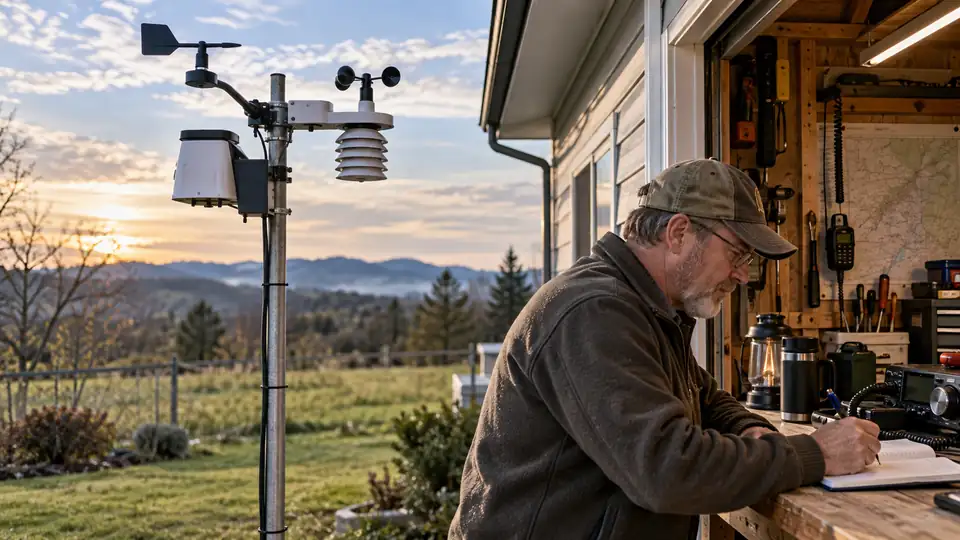
CWOP-focused weather monitoring starts with a practical question: can the station collect useful local observations and move them onto a supported online network? Temperature, relative humidity, barometric pressure, rainfall, wind speed, and wind direction matter most for a complete observation set. Wi-Fi or another Internet connection matters because a wireless sensor link to a console does not automatically submit data to CWOP.
The product information for these stations identifies services such as Weather Underground, Ambient Weather Network, Wunderground Sync, and Weatherseed. It does not explicitly confirm direct CWOP support for any model here. That distinction matters. A station may measure the right variables yet require a compatible gateway, software path, or separate integration before its readings can reach CWOP. Sensor placement matters too. A rain cup needs a level, unobstructed position, while a wind sensor needs clear exposure away from buildings and trees.
The rankings below favor complete stations with useful local measurements, genuine Internet connectivity where available, data history, rainfall and wind sensing, and practical displays. Connected Ambient Weather models lead the list because their Wi-Fi and weather-network features are clearly described, while the strongest Sainlogic and Tempest alternatives bring different advantages in data export, app alerts, sensor design, or maintenance.
Quick Answer
- Best Overall: Ambient Weather WS-5000, for a connected station with an ultrasonic sensor array, five-second updates, Wi-Fi, and smart-home support.
- Best Value for Connected Monitoring: Ambient Weather WS-2902, with wind, rain, UV, solar radiation, Wi-Fi, and a color console in one system.
- Best for Data Export: Sainlogic 5G/2.4G WiFi Smart Weather Station, with app alerts, Wunderground Sync, two-year local storage, and Excel export.
- Best for Low-Maintenance Sensor Hardware: Tempest Weather Station, with a solar-powered outdoor sensor, no moving parts, lightning detection, and app connectivity.
Best Weather Stations for CWOP Comparison Table
| Product | Measurements | Connectivity | Sensor Design | Best For |
|---|---|---|---|---|
| Ambient Weather WS-5000 | Temperature, humidity, pressure, rain, wind, UV, solar radiation | Wi-Fi, app, smart-home platforms | Ultrasonic array, rain cup | Advanced connected monitoring |
| Ambient Weather WS-2902 | Temperature, humidity, rain, wind, UV, solar radiation | Wi-Fi, Ambient Weather Network, smart-home platforms | Integrated Osprey array | Overall balance |
| Sainlogic 5G/2.4G WiFi Smart Weather Station | Temperature, humidity, rain, wind, pressure, derived readings | Dual-band Wi-Fi, Bluetooth pairing, app | Integrated outdoor array | Data logging and export |
| Tempest Weather Station | Temperature, humidity, pressure, rain, wind, UV, solar radiation, lightning | App, Alexa, Rachio, IFTTT | Solar-powered, no moving parts | Low-maintenance connected use |
| Ambient Weather WS-2000 | Temperature, humidity, rain, wind, UV, solar radiation | Wi-Fi, weather-network connection | Integrated outdoor array | Color console and calibration |
| AcuRite Iris 5-in-1 01540M | Temperature, humidity, pressure, rain, wind | Wi-Fi, Weather Underground | 5-in-1 array | Weather Underground sharing |
| Sainlogic 10-in-1 WiFi Weather Station | Temperature, humidity, rain, wind, pressure, derived readings | 2.4 GHz Wi-Fi, Weatherseed app | Integrated outdoor sensor | Alerts and long-term records |
| AcuRite Iris 01512MCB | Temperature, humidity, pressure, rain, wind, derived readings | Wireless console connection | Outdoor array with mounting bracket | Local display and simple setup |
| AIRAIN TECH Wireless Weather Station | Temperature, humidity, rain, wind, pressure, UV, derived readings | Local wireless link, no Wi-Fi | Outdoor array with two displays | Local monitoring without Internet |
The detailed reviews explain which stations offer a realistic starting point for CWOP-related monitoring and which ones remain local or platform-dependent.
1. Ambient Weather WS-5000 Ultrasonic Smart Weather Station – Best Overall
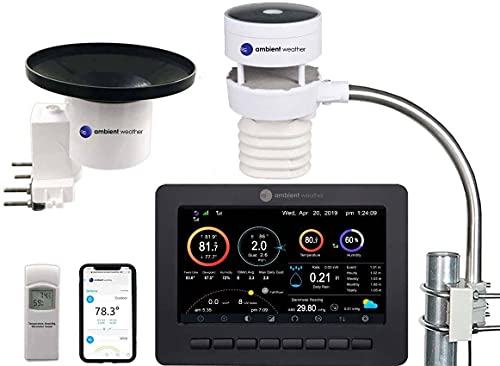
The WS-5000 has the strongest overall architecture for a connected observation setup. Its package includes an ultrasonic sensor array, a rain cup, an indoor and outdoor thermo-hygrometer-barometer, and a TFT color display. The ultrasonic array has no moving parts, which removes the mechanical cups and vane found in many conventional outdoor arrays. That does not eliminate the need for careful mounting, but it makes the sensor design especially interesting for someone who wants frequent updates without a mechanically rotating wind assembly.
Listed updates arrive every five seconds, giving the console and connected services a lively view of changing wind and weather conditions. Wi-Fi enables remote access and optional transmission to the Ambient Weather Network, while the listing also identifies IFTTT, Google Home, and Alexa support. Those capabilities are useful for a CWOP-minded buyer who wants a connected station, although direct CWOP compatibility is not explicitly stated. Confirm the required upload path before treating this model as a guaranteed CWOP station.
Pros
- Ultrasonic outdoor sensor array has no moving parts.
- Listed five-second updates suit changing wind conditions.
- Includes a separate indoor and outdoor thermo-hygrometer-barometer.
- Supports Wi-Fi, remote access, and Ambient Weather Network transmission.
- Identifies IFTTT, Google Home, and Alexa compatibility.
Cons
- Direct CWOP support is not explicitly identified in the available product information.
- Premium hardware may be more capability than a reader needs for simple local observations.
This is the most complete choice for someone building a connected personal weather setup around broad measurements, fast updates, and smart-home access. The ultrasonic design gives it a meaningful distinction from the WS-2902 and WS-2000, while the separate indoor sensor adds useful pressure and indoor-condition context. A buyer who needs a direct, confirmed CWOP upload method should verify that connection before ordering. For advanced local monitoring with a clearly connected ecosystem, though, this is the strongest starting point.
To buy this product, click here.
2. Ambient Weather WS-2902 Wi-Fi Smart Weather Station – Best Value for Connected Monitoring
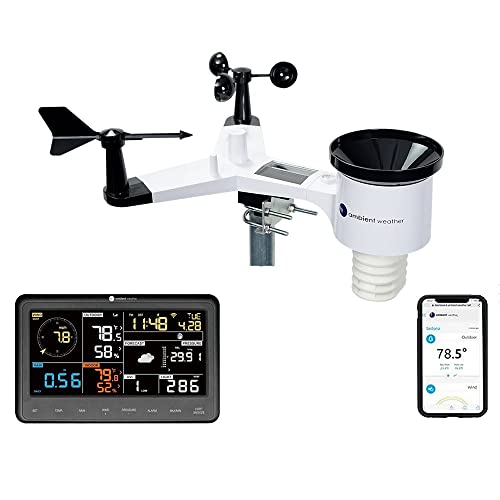
The WS-2902 covers the core outdoor observations most people expect from a personal weather station. Its Osprey sensor array measures temperature, humidity, wind speed, wind direction, rainfall, UV intensity, and solar radiation, then sends the information to an easy-to-read color LCD display. That combination gives a CWOP-oriented setup the basic ingredients for a useful local record, with Wi-Fi available for networked access.
Remote access, alerts, IFTTT, Google Home, and Alexa support give this model more reach than a local-only console. The listing also identifies optional transmission to the Ambient Weather Network. CWOP is not named, so the station should be viewed as a connected data source rather than a confirmed direct CWOP submission device. Its appeal is balance: the system includes a broad sensor set without moving into the more specialized ultrasonic design of the WS-5000.
Pros
- Measures wind speed, wind direction, temperature, humidity, rainfall, UV, and solar radiation.
- Includes an outdoor sensor array and color LCD display.
- Provides Wi-Fi access, alerts, and remote monitoring features.
- Identifies IFTTT, Google Home, and Alexa support.
- Can optionally transmit data to the Ambient Weather Network.
Cons
- Direct CWOP compatibility is not stated.
- The integrated array gives less flexibility than a system with separately placed instruments.
The WS-2902 suits a household or small property that needs a broad set of observations and a clear path toward online data access. It ranks below the WS-5000 because the ultrasonic sensor design and five-second update claim are absent here, yet it remains a more balanced pick for many connected installations. Place the array away from roof heat, nearby walls, and wind obstructions, then verify the software or gateway requirements for any CWOP upload plan.
To buy this product, click here.
3. Sainlogic 5G/2.4G WiFi Smart Weather Station – Best for Data Export

For someone who wants to study weather records rather than glance at a single reading, this Sainlogic station brings unusually useful data features to the comparison. The product information lists two-year local storage and Excel export, with each export covering up to 30 days. That setup can help a garden, greenhouse, or property owner examine temperature changes, humidity swings, rainfall totals, and other trends instead of relying only on the live screen.
The station supports 5 GHz and 2.4 GHz Wi-Fi, Bluetooth fast pairing, app alerts, and Wunderground Sync. The outdoor system measures temperature, humidity, rainfall, wind, and related readings. Listed temperature accuracy is ±0.2°C, humidity accuracy is ±1.8% RH, and rainfall accuracy is given as ±1 mm below 15 mm and ±7% above that level. These are listing claims, not independent verification. CWOP is not explicitly named, so confirm whether the supported data path can serve that purpose.
Pros
- Supports both 5 GHz and 2.4 GHz Wi-Fi according to the listing.
- Includes Bluetooth pairing for setup.
- Stores up to two years of local data with Excel export.
- Provides app alerts and Wunderground Sync.
- Lists rainfall accuracy figures and a built-in bubble level.
Cons
- Direct CWOP support is not identified.
- Exports are limited to periods of up to 30 days at a time according to the listing.
This is a compelling choice for readers who want records they can download and analyze. The 443-foot open-area transmission figure may help with a spread-out property, but walls, metal structures, terrain, and interference can reduce actual performance. Choose it over the simpler WS-2902 if exported history matters more than smart-home integration. Choose something else if a confirmed CWOP workflow is the deciding requirement.
To buy this product, click here.
4. Tempest Weather Station – Best for Low-Maintenance Sensor Hardware
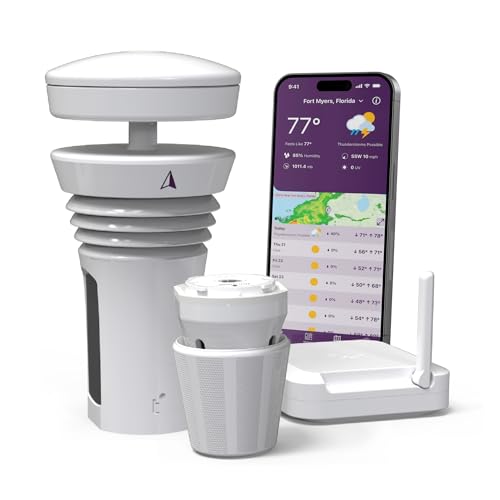
Tempest takes a different approach to the outdoor sensor. The listing describes a solar-powered unit with no moving parts, plus measurements for temperature, humidity, barometric pressure, wind speed, wind direction, dew point, solar radiation, UV index, lightning strikes, and rainfall. That broad mix is useful for a connected property where lightning and solar information matter alongside standard observations.
Wireless transmission is listed at more than 1,000 feet, and updates are identified as arriving every three seconds. Those figures can make the system attractive for a large property, but they remain published maximum or marketing specifications rather than a guarantee through walls or across difficult terrain. App, Alexa, Rachio, and IFTTT support add automation options. The product information does not explicitly confirm CWOP access, so a buyer should verify how its data can be routed to that program.
Pros
- Measures lightning strikes along with common weather variables.
- Outdoor sensor uses solar power and has no moving parts.
- Lists wireless transmission beyond 1,000 feet.
- Lists three-second real-time updates.
- Supports app access, Alexa, Rachio, and IFTTT.
Cons
- Direct CWOP compatibility is not stated.
- The listing does not explain the precise power arrangement for every system component.
Tempest is a strong fit for someone who wants a modern connected station with a compact, low-mechanical-complexity outdoor sensor. It earns a place above conventional systems for readers who value lightning information and automation. The lack of explicit CWOP support keeps it from taking the top spot, and its connected features may be unnecessary for someone who wants a simple console. Check the data-sharing path before using it as the centerpiece of a CWOP submission plan.
To buy this product, click here.
5. Ambient Weather WS-2000 Smart Weather Station – Best for a Color Console and Calibration
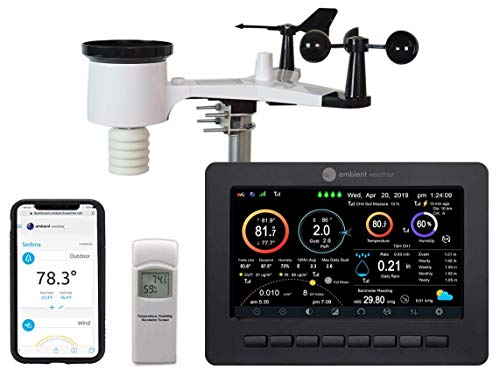
The WS-2000 centers the experience around a TFT color display and an integrated outdoor array. It measures temperature, humidity, rainfall, wind speed, wind direction, UV, and solar radiation, which gives it the same broad observation foundation as the WS-2902. Imperial and metric units are supported, and the listing identifies calibration capability, a useful detail for readers who want more control over how readings are presented.
Wi-Fi connectivity can send station data toward the Ambient Weather network, while the 5V DC adapter powers the console. The outdoor array requires three AAA batteries, and those batteries are not included. That split power arrangement is ordinary for a wireless station, but it matters in a remote or hard-to-service installation. CWOP support is not explicitly named, so the model should be treated as a capable connected station that still requires compatibility confirmation.
Pros
- Includes a TFT color display.
- Measures wind, rain, temperature, humidity, UV, and solar radiation.
- Supports imperial and metric units.
- Lists calibration capability.
- Offers Wi-Fi connectivity for Ambient Weather network transmission.
Cons
- Outdoor sensor batteries are required and not included.
- Direct CWOP compatibility is not identified.
This model makes sense for someone who values a richer color console and calibration controls without moving to the WS-5000’s ultrasonic array. Its measurement set is appropriate for a complete personal station, while the Wi-Fi feature keeps online access in view. It ranks below the WS-2902 because the available information gives less detail about smart-home features, and below the top options because CWOP support remains unconfirmed. Plan the sensor location and battery maintenance before mounting it on a distant outbuilding.
To buy this product, click here.
6. AcuRite Iris 5-in-1 Home Weather Station 01540M – Best for Weather Underground Sharing
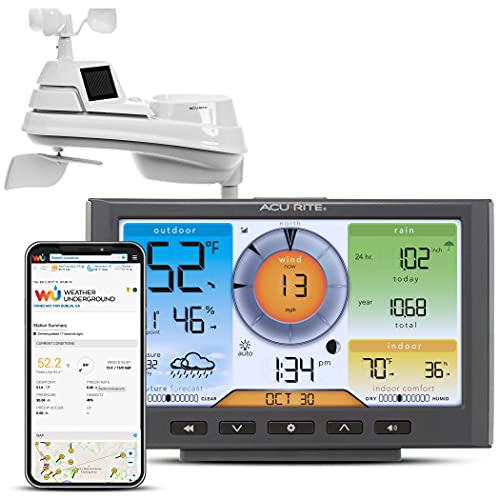
The AcuRite Iris 01540M is a straightforward complete station with a clear network identity. Its indoor and outdoor system measures temperature, humidity, wind speed, wind direction, barometric pressure, and rainfall, while the color display adds time, date, adjustable dimming, and weather information. The product information also lists more than 25 data points, including heat index, dew point, wind chill, rainfall history, and threshold alarms.
Its most relevant connected feature is Wi-Fi access to Weather Underground for remote monitoring and data sharing. That is useful for readers who already use that platform, but Weather Underground support should not be treated as automatic CWOP compatibility. The station’s 5-in-1 label also should not be compared too literally with every other manufacturer’s sensor count, since brands may count measurements differently.
Pros
- Provides Wi-Fi connection to Weather Underground.
- Measures indoor and outdoor temperature and humidity, wind, pressure, and rain.
- Includes a color LCD display with adjustable dimming.
- Lists more than 25 data points and historical information.
- Offers threshold alarms, heat index, dew point, and wind chill readings.
Cons
- Direct CWOP support is not stated.
- The 5-in-1 label does not describe a universal cross-brand measurement standard.
This station is a sensible route for someone whose online weather records already live on Weather Underground. It offers the core measurements needed for a personal station without the more complex sensor architecture of the Ambient Weather WS-5000. Choose it for established Weather Underground sharing, but verify whether a separate bridge or data service is needed for CWOP. Readers who want local Excel export or two-year storage should look at the Sainlogic connected models instead.
To buy this product, click here.
7. Sainlogic 10-in-1 WiFi Weather Station – Best for Alerts and Long-Term Records

This Sainlogic model is built around the Weatherseed app, with the listing describing alerts for changes in temperature, humidity, and barometric pressure. It also records rainfall by hour, day, week, month, and year, then supports storage and downloads covering up to two years. For someone tracking a garden, orchard, or property from a phone, that combination is more useful than a console that only shows current conditions.
The station uses 2.4 GHz Wi-Fi, so router compatibility deserves attention before purchase. Its display uses enlarged text, which may help readers who want a quick view across a room. The listing gives rainfall figures of ±1 mm below 15 mm and ±7% from 15 to 9,999 mm, but these remain stated product claims. Weatherseed and Wi-Fi are clearly identified, while direct CWOP support is not.
Pros
- Provides app alerts for temperature, humidity, and pressure changes.
- Records rainfall across hourly, daily, weekly, monthly, and yearly periods.
- Lists up to two years of storage and Excel download capability.
- Uses an enlarged, high-contrast display.
- Includes a 2.4 GHz Wi-Fi connection to the Weatherseed app.
Cons
- Only 2.4 GHz Wi-Fi is identified.
- Direct CWOP compatibility is not stated.
The 10-in-1 Sainlogic is most attractive for data-conscious monitoring that happens through a phone and stored records. It ranks below the dual-band Sainlogic because the connectivity is narrower, yet its alert and historical-data emphasis may suit someone who cares more about trend tracking than Bluetooth setup. Confirm the app’s supported data destinations before purchase, especially if CWOP submission is the central reason for buying.
To buy this product, click here.
8. AcuRite Iris 01512MCB Indoor/Outdoor Weather Station – Best for Simple Setup
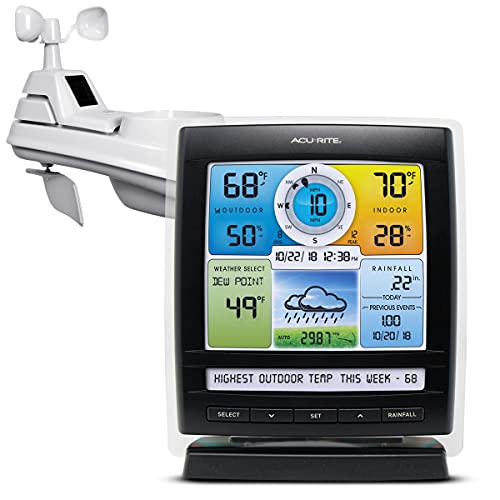
The 01512MCB keeps the installation story simple. The listing describes a color display, an outdoor sensor with a mounting bracket, and a setup process that involves installing batteries and attaching the sensor to a pole or post. Its measurements include indoor and outdoor temperature and humidity, wind speed and direction, barometric pressure, and rainfall. For a home that wants a broad local snapshot without a complicated network setup, that is a useful combination.
More than 55 data points are listed, including pressure trends, heat index, dew point, feels-like temperature, and historical information. These additional values include calculated readings, so they should not be confused with separate physical sensors. The display can generate a personalized 12-hour forecast using elevation and barometric pressure. Because the available information does not identify Wi-Fi or direct CWOP support for this model, it is better suited to local observation than remote network contribution.
Pros
- Includes a color display and outdoor mounting bracket.
- Measures indoor and outdoor temperature, humidity, wind, pressure, and rain.
- Lists more than 55 data points and historical information.
- Displays pressure trends, heat index, dew point, and feels-like temperature.
- Uses elevation and pressure information for a localized forecast.
Cons
- Wi-Fi and direct CWOP support are not identified.
- Local console monitoring is more limited for readers who need data away from home.
This AcuRite is a reasonable choice for a local station where the display is the main destination for readings. It is easier to position as a household weather monitor than as a CWOP-connected platform, which explains its lower ranking. Choose it if a visible console and uncomplicated outdoor mounting matter most. Skip it for a remote property or network contribution plan unless a separate supported connection method is confirmed.
To buy this product, click here.
9. AIRAIN TECH Wireless Weather Station – Best for Local Monitoring Without Wi-Fi
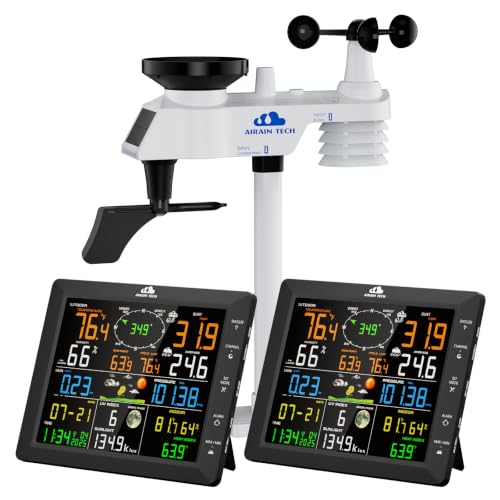
AIRAIN TECH is aimed at readers who want a broad local display rather than Internet access. The system includes two main displays and an outdoor sensor, with readings for temperature, humidity, rainfall, wind speed, wind direction, barometric pressure, UV, dew point, wind chill, and moon phase. Its 8.5-inch color screen puts many observations in one place, which can be handy in a kitchen, office, workshop, or school setting.
The product information lists a wireless transmission distance of up to 328 feet in open conditions and gives temperature and humidity accuracy figures of ±2°F or 1°C and ±5 percent, respectively. The outdoor sensor pairs automatically with the display, and the package includes a mounting pole, brackets, hardware, and a power adapter. There is no Wi-Fi, so this station cannot be treated as a remote CWOP source without an additional, separately supported method that is not identified here.
Pros
- Includes two main displays.
- Measures temperature, humidity, rain, wind, pressure, and UV.
- Provides an 8.5-inch adjustable-brightness color screen.
- Lists automatic sensor pairing and up to 328 feet of open-area transmission.
- Includes a mounting pole, brackets, nuts, bolts, and screws.
Cons
- No Wi-Fi is identified.
- Its local wireless design does not directly suit remote CWOP data access.
This station belongs near the bottom because CWOP depends on a connected data path, while AIRAIN TECH is explicitly a no-Wi-Fi system. It still has a genuine use case: a reader who wants two large local displays, a broad measurement set, and included mounting hardware without configuring an app or network. Select it for on-site awareness, not for online contribution. A connected Ambient Weather or Sainlogic model is a better starting point for remote records.
To buy this product, click here.
Buying Guide
Confirm the CWOP Data Path Before Buying
A station can measure the right variables and still fail to meet your online reporting goal. The product information here identifies Wi-Fi, Weather Underground, Ambient Weather Network, Wunderground Sync, Weatherseed, apps, and smart-home services, but it does not explicitly confirm direct CWOP support. Treat those platforms as separate capabilities. Before ordering, confirm whether your intended CWOP workflow accepts the station directly or needs a gateway, software bridge, or compatible service.
Wireless Sensor Communication Is Not Wi-Fi
Every wireless station still needs a way to move outdoor readings to an indoor console. That short-range sensor link is different from Wi-Fi. AIRAIN TECH, for example, has a wireless outdoor sensor connection but no Wi-Fi. The WS-2902 combines a wireless sensor array with Wi-Fi, while the Sainlogic models add app-based network access. A wireless console alone does not provide Internet monitoring.
Prioritize the Measurements Your Observation Plan Uses
Temperature, humidity, pressure, rainfall, wind speed, and wind direction form the practical foundation of a complete personal station. UV, solar radiation, and lightning can add useful context, but more measurements do not automatically create better CWOP observations. Tempest adds lightning and solar measurements, while the Ambient Weather models list UV and solar radiation. Choose the set that fits your record-keeping goal rather than counting every “in-1” label as a universal standard.
Separate Direct Measurements From Calculated Readings
A station may display dew point, wind chill, heat index, feels-like temperature, or a forecast icon without using a separate sensor for each value. Those readings are calculated from other measurements. The AcuRite and Sainlogic products list several derived values, while pressure-based forecasts are interpretations of local conditions rather than direct measurements of future weather. For a station report, keep the sensor observations distinct from calculated information.
Treat Accuracy, Resolution, and Range as Different Specifications
A display that shows small increments is not automatically more accurate. Accuracy describes how close a measurement is expected to be to a reference, while resolution describes the displayed step size. The Sainlogic listings provide stated temperature, humidity, and rainfall accuracy figures, and AIRAIN TECH lists its own temperature and humidity figures. These are product claims, not independent testing results. Transmission range is separate again, and a published open-area distance can shrink around walls, metal, trees, and terrain.
Plan Sensor Placement Before Installation
Rainfall readings can be affected by nearby obstructions and an unlevel rain cup. Wind readings need clear exposure, while temperature and humidity readings can be influenced by direct sun, roofs, pavement, and walls. An integrated array simplifies setup, but it also places several measurements in one location. A larger property may benefit from flexible placement, yet the products here primarily use integrated outdoor arrays. Follow the product instructions and use safe mounting practices for poles, roofs, and elevated locations.
Check Power and Maintenance Details
The console and outdoor sensor may use different power sources. The WS-2000 console uses a 5V adapter, while its outdoor array requires three AAA batteries. Tempest lists a solar-powered outdoor sensor, but that does not automatically mean the entire system is free from power requirements or maintenance. Sainlogic and AIRAIN TECH also have component-specific power needs. A station on a distant shed or outbuilding deserves a clear battery and access plan before installation.
Choose Data History Based on How You Work
Live readings are enough for checking whether a storm is approaching, but long-term records matter for seasonal comparisons, garden decisions, and station reporting. The Sainlogic 5G/2.4G model lists two-year local storage and Excel export, while the 10-in-1 model lists two-year storage and downloads through Weatherseed. AcuRite and Ambient Weather products identify historical or network data features, though the supplied information does not give identical export details for every model.
Best Weather Stations for CWOP FAQ
Do These Weather Stations Directly Support CWOP?
The available product information does not explicitly confirm direct CWOP support for any of the nine models. Several identify other network services, including Weather Underground, Ambient Weather Network, Wunderground Sync, and Weatherseed. Confirm the exact CWOP connection method before purchase.
What Measurements Matter Most for CWOP-Style Observations?
Temperature, relative humidity, barometric pressure, rainfall, wind speed, and wind direction are the core measurements to prioritize in a complete personal weather station. UV, solar radiation, and lightning can be useful additions, but they do not replace the basic observation set.
Is a Wireless Weather Station the Same as a Wi-Fi Weather Station?
No. Wireless usually describes the connection between an outdoor sensor and a console. Wi-Fi connects a console or gateway to a local network and may enable app access, cloud services, or uploads. AIRAIN TECH is wireless but has no Wi-Fi, while the Ambient Weather and Sainlogic connected models identify Wi-Fi functions.
Which Model Offers the Strongest Data-Logging Features?
The Sainlogic 5G/2.4G WiFi Smart Weather Station lists two years of local storage and Excel export, with each export covering up to 30 days. The Sainlogic 10-in-1 model also lists two-year storage and downloads through its Weatherseed app. These features are useful for keeping records, but they do not by themselves confirm CWOP submission.
Does a Long Wireless Range Guarantee Reliable Reception?
No. Published ranges generally describe favorable or open conditions. Walls, floors, metal structures, terrain, interference, and sensor placement can reduce the distance available in a real installation. The Sainlogic 5G/2.4G and 12-in-1 listings give open-area range figures, and AIRAIN TECH lists up to 328 feet, but none should be treated as guaranteed through every building.
Which Station Has the Most Distinctive Sensor Design?
The Ambient Weather WS-5000 uses an ultrasonic sensor array with no moving parts, while Tempest also lists an outdoor sensor with no moving parts. The WS-2902, WS-2000, AcuRite, Sainlogic, and AIRAIN TECH models use integrated outdoor sensor arrangements described in their product information. Sensor design affects installation and maintenance considerations, but it does not independently prove better accuracy.
Can a Local-Only Weather Station Send Data to CWOP?
A local-only station cannot provide remote network data by itself. AIRAIN TECH, for example, is listed as having no Wi-Fi and sends readings to its local displays. A separate, supported connection system would be required, but the available product information does not identify one for that model. A station with documented Wi-Fi and data services is a more practical starting point.
Does a Better Display Mean Better Weather Measurements?
No. A large or colorful display improves visibility, but screen size and resolution do not establish sensor accuracy. AIRAIN TECH lists an 8.5-inch display, the Sainlogic 12-in-1 has a 6.5-inch display, and several Ambient Weather and AcuRite models use color consoles. Evaluate the sensor specifications and data path separately from the screen.
Final Verdict
The Ambient Weather WS-5000 is the strongest overall choice for a connected personal weather setup aimed at serious local observation. Its ultrasonic array, listed five-second updates, rain cup, separate thermo-hygrometer-barometer, Wi-Fi, and smart-home support give it the broadest combination of sensing and connectivity in this group. It still should not be called a confirmed CWOP station without verifying the upload path, since direct CWOP support is not identified in the supplied product information.
The WS-2902 is the more balanced alternative for broad measurements and connected household monitoring, while the Sainlogic 5G/2.4G model is the better fit for Excel exports and long-term local records. Tempest deserves attention for its no-moving-parts outdoor sensor, lightning measurement, and connected automation options. Buyers should match the station to the actual reporting workflow, sensor placement, power access, and data-history needs. For CWOP, the best purchase is the model whose supported connection can be confirmed before installation, not automatically the station with the longest feature list.