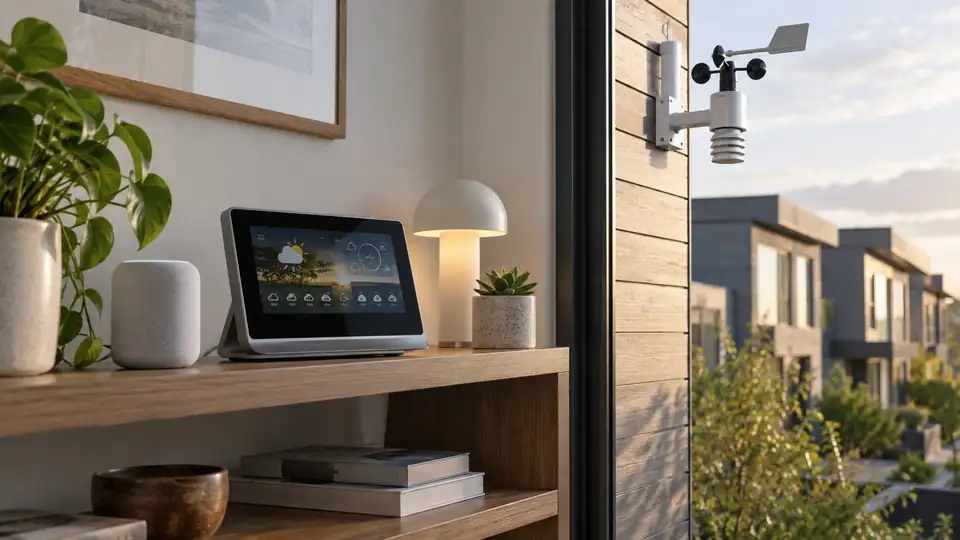
A smart-home weather station has to do more than show a temperature on a tabletop screen. The useful setup combines outdoor measurements, a practical console, wireless sensor communication, and a network connection that can move readings into an app, weather platform, or supported automation service. Rainfall, wind, humidity, barometric pressure, UV, and solar radiation can all matter, but the right mix depends on whether you are checking the backyard, managing a garden, watching a greenhouse, or building weather-based routines.
The distinction between wireless and Wi-Fi deserves attention. Wireless usually describes the link between the outdoor sensor and the indoor console. Wi-Fi connects the station or console to your home network. Those are separate jobs. A long advertised transmission range can help with sensor placement, yet walls, metal structures, floors, and interference may reduce the practical distance. A station that supports remote access or smart-home automation also needs clearer consideration than one that simply displays data locally.
This comparison weighs local measurements, app and network access, smart-home usefulness, sensor design, data history, installation details, and power requirements. The Ambient Weather WS-2902 is the strongest overall fit because it combines a broad outdoor measurement set with Wi-Fi access and stated support for IFTTT, Google Home, and Alexa. Several alternatives make more sense for specialized priorities, including detailed data export, ultrasonic wind sensing, Weather Underground access, or a simpler temperature and humidity setup.
Quick Answer
- Best Overall: Ambient Weather WS-2902 Wi-Fi Smart Weather Station combines wind, rain, temperature, humidity, UV, and solar-radiation readings with Wi-Fi, remote access, and stated smart-home support.
- Best for Detailed Data: Sainlogic 5G/2.4G WiFi Smart Weather Station adds two-year local storage and Excel export, making it useful for reviewing seasonal conditions.
- Best Premium Option: Ambient Weather WS-5000 uses an ultrasonic sensor array with no moving parts and five-second weather updates.
- Best for Weather Underground: AcuRite Iris 5-in-1 offers Wi-Fi connection to Weather Underground and a broad set of home weather readings.
Best Weather Stations for Smart Home Comparison Table
| Product | Measurements | Connectivity | Sensor Design | Best For |
|---|---|---|---|---|
| Ambient Weather WS-2902 | Wind, rain, temperature, humidity, UV, solar radiation | Wi-Fi, stated IFTTT, Google Home, Alexa support | Wireless Osprey array | Best overall smart-home setup |
| Ambient Weather WS-2000 | Wind, rain, temperature, humidity, UV, solar radiation | Wi-Fi network access | Wireless integrated array | Color-console monitoring |
| Sainlogic 5G/2.4G WiFi Station | Temperature, humidity, rain, wind, pressure, moon phase | Dual-band Wi-Fi, Bluetooth, app | Wireless outdoor array | Data logging and export |
| AcuRite Iris 5-in-1 | Temperature, humidity, pressure, rain, wind | Wi-Fi, Weather Underground | Wireless 5-in-1 array | Weather Underground users |
| Ambient Weather WS-5000 | Outdoor and indoor weather measurements, rain | Wi-Fi, stated IFTTT, Google Home, Alexa support | Ultrasonic array with no moving parts | Premium connected monitoring |
| Aerivan W1 PRO | Temperature, humidity, wind, rain, pressure | Wi-Fi, Smart Life app | Solar-assisted outdoor sensor with battery backup | Smart Life routines and large display |
| Sainlogic Smart Weather Station | Temperature, humidity, rain, wind, pressure | Dual-band Wi-Fi, Bluetooth, app | Wireless outdoor array | Large-property sensor placement |
| Sainlogic Station with Extra Sensor | Temperature, humidity, rain, wind, UV, pressure | Dual-band Wi-Fi, Bluetooth, app alerts | Outdoor array with extra sensor | Multiple-location monitoring |
| Smart WiFi Weather Station with App Control | Indoor and outdoor temperature, humidity | 2.4 GHz Wi-Fi, Tuya app | Up to three sensor channels | Compact smart-home monitoring |
The detailed reviews below show where each station fits, which measurements it provides, and what you give up by choosing one system over another.
1. Ambient Weather WS-2902 Wi-Fi Smart Weather Station: Best Overall
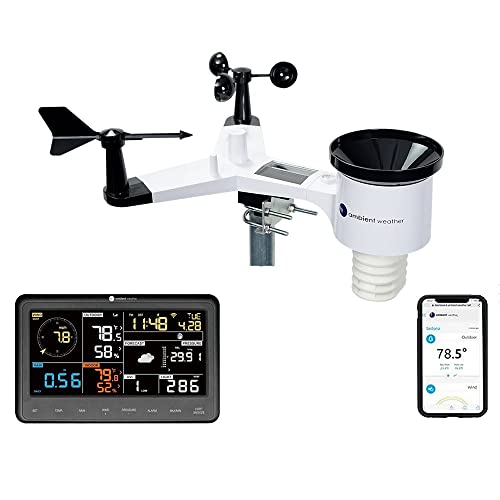
The WS-2902 is the most balanced choice for a connected home because its outdoor array covers the measurements people usually want from a full personal weather station. The listing identifies wind speed, wind direction, temperature, humidity, rainfall, UV intensity, and solar radiation, while the included color display keeps local readings visible without opening a phone. That combination suits a kitchen counter, home office, or hallway where a quick glance can answer whether the yard is wet, windy, or heating up.
Its smart-home emphasis gives it an advantage over a station that stops at a local console. The product information states that users can set alerts, access data remotely, and program a home through IFTTT, Google Home, and Alexa. Those claims make it relevant for weather-triggered routines, such as adjusting irrigation behavior after rain, though the exact automation setup depends on the supported service and configuration. The sensor array still needs sensible outdoor placement, since nearby roofs, walls, pavement, and trees can influence readings.
Pros
- Measures wind speed, wind direction, temperature, humidity, rainfall, UV intensity, and solar radiation.
- Includes a wireless Osprey sensor array and color LCD display.
- Product information states support for IFTTT, Google Home, and Alexa.
- Supports remote data access and weather-based alerts.
- Offers a strong balance between local viewing and connected monitoring.
Cons
- The outdoor sensor array requires careful placement for useful wind, rain, and temperature readings.
- The exact requirements for each smart-home automation or network service are not fully detailed in the listing.
This is the station to choose when a smart home needs broad outdoor observations without moving into the more specialized WS-5000 tier. It makes less sense for someone who only needs indoor and outdoor temperature, since a smaller multi-channel monitor can be simpler. For most connected households, though, the combination of measurements, display, Wi-Fi access, and stated automation support gives the WS-2902 the clearest overall case.
To buy this product, click here.
2. Ambient Weather WS-2000 Smart Weather Station: Best for a Color Console
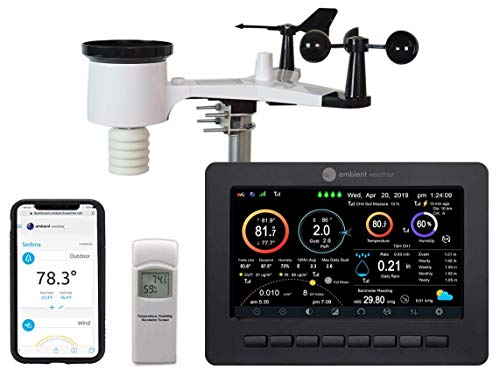
The WS-2000 follows the same broad measurement idea as the WS-2902, with an integrated wireless array for wind speed, wind direction, temperature, humidity, rainfall, UV, and solar radiation. Its TFT color display is the centerpiece, giving the station a more information-rich feel for people who prefer a dedicated console over checking an app each time a storm rolls in.
Calibration and unit flexibility are useful details for a household that switches between imperial and metric readings or wants to adjust displayed values. The listing also describes enhanced Wi-Fi connectivity for transmitting information to a personal weather-station network. The console uses a 5V DC adapter, while the outdoor array requires three AAA batteries, which means the system has separate power needs that should be planned before mounting the sensor outside.
Pros
- Tracks wind, rain, temperature, humidity, UV, and solar radiation.
- Uses a TFT color display for at-a-glance local monitoring.
- Supports imperial and metric units.
- Offers calibration capability according to the product information.
- Provides Wi-Fi network connectivity through the enhanced Wi-Fi option.
Cons
- The console requires a 5V DC adapter for power.
- Three AAA batteries for the outdoor sensor array are not included.
The WS-2000 fits a room where the display matters as much as remote access. It is a sensible alternative to the WS-2902 for someone who wants a color console and unit calibration, while the shared integrated-array approach keeps installation familiar. Buyers focused on automation should verify the exact platform features they need before choosing it over the more explicitly smart-home-oriented WS-2902.
To buy this product, click here.
3. Sainlogic 5G/2.4G WiFi Smart Weather Station: Best for Data Logging

Historical data is the reason to look closely at this Sainlogic model. The listing describes two years of local storage and Excel export, with each export covering up to 30 days. That setup is useful for someone tracking rainfall across a growing season, reviewing humidity in a plant space, or keeping a record of temperature changes instead of relying on a few high and low values shown on a console.
The station also brings unusually specific environmental claims for temperature, humidity, and rainfall. The product information lists temperature accuracy of plus or minus 0.2 degrees Celsius, humidity accuracy of plus or minus 1.8 percent relative humidity, and rainfall accuracy of plus or minus 1 millimeter below 15 millimeters, changing to plus or minus 7 percent above that amount. These are listing claims rather than independent verification. A built-in bubble level can help with horizontal sensor placement, while the stated open-area wireless range reaches up to 443 feet. Buildings and other obstructions can reduce that distance.
Pros
- Supports 5 GHz and 2.4 GHz Wi-Fi according to the listing.
- Includes Bluetooth fast pairing for setup.
- Stores up to two years of local weather data.
- Exports recorded information to Excel for further review.
- Tracks rainfall totals across hourly, daily, monthly, and yearly periods.
Cons
- The stated 443-foot transmission distance applies to open-area conditions and is not a guarantee through a building.
- The exact app and smart-home automation platforms beyond the listed functions are not clearly identified.
This model is especially appealing for readers who want their weather station to become a record-keeping tool. It ranks below the Ambient Weather WS-2902 for clearly stated smart-home platform support, but its storage and export features are stronger for analysis. Choose it for garden, greenhouse, or property records. Skip it if you only want a clean display and have no use for archived data.
To buy this product, click here.
4. AcuRite Iris 5-in-1 Home Weather Station: Best for Weather Underground
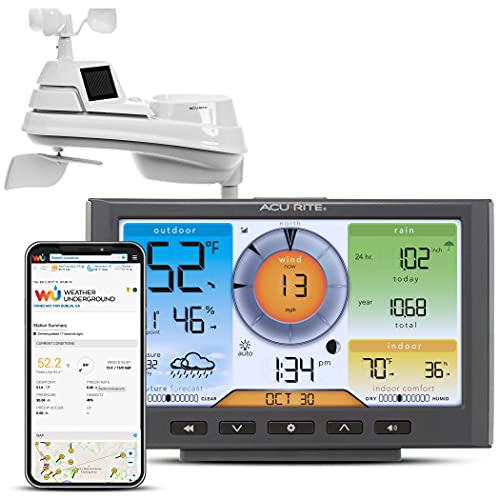
AcuRite Iris takes a more defined route into connected weather monitoring. Its wireless station measures indoor and outdoor temperature and humidity, wind speed and direction, barometric pressure, and rainfall. The included color display also functions as a weather clock, showing time and date alongside current conditions, while an adjustable dimmer helps it fit a living room or office where a bright screen could become distracting.
The key smart-home-adjacent feature is its stated Wi-Fi connection to Weather Underground. That gives the station a clear purpose for people who want to share or view personal weather observations through that platform. The listing also describes more than 25 data points, threshold alarms, historical data, heat index, dew point, wind chill, and rainfall history. Some of those values are calculated from the station’s measurements, so they should be read as derived information rather than separate physical sensors.
Pros
- Provides a complete 5-in-1 outdoor measurement set with indoor readings.
- Offers stated Wi-Fi connection to Weather Underground.
- Includes a color display with adjustable dimming.
- Records historical information and rainfall history.
- Displays calculated values such as heat index, dew point, and wind chill.
Cons
- Weather Underground is the clearly identified connected platform, so other integrations are not established by the listing.
- The listing does not provide a detailed breakdown of the accuracy for every measurement.
AcuRite Iris is the better match for a household already interested in Weather Underground rather than a buyer choosing primarily for voice-assistant routines. It gives you a wide set of readings without the more advanced ultrasonic design of the WS-5000. Its ranking reflects clear platform relevance, while buyers who need IFTTT, Google Home, or Alexa should compare those requirements carefully before ordering.
To buy this product, click here.
5. Ambient Weather WS-5000 Ultrasonic Smart Weather Station: Best Premium Option
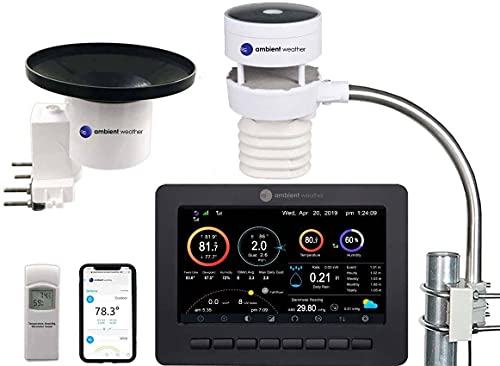
The WS-5000 earns its premium position through sensor architecture rather than a longer list of ordinary console features. Its ultrasonic sensor array has no moving parts, and the product information describes real-time weather updates every five seconds. That can be attractive for monitoring changing wind conditions around a property, where a rapid refresh feels more useful than a screen that updates only occasionally.
The package includes the ultrasonic array, a rain cup, an indoor and outdoor thermo-hygrometer-barometer, and a full-color TFT display. Wi-Fi access, remote data, alerts, and stated IFTTT, Google Home, and Alexa support give it the connected-home foundation expected from a high-end system. The listing does not provide full accuracy details for every measurement, so its price should be justified by the ultrasonic design, update behavior, and smart-home fit rather than by an assumption of universally superior readings.
Pros
- Uses an ultrasonic sensor array with no moving parts.
- Provides weather updates every five seconds according to the listing.
- Includes a rain cup, indoor and outdoor thermo-hygrometer-barometer, and TFT display.
- Supports remote access, alerts, and stated IFTTT, Google Home, and Alexa functions.
- Offers a broad connected-weather setup for advanced home monitoring.
Cons
- Its premium cost is difficult to justify for households that need only basic temperature and humidity.
- The listing does not give complete accuracy specifications for every measured variable.
This is the choice for someone who cares about the sensor design and fast update cycle as much as smart-home access. It may be excessive beside the WS-2902 for routine backyard checks, yet the lack of moving parts gives the system a meaningful architectural distinction. The installation still matters, and no ultrasonic array can compensate for a poor location blocked by buildings or surrounded by heat-producing surfaces.
To buy this product, click here.
6. Aerivan W1 PRO WiFi Home Weather Station: Best for Smart Life Routines

The Aerivan W1 PRO targets a connected household that wants a large local display and Smart Life access in the same package. Its 7.5-inch color screen shows temperature, humidity, wind speed, wind direction, and rainfall, while the app adds remote readings and barometric pressure information. The product information also describes historical export by email, which gives the station a little more depth than a console that only shows current conditions.
Its solar-powered outdoor sensor switches to battery backup on cloudy days, but the system still requires three AAA batteries indoors and three AA batteries outdoors, and those batteries are not included. That distinction matters. Solar assistance reduces the burden on the outdoor sensor under the stated conditions, yet it does not make the complete station a battery-free system. The listing also identifies Smart Life routines, such as pausing watering when rain is detected, although compatible additional devices are sold separately.
Pros
- Includes a 7.5-inch color display for local monitoring.
- Supports Smart Life app access and weather-based routines.
- Tracks temperature, humidity, wind speed, wind direction, and rainfall.
- Offers historical data export by email according to the listing.
- Outdoor sensor uses solar assistance with battery backup.
Cons
- Indoor and outdoor batteries are required and are not included.
- The Smart Life ecosystem’s additional devices are sold separately.
The W1 PRO makes sense for a home already using Smart Life devices, especially where a large screen and rainfall-triggered routine are useful. Its stated 328-foot wireless range is a listed maximum for favorable conditions, not a guarantee through every wall. Buyers who want Weather Underground or the broader Ambient Weather platform should choose a different ecosystem.
To buy this product, click here.
7. Sainlogic Smart Weather Station: Best for Large Properties

The appeal here is placement flexibility. Sainlogic lists an open-area wireless transmission distance of up to 443 feet, which can help when the outdoor array needs to sit at the far end of a yard, garden, or orchard. The station also supports 5 GHz and 2.4 GHz Wi-Fi with Bluetooth pairing, so setup does not depend on manually switching router bands according to the product description.
Its measurements cover temperature, humidity, rainfall, wind, and pressure, while the app records hourly, daily, monthly, and yearly rainfall totals. The listing gives the same temperature, humidity, and rainfall accuracy claims as the closely related Sainlogic data-focused model, plus two years of local storage and Excel export. A bubble level is built into the sensor for horizontal setup. That helps with rain-gauge installation, though the surrounding exposure still affects the result.
Pros
- Supports dual-band Wi-Fi and Bluetooth pairing.
- Lists an open-area wireless range of up to 443 feet.
- Includes rainfall tracking across several time periods.
- Provides two years of local data storage and Excel export.
- Uses a built-in bubble level to assist with sensor placement.
Cons
- The published wireless range can be reduced by walls, metal, floors, and other obstructions.
- Specific smart-home platform support is not clearly identified beyond the app and network functions described.
This station is a strong fit for a larger residential property where the sensor cannot sit close to the console. It overlaps heavily with the other Sainlogic model, so the purchasing decision should focus on the exact console, app, and included-sensor configuration shown in the current listing. The data tools are useful, but the advertised range should be treated as an open-area figure rather than a guaranteed indoor result.
To buy this product, click here.
8. Sainlogic 5G/2.4G WiFi Smart Weather Station with Extra Sensor: Best for Multiple Locations

This Sainlogic configuration stands out because the listing specifically identifies an extra sensor alongside the outdoor weather system. That matters in a home with separate spaces to watch, such as an indoor living area and a greenhouse or wine cellar. The station also measures rainfall, wind, UV, temperature, humidity, and pressure, so it is broader than a simple multi-room thermometer.
Its Inercom app supplies real-time data, weather maps, alerts, and a two-year local archive with Excel export. The listing gives temperature accuracy of plus or minus 0.2 degrees Celsius and humidity accuracy of plus or minus 1.8 percent relative humidity, along with rainfall claims that vary for totals below and above 15 millimeters. Those figures come from the product information and should not be treated as independent testing. With a stated open-area transmission distance of up to 443 feet, the system is aimed at properties where sensor placement needs room.
Pros
- Includes an extra sensor for monitoring more than one location.
- Supports 5 GHz and 2.4 GHz Wi-Fi with Bluetooth pairing.
- Provides app alerts, weather maps, and real-time observations.
- Stores up to two years of data and supports Excel export.
- Measures UV, rainfall, wind, temperature, humidity, and pressure.
Cons
- The extra sensor configuration should be checked carefully against the exact locations and measurements required.
- The 443-foot transmission figure is an open-area maximum rather than a guaranteed building-to-sensor distance.
This is the Sainlogic option to examine first if one outdoor location is not enough. It may be more equipment than a small apartment needs, while the extra sensor can become genuinely useful across a detached home or garden property. The major trade-off is product complexity. Buyers should confirm the included sensor arrangement and app details before ordering because the listing title describes a specific bundle.
To buy this product, click here.
9. Smart WiFi Weather Station with App Control Indoor Outdoor Thermometer: Best Compact Option

For a smaller home, the most useful weather information may be temperature and humidity in a few locations rather than wind and rainfall. This compact station focuses on that job. It includes one sensor, supports up to three channels, and sends readings to the Tuya app through 2.4 GHz Wi-Fi. The app provides current readings, historical trends, high and low alerts, and Celsius or Fahrenheit selection.
The console adds a five-day forecast display, 23 weather icons, an alarm clock, and four brightness levels. Those forecast elements are separate from direct local measurements, while the indoor and outdoor temperature and humidity readings come from the station’s sensors. Power choice affects connectivity: battery mode provides basic weather data, while Wi-Fi and app features require the supplied power arrangement. That makes it convenient for a plugged-in office or living room, but less suitable for a location without nearby power.
Pros
- Supports up to three temperature and humidity sensor channels.
- Connects to the Tuya app through 2.4 GHz Wi-Fi.
- Offers historical trends and customizable high and low alerts.
- Includes a five-day forecast screen with adjustable brightness.
- Provides basic readings in battery mode and fuller functions with an adapter.
Cons
- Wi-Fi and app features require the station to be plugged into a power adapter.
- Its measurement set is limited to temperature and humidity rather than wind and rainfall.
This is the practical pick for a compact smart-home monitoring job, such as checking a nursery, bedroom, office, or indoor-outdoor comfort conditions. It should not replace a full personal weather station for rainfall, wind, UV, or solar-radiation tracking. Its strength is the simple multi-location temperature and humidity setup, especially for buyers already using Tuya-compatible devices.
To buy this product, click here.
Buying Guide
Wi-Fi and the Outdoor Sensor Link Solve Different Problems
A weather station can send outdoor readings wirelessly to a console without connecting to Wi-Fi. Wi-Fi becomes relevant when the system needs an app, remote access, weather-network upload, or home automation. The WS-2902 and WS-5000 have the clearest stated smart-home positioning in this group, while the AcuRite Iris identifies Weather Underground support. Check the specific platform before assuming that a Wi-Fi label means compatibility with every service.
Decide Which Measurements Matter
Wind, rain, UV, solar radiation, and barometric pressure add useful context, but they also bring more outdoor installation decisions. A garden may benefit from rainfall totals, while a small apartment may need only temperature and humidity in several rooms. The compact Tuya station is a better fit for the latter task. A station with more measurements is not automatically a better purchase if those measurements will never influence a routine or decision.
Remote Monitoring Requires More Than Wireless Range
The advertised 443-foot figures on the Sainlogic models describe open-area sensor transmission, not internet access from another location. Remote monitoring depends on the station connecting to a network and providing an app, platform, or service that can be reached away from home. Walls, metal siding, floors, and interference can also reduce the outdoor sensor’s communication distance.
Accuracy, Resolution, and Update Speed Are Separate
A display showing small increments does not prove that the sensor is equally accurate. A five-second update cycle describes how often information refreshes, not how close each reading is to a reference. The Sainlogic listings provide specific temperature, humidity, and rainfall claims, but those remain product-listing specifications rather than independent test results.
Check What Is Included and What Needs Power
Some systems separate console power from outdoor sensor power. The Ambient Weather WS-2000 uses a 5V adapter for its console and three AAA batteries for the sensor array. The Aerivan W1 PRO uses solar assistance outdoors but still requires batteries for the indoor and outdoor components. The Tuya station also changes behavior between battery and adapter operation, so power choice can affect smart features.
Plan Sensor Placement Before Ordering
Rain gauges need open exposure and level placement, while temperature and humidity sensors can be influenced by direct sun, roofs, walls, pavement, and nearby heat sources. Wind sensors need unobstructed moving air. A premium station cannot correct for a sensor installed beside a hot wall or beneath a roof overhang. Check the physical mounting location and communication path before comparing screens or app features.
Best Weather Stations for Smart Home FAQ
What is the best overall weather station for a smart home?
The Ambient Weather WS-2902 is the strongest overall choice in this comparison. It measures wind, rain, temperature, humidity, UV, and solar radiation, includes a local color display, and has stated support for Wi-Fi, remote access, IFTTT, Google Home, and Alexa. Confirm the current requirements for any specific automation before purchase.
Does wireless mean a weather station has Wi-Fi?
No. Wireless commonly describes the radio link between an outdoor sensor and its indoor console. Wi-Fi connects a station or console to a home network. A product needs explicit Wi-Fi information before it should be treated as suitable for app access or remote monitoring.
Which station is best for keeping weather records?
The Sainlogic 5G/2.4G model with two-year storage and the related Sainlogic station with extra sensor are the strongest choices for data-focused use. Their product information describes local storage and Excel export, with rainfall records available across several time periods.
Which weather station supports Weather Underground?
The AcuRite Iris listing specifically describes a Wi-Fi connection to Weather Underground. The other stations may support different services, but generic Wi-Fi capability should not be treated as proof of Weather Underground compatibility.
Can a weather station trigger smart-home routines?
The Ambient Weather WS-2902 and WS-5000 listings state support for IFTTT, Google Home, and Alexa. The Aerivan W1 PRO lists Smart Life routines and gives rain-triggered watering as an example. Exact routine availability depends on the platform, account setup, and compatible devices.
Are forecast icons the same as locally measured weather?
No. Temperature, humidity, wind, and rainfall can come from local sensors when the station includes those instruments. Forecast icons and similar displays may be calculated from station information or supplied through an internet service. They should not be treated as additional physical measurements.
Does solar assistance mean the station needs no batteries?
No. The Aerivan W1 PRO listing says its outdoor sensor uses solar power with battery backup, while also identifying three AAA indoor batteries and three AA outdoor batteries as required and not included. Solar assistance applies to a component of the system, not automatically to the entire station.
Final Verdict
The Ambient Weather WS-2902 is the strongest overall option for a connected home because it combines a broad outdoor measurement set with a local display, Wi-Fi access, remote data, alerts, and stated support for major smart-home services. It gives the buyer more useful information than a simple temperature and humidity monitor without moving into the specialized price and sensor design of the WS-5000. Installation still deserves care, especially for the rain cup, wind sensors, and exposure around the outdoor array.
Choose the Sainlogic data-focused station if two years of storage and Excel export matter more than clearly stated voice-assistant support. The AcuRite Iris is the natural choice for Weather Underground users, while the WS-5000 offers the most distinctive premium sensor architecture. For a smaller connected setup, the Tuya station keeps the job focused on indoor and outdoor temperature and humidity. Match the system to the measurements, platforms, power arrangement, and installation location you actually have, then verify the current listing details before ordering.