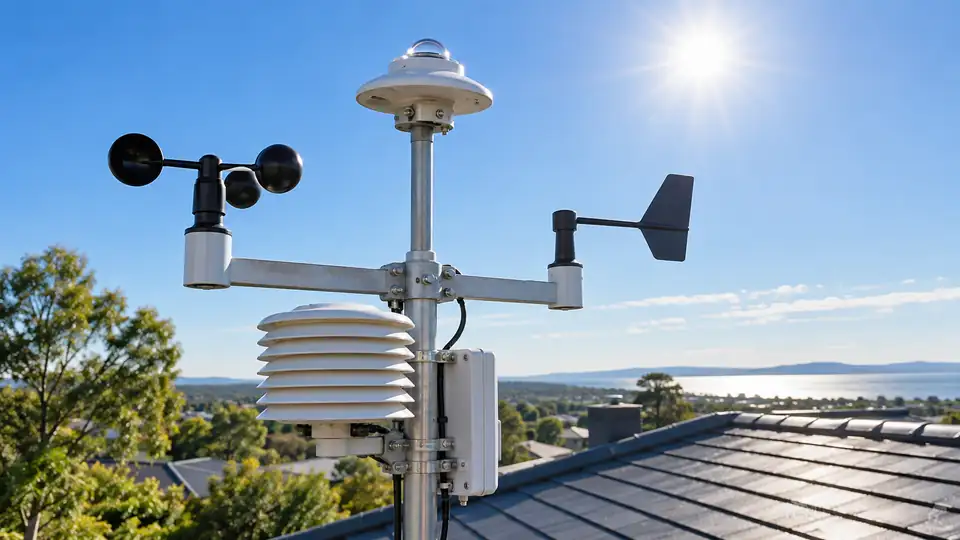
UV data adds a useful layer to a personal weather station. It can help you judge sun exposure around a patio, track conditions for garden work, compare bright and shaded parts of a property, or follow local weather alongside temperature, rainfall, and wind. The strongest options here combine a genuine UV sensor with practical measurements such as humidity, pressure, wind direction, and rain, while weak comparisons often focus on a large screen or a high “in-one” count without asking how the data reaches you.
The sensor arrangement matters just as much as the feature list. An integrated outdoor array keeps installation tidy, while a station with Wi-Fi can put readings on a phone when you are away from the console. Those are separate benefits. Wireless sensor transmission may connect an outdoor unit to its display without providing Internet access, and Wi-Fi may require a continuously powered console or a 2.4 GHz network. Ambient Weather’s WS-2902 stands out overall because it combines UV intensity, solar radiation, rainfall, wind, Wi-Fi access, and smart-home support in one established system.
Different properties call for different compromises. A greenhouse may benefit from extra sensor support, a large home may favor a clear display, and a remote-monitoring setup may need app history or alerts more than a bright console. The rankings below weigh UV capability first, then connectivity, data access, sensor design, display practicality, and the limits stated in the product information.
Quick Answer
- Ambient Weather WS-2902: Best overall for a connected home weather setup, with UV intensity, solar radiation, rainfall, wind data, Wi-Fi, and smart-home compatibility.
- Sainlogic SA9 Plus: A strong choice for remote monitoring, app alerts, historical records, Bluetooth, and optional Weather Underground connectivity.
- Grillum Smart WiFi Weather Station: A practical lower-cost option with a 7.5-inch display, UV readings, app history, and support for up to three additional sensors.
- 16-in-1 WiFi Weather Station with Air Quality Monitor: Best for readers who want UV and light intensity alongside TVOC air-quality information.
Best Weather Stations With UV Sensor Comparison Table
| Product | Measurements | Connectivity | Sensor Design | Best For |
|---|---|---|---|---|
| Ambient Weather WS-2902 | UV, solar radiation, rain, wind, temperature, humidity | Wi-Fi, smart-home support | Integrated Osprey array | Best overall |
| Grillum Smart WiFi Weather Station | UV, rain, wind, pressure, temperature, humidity | 2.4 GHz Wi-Fi, app | Integrated sensor with solar panel | App access and expandability |
| VEVOR YT60234 | UV or light data, rain, wind, temperature, humidity, pressure | Wi-Fi, Weather Underground, WeatherCloud | 7-in-1 solar-assisted array | Weather-network uploads |
| Sainlogic 14-in-1 WiFi Station | UV, sunlight, rain, wind, temperature, humidity | 2.4 GHz Wi-Fi, Weatherseed app | 7-in-1 outdoor sensor | Data export and large display |
| Ambient Weather WS-2000 | UV, solar radiation, rain, wind, temperature, humidity | Wi-Fi connectivity option | Integrated sensor array | Premium Ambient Weather setup |
| Raddy UV-6 | UV, light, rain, wind, pressure, temperature, humidity | Local wireless link | Integrated outdoor sensor | Multiple indoor or outdoor zones |
| WiFi 7-in-1 Weather Station | UV, rain, wind, pressure, temperature, humidity | 2.4 GHz Wi-Fi, app | 433.92 MHz array with solar panel | Large color display |
| 16-in-1 WiFi Weather Station | UV, light, TVOC, rain, wind, pressure, temperature, humidity | 2.4 GHz Wi-Fi, TUYA app | Integrated outdoor sensor | Weather and air-quality monitoring |
| Sainlogic SA9 Plus | UV, sunlight, rain, wind, pressure, temperature, humidity | Wi-Fi, Bluetooth, Weatherseed app | 7-in-1 outdoor sensor | Remote alerts and history |
The detailed reviews explain how each UV-capable station handles data, installation, power, and everyday monitoring.
1. Ambient Weather WS-2902 Wi-Fi Smart Weather Station: Best Overall
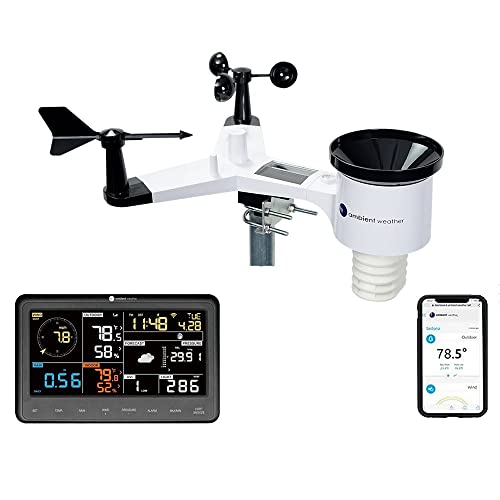
The WS-2902 earns the top position because its UV measurement is part of a well-rounded outdoor array rather than an isolated add-on. The Osprey sensor array reports UV intensity, solar radiation, temperature, humidity, wind speed, wind direction, and rainfall, while the included color display keeps those readings visible indoors. That combination suits a backyard where the morning sun, afternoon heat, and passing showers all matter in the same glance.
Wi-Fi gives this station a broader role than a local console alone. The product information identifies remote data access, alerts, IFTTT, Google Home, Alexa, and optional transmission to the Ambient Weather Network. Those features can make UV and weather readings useful for smart-home routines or checking conditions from another location. The trade-off is a more involved setup than a basic wireless display, and the outdoor array still needs thoughtful placement away from obstructions and misleading heat sources.
Pros
- Measures UV intensity and solar radiation alongside core weather variables.
- Includes a wireless Osprey outdoor sensor array and color display.
- Supports Wi-Fi access, alerts, and remote data viewing.
- Lists IFTTT, Google Home, and Alexa compatibility.
- Can share data with the Ambient Weather Network as an optional setting.
Cons
- The sensor array uses three AAA batteries, which are not included.
- Wi-Fi and smart-home features add setup steps beyond a local-only station.
This is the strongest fit for someone who wants UV data to live alongside a complete home weather record, especially if app access or smart-home routines matter. It may be more equipment than a reader who simply wants a screen near the kitchen, but its blend of measurements and connectivity gives it a convincing lead over simpler stations.
To buy this product, click here.
2. Grillum Smart WiFi Weather Station: Best for App History and Expandability

The Grillum makes the UV reading easy to fit into a broader household dashboard. Its 7.5-inch VA display shows UV index, rainfall, wind, barometric pressure, temperature, humidity, and feels-like conditions, so a quick look at the console can answer more than “Is it sunny?” The adjustable brightness and wide viewing angles are useful in a bright kitchen or a dim hallway where a fixed, glowing screen can become irritating.
Its app adds current conditions and historical data, with alarms and unit controls available through the phone interface. The outdoor unit combines the UV sensor, light sensor, rain funnel, wind cups, vane, and temperature-humidity module in one array. Up to three additional standard sensors are supported, although those extra sensors are not included. Wi-Fi works only on 2.4 GHz and requires the station to be plugged in, while battery operation turns the display off to conserve power.
Pros
- Displays UV index, rainfall, wind, pressure, temperature, and humidity.
- Includes a 7.5-inch VA display with adjustable brightness.
- Provides app access to current conditions and historical data.
- Supports up to three additional standard sensors.
- Outdoor sensor uses solar assistance with battery backup.
Cons
- Wi-Fi works only when the station is plugged in.
- Additional sensors are supported but sold separately.
Choose this model if phone history and future sensor expansion matter more than smart-home integration. It is a sensible match for a garden, backyard, or home with several monitoring points, provided the 2.4 GHz network and powered-console requirement fit the installation.
To buy this product, click here.
3. VEVOR YT60234 WiFi Weather Station: Best for Weather Network Uploads

The VEVOR YT60234 brings a useful mix of local readings and online access. Its 7-in-1 outdoor sensor measures wind speed, wind direction, temperature, humidity, rainfall, and light, while the station also presents pressure, dew point, and wind chill. The supplied information describes UV-related light monitoring rather than a standalone UV index specification, so this model suits readers who want solar-light information but should not be treated as identical to every dedicated UV-index station.
Its Wi-Fi support reaches Weather Underground and WeatherCloud, a meaningful distinction for people who want their local observations available through a weather platform. The listing also gives a 150-meter transmission distance and describes a solar panel with rechargeable Ni-MH batteries for the outdoor sensor. The display measures 7.5 inches and offers four brightness levels. Wi-Fi and date synchronization require the adapter to remain plugged in, which limits fully off-grid placement.
Pros
- Supports Weather Underground and WeatherCloud connections.
- Measures wind, temperature, humidity, rainfall, and light through one outdoor array.
- Includes pressure, dew point, and wind chill information on the display.
- Lists a 150-meter transmission distance under its stated conditions.
- Uses a solar panel with rechargeable Ni-MH battery support for the sensor.
Cons
- The product information describes light monitoring but does not clearly specify a standalone UV index.
- Wi-Fi and date synchronization require the adapter to stay plugged in.
This is the better pick for a weather-network user who values platform support and a solar-assisted outdoor sensor. Readers who specifically need a clearly labeled UV index may prefer the Ambient, Grillum, or Sainlogic options above, while those who want WeatherCloud access have a sharper reason to choose VEVOR.
To buy this product, click here.
4. Sainlogic 14-in-1 WiFi Smart Weather Station: Best for Data Export

Sainlogic takes the data-recording angle seriously. The Weatherseed app is described as storing up to two years of historical information, displaying charts and graphs, and allowing Excel exports in periods of up to 30 days. For someone tracking UV and sunlight through a growing season, that history can be more useful than a single live number on a console.
The outdoor sensor reports temperature, humidity, rainfall, wind speed, wind direction, UV, and sunlight levels. An 8.5-inch display divides the readings into clear sections, while the listing describes five-minute updates, app or email alerts, and a solar-plus-battery power arrangement for the outdoor unit. Wi-Fi is limited to 2.4 GHz, and the batteries are not included. The app’s forecast language should be treated as forecast information, separate from the station’s direct UV, wind, rain, and temperature observations.
Pros
- Includes UV and sunlight measurements in the outdoor sensor package.
- Offers up to two years of historical data according to the listing.
- Supports Excel export in selectable periods up to 30 days.
- Uses an 8.5-inch display with clearly separated data areas.
- Provides app or email alerts for temperature, humidity, and pressure thresholds.
Cons
- Wi-Fi support is limited to 2.4 GHz networks.
- Backup batteries for the outdoor sensor are not included.
This version suits gardeners, property owners, and data-minded users who want to compare UV and sunlight patterns over time. It is less compelling for anyone who only wants a simple local display, and the export workflow is better suited to periodic records than a single continuously selected date range.
To buy this product, click here.
5. Ambient Weather WS-2000 Smart Weather Station: Best Premium Ambient Weather Alternative
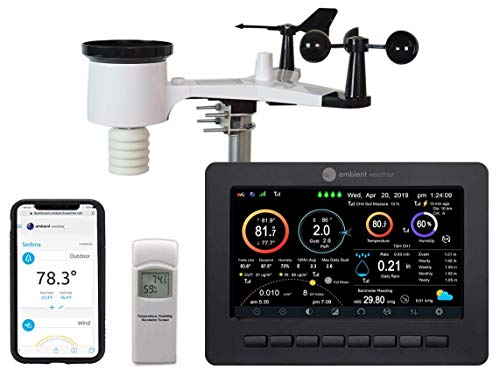
The WS-2000 focuses on the same core measurements that make the WS-2902 attractive for UV monitoring. Its integrated wireless array measures UV, solar radiation, rainfall, wind speed, wind direction, temperature, and humidity, while a TFT color display presents the information indoors. Support for both imperial and metric units is useful in a household where weather records need to match local preferences or imported data.
Wi-Fi connectivity is identified as an option for transmitting station data to the Ambient Weather network. The console uses the included 5V DC adapter, while the sensor array requires three AAA batteries that are not included. This arrangement is straightforward, but buyers should separate the powered indoor console from the battery-operated outdoor array when planning placement and maintenance. It offers a strong measurement set, although the supplied product information gives less detail about app functions than some newer connected options.
Pros
- Measures UV and solar radiation with rainfall, wind, temperature, and humidity.
- Includes a TFT color display for local monitoring.
- Supports imperial and metric units.
- Offers calibration capability according to the product information.
- Provides an optional Wi-Fi route to the Ambient Weather network.
Cons
- The sensor array requires three AAA batteries, which are not included.
- The supplied information gives fewer details about app features than several alternatives.
This station makes sense for someone already interested in the Ambient Weather ecosystem and wanting UV plus solar-radiation measurements on a color console. The WS-2902 is easier to recommend as the overall choice because its supplied information spells out more smart-home and remote-access functions, but the WS-2000 remains a capable premium alternative.
To buy this product, click here.
6. Raddy UV-6 Professional Weather Station: Best for Multiple Indoor Zones

The Raddy UV-6 puts UV and light readings on a local 6-inch VA display with a dense set of companion information. The screen shows temperature, humidity, pressure, wind speed and direction, rainfall, UV, light index, forecast information, and daily maximum and minimum records. A radiation-shielded temperature and humidity sensor is part of the outdoor suite, which is a useful design detail for readers comparing sensor construction rather than simply counting features.
Its strongest practical feature is channel flexibility. The system supports up to five areas, with the console and outdoor sensor included and three optional R5 sensors available separately. That could suit a greenhouse, basement, garage, or child’s room alongside outdoor readings. The station uses a listed 300-foot wireless transmission distance, but walls and metal structures can affect actual communication. There is no supplied indication of Wi-Fi or app access, so this is a local monitoring choice.
Pros
- Includes UV and light-index measurements alongside rain and wind data.
- Uses a 6-inch VA display with adjustable brightness and night mode.
- Supports up to five monitoring areas with optional R5 sensors.
- Outdoor sensor includes a radiation-shielded temperature and humidity module.
- Provides atomic time synchronization, dual alarms, and maximum or minimum records.
Cons
- Optional R5 sensors are sold separately.
- The supplied information does not identify Wi-Fi or remote app access.
Pick the UV-6 for a property where several local rooms or zones matter more than cloud history. It is a particularly practical fit for a greenhouse and adjacent indoor areas, while readers who need to check UV conditions from work or while traveling should move toward a Wi-Fi model.
To buy this product, click here.
7. WiFi 7-in-1 Weather Station With Full-Color LCD: Best for a Large Color Display

This 7-in-1 station keeps the measurement set focused: outdoor temperature, humidity, wind speed, wind direction, rainfall, UV index, and barometric pressure. The full-color LCD adds forecast icons, dew point, feels-like temperature, heat index, and wind chill, giving a busy but useful snapshot for a home, farm, or garden. Four backlight levels and automatic night dimming help the display adapt from a sunlit room to a dark bedroom.
Its outdoor sensor uses 433.92 MHz RF communication and lists a transmission distance of up to 300 feet in open areas. The built-in solar panel assists the outdoor sensor, while the app provides remote readings, historical charts, alerts, and automatic time calibration through 2.4 GHz Wi-Fi. The listing cautions that Wi-Fi can consume battery quickly and may require charging, so the convenience of app access comes with a power detail worth planning around.
Pros
- Includes a clearly identified UV index measurement.
- Combines Wi-Fi app access with a full-color local display.
- Provides historical charts and alerts through the app.
- Lists a 300-foot open-area transmission distance.
- Supports 15 languages and several weather measurement units.
Cons
- Wi-Fi use can consume battery power quickly and requires charging during use.
- The listed 300-foot range is an open-area maximum, not a guaranteed indoor distance.
This model is appealing for readers who want the console to feel like a visual dashboard, with UV, rain, wind, and pressure all visible at once. The Ambient Weather and Sainlogic stations offer more clearly described ecosystem or history features, but this unit gives a balanced route to a colorful local display and app access.
To buy this product, click here.
8. 16-in-1 WiFi Weather Station With Air Quality Monitor: Best for UV and Air-Quality Data

The extra appeal here is the addition of TVOC air-quality monitoring to a UV-capable weather station. The system reports temperature, humidity, pressure, wind speed, wind direction, rainfall, UV index, light intensity, and TVOC information. The listing gives a UV index range of 0 to 15 and light intensity up to 128 kilolux, making this a more detailed choice for a patio, greenhouse, or family space where sun conditions and air readings sit side by side.
The TUYA app provides current data, historical trends, and rainfall records over a 2.4 GHz Wi-Fi connection. A large color display includes five brightness levels and night mode, while the outdoor sensor lists a 300-foot open-area wireless range and an IPX5 rating. That rating is a specific product claim for the sensor and should not be stretched into a promise of protection against every installation condition. The added TVOC information also means a busier interface than a simpler weather station.
Pros
- Combines UV index, light intensity, and TVOC air-quality readings.
- Supports remote access and historical trends through the TUYA app.
- Includes a large color display with five brightness levels.
- Lists a 300-foot open-area wireless range.
- Offers two-year data storage and export according to the listing.
Cons
- Wi-Fi support is limited to 2.4 GHz networks.
- The broader data set may feel crowded for readers who only need basic weather readings.
Choose this station if air quality is a genuine part of the buying decision rather than a bonus feature. It gives up the more established smart-home ecosystem of the WS-2902, but it adds information that the other weather stations here do not clearly provide. For UV-only monitoring, a simpler model may be easier to live with.
To buy this product, click here.
9. Sainlogic SA9 Plus Smart WiFi Weather Station: Best for Remote Alerts

The SA9 Plus is built around the idea that weather readings should remain useful after you leave the property. Its Weatherseed app supports Wi-Fi and Bluetooth connections, while the listing describes app or email alerts, two years of historical data, Excel export, real-time Wi-Fi synchronization, and optional Weather Underground integration. The 7-in-1 outdoor sensor includes UV and sunlight, wind speed and direction, rainfall, temperature, humidity, and pressure, giving the remote data a solid local measurement base.
An 8.5-inch display uses enlarged fonts and three backlight levels, a practical touch for a kitchen, office, or household where several people need to read the console. The product information lists outdoor temperature and humidity specifications, plus rainfall figures, but those are listing claims rather than independent verification. The outdoor sensor can be mounted on a pole, roof, fence, or countertop according to the listing, and the system includes an indoor thermo-hygrometer. Buyers should still confirm the mounting surface and network arrangement before installation.
Pros
- Measures UV and sunlight with wind, rain, temperature, humidity, and pressure.
- Supports Wi-Fi, Bluetooth, and optional Weather Underground connectivity.
- Offers app and email alerts for selected temperature or humidity thresholds.
- Stores up to two years of history and supports Excel export in limited periods.
- Includes an 8.5-inch display with enlarged bold information.
Cons
- Excel export is limited to periods of up to 30 days per export.
- The listing’s accuracy specifications are product claims, not independent test results.
The SA9 Plus deserves this position for readers who prioritize alerts and records from away from home. The WS-2902 remains the more balanced overall recommendation because its smart-home support is clearly described, while the SA9 Plus is the more focused alternative for app notifications, historical data, and Weather Underground connectivity.
To buy this product, click here.
Buying Guide
UV Data Is Different From Solar Radiation and Light Intensity
A UV index or UV measurement describes ultraviolet conditions, while solar radiation and light intensity describe different parts of the sunlight picture. A station may list more than one of these, as the Ambient Weather models do, or may emphasize light and sunlight instead. Decide whether you need a clearly identified UV index for sun-exposure decisions, broader solar information for a garden, or both.
Wireless Sensor Links Do Not Automatically Mean Wi-Fi
Every station still needs a communication path between the outdoor array and the indoor display. That path may use RF or another wireless link. Wi-Fi is a separate connection that can carry data to an app, cloud service, or weather platform. The Raddy UV-6 is useful as a local multi-zone station, while the WS-2902, SA9 Plus, and other Wi-Fi models are better suited to checking data away from the console.
Remote Access Depends on the Complete Connection
App language deserves a close read. A phone may display local data through Bluetooth, or a Wi-Fi-connected console may place readings online for genuine remote access. The SA9 Plus lists Wi-Fi, Bluetooth, alerts, and Weather Underground support, while the Grillum specifies that Wi-Fi requires the console to be plugged in. Those power and connection details affect whether the station keeps working as expected while nobody is home.
More Measurements Are Useful Only If You Will Use Them
Pressure, dew point, wind chill, feels-like temperature, sunlight, and air quality can all add context, but each also adds another number to the display. A gardener may value UV, rain, sunlight, and temperature history. Someone checking tomorrow’s patio conditions may prefer a simpler console. The 16-in-1 model earns its extra complexity through TVOC monitoring, not because a larger count automatically makes a station better.
Check Which Sensors Are Included
Sensor ecosystems can be helpful for a greenhouse, garage, basement, or several rooms. Grillum supports up to three additional standard sensors, and Raddy supports three optional R5 sensors beyond its included console and outdoor unit. Those extra sensors are sold separately. A station that supports expansion is not the same as a package that includes every monitoring point.
Range Is a Planning Figure, Not a Guarantee
Several products list transmission distances around 300 feet, while VEVOR lists 150 meters. These figures describe favorable or open-area conditions. Walls, floors, metal structures, terrain, and interference can reduce the usable distance in a home or farm building. Place the display and outdoor array with the stated range in mind, but avoid treating the maximum figure as a promise through every obstruction.
Solar Assistance Does Not Remove Every Power Requirement
A solar panel may assist the outdoor sensor while the indoor console still uses an adapter. Some stations also rely on batteries at night or during cloudy periods. VEVOR describes rechargeable Ni-MH batteries for its sensor, while the Sainlogic stations describe solar power with battery backup. Check each component’s power arrangement before planning an installation at a cabin, greenhouse, or remote property.
Sensor Placement Can Affect the Readings
A UV sensor needs exposure to the sky, while a temperature and humidity sensor needs protection from misleading heat and direct radiant surfaces. Wind cups and vanes need open airflow, and a rain gauge needs a reasonably open, level location. A sophisticated console cannot correct for an outdoor array mounted beside a hot wall, under a roof edge, or behind a large obstruction.
Best Weather Stations With UV Sensor FAQ
What Is the Best Weather Station With a UV Sensor?
The Ambient Weather WS-2902 is the strongest overall choice in this group. It combines UV intensity, solar radiation, rainfall, wind speed, wind direction, temperature, and humidity with Wi-Fi access, remote data viewing, alerts, and listed smart-home compatibility. A reader focused on historical export or Weather Underground may prefer a Sainlogic or VEVOR model instead.
Do All Wireless Weather Stations Have Wi-Fi?
No. Wireless may describe the connection between an outdoor sensor and its console. Wi-Fi usually describes the connection from the station or console to a home network. The Raddy UV-6 provides local wireless monitoring and multi-area support, while models such as the WS-2902 and SA9 Plus add Wi-Fi functions.
Can These Stations Measure UV and Solar Radiation at the Same Time?
Some can. The Ambient Weather WS-2902 and WS-2000 list both UV and solar radiation. Other products identify UV index, sunlight, or light intensity instead. Those terms describe different measurements, so check the specific sensor description rather than assuming that every UV-capable station measures solar radiation too.
Are Additional Sensors Included With These Weather Stations?
Usually, the main outdoor array and indoor console are included, while expansion sensors are optional. Grillum supports up to three additional standard sensors, and Raddy supports three optional R5 sensors. The supplied information does not describe those extra sensors as included, so they should be treated as separate purchases.
Can I Monitor UV Readings Away From Home?
Wi-Fi and supported app or cloud services can make remote access possible, but a local wireless link alone does not. The WS-2902 lists remote access, and the SA9 Plus lists real-time Wi-Fi synchronization, app and email alerts, and optional Weather Underground integration. Confirm the station’s power and network requirements because some consoles need to remain plugged in for Wi-Fi operation.
Does a Larger UV Sensor Number Mean Better Performance?
No. “7-in-1,” “14-in-1,” and “16-in-1” labels are product-specific counting systems. One brand may count wind speed and direction separately, while another may include calculated values or light measurements. Compare the actual UV, sunlight, rain, wind, temperature, humidity, and connectivity features instead of relying on the headline count.
Are Weather Station Accuracy Claims Independently Verified?
The product information supplied for these models includes listing claims, but it does not provide independent test results for this comparison. Published accuracy, where listed, should be read as a product specification rather than a guarantee of performance in every installation. Placement, exposure, obstructions, and maintenance can affect readings.
Final Verdict
The Ambient Weather WS-2902 is the strongest overall option for most connected home installations. It covers the measurements that matter most for a UV-focused station, including UV intensity, solar radiation, rainfall, wind, temperature, and humidity, then adds Wi-Fi, remote access, alerts, and listed support for IFTTT, Google Home, and Alexa. That broad mix gives it more practical range than a local-only display without making the UV feature feel like an afterthought.
The choice changes with the job. The Sainlogic SA9 Plus is a better fit for app alerts, historical records, and optional Weather Underground access. Grillum offers a useful combination of app history, a clear display, and optional sensor expansion, while the 16-in-1 station is the one to choose if TVOC air-quality information belongs beside UV data. Before ordering, check the required Wi-Fi band, console power, outdoor sensor batteries, mounting location, and exact measurements you plan to use. A well-placed station with the right data path will serve you better than a feature-heavy unit installed where sunlight, wind, or rain readings are compromised.