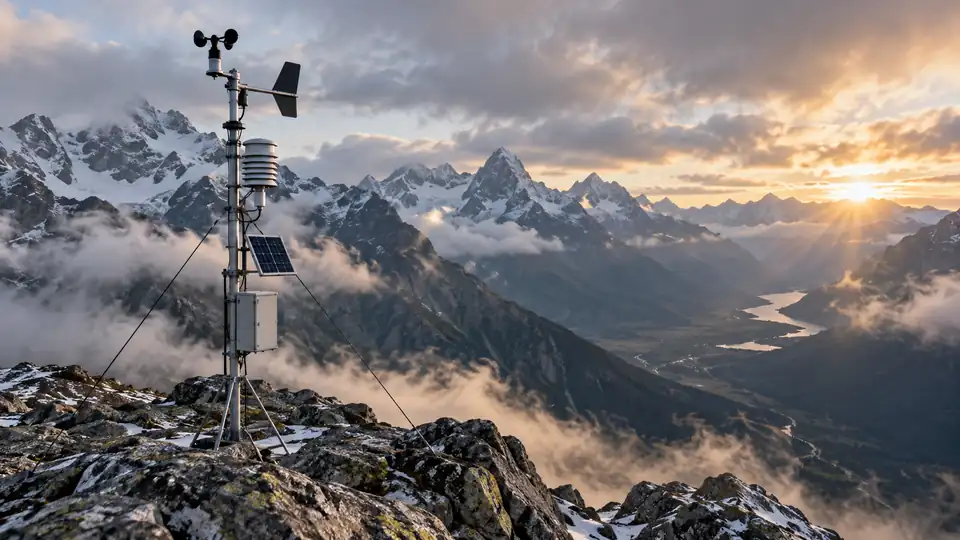
Mountain weather can change across a short distance, so a useful station needs to do more than display an indoor temperature. Wind speed and direction, rainfall, barometric pressure, humidity, and outdoor temperature can reveal what is happening around a cabin, exposed home, trailhead, or high-elevation property. Sensor placement matters just as much. A station mounted near a wall, roof, or sheltered tree line may report a very different picture from one with open exposure.
The biggest distinction among these products is how much local weather information they provide and how you access it. Some use a wireless outdoor sensor and a nearby console, while others add Wi-Fi, app access, smart-home controls, or weather-network sharing. A long advertised transmission distance can help on a large property, but terrain, walls, metal structures, and interference can reduce the practical range. Temperature resolution, advertised accuracy, and wireless distance also describe different things, so they should not be treated as interchangeable.
This comparison gives the strongest emphasis to mountain-relevant measurements, wind and rain monitoring, pressure trends, installation practicality, and access to observations away from the console. The Tempest Weather Station takes the top position for its broad measurement set, rapid listed updates, solar-powered outdoor sensor, lightning detection, and supported smart-home connections. The Ambient Weather WS-2902 remains a strong choice for buyers who want a full sensor array with Wi-Fi and a color display.
Quick Answer
- Tempest Weather Station: Best overall for broad local monitoring, app access, lightning information, and smart-home use.
- Ambient Weather WS-2902: Best for a conventional sensor array with Wi-Fi, wind, rain, UV, and solar-radiation readings.
- AcuRite Iris 5-in-1: Best for Weather Underground sharing and remote access through a connected console.
- Sainlogic 12-in-1: Best for a larger property that needs a local display, rainfall records, and a long listed open-air transmission range without Wi-Fi.
Best Weather Stations for Mountain Weather Comparison Table
| Product | Measurements | Connectivity | Sensor Design | Best For |
|---|---|---|---|---|
| Tempest Weather Station | Temperature, humidity, pressure, wind, rain, UV, solar radiation, lightning | Wireless, app, Alexa, Rachio, IFTTT | Solar-powered outdoor sensor | Broad monitoring and remote access |
| Ambient Weather WS-2902 | Temperature, humidity, pressure, wind, rain, UV, solar radiation | Wireless, Wi-Fi, Ambient Weather Network | Integrated Osprey array | Connected home weather monitoring |
| AcuRite Iris 5-in-1 | Temperature, humidity, pressure, wind, rain | Wireless, Wi-Fi, Weather Underground | Integrated 5-in-1 array | Weather-network sharing |
| Sainlogic 12-in-1 | Temperature, humidity, pressure, wind, rain, dew point, feels-like | Wireless, no Wi-Fi | Outdoor sensor with included mounting hardware | Local monitoring across larger spaces |
| AcuRite Iris 01512MCB | Temperature, humidity, pressure, wind, rain, dew point, heat index | Wireless console | Integrated outdoor sensor | Historical local observations |
| Ambient Weather WS-2000 | Temperature, humidity, pressure, wind, rain, UV, solar radiation | Wireless, optional Wi-Fi connection | Integrated sensor array | Detailed display-based monitoring |
| Newentor Wireless Weather Station | Temperature, humidity, pressure, forecast information | Wireless sensor link | One included sensor, up to three supported | Cabins and indoor-outdoor temperature checks |
| DreamSky Weather Station | Temperature, humidity, pressure-based forecast | Wireless sensor link | One included sensor, up to three supported | Large, readable local display |
| Fokey Weather Station | Temperature, humidity, pressure trends | Wireless sensor link | One included sensor, up to three supported | Multiple indoor locations and remote sensor display |
The detailed reviews below explain which stations offer meaningful advantages for exposed terrain, remote access, rainfall tracking, large-property coverage, and simpler local monitoring.
1. Tempest Weather Station — Best Overall
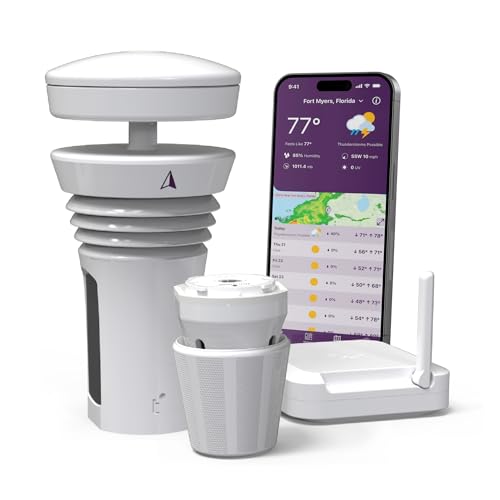
Mountain conditions can turn on wind, pressure, and rainfall information before the view outside changes. Tempest covers those core observations and adds temperature, humidity, dew point, solar radiation, UV index, and lightning strikes in its listed measurement set. That breadth gives a cabin owner or property manager more context than a basic indoor-outdoor thermometer, especially when a dark band of weather is moving across a ridge.
The outdoor sensor is listed as solar powered, with wireless transmission of more than 1,000 feet and updates every three seconds. Those claims can make the system attractive for an exposed property where a fast-changing wind reading matters, although actual communication depends on terrain and obstructions. The listing also identifies app access and integrations with Alexa, Rachio, IFTTT, and other smart-home platforms, giving the station a stronger remote-monitoring profile than console-only systems.
Pros
- Measures wind, rainfall, temperature, humidity, pressure, UV, solar radiation, and lightning strikes.
- Listed three-second update frequency supports close observation of changing conditions.
- Solar-powered outdoor sensor reduces dependence on routine battery changes at the sensor.
- Supports app access and listed Alexa, Rachio, and IFTTT integrations.
- No moving parts are identified in the product information.
Cons
- The available information does not clearly specify the console or display arrangement.
- Smart-home and remote features depend on the required connected services and network access.
Tempest is the strongest fit for a connected mountain property where data away from the sensor matters as much as the local measurements. It is a weaker match for someone who wants a prominent dedicated console and prefers a conventional cup or vane array. Buyers should also separate the listed sensor transmission distance from structural mounting decisions, since a long radio link does not prove that a particular ridge, wall, or metal building will provide clear communication.
To buy this product, click here.
2. Ambient Weather WS-2902 — Best Connected Sensor Array
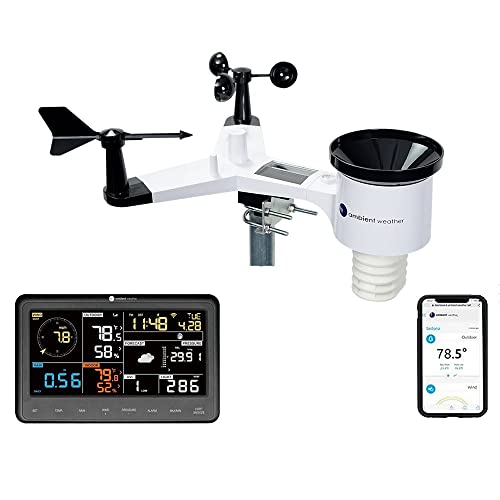
The WS-2902 takes a traditional personal weather station layout and adds Wi-Fi access. Its Osprey sensor array includes a rain cup and measures wind speed, wind direction, temperature, humidity, rainfall, UV intensity, and solar radiation. For a mountain home, that combination covers the observations most likely to explain a cold front, wet trail, or gusty afternoon without requiring several separate instruments.
A color LCD console provides local readings, while the listing identifies remote access, alerts, Ambient Weather Network sharing, and smart-home support through IFTTT, Google Home, and Alexa. The display is useful when someone is standing in the kitchen with muddy boots and wants a quick glance, while Wi-Fi helps when the property is vacant. The integrated array simplifies installation, but it also means all outdoor measurements come from one mounting location.
Pros
- Includes an Osprey array and color LCD display.
- Measures wind speed and direction, temperature, humidity, rainfall, UV, and solar radiation.
- Provides Wi-Fi connectivity and remote data access.
- Supports listed alerts, IFTTT, Google Home, and Alexa functions.
- Shares data through the Ambient Weather Network as an optional setting.
Cons
- The integrated array limits the ability to place temperature, rain, and wind sensors in separate locations.
- Wi-Fi features add network setup and service dependencies beyond the local console.
This is a sensible alternative to Tempest for readers who want a familiar console alongside online access. It suits a cabin, home, or small property where one well-exposed array can represent local conditions. A heavily wooded site or steep property may benefit from careful mounting before purchase, since the station’s measurements depend on finding a location with suitable wind and rainfall exposure.
To buy this product, click here.
3. AcuRite Iris 5-in-1 — Best for Weather Underground
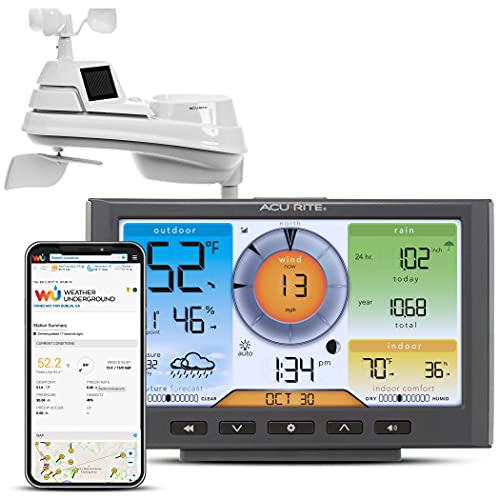
For a mountain property that needs its observations available beyond the room containing the console, the Iris 5-in-1 has a clear advantage: the listing specifically identifies a Wi-Fi connection to Weather Underground. Its sensor package measures indoor and outdoor temperature and humidity, wind speed and direction, barometric pressure, and rainfall. That is a focused set rather than an attempt to cover every atmospheric variable.
The display also tracks more than the immediate reading. The product information lists threshold alarms, historical data, heat index, dew point, wind chill, and enhanced rainfall history. Some of these are calculated values rather than separate sensor measurements, but they can help interpret a chilly, wet, or windy day. The built-in anemometer, wind vane, barometer, hygrometer, rain gauge, and thermometer form a single outdoor array, so placement remains central to useful results.
Pros
- Explicitly supports Wi-Fi connection to Weather Underground.
- Measures outdoor wind, rainfall, temperature, humidity, and pressure.
- Includes a color display with adjustable dimming.
- Tracks historical data and lists threshold alarm support.
- Provides calculated heat index, dew point, and wind chill information.
Cons
- Its 5-in-1 array does not list UV, solar radiation, or lightning detection.
- The product information does not clearly identify whether a separate gateway is required for every connected function.
Choose this model if Weather Underground sharing is part of the plan and the listed measurement set covers your needs. It is less compelling for someone who wants solar-radiation data or lightning information from the station itself. The Wi-Fi connection should also be treated as a separate function from the sensor’s wireless link to the display.
To buy this product, click here.
4. Sainlogic 12-in-1 — Best Local Station for a Larger Property
Sainlogic takes a data-heavy local approach. The 12-in-1 station lists indoor and outdoor temperature and humidity, barometric pressure, wind speed and direction, rainfall, dew point, feels-like temperature, moon phase, calendar, and alarm functions. Its rainfall records cover hourly, daily, weekly, monthly, and cumulative totals according to the product information, which is useful when a mountain garden, driveway, or access road needs more than a passing glance at the current rain icon.
The listing gives the outdoor sensor a wireless transmission distance of up to 443 feet in open, unobstructed conditions and includes mounting hardware. That can be useful across a broad yard or farmstead, but it is a best-case figure rather than a guarantee through trees, walls, or terrain. This model has no Wi-Fi, so its strength is local monitoring through the 6.5-inch color display rather than checking conditions from another location.
Pros
- Lists wind, rainfall, pressure, temperature, humidity, dew point, and feels-like readings.
- Provides hourly, daily, weekly, monthly, and cumulative rainfall records.
- Includes mounting hardware for the outdoor sensor.
- Lists a transmission distance of up to 443 feet in open conditions.
- Offers a 6.5-inch color display with adjustable backlight.
Cons
- No Wi-Fi or remote monitoring is identified in the product information.
- The listed rainfall accuracy and temperature and humidity accuracy claims come from the product listing rather than independent testing.
This station makes sense for a property where the console is easy to reach and rainfall history matters. It gives up the away-from-home access of Tempest and the connected AcuRite models, but it avoids making Wi-Fi part of the setup. For a remote cabin that sits empty, that trade-off may be decisive.
To buy this product, click here.
5. AcuRite Iris 01512MCB — Best for Detailed Local History
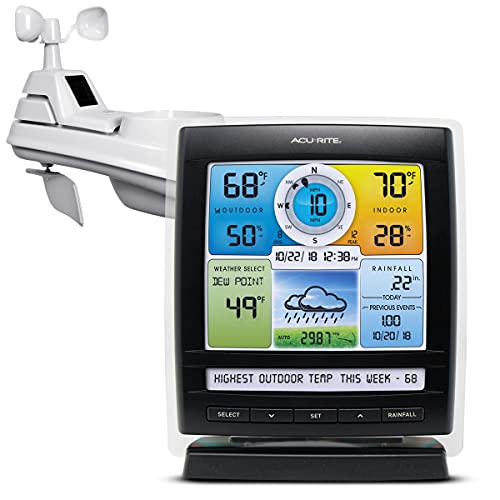
The Iris 01512MCB focuses on information visible at home. It lists more than 55 data points, including indoor and outdoor temperature and humidity, wind speed and direction, rainfall, barometric pressure, pressure trends, dew point, heat index, feels-like temperature, and historical information. For someone watching a mountain valley from a kitchen or workshop, those trend indicators can put a sudden temperature drop or pressure change into context.
Setup is described as a battery installation followed by attaching the outdoor sensor to a pole or post with the included mounting bracket. The color LCD has an adjustable dimmer and doubles as a weather clock. Forecast information is generated from elevation data and pressure information, so it should be read as a station-based forecast aid rather than a promise of conditions on the next ridge.
Pros
- Lists more than 55 data points and historical information.
- Measures wind speed and direction, rainfall, temperature, humidity, and pressure.
- Includes pressure trends, dew point, heat index, and feels-like information.
- Includes a color LCD with adjustable dimming.
- Product information identifies an included mounting bracket.
Cons
- Wi-Fi or remote Internet access is not identified.
- The integrated outdoor arrangement offers less placement flexibility than separate sensors.
This model is a good fit for local observation when detailed console information matters more than cloud access. It ranks below the connected stations for a property that needs readings while vacant, but it offers a broad set of displayed weather details without requiring a networked monitoring plan.
To buy this product, click here.
6. Ambient Weather WS-2000 — Best for a Detailed Color Console
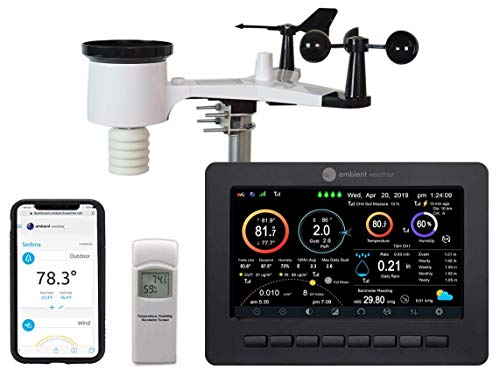
The WS-2000 uses an all-in-one outdoor sensor array to measure wind speed and direction, temperature, humidity, rainfall, UV, and solar radiation. That makes it relevant to exposed properties where both storm information and sunlight conditions matter. The TFT color display gives the station a more information-rich local feel than a basic temperature console, while the listing identifies support for imperial and metric units and calibration.
Its Wi-Fi connection is described as an option that can transmit station data to a personal weather-station network. The product information does not provide the same breadth of connected-service detail as the WS-2902 listing, so buyers should verify the exact current configuration and desired online functions before ordering. The console uses a 5V DC adapter, and the outdoor array requires three AAA batteries.
Pros
- Measures wind, temperature, humidity, rainfall, UV, and solar radiation.
- Includes a TFT color display.
- Supports imperial and metric units.
- Lists calibration capability.
- Offers an optional Wi-Fi connection for weather-network transmission.
Cons
- The outdoor sensor requires three AAA batteries.
- The available product information does not clearly detail every remote-access or app function.
The WS-2000 suits readers who want a capable local display and the possibility of connected sharing. It is a reasonable alternative to the WS-2902, though the clearer Wi-Fi and smart-home description of the WS-2902 gives that model an advantage for a connected mountain cabin. Check the exact console and online-service requirements before purchase.
To buy this product, click here.
7. Newentor Wireless Weather Station — Best for Multiple Temperature Locations

Not every mountain property needs wind and rainfall instruments. A cabin owner may mainly want to compare the living room, porch, basement, or detached storage area. Newentor includes one remote sensor and supports up to three remote sensors, with indoor and outdoor temperature and humidity shown on a color LCD. That multi-location arrangement can be more useful than a larger weather array for monitoring frost-prone rooms or an unheated entryway.
The station also lists barometric pressure, high and low records, customizable alerts, forecast information, moon phase, an atomic clock, and dual alarms. It can remain continuously lit with the included adapter, while battery operation switches to an energy-saving display mode. Wind speed, wind direction, and rainfall are not identified, so this is a secondary choice for mountain weather rather than a full exposed-site instrument.
Pros
- Supports up to three remote sensors for temperature and humidity monitoring.
- Includes one remote sensor.
- Provides a large color display with high and low records.
- Offers customizable alerts, barometric pressure, and forecast information.
- Includes an adapter for continuous display operation.
Cons
- Wind speed, wind direction, and rainfall measurement are not identified.
- Additional sensors beyond the included unit are not identified as included.
Newentor is best for temperature and humidity checks across several indoor or sheltered locations. It can help with cold rooms and arrival checks at a cabin, but it cannot replace a station that measures mountain wind and precipitation. Choose it when location coverage matters more than a complete outdoor sensor array.
To buy this product, click here.
8. DreamSky Weather Station — Best for a Large, Readable Display

DreamSky puts readability at the center of the experience. Its large display shows indoor and outdoor temperature, forecast information, atomic time, date, and calendar details, while five backlight levels make it easier to adjust the screen for daytime or nighttime use. In a cabin with the console across the room, large numbers can be more practical than a dense screen filled with small symbols.
The station includes one outdoor sensor and supports up to three outdoor sensors for temperature and humidity at several locations. It also lists high and low alerts, pressure-based forecast information, automatic daylight-saving adjustment, a USB port, and battery backup. The display remains lit through adapter power, while battery-only operation dims after a short period. Like Newentor, it does not list wind or rainfall measurement.
Pros
- Large display uses clear numbers for indoor and outdoor conditions.
- Supports up to three outdoor sensors, with one included.
- Offers high and low temperature alerts.
- Provides five adjustable backlight brightness levels.
- Includes automatic daylight-saving adjustment and battery backup support.
Cons
- Wind, rainfall, UV, and solar-radiation measurements are not identified.
- Battery-only display operation enters a power-saving mode after a short period.
DreamSky is a practical local display for a home, cabin, or outbuilding where temperature and humidity are the priority. It ranks below full sensor arrays because mountain exposure often makes wind and rain important, but its readable screen and multi-sensor support give it a clear role for indoor and sheltered monitoring.
To buy this product, click here.
9. Fokey Weather Station — Best for a Remote Sensor Display

Fokey takes the multi-location temperature approach a step further by giving the remote sensor its own 2-inch digital screen. That means someone outside can check the local temperature without walking back to the main console, a small but useful detail for a porch, greenhouse entrance, workshop, or detached room. The main 7.6-inch VA display shows temperature, humidity, pressure trends, time, and forecast information.
The product information lists support for up to three remote sensors and a maximum wireless pairing range of 328 feet. It also identifies adjustable absolute and relative pressure modes, hourly pressure updates, atomic time, and seven time-zone settings. The listing makes a specific temperature error claim, but that remains a product-listing claim rather than independent verification. Wind and rainfall measurements are not identified.
Pros
- Remote sensor includes a 2-inch display for local readings.
- Main unit uses a 7.6-inch VA display.
- Supports up to three remote sensors.
- Lists absolute and relative pressure modes with hourly trend updates.
- Provides atomic time and seven time-zone settings.
Cons
- Wind speed, wind direction, and rainfall measurement are not identified.
- The listed temperature accuracy claim is not independent verification.
Fokey is a useful fit for temperature and pressure monitoring across separate locations, especially where the outdoor sensor’s own screen is valuable. It is not the right choice for a full mountain weather record that includes wind and rain. Buyers should also treat the stated 328-foot distance as an open-area maximum rather than a guaranteed range through a cabin or across uneven terrain.
To buy this product, click here.
Buying Guide
Prioritize Wind, Rain, and Pressure for Exposed Terrain
Temperature alone can miss the conditions that make mountain weather difficult. Wind speed and direction help show exposure, rainfall records help track wet access roads and runoff, and barometric pressure trends can add context to a changing system. Tempest, the Ambient Weather models, the AcuRite arrays, and Sainlogic provide a more complete outdoor picture than the temperature and humidity stations.
Wireless Sensor Links Are Different From Wi-Fi
A wireless outdoor sensor can send readings to a nearby console without connecting to the Internet. Wi-Fi is a separate link that may support remote access, network sharing, alerts, or smart-home functions. The Tempest, WS-2902, AcuRite 5-in-1, and WS-2000 list connected features, while Sainlogic is explicitly presented as a no-Wi-Fi station. Match the connection type to how you plan to read the data.
Check Whether the Station Supports Genuine Remote Monitoring
A console in a cabin does not help much if you need to check conditions from town. The Tempest lists app access and smart-home integrations, the WS-2902 lists remote access and network functions, and the AcuRite 5-in-1 identifies Weather Underground connectivity. The local-only models are better for an occupied property or a station placed where the display is easy to reach.
Treat Transmission Distance as a Best-Case Figure
Listings for Sainlogic, Fokey, and other stations give maximum distances under open or favorable conditions. A mountain property adds slopes, trees, walls, metal roofing, and other possible obstructions. Place the outdoor sensor where it can measure conditions properly, then treat the published wireless distance as a planning reference rather than a guarantee.
Integrated Arrays Simplify Setup but Limit Sensor Placement
An all-in-one array puts the rain, wind, temperature, and humidity instruments together, which can reduce installation complexity. It also means one mounting position affects every reading. A sheltered spot may distort wind, while a sun-exposed position can affect temperature. The WS-2902, WS-2000, AcuRite arrays, and Sainlogic all require thoughtful outdoor placement.
Separate Accuracy From Resolution and Forecast Icons
A display showing tenths of a degree does not prove that the sensor measures temperature to that same accuracy. Likewise, a forecast icon based on pressure trends is not a direct observation of future weather. Use published accuracy figures cautiously, and select the station for the measurements and access you actually need rather than the number of digits on the screen.
Decide Whether Solar Power Helps Your Installation
The Tempest listing identifies a solar-powered outdoor sensor, which can reduce routine attention at the sensor. That does not automatically mean the entire system is independent of batteries, adapters, networks, or other power requirements. Check which component uses solar power and what the console or connected equipment still needs.
Best Weather Stations for Mountain Weather FAQ
What is the best overall weather station for mountain weather?
The Tempest Weather Station is the strongest overall choice in this comparison because it lists wind, rainfall, temperature, humidity, pressure, UV, solar radiation, and lightning measurements. It also lists app access, rapid updates, a solar-powered outdoor sensor, and smart-home integrations. Verify the required connected services and installation needs for your property.
Which station is best for remote monitoring?
Tempest is the clearest choice for remote monitoring because the product information identifies app access and smart-home connections. The Ambient Weather WS-2902 and AcuRite Iris 5-in-1 also list connected functions. A wireless console-only station should not be treated as remotely accessible simply because its outdoor sensor communicates without a cable.
Do all wireless weather stations have Wi-Fi?
No. Wireless often describes the radio link between an outdoor sensor and an indoor console. Wi-Fi usually connects a console or gateway to a local network and may enable Internet-based features. Sainlogic, Newentor, DreamSky, and Fokey list wireless sensor communication, but their supplied information does not identify Wi-Fi access.
Which stations measure rainfall?
Tempest, Ambient Weather WS-2902, AcuRite Iris 5-in-1, AcuRite Iris 01512MCB, Ambient Weather WS-2000, and Sainlogic list rainfall measurement. Rain-gauge readings depend on placement, exposure, and installation. The Sainlogic listing also identifies hourly, daily, weekly, monthly, and cumulative rainfall records.
Are these stations suitable for a remote mountain cabin?
Connected models are better suited to an unattended cabin because their listed app or network features can provide access away from the local console. Tempest, WS-2902, and AcuRite Iris 5-in-1 are the strongest candidates here. Confirm that the property has the required Internet service and power, and remember that the sensor link may be affected by terrain and building materials.
Is a larger sensor count automatically better?
No. A larger measurement list helps only when those observations support your actual decisions. Wind and rain may matter more than UV or solar radiation for one property, while pressure and humidity may matter more for another. Also check whether a listed value is directly measured or calculated, such as dew point, wind chill, or feels-like temperature.
Does a solar-powered sensor eliminate batteries?
Not necessarily. The Tempest listing identifies the outdoor sensor as solar powered, but that claim applies to the listed sensor rather than automatically to every component in the system. Check the current product details for console, backup, and connected-equipment power requirements before planning an off-grid installation.
Final Verdict
The Tempest Weather Station is the strongest overall choice for mountain weather monitoring because its listed measurement set covers wind, rain, temperature, humidity, pressure, UV, solar radiation, and lightning. Its app and smart-home connections are useful for a property that cannot be checked from the console every day, while the listed solar-powered outdoor sensor and frequent updates suit changing conditions. The Ambient Weather WS-2902 is the better alternative for readers who prefer a conventional color display and a connected Osprey array with Wi-Fi.
For Weather Underground sharing, the AcuRite Iris 5-in-1 has a clear advantage. Sainlogic is a strong local-only option for rainfall records and a larger open property, while the Newentor, DreamSky, and Fokey stations make more sense for temperature and humidity monitoring across indoor or sheltered locations. Before ordering, decide which measurements matter, where the outdoor array can be mounted, how the data will be accessed, and whether the required power and network connections are available.