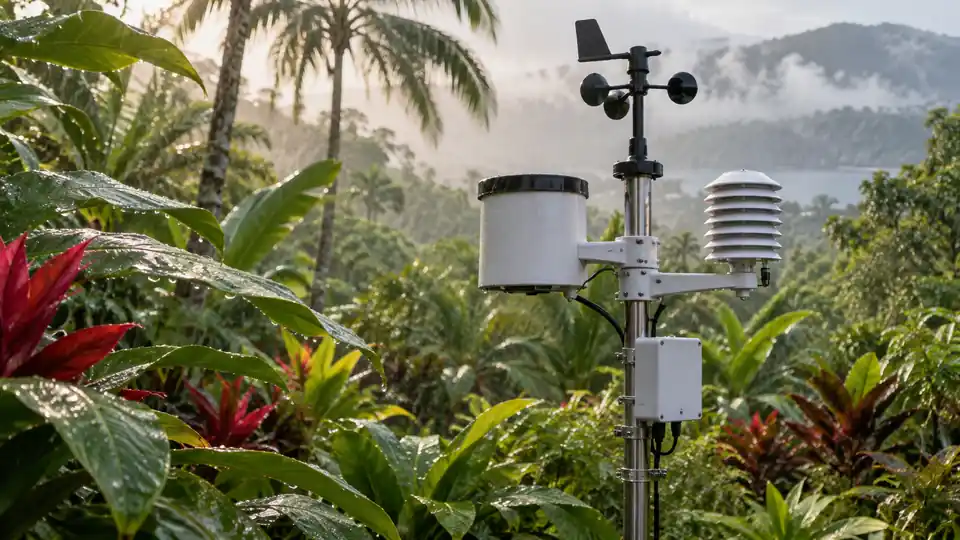
Humid climates put unusual pressure on a weather station. Temperature matters, but indoor and outdoor humidity, rainfall, dew point, wind, and ventilation conditions often tell the more useful story. A station that shows only a forecast icon may leave you guessing about a muggy bedroom, a damp basement, a rain-soaked garden, or a greenhouse that needs closer attention.
The strongest choices here use different sensor arrangements and data paths. Some provide a simple wireless link to a color console, while others add Wi-Fi, remote access, weather-network sharing, and smart-home controls. Rain gauges also deserve careful attention because proper leveling and open placement affect readings, while a sensor mounted near a wall, roof, pavement, or direct sun may report conditions that do not represent the surrounding air.
The Ambient Weather WS-2902 leads this group because it combines temperature, humidity, rainfall, wind, UV, solar radiation, Wi-Fi, and remote access in one complete system. Still, a local-only station may suit a simpler home, and a multi-sensor model can be the better fit for monitoring several rooms or outbuildings. The comparison below gives a quick view before the detailed reviews.
Quick Answer
- Ambient Weather WS-2902: Best overall for humid climates because it combines humidity, rainfall, wind, UV, solar radiation, Wi-Fi, remote access, and smart-home support.
- AcuRite Iris 5-in-1: A strong choice for Weather Underground sharing, remote monitoring, rainfall history, and a broad set of calculated weather data.
- Sainlogic 12-in-1: Best for detailed local rainfall records and a wide measurement set when Wi-Fi is not required.
- Newentor Weather Station: A sensible lower-cost option for indoor and outdoor temperature and humidity monitoring across multiple locations.
Best Weather Stations for Humid Climates Comparison Table
| Product | Measurements | Connectivity | Sensor Design | Best For |
|---|---|---|---|---|
| Ambient Weather WS-2902 | Temperature, humidity, rain, wind, UV, solar radiation | Wireless, Wi-Fi, remote access | Outdoor Osprey array | Connected whole-property monitoring |
| AcuRite Iris 5-in-1 | Temperature, humidity, rain, wind, pressure | Wi-Fi, Weather Underground | Integrated 5-in-1 array | Weather-network sharing |
| Sainlogic 12-in-1 | Temperature, humidity, rain, wind, pressure, dew point | Wireless, no Wi-Fi | Integrated outdoor sensor | Rainfall records and local detail |
| AcuRite Iris 01512MCB | Temperature, humidity, rain, wind, pressure | Wireless local console | Integrated outdoor sensor | Detailed local readings |
| AcuRite 02077M | Temperature, humidity, pressure, forecast trends | Wireless local console | Outdoor temperature sensor | Simple home monitoring |
| Newentor Weather Station | Temperature, humidity, pressure, forecast | Wireless, up to 3 sensor channels | One included remote sensor | Multiple indoor locations |
| DreamSky Weather Station | Temperature, humidity, pressure, forecast | Wireless, up to 3 sensors | One included outdoor sensor | Large readable display |
| Large Display Weather Station | Temperature, humidity, pressure, forecast | Wireless, up to 3 sensors | Optional additional sensors | Whole-home display monitoring |
| La Crosse Advanced Weather Station | Temperature, humidity, forecast trends | Wireless local console | Weather-resistant outdoor sensor | Alerts and atomic time |
The full reviews explain where each station fits, how its sensor system handles humid-climate monitoring, and which limitations deserve attention before purchase.
1. Ambient Weather WS-2902 — Best Overall
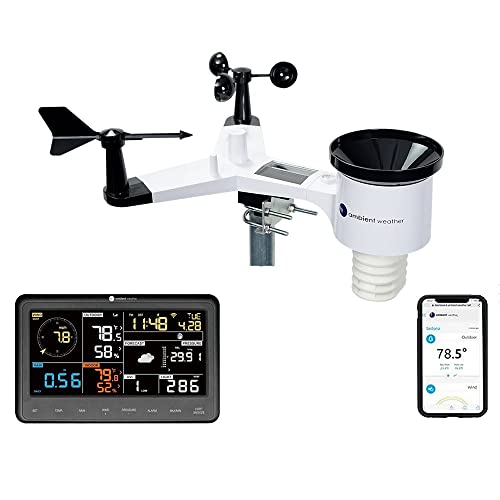
Humid-climate monitoring becomes far more useful once rainfall, wind, and solar conditions join temperature and humidity. The WS-2902 includes an outdoor Osprey sensor array with a rain cup and measures temperature, humidity, wind speed, wind direction, rainfall, UV intensity, and solar radiation. That combination gives a fuller picture of why a property feels damp, overheated, or poorly ventilated after a storm.
Its Wi-Fi connection is the major distinction. The listing describes remote access, alerts, smart-home programming through IFTTT, Google Home, and Alexa, plus optional sharing with the Ambient Weather Network. A homeowner can check conditions away from the console, while someone managing a garden or outbuilding can use local observations rather than relying solely on a broad regional forecast. The outdoor array still needs sensible placement, with open exposure for wind and rainfall and protection from nearby heat sources.
Pros
- Measures temperature, humidity, rainfall, wind speed, wind direction, UV, and solar radiation.
- Provides Wi-Fi connectivity for remote access and alerts.
- Supports IFTTT, Google Home, and Alexa according to the listing.
- Includes a color LCD console and an outdoor Osprey sensor array with rain cup.
- Can share data with the Ambient Weather Network as an optional setting.
Cons
- More setup and mounting work is required than with a basic indoor/outdoor thermometer.
- The listing does not clearly specify the system’s operating range, accuracy figures, or data-export options.
This is the strongest choice for a connected home that needs more than a humidity number on a bedside screen. It brings the most relevant outdoor measurements together and adds remote data access, which is particularly useful after heavy rain or during periods of persistent moisture. Skip it if you only need temperature and humidity in one or two rooms, or if you prefer a station with no network setup.
To buy this product, click here.
2. AcuRite Iris 5-in-1 — Best for Weather Network Uploads
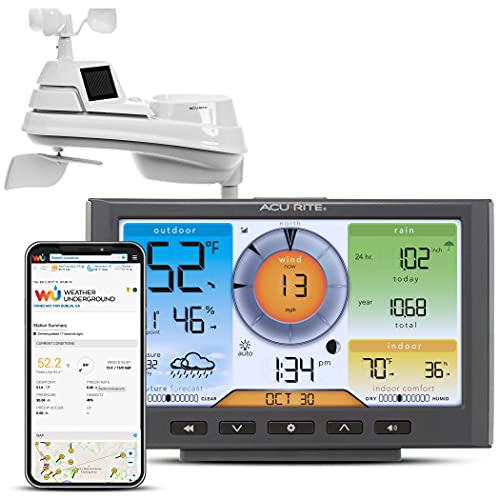
The AcuRite Iris 5-in-1 takes a focused approach to outdoor monitoring. Its integrated array reports temperature, humidity, wind speed, wind direction, barometric pressure, and rainfall, while the color console adds information such as dew point, heat index, wind chill, rainfall history, and threshold alarms. For humid regions, dew point can be especially helpful because it describes the moisture level in the air more directly than temperature alone.
Wi-Fi and Weather Underground support give this model a clear role for people who want to view or share observations beyond the room containing the console. The system is less expansive than the WS-2902 because the supplied information does not identify UV or solar-radiation readings, yet its rainfall history and remote-monitoring path remain useful. The integrated array also means wind and rain placement need to be planned together rather than handled by separately positioned instruments.
Pros
- Measures outdoor temperature, humidity, wind speed, wind direction, pressure, and rainfall.
- Connects to Weather Underground for remote monitoring and data sharing.
- Reports dew point, heat index, wind chill, and enhanced rainfall history.
- Includes a color LCD display with adjustable dimmer.
- Uses an integrated anemometer, wind vane, barometer, hygrometer, rain gauge, and thermometer.
Cons
- The supplied information does not identify UV or solar-radiation measurement.
- Integrated sensor placement can be less flexible than a system with separate instruments.
Choose this model if Weather Underground is central to your monitoring routine and you want rainfall history with a broad set of local observations. It fits a home, garden, or small property where one outdoor array can cover the main measurements. A reader who needs smart-home platforms beyond Weather Underground, or who wants UV and solar radiation, should look first at the WS-2902.
To buy this product, click here.
3. Sainlogic 12-in-1 Wireless Weather Station — Best for Rainfall Records
Rain can turn a quiet backyard into a dripping, saturated mess within minutes, so rainfall history is a meaningful advantage in humid conditions. The Sainlogic 12-in-1 lists hourly, daily, weekly, monthly, and cumulative rainfall records, with a stated 0 to 9999 mm rainfall range and a listed accuracy claim of plus or minus 7 percent. Those figures come from the product listing and should be treated as published claims rather than independent verification.
The station also reports indoor and outdoor temperature and humidity, pressure, wind speed, wind direction, dew point, and feels-like temperature. A 6.5-inch display with three backlight levels keeps the information visible in a utility room, kitchen, or office. Its advertised wireless transmission distance reaches 443 feet in open, unobstructed conditions, though walls, metal structures, and terrain can reduce practical range. This model has no Wi-Fi, so the data stays on the local display.
Pros
- Records hourly, daily, weekly, monthly, and cumulative rainfall totals.
- Lists temperature accuracy of plus or minus 0.2°C and humidity accuracy of plus or minus 1.8% RH.
- Measures indoor and outdoor temperature, humidity, pressure, wind, dew point, and feels-like temperature.
- Includes a 6.5-inch color display with three backlight levels.
- Includes mounting hardware and lists wireless transmission up to 443 feet in open conditions.
Cons
- No Wi-Fi or remote Internet access is identified.
- The integrated outdoor sensor requires careful placement for representative rain and wind readings.
This is a practical pick for someone who wants detailed rainfall records without moving into a cloud-connected system. It suits a garden, farmyard, or home where the console will be checked locally. It is less appropriate for a remote property that needs alerts away from home, and the rain gauge should be kept level and clear of obstructions according to ordinary installation best practices.
To buy this product, click here.
4. AcuRite Iris 01512MCB — Best for Detailed Local Readings
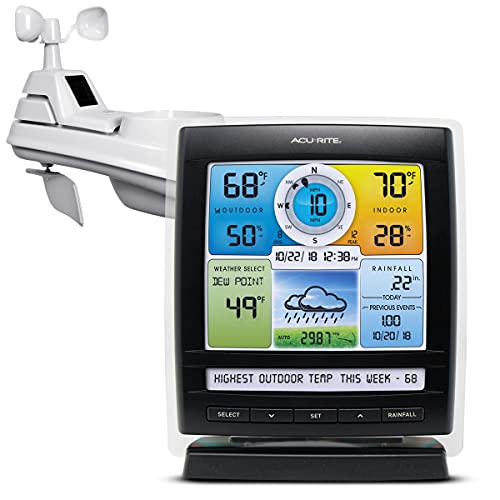
The AcuRite Iris 01512MCB is built around a broad local information set. Its product information lists more than 55 data points, including indoor and outdoor temperature and humidity, rainfall, wind speed and direction, pressure trends, heat index, dew point, and feels-like temperature. In a humid home, those calculated readings can make a sticky afternoon easier to interpret, particularly when the temperature alone does not explain discomfort.
The color screen keeps the main observations in the house, while the outdoor sensor sends readings wirelessly to the console. Its forecast uses elevation data and pressure information to create a personalized 12-hour forecast. This is a local display system rather than a Wi-Fi model in the supplied description, so it is better suited to someone who wants a detailed console than someone who needs remote access from work or while traveling.
Pros
- Lists more than 55 data points, including rainfall, wind, humidity, and pressure trends.
- Provides dew point, heat index, feels-like temperature, and historical information.
- Includes a color screen with adjustable dimmer.
- Uses a wireless outdoor sensor with a mounting bracket.
- Generates a personalized 12-hour forecast using elevation and pressure data.
Cons
- Wi-Fi or remote monitoring is not identified in the supplied product information.
- The listing does not clearly specify individual measurement accuracy figures.
This model makes sense for a household that enjoys detailed local weather information and wants rainfall, wind, and moisture-related readings in one console. It offers more depth than a basic thermometer, yet avoids the network setup associated with the connected picks. Choose something else if checking conditions away from home is a central requirement.
To buy this product, click here.
5. AcuRite 02077M — Best for Simple Home Monitoring
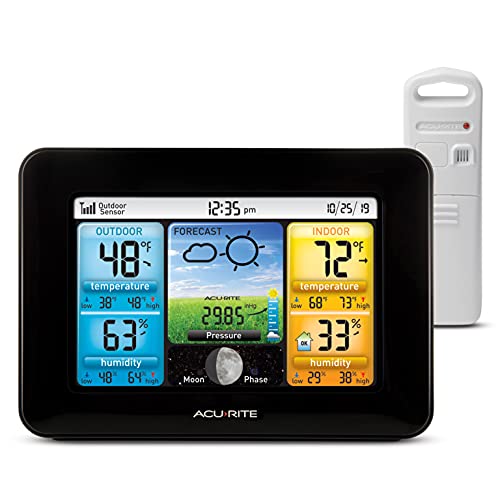
Some humid homes need a clear answer to a simple question: how warm and damp is it inside compared with outside? The AcuRite 02077M focuses on indoor and outdoor temperature, humidity, pressure trends, high and low records, and forecast information. Its outdoor temperature sensor hangs from a post or tree branch using an integrated hanger, which keeps setup straightforward for a patio, office, RV, or small home.
The illuminated color display includes forecast icons, trend arrows, moon phase information, and an adjustable dimmer. The product information describes more than 15 data points, so this is more informative than a basic two-number thermometer without becoming a full wind and rainfall station. Batteries for the outdoor sensor are not included, and the listing does not identify Wi-Fi, rainfall measurement, or wind measurement.
Pros
- Monitors indoor and outdoor temperature and humidity.
- Tracks pressure trends, high and low records, and forecast information.
- Includes an outdoor sensor with an integrated hanger.
- Provides a color display with adjustable dimmer.
- Offers forecast icons, trend arrows, moon phase, and more than 15 listed data points.
Cons
- Wind and rainfall measurement are not identified.
- Outdoor sensor batteries are not included.
This is a reasonable choice for a bedroom, living room, office, or RV where indoor moisture awareness matters more than complete outdoor weather logging. It is easier to live with than a large sensor array, but it cannot tell you how much rain fell or which way wind is moving. Choose a station with a rain gauge and anemometer if garden planning or property-wide weather records are part of the job.
To buy this product, click here.
6. Newentor Weather Station — Best for Multiple Temperature and Humidity Locations

A humid climate often creates several microclimates under one roof. The basement may feel clammy while an upstairs room runs warm, and an outdoor sensor near a shaded wall may show something different from one placed in an open yard. Newentor supports up to three remote sensors and includes one, allowing the system to monitor temperature and humidity in multiple locations as additional sensors are added.
The large color display also shows barometric pressure, forecast information, daily high and low records, alerts, moon phase, time, and date. The forecast uses a 7 to 10 day calibration period according to the listing, while the display can remain lit with the included DC adapter. Battery operation is available, but the screen enters an energy-saving mode and lights briefly for a glance. This is a local wireless station, not a Wi-Fi monitoring system.
Pros
- Supports up to three remote sensors for multiple temperature and humidity locations.
- Includes indoor and outdoor humidity, temperature, pressure, alerts, and high-low records.
- Provides a large color display with adjustable backlight.
- Includes an atomic clock, dual alarms, and snooze function.
- Offers both adapter power and battery-based backup operation.
Cons
- Only one remote sensor is included.
- Remote Internet access, rainfall, and wind measurement are not identified.
Pick Newentor if the main concern is finding damp rooms, tracking outdoor humidity, or comparing several indoor areas. It is especially practical for a home with a basement, nursery, storage room, or enclosed porch. Someone managing rainfall, wind, or away-from-home alerts should step up to a complete connected station instead.
To buy this product, click here.
7. DreamSky Weather Station — Best for Readable Room-to-Room Monitoring

DreamSky puts large numbers and adjustable illumination at the center of the experience. The display shows indoor and outdoor temperature, forecast information, humidity, atomic time, date, year, and calendar day, making it easy to read from across a kitchen or hallway. Five backlight levels help reduce the harsh glow that can be distracting in a bedroom at night.
The system supports up to three outdoor sensors and includes one, with high and low temperature alerts for changes that might matter in a nursery, basement, or enclosed porch. Its forecast uses local pressure trends after a seven-day calibration period. The USB-powered console includes battery backup, while battery-only operation dims after about ten seconds according to the listing. Rainfall, wind, Wi-Fi, and remote access are not identified.
Pros
- Uses large, readable numbers for indoor and outdoor conditions.
- Supports up to three outdoor sensors for temperature and humidity monitoring.
- Offers high and low temperature alerts.
- Includes five adjustable backlight levels.
- Provides atomic time, automatic daylight-saving adjustment, USB power, and battery backup.
Cons
- Rainfall and wind measurements are not identified.
- Only one outdoor sensor is included, and added sensors may require a separate purchase.
This is a comfortable fit for a household that wants a large local display and several temperature or humidity points without a complex weather array. It works well for spotting a damp basement or a warm nursery, while its alerts add a little practical awareness. Select a more capable model if outdoor rain totals or remote checking matter more than display readability.
To buy this product, click here.
8. Large Display Weather Station — Best for Whole-Home Visibility

The 7.5-inch display is the reason to look closely at this unnamed large-display model. Its high-contrast layout separates temperature, humidity, forecast, time, and date, which can be useful when the console sits on a kitchen counter or common-room shelf. In a humid home, a screen that can be read quickly may encourage more frequent checks than a cramped display hidden behind small icons.
The unit supports up to three sensors and lists a transmission range of up to 328 feet in open areas, or 200 feet where obstacles are present. Those are advertised figures, not guarantees through walls or floors. The forecast covers an estimated 8 to 12 mile radius after a 7 to 10 day pressure calibration period. Adapter power keeps the screen lit, while batteries preserve settings and provide brief viewing during outages. Rainfall, wind, and Internet access are not listed.
Pros
- Includes a 7.5-inch high-contrast color display.
- Supports up to three sensors for monitoring multiple rooms or locations.
- Lists wireless transmission up to 328 feet in open areas.
- Provides atomic time, daylight-saving support, pressure-based forecasts, and multiple time zones.
- Offers adapter operation with battery backup for settings and power interruptions.
Cons
- Rainfall, wind measurement, and Wi-Fi are not identified.
- Continuous display operation requires the adapter, while battery mode dims automatically.
This station belongs in a large home where the display itself is a major part of the buying decision. It can help compare a basement, bedroom, nursery, and outdoor location if the extra sensors are obtained. A property that needs actual rainfall records or remote monitoring should use one of the more instrumented models above.
To buy this product, click here.
9. La Crosse Advanced Weather Station — Best for Alerts and Atomic Time

La Crosse keeps its focus on the everyday readings most households check first. The system displays indoor and outdoor temperature, humidity, minimum and maximum records, forecast icons, and tendency indicators. Customizable alerts can draw attention to temperature or humidity changes, which may help in a damp basement, storage area, or room where ventilation varies through the day.
The included outdoor sensor has a listed transmission range of 330 feet with no obstructions, and the display offers an adjustable backlight, atomic time, daylight-saving adjustment, and a snooze alarm. The range figure should be treated as an open-condition maximum because walls and building materials can affect communication. The supplied information does not identify rainfall, wind measurement, Wi-Fi, or remote monitoring.
Pros
- Displays indoor and outdoor temperature and humidity.
- Includes minimum and maximum records with customizable alerts.
- Provides forecast icons and tendency indicators.
- Includes a weather-resistant outdoor sensor with a listed 330-foot unobstructed range.
- Offers atomic time, daylight-saving adjustment, adjustable backlight, and snooze alarm.
Cons
- Rainfall, wind measurement, and remote Internet access are not identified.
- The listed transmission range applies to unobstructed conditions and may not represent performance through walls.
This is a sensible local console for someone who wants humidity alerts and basic outdoor context without a rain gauge or network account. It is less demanding than the connected stations and gives timekeeping features alongside weather readings. For a garden, exposed property, or rain-focused monitoring plan, a station with precipitation and wind sensors will provide more useful information.
To buy this product, click here.
Buying Guide
Humidity and Rainfall Deserve Separate Attention
A humid-climate station should show relative humidity, but rainfall adds a different piece of the picture. Humidity describes moisture in the air, while a rain gauge records precipitation reaching the ground. Dew point, where provided, offers another useful moisture-related figure. The WS-2902, AcuRite Iris models, and Sainlogic station provide a broader outdoor picture than products centered on temperature and humidity alone.
Wireless Does Not Mean Wi-Fi
Wireless sensor transmission usually means the outdoor unit sends readings to a nearby console. It does not automatically provide Internet access. The Newentor, DreamSky, large-display, and La Crosse models use wireless links for local viewing, while the WS-2902 and AcuRite Iris 5-in-1 explicitly add Wi-Fi-related functions. Choose based on whether you want a screen in the house or observations available while away.
Sensor Placement Shapes the Reading
Humidity and temperature sensors can be affected by direct sun, walls, roofs, pavement, and nearby heat sources. Wind and rain instruments need open exposure, and rain gauges need appropriate leveling. An integrated array simplifies setup because the instruments travel together, but separate indoor sensors can be more useful for comparing a basement, bedroom, greenhouse, or storage room.
Transmission Range Needs Context
Advertised wireless distances generally describe open or favorable conditions. A 443-foot figure from the Sainlogic listing and a 330-foot unobstructed figure from La Crosse should not be read as guarantees through concrete walls, metal siding, floors, or dense construction. Place the console where it can communicate with the outdoor sensor before finalizing the installation.
Accuracy and Resolution Are Different
A display showing several decimal places does not prove that the sensor is equally accurate. The Sainlogic listing supplies temperature and humidity accuracy claims, but the other listings do not provide comparable figures for every measurement. Treat advertised accuracy as a product claim and avoid comparing models as more accurate unless the specifications use comparable conditions and definitions.
Check What Is Included
Several stations support multiple sensors but include only one outdoor sensor. That distinction matters if you plan to monitor a basement, nursery, greenhouse, or detached building. The Newentor, DreamSky, and large-display models identify support for up to three sensors, while the additional units are not described as included. Budget for compatible sensors only after confirming the current listing details.
Choose the Data Path Before the Display
A large color screen is useful for quick checks, especially in a kitchen or living room. Remote monitoring requires a supported Internet or cloud path, however. The WS-2902 lists remote access and smart-home support, while the AcuRite Iris 5-in-1 identifies Weather Underground connectivity. Local-only stations remain useful, but they require someone to be near the console to see current readings.
Best Weather Stations for Humid Climates FAQ
What measurements matter most in a humid climate?
Indoor and outdoor temperature, relative humidity, rainfall, and pressure are useful starting points. Wind can add context after storms, while dew point helps describe how much moisture is in the air. A station does not need every available measurement if your main concern is a damp basement or a single bedroom.
Is Wi-Fi necessary for a weather station in a humid climate?
No. Wi-Fi is useful if you want remote access, alerts, weather-network sharing, or smart-home routines. A wireless local station can still measure and display temperature and humidity without Internet connectivity. The two communication methods solve different problems.
Which station is best for monitoring rainfall?
The Ambient Weather WS-2902, AcuRite Iris 5-in-1, AcuRite Iris 01512MCB, and Sainlogic 12-in-1 identify rainfall measurement. Sainlogic gives the most specific rainfall record details in the supplied information, while the WS-2902 adds Wi-Fi and remote access. Rain readings still depend on proper placement and leveling.
Can I use a weather station to monitor a basement and outdoor humidity?
Yes, provided the station supports additional remote temperature and humidity sensors. Newentor, DreamSky, and the large-display model identify support for up to three sensors, although each listing includes only one remote sensor. Confirm the compatibility and purchase requirements for additional units before ordering.
Are weather forecasts from these stations the same as local weather service forecasts?
No. Several models generate short-term forecast information from pressure trends and other station data. That is different from a forecast delivered by an Internet weather service. Forecast icons should be treated as a local station feature, not as a guarantee of future conditions.
Does a long wireless range guarantee a connection through my house?
No. Listed ranges generally refer to open or unobstructed conditions. Walls, floors, metal structures, interference, and terrain can reduce the usable distance. Place the display and outdoor sensor with the building layout in mind, then follow the product’s setup instructions.
Do these weather stations measure mold risk directly?
The supplied products measure conditions such as temperature and humidity, but they are not identified as mold detectors. Those readings can help you notice persistently damp conditions, yet they do not diagnose mold or replace appropriate inspection and ventilation practices.
Final Verdict
The Ambient Weather WS-2902 is the strongest overall choice for humid-climate monitoring because it covers the measurements that matter most outdoors and adds Wi-Fi, remote access, alerts, weather-network connectivity, and smart-home support. Rainfall, wind, humidity, UV, and solar radiation create a more complete picture than a basic indoor/outdoor thermometer, especially after storms or during long periods of heavy moisture.
The AcuRite Iris 5-in-1 is the better alternative for Weather Underground sharing, while the Sainlogic 12-in-1 stands out for detailed local rainfall records without Wi-Fi. For a simpler home setup, Newentor offers support for multiple temperature and humidity locations, and the large-display models make frequent local checks easy. Match the station to the data path, sensor coverage, installation space, and monitoring habits you actually have. In a humid climate, a carefully placed simpler station can be more useful than a feature-heavy array installed beside a wall or under direct sun.