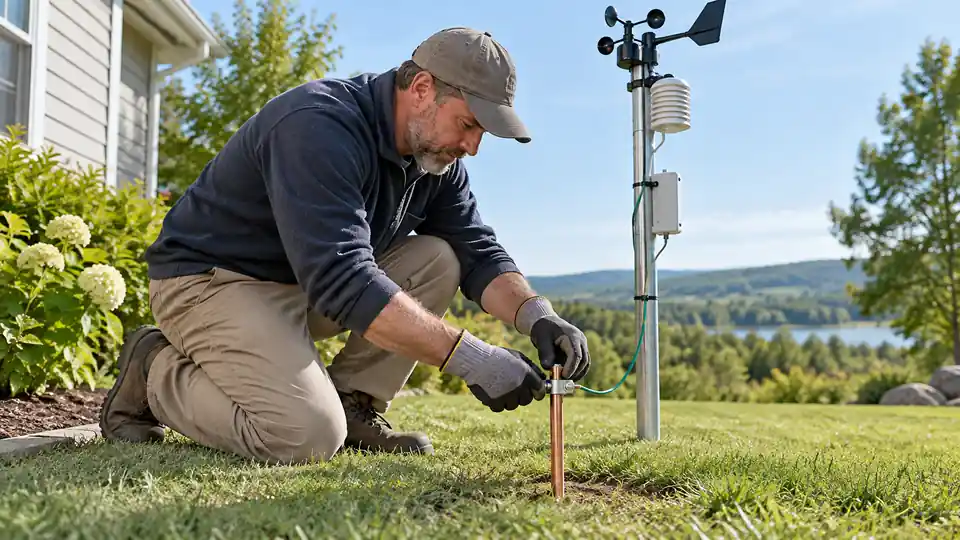
A weather station can sit quietly above a garden, fence, or roof while its metal mast becomes part of the building’s electrical environment. That makes grounding a safety and code question, rather than a simple matter of driving a wire into the soil. The correct approach depends on the station, mast, power system, building, and local requirements.
For a small battery-powered outdoor sensor on a nonconductive support, the sensor itself may have no user-provided grounding connection. A metal mast, roof installation, wired power supply, or cable entering a building creates a different situation. Before attaching anything, identify which part needs bonding or protection and check the installation instructions for the exact model.
What “grounding” means for a weather station
Several ideas often get mixed together under the word grounding:
- Equipment grounding: Connecting exposed conductive equipment or a metal enclosure to an appropriate grounding system.
- Mast bonding: Connecting a conductive support structure to the building’s grounding and bonding system where required.
- Surge protection: Using suitable protective devices to help divert transient voltage from power or signal wiring.
- Lightning protection: A coordinated system intended to manage lightning current and reduce damage to a structure. A single wire on a weather-station pole is not automatically such a system.
A grounding conductor does not guarantee that a station, mast, roof, or home will survive a lightning strike. It also does not make an exposed mast safe to install near overhead electrical conductors. If the installation involves a roof, tall mast, building wiring, or a cable entering the house, the work may require qualified electrical or lightning-protection guidance.
Decide whether your station needs a grounding connection
Start with the physical arrangement, not with a generic grounding diagram found online. A compact sensor array powered by batteries and mounted on a fiberglass or plastic support may have no grounding terminal at all. Adding an improvised wire can create a new path for current without providing a coordinated protection system.
A metal pole attached to a roof or building deserves more careful attention. The pole may be bonded as part of the property’s electrical grounding and lightning-protection arrangements, subject to local requirements. A station with a wired outdoor sensor, power adapter, gateway, or long cable also needs protection appropriate to that wiring path.
| Installation feature | Why it changes the decision |
|---|---|
| Battery-powered sensor on a nonconductive support | There may be no user-accessible grounding point. Follow the manual and avoid adding an unofficial connection. |
| Metal mast in an open yard | The mast is a conductive structure exposed outdoors. Local electrical requirements and the mounting design determine whether bonding is needed. |
| Roof-mounted metal mast | Roof access, structural attachment, electrical bonding, and lightning exposure all become relevant. |
| Wired sensor or cable entering a building | The cable can carry a surge indoors. Model-specific and building-level surge protection may be needed. |
| Solar-powered outdoor array | A solar panel may power or assist one component, but it does not automatically provide grounding or lightning protection. |
How to ground a weather station safely
1. Read the station and mounting instructions
Look for terms such as ground terminal, bonding point, mast grounding, surge protection, or lightning protection. Some products provide no grounding point because the outdoor unit is a low-voltage, battery-powered device. Others include a conductive mounting system or require a particular installation method.
Do not assume that a similarly shaped station uses the same procedure. A replacement sensor, mounting pole, gateway, or console may belong to a different product generation with different connections, so the exact model documentation matters.
2. Inspect the mounting arrangement
Identify every conductive part: the sensor bracket, mast, roof hardware, guy wires, cable shields, power wiring, and nearby metal structures. Check whether the pole is freestanding, attached to a building, or fastened to a roof. A metal pole in an open yard presents a different problem from a short plastic post beside a flower bed.
Also look up before working. Do not install or move a mast near overhead electrical lines, and postpone outdoor work during thunderstorms or strong winds. A stable sensor reading is never worth a ladder accident or electrical contact.
3. Use an existing grounding system only through an appropriate connection
If the mast or station must be bonded, the connection should lead to an appropriate grounding and bonding system for the building or installation. That decision depends on local electrical requirements, the structure, and the equipment. A random ground rod beside the station may fail to bond correctly with other systems and can create dangerous voltage differences during a fault or surge.
Do not attach a grounding wire to a water pipe, gas pipe, fence, downspout, or other convenient metal object unless a qualified professional has confirmed that the connection is suitable. Do not connect the station to a household outlet’s ground pin with an improvised adapter or loose wire.
4. Protect cables and entry points
A cable running from an outdoor sensor into a house creates a route between outdoor equipment and indoor electronics. Keep cable routing short and orderly, follow the manufacturer’s instructions, and use protection intended for the cable type if the installation calls for it. Avoid creating loops of excess cable around the mast, and do not place wiring where water can follow it directly into an enclosure or wall opening.
For a station connected to an indoor console, gateway, computer, or network device, remember that sensor communication and Wi-Fi are separate paths. A wireless outdoor sensor may communicate with its console by radio, while the console uses Wi-Fi for Internet access. Grounding or surge protection for one path does not automatically protect the other.
5. Bond the mast only with suitable hardware and guidance
If the installation requires mast bonding, use a connection point and conductor arrangement suited to the structure and equipment. Hardware must remain secure outdoors and maintain a reliable electrical connection. A thin piece of hobby wire wrapped around a pole is not a substitute for an engineered or code-compliant bonding method.
Roof work adds structural and access concerns. Drilling, attaching clamps, routing conductors, or modifying flashing can introduce leaks or weaken the installation. A qualified installer may be appropriate for a roof mast, tall exposed pole, or system tied into building wiring.
Grounding mistakes that can make the installation worse
- Adding a ground rod without bonding it correctly: A separate rod is not automatically a complete grounding system.
- Using plumbing or gas piping as a shortcut: These systems are not interchangeable with an approved grounding connection.
- Assuming a solar panel provides protection: Solar charging and electrical grounding perform different functions.
- Connecting a low-voltage sensor wire to household electrical ground: The station’s manual must identify any permitted connection.
- Installing during threatening weather: A mast, ladder, and tools should not be handled during a thunderstorm.
- Calling a grounded mast lightning-proof: Grounding can be one part of a protection strategy, but it does not eliminate lightning risk.
Suppose a homeowner notices that the station works perfectly after a new metal pole is installed, then the indoor console later fails after a nearby storm. That sequence does not prove the pole caused the damage, but it does show why mast bonding, cable routing, surge protection, and the building’s electrical system must be considered together. A second common situation is a battery-powered array mounted on a short plastic post. In that case, adding an unapproved wire may offer no meaningful benefit and could complicate maintenance.
How to check the finished installation
After mounting or bonding work, inspect the system before relying on the readings. The mast should be secure, the sensor should remain in its intended orientation, and cables should have no cuts, crushed sections, loose connections, or paths that allow water into the building. Confirm that the station still communicates with its console or gateway.
Check the measurements as well. Grounding does not correct poor sensor exposure, so a temperature sensor beside a hot wall can still read too high, and an anemometer behind a roof edge can still report sheltered or turbulent wind. Rainfall equipment can still need leveling and debris removal. Electrical safety and measurement quality are separate checks.
Stop and seek qualified help if the installation involves a roof, a tall metal mast, overhead conductors, building wiring, a lightning-protection system, or uncertainty about the property’s grounding arrangement. The station manual can explain the equipment connection, but it cannot replace the electrical and structural requirements that apply to the building.