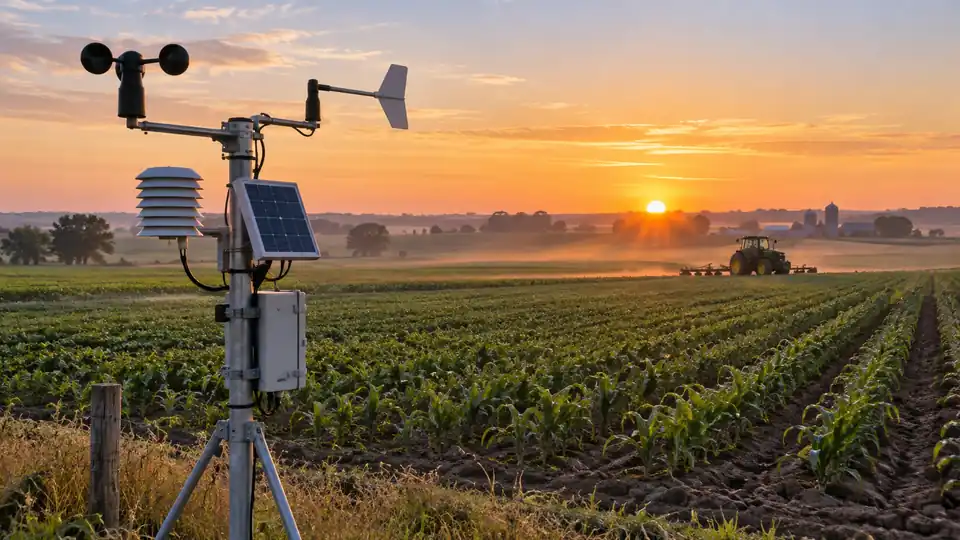
A farm weather station has a tougher job than a simple indoor thermometer. Rainfall totals can guide irrigation, wind direction can affect spraying decisions, and temperature and humidity readings help put greenhouse or crop conditions into context. Across a larger property, the sensor link also matters. A console in the house is useful only if the outdoor array can communicate from the field, orchard, barn, or garden.
The biggest buying distinction is the gap between local wireless monitoring and genuine internet access. A wireless sensor can send readings to a nearby display without Wi-Fi, while a Wi-Fi station may add app access, cloud history, weather-network uploads, or alerts away from the property. Accuracy claims also need careful reading. A display that shows small increments is not automatically more accurate, and an advertised transmission range is usually an open-area maximum rather than a guarantee through walls, trees, and metal buildings.
This comparison gives extra weight to rainfall, wind, property coverage, data history, remote access, display usability, and installation practicality. The Ambient Weather WS-2902 leads the group because it combines a broad sensor set with Wi-Fi, smart-home support, and remote data access. Several lower-ranked stations make more sense for local monitoring, large displays, or long-term rainfall records.
Quick Answer
- Ambient Weather WS-2902: Best overall for connected farm monitoring, with rainfall, wind, UV, solar radiation, Wi-Fi, alerts, and smart-home support.
- Sainlogic 5G/2.4G WiFi Smart Weather Station: A strong data-focused alternative with dual-band Wi-Fi, app alerts, rainfall history, and two-year local storage with Excel export.
- Tempest Weather Station: Best premium choice for a low-maintenance sensor with lightning detection, solar radiation, app access, and frequent updates.
- Sainlogic 12-in-1 Wireless Weather Station: A practical local-display option for properties that do not need Wi-Fi.
Best Weather Stations for Farmers Comparison Table
| Product | Measurements | Connectivity | Data and Display | Best For |
|---|---|---|---|---|
| Ambient Weather WS-2902 | Temperature, humidity, rain, wind, UV, solar radiation | Wireless sensor array, Wi-Fi | Color LCD, alerts, remote access | Best overall connected setup |
| Sainlogic 5G/2.4G WiFi Smart Weather Station | Temperature, humidity, rain, wind, pressure | 5GHz and 2.4GHz Wi-Fi, Bluetooth pairing | App alerts, Excel export, two-year storage | Farm records and remote alerts |
| Tempest Weather Station | Temperature, humidity, rain, wind, UV, solar radiation, lightning | Wireless, app, Alexa, Rachio, IFTTT | Updates every three seconds, solar-powered outdoor sensor | Premium low-maintenance monitoring |
| AcuRite Iris 5-in-1 | Temperature, humidity, rain, wind, pressure | Wireless, Wi-Fi, Weather Underground | Color LCD, history, threshold alarms | Weather-network uploads |
| Sainlogic 12-in-1 Wireless Weather Station | Temperature, humidity, rain, wind, pressure, dew point | Wireless sensor-to-console | 6.5-inch display, rainfall history | Local farm monitoring without Wi-Fi |
| AcuRite Iris 01512MCB | Temperature, humidity, rain, wind, pressure | Wireless sensor-to-console | Color display, history, forecast | Simple setup and broad local data |
| Wireless 12-in-1 Weather Station | Temperature, humidity, rain, wind, pressure, dew point | Wireless, no internet required | 7.5-inch display, rainfall records | Large-screen property monitoring |
| Sainlogic 10-in-1 WiFi Weather Station | Temperature, humidity, rain, wind, pressure | 2.4GHz Wi-Fi, Weatherseed app | Alerts, two-year storage, Excel export | Budget data logging |
| 14-in-1 Wi-Fi Weather Station | Temperature, humidity, rain, wind, UV, light, pressure | Wi-Fi, wireless sensor link | 8.07-inch display, weather-network uploads | Large display with broad measurements |
The detailed reviews below focus on how each station handles rainfall, wind, property coverage, data access, and the practical compromises behind its ranking.
1. Ambient Weather WS-2902 Wi-Fi Smart Weather Station — Best Overall
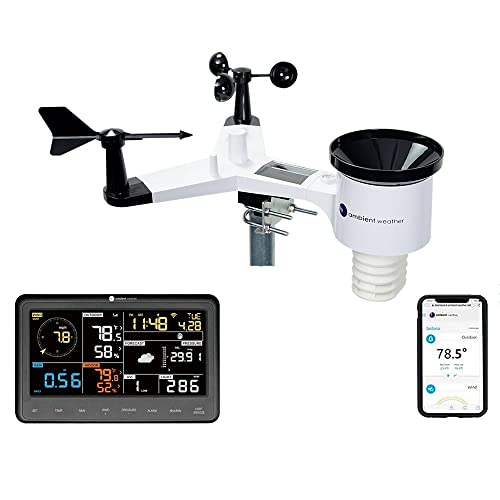
A farm office can be many steps, buildings, or muddy tire tracks away from the field. The WS-2902 addresses that separation with an Osprey outdoor sensor array and Wi-Fi access, so local readings can be viewed through connected services rather than remaining trapped on the console. Its sensor set covers outdoor temperature, humidity, rainfall, wind speed, wind direction, UV intensity, and solar radiation, giving irrigation and exposure decisions more context than a temperature-only monitor.
The color LCD keeps the station useful inside the house, while Wi-Fi adds remote access, alerts, and optional uploads to the Ambient Weather Network. The listing also identifies IFTTT, Google Home, and Alexa support, which can matter if weather readings are part of an automated irrigation or alert routine. The trade-off is greater setup complexity than a local-only station, and the listing does not provide detailed accuracy figures for every measurement.
Pros
- Measures rainfall, wind speed, wind direction, UV intensity, and solar radiation alongside temperature and humidity.
- Combines an outdoor sensor array with a color LCD console.
- Wi-Fi enables remote data access and weather alerts.
- Supports IFTTT, Google Home, and Alexa according to the listing.
- Can optionally transmit data to the Ambient Weather Network.
Cons
- Wi-Fi and connected services require more setup than a local-only console.
- The available product information does not clearly provide model-specific accuracy values for every sensor.
This is the strongest choice for a property where rainfall, wind, sun exposure, and remote access all matter. It suits someone who wants a console in the kitchen but also wants to check conditions while away. A buyer seeking the simplest possible station without network features may prefer the Sainlogic 12-in-1 or AcuRite Iris 01512MCB.
To buy this product, click here.
2. Sainlogic 5G/2.4G WiFi Smart Weather Station — Best for Farm Data Logging

Seasonal records become more useful when they can leave the display and reach a spreadsheet. This Sainlogic model stores up to two years of local weather data and supports Excel export, with records covering temperature changes, humidity, rainfall, and weather events. The app adds real-time readings and alerts, while the listing specifically identifies support for both 5GHz and 2.4GHz Wi-Fi.
Its published specifications are unusually detailed for temperature, humidity, and rainfall. The listing gives temperature accuracy as ±0.2°C, humidity accuracy as ±1.8% RH, and rainfall accuracy as ±1 mm below 15 mm or ±7% above that amount. A built-in bubble level helps with rain-gauge placement. The stated 443-foot wireless range is an open-area figure, so barns, metal siding, trees, and terrain can change the practical result.
Pros
- Supports both 5GHz and 2.4GHz Wi-Fi according to the listing.
- Provides app-based real-time readings and alerts.
- Stores up to two years of data locally.
- Supports Excel export for records and trend analysis.
- Lists temperature, humidity, and rainfall accuracy figures.
Cons
- Wi-Fi is limited to the bands identified in the product information, so router setup should be confirmed before ordering.
- The stated 443-foot transmission range is an open-area maximum, not a guarantee across buildings.
This is a smart fit for someone who wants a weather log for irrigation planning or seasonal comparison rather than a display that only shows current conditions. It gives up some of the Ambient Weather station’s broader smart-home positioning, but the storage and export tools are highly relevant for records. Buyers who want a station with no internet dependency should choose a local wireless model instead.
To buy this product, click here.
3. Tempest Weather Station — Best Premium Low-Maintenance Option
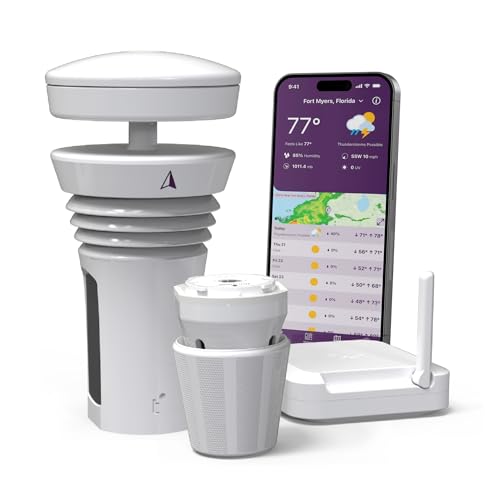
Tempest takes a different approach from stations built around visibly moving cups or vanes. The product information describes an outdoor sensor with no moving parts, solar power, and wireless transmission up to 1,000 feet or more. It reports temperature, humidity, barometric pressure, rainfall, wind speed, wind direction, dew point, solar radiation, UV index, and lightning strikes, giving a broad view of conditions around a house, barn, or growing area.
Updates are listed at three-second intervals, which is useful for watching changing wind conditions near outdoor work. App access and integrations with Alexa, Rachio, IFTTT, and other smart-home platforms can connect observations to irrigation or property routines. The premium positioning is the clear drawback, and the supplied information does not identify every power requirement for the complete system, so the console and any backup arrangements deserve attention before purchase.
Pros
- Measures rainfall, wind, temperature, humidity, pressure, UV, solar radiation, and lightning strikes.
- Outdoor sensor is listed as solar powered.
- No-moving-parts design may reduce the number of mechanical components exposed outdoors.
- Provides listed updates every three seconds.
- Supports app access plus Alexa, Rachio, and IFTTT integrations.
Cons
- Premium pricing makes it a larger investment than the local-display alternatives.
- The supplied information does not fully detail power requirements for every system component.
Tempest is aimed at a property owner who values broad measurements, connected access, and a sensor architecture intended to reduce routine mechanical maintenance. Its lightning and solar-radiation readings add useful context, although those features should not be treated as a safety system or a guarantee of storm protection. For basic rainfall and wind tracking, a less expensive station may deliver enough information.
To buy this product, click here.
4. AcuRite Iris 5-in-1 Home Weather Station — Best for Weather Underground
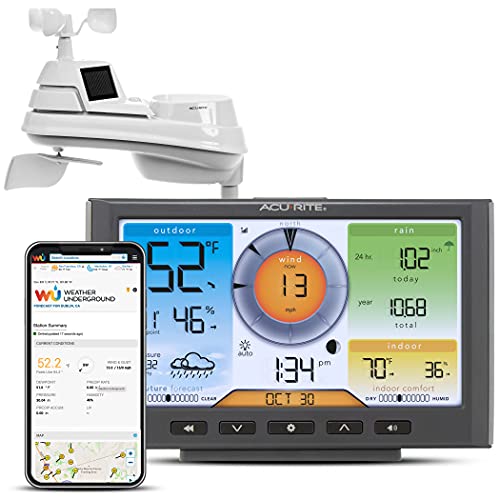
The AcuRite Iris focuses on the measurements most properties use first: indoor and outdoor temperature, humidity, rainfall, wind speed, wind direction, and barometric pressure. Its color LCD gives the household a local reference point, while Wi-Fi connection to Weather Underground allows remote monitoring and sharing of station data. That combination works well for someone who wants a familiar console indoors but also checks conditions away from the property.
The listing describes more than 25 data points, including dew point, heat index, wind chill, rainfall history, and threshold alarms. Some of these are calculated values rather than separate sensors, which is useful context when comparing it with a station advertising a higher sensor count. The station is less compelling for buyers who need UV, solar radiation, lightning, or long-term spreadsheet export, since those capabilities are not identified in the supplied information.
Pros
- Measures temperature, humidity, rainfall, wind speed, wind direction, and pressure.
- Connects to Weather Underground for remote monitoring.
- Includes a color LCD display with adjustable dimming.
- Provides historical rainfall information and threshold alarms.
- Reports calculated values such as dew point, heat index, and wind chill.
Cons
- The listing does not identify UV, solar-radiation, or lightning measurements.
- The available information does not specify a two-year local export system.
This station fits a connected property that values Weather Underground support more than a long list of specialized measurements. It ranks below the top three because its data and sensor coverage are narrower, yet it remains a sensible middle ground for rainfall and wind observations. Confirm the current Weather Underground connection process before ordering, since network services can involve their own setup requirements.
To buy this product, click here.
5. Sainlogic 12-in-1 Wireless Weather Station — Best Local Display

Some properties have dependable local internet and still prefer a station that works without an app. This Sainlogic model sends outdoor readings to a console wirelessly and includes a 6.5-inch color display with adjustable backlighting. The screen presents temperature, humidity, pressure, wind, rainfall, dew point, and feels-like temperature in one place, which is handy beside a kitchen door or in an office where conditions are checked throughout the day.
Rainfall records extend across hourly, daily, weekly, monthly, and cumulative periods, while the listing gives a 0 to 9999 mm rainfall range and ±7% accuracy. Temperature and humidity specifications are listed as ±0.2°C and ±1.8% RH. The stated 443-foot wireless range applies to open, unobstructed conditions. Since this model has no Wi-Fi, it cannot offer the remote app access available from the higher-ranked connected stations.
Pros
- Works as a local wireless station without Wi-Fi.
- Includes a 6.5-inch color display with three backlight levels.
- Tracks rainfall across several time periods.
- Lists temperature accuracy of ±0.2°C and humidity accuracy of ±1.8% RH.
- Includes mounting hardware according to the product information.
Cons
- No Wi-Fi or app-based remote monitoring is identified.
- The 443-foot wireless figure is an open-area maximum and may not carry through farm structures.
This is a good match for a property where the display is the main data destination. It avoids account setup and internet dependence, while still providing rainfall and wind information for day-to-day work. Choose a Wi-Fi model instead if you need alerts while away or want to build a digital weather record outside the console.
To buy this product, click here.
6. AcuRite Iris 01512MCB Indoor/Outdoor Weather Station — Best for Simple Setup
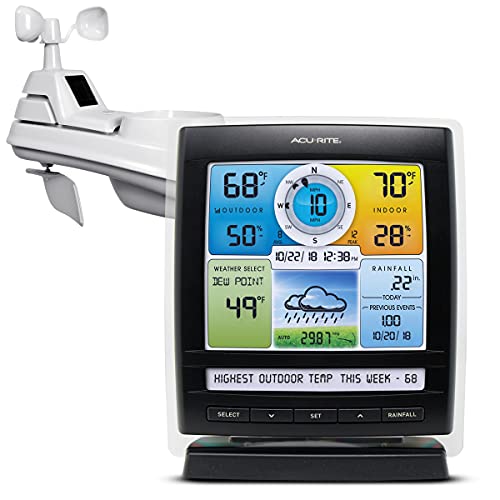
Installation feels less intimidating when the outdoor sensor mounts to a pole or post and the console begins receiving readings after batteries are installed. That is the central appeal of this AcuRite Iris model. It provides indoor and outdoor temperature and humidity, wind speed and direction, pressure, and rainfall without requiring a Wi-Fi account or internet service.
The color screen presents more than 55 listed data points, including pressure trends, dew point, heat index, feels-like temperature, historical information, and a 12-hour personalized forecast. These extras can help interpret a wet or windy day, but calculated values should not be confused with additional physical sensors. The station is also less suitable for someone who needs remote access, since the supplied information describes a local wireless console rather than Wi-Fi or app connectivity.
Pros
- Supports local monitoring of temperature, humidity, rain, wind, and pressure.
- Includes a mounting bracket for attaching the outdoor sensor to a pole or post.
- Displays historical data and pressure trends.
- Provides calculated values such as dew point, heat index, and feels-like temperature.
- Offers a color display with adjustable dimming.
Cons
- No Wi-Fi, app, or remote monitoring feature is identified.
- The supplied product information does not give detailed accuracy figures for the sensor suite.
This model makes sense for a straightforward local setup at a home, barn office, or small property. It avoids the network dependencies of the first four picks, though that simplicity means readings stay tied to the console. A buyer planning spreadsheet-based rainfall analysis or off-site alerts should move up to a Wi-Fi station.
To buy this product, click here.
7. Wireless 12-in-1 Weather Station with 7.5-Inch Display — Best for a Large Screen

A large display can be surprisingly useful when the station sits across a room, in a workshop, or on a shelf near the back door. This model uses a 7.5-inch high-contrast color screen with three brightness levels. It shows temperature, humidity, wind, rainfall, pressure, dew point, feels-like temperature, and forecast information without requiring a phone or internet connection.
The listing gives outdoor temperature coverage from -40 to 60°C, indoor temperature from 0 to 60°C, humidity from 10% to 99%, and pressure from 300 to 1100 hPa. It also lists rainfall accuracy of ±1 mm below 15 mm and ±7% from 15 to 9999 mm. Those are published listing claims, not independent verification. The station’s wireless range is stated as stable across up to 443 feet, but structures and obstructions still matter during placement.
Pros
- Includes a 7.5-inch high-contrast display with three brightness levels.
- Works without internet, passwords, or app pairing.
- Records hourly, daily, weekly, monthly, and total rainfall.
- Lists broad temperature, humidity, and pressure measurement ranges.
- Tracks wind direction, wind speed, dew point, and feels-like temperature.
Cons
- No Wi-Fi, app, or remote access is identified.
- The generic product information does not clearly identify a brand or detailed sensor accuracy beyond rainfall.
This station suits a property where clear local readings matter more than cloud history. The large screen can help when several people need to glance at conditions during chores, while the rainfall log adds more usefulness than a basic thermometer. For remote monitoring or integration with a weather platform, the connected models are better equipped.
To buy this product, click here.
8. Sainlogic 10-in-1 WiFi Weather Station — Best for Budget Data History

For a smaller connected setup, this Sainlogic model brings together a Weatherseed app, Wi-Fi monitoring, rainfall records, and alerts for temperature, humidity, and pressure changes. The listing specifies 2.4GHz Wi-Fi only, so a buyer should check the property’s network arrangement before choosing it. Once connected, the app is intended to make readings available beyond the room where the console sits.
Its two-year storage and Excel download support are valuable for reviewing seasonal patterns, while rainfall is recorded by hour, day, week, month, and year. The product information gives rainfall accuracy as ±1 mm below 15 mm and ±7% from 15 to 9999 mm. Export is described as covering up to 30 days per selection, which is an important practical detail for anyone planning to build a longer farm record.
Pros
- Provides Wi-Fi access through the Weatherseed app.
- Sends alerts for changes in temperature, humidity, and pressure.
- Stores up to two years of weather data according to the listing.
- Supports Excel downloads for trend analysis.
- Tracks rainfall across hourly, daily, weekly, monthly, and yearly periods.
Cons
- Supports only 2.4GHz Wi-Fi according to the product information.
- Each export selection is limited to up to 30 days, despite the longer storage period.
This is a reasonable choice for someone who wants connected records without moving into the higher price range of the Tempest or Ambient Weather systems. The 2.4GHz limitation and export workflow deserve attention, particularly on a property with a complex network. It gives up the broader sensor coverage of the top-ranked stations, but its history and alerts remain useful for routine agricultural monitoring.
To buy this product, click here.
9. 14-in-1 Wi-Fi Weather Station with 8.07-Inch Display — Best for Broad Measurements

This station puts a broad group of readings on an 8.07-inch color display, including temperature, humidity, rainfall, wind speed, wind direction, pressure, UV, light intensity, wind chill, and dew point. The large screen is useful for a home office or farm entryway where current conditions need to be visible from several feet away. Three backlight settings help adapt the console to brighter and darker rooms.
Wi-Fi access allows the console to upload information to Weather Underground, Weather Cloud, and PWS according to the listing, with smartphone, tablet, and laptop access to current conditions and history. The outdoor sensor’s stated wireless transmission distance is up to 328 feet. That is shorter than the 443-foot figures listed for several Sainlogic models, though range should be judged against the actual buildings and terrain between the sensor and console rather than the number alone.
Pros
- Includes an 8.07-inch display with adjustable backlighting.
- Measures temperature, humidity, rain, wind, pressure, UV, and light intensity.
- Lists support for Weather Underground, Weather Cloud, and PWS uploads.
- Provides alerts for temperature drops, high winds, and freezing conditions according to the listing.
- Includes a self-emptying rain gauge and wind vane in the stated sensor design.
Cons
- The listed wireless transmission distance is up to 328 feet, shorter than several alternatives here.
- The supplied information does not identify detailed accuracy figures for the complete measurement suite.
This is a useful fit for someone who wants a large console and broad connected reporting in one package. Its platform support is attractive for readers who already use a weather-sharing service, though each service may have its own account or setup steps. The station ranks below the top connected models because its product information gives less detail about accuracy and the stated transmission range is more limited.
To buy this product, click here.
Buying Guide
Rainfall and Wind Usually Matter First
For agricultural monitoring, rainfall and wind often affect decisions more directly than decorative forecast icons. A rain gauge can help track accumulated precipitation, while wind speed and direction provide context for outdoor work and spray planning. Look for a station that records rainfall across useful time periods and reports both wind speed and direction. Rain-gauge placement and leveling still matter, so a strong listing specification cannot compensate for an obstructed or uneven installation.
Wireless Does Not Automatically Mean Wi-Fi
Every station in this roundup uses a wireless relationship between the outdoor sensor and the console, but only some connect to a home network. Local wireless models can work without internet, which is useful at a barn, cabin, or property with inconsistent service. Wi-Fi models add app access, alerts, uploads, or export tools, but they introduce router setup and network dependencies.
Remote Monitoring Requires an Internet Path
A console across the room is local monitoring. Checking rainfall from town requires a supported app, cloud service, or weather platform connected to the station. Ambient Weather, Tempest, AcuRite, Sainlogic, and the 14-in-1 Wi-Fi station list different forms of connected access, so compare the actual service rather than assuming every Wi-Fi label provides identical remote features.
Accuracy, Resolution, and Range Are Different
A temperature display showing one decimal place describes resolution, not necessarily accuracy. A rainfall figure such as ±1 mm is an accuracy claim for a specified rainfall range, while a 443-foot figure describes wireless transmission distance. These numbers answer different questions. Treat listed accuracy as product information for that model, and treat wireless distance as a best-case figure that can be affected by walls, metal structures, trees, and terrain.
Check Which Measurements Are Direct
Temperature, humidity, pressure, rain, wind, UV, and solar radiation require the appropriate sensing hardware. Dew point, wind chill, heat index, feels-like temperature, and forecast icons may be calculated from other readings. A station advertising 12-in-1 or 14-in-1 is not automatically more capable than a 5-in-1 model. Identify the actual measurements before comparing the numbers in the product names.
Plan the Sensor Location Before Ordering
An outdoor array needs a suitable position away from obvious heat sources and obstructions, while a rain gauge needs clear exposure and appropriate leveling. Wind readings can be affected by nearby buildings, trees, and rooflines. A long advertised range may help with a spread-out property, but the console and sensor still need a communication path that works in the actual layout.
Decide Whether Data Export Matters
If the goal is a quick glance before heading outside, a clear local console may be enough. If you want to compare rainfall across seasons, document temperature patterns, or review conditions after an event, local storage and Excel export become more important. The Sainlogic Wi-Fi models make this feature central, while the local-only stations focus on immediate display information.
Best Weather Stations for Farmers FAQ
What is the best weather station for a farm?
The Ambient Weather WS-2902 is the strongest overall choice in this comparison because it measures rainfall, wind, temperature, humidity, UV, and solar radiation while adding Wi-Fi access, alerts, and smart-home support. A local-only station may be a better fit if internet access is unnecessary.
Do farmers need a Wi-Fi weather station?
Wi-Fi is useful if conditions need to be checked away from the property, if the station should send alerts, or if readings need to reach a weather platform or spreadsheet. It is not required for local rainfall and wind monitoring. A wireless station with a console can continue to provide on-site readings without internet access.
What measurements matter most for agricultural weather monitoring?
Rainfall, temperature, humidity, wind speed, and wind direction are the main measurements to prioritize. Pressure, UV, solar radiation, and calculated values such as dew point can add context. The right mix depends on whether the station supports irrigation planning, greenhouse observation, outdoor work, or general property monitoring.
Can a weather station monitor conditions across a large property?
It may, but the result depends on the sensor-to-console path. Several products list wireless ranges from 328 to more than 1,000 feet, yet those figures describe favorable conditions. Buildings, metal siding, trees, terrain, and interference can reduce communication distance. Review the stated range and plan the sensor location before mounting it permanently.
Is a weather station with more measurements always better?
No. A station with more listed measurements may include calculated values or features that do not matter for the intended work. A five-in-one system with rainfall and wind can be more useful than a larger-count model that lacks the connectivity or data history you need. Compare the actual sensors and services.
How should a farm weather station be installed?
Follow the product instructions and choose an outdoor position with suitable exposure. Keep the rain gauge level, avoid obvious obstructions around wind sensors, and avoid placing temperature or humidity sensors where nearby surfaces can distort readings. Tall mounts, roofs, and electrical work may require additional safety precautions and appropriate hardware.
Are calculated dew point and feels-like readings useful?
They can help interpret conditions, especially around humidity, heat, and outdoor comfort, but they are derived values rather than separate direct measurements in most stations. Use them as context alongside the underlying temperature, humidity, pressure, and wind readings.
Final Verdict
The Ambient Weather WS-2902 is the strongest overall choice for a connected farm setup. Its sensor array covers the measurements most likely to matter across a property, including rainfall, wind, temperature, humidity, UV, and solar radiation. Wi-Fi access, alerts, smart-home support, and the color console give it more flexibility than a local-only station. The Sainlogic 5G/2.4G model is the better alternative for buyers who place extra value on two-year storage and Excel export.
Tempest earns the premium recommendation for its broad measurements, listed three-second updates, solar-powered outdoor sensor, and connected integrations. For simpler local monitoring, the Sainlogic 12-in-1 provides a useful display and rainfall history without Wi-Fi. Before ordering, map out the sensor location, check the path between the outdoor array and console, confirm the required network band, and decide whether you need remote access or only a clear reading in the farm office.